
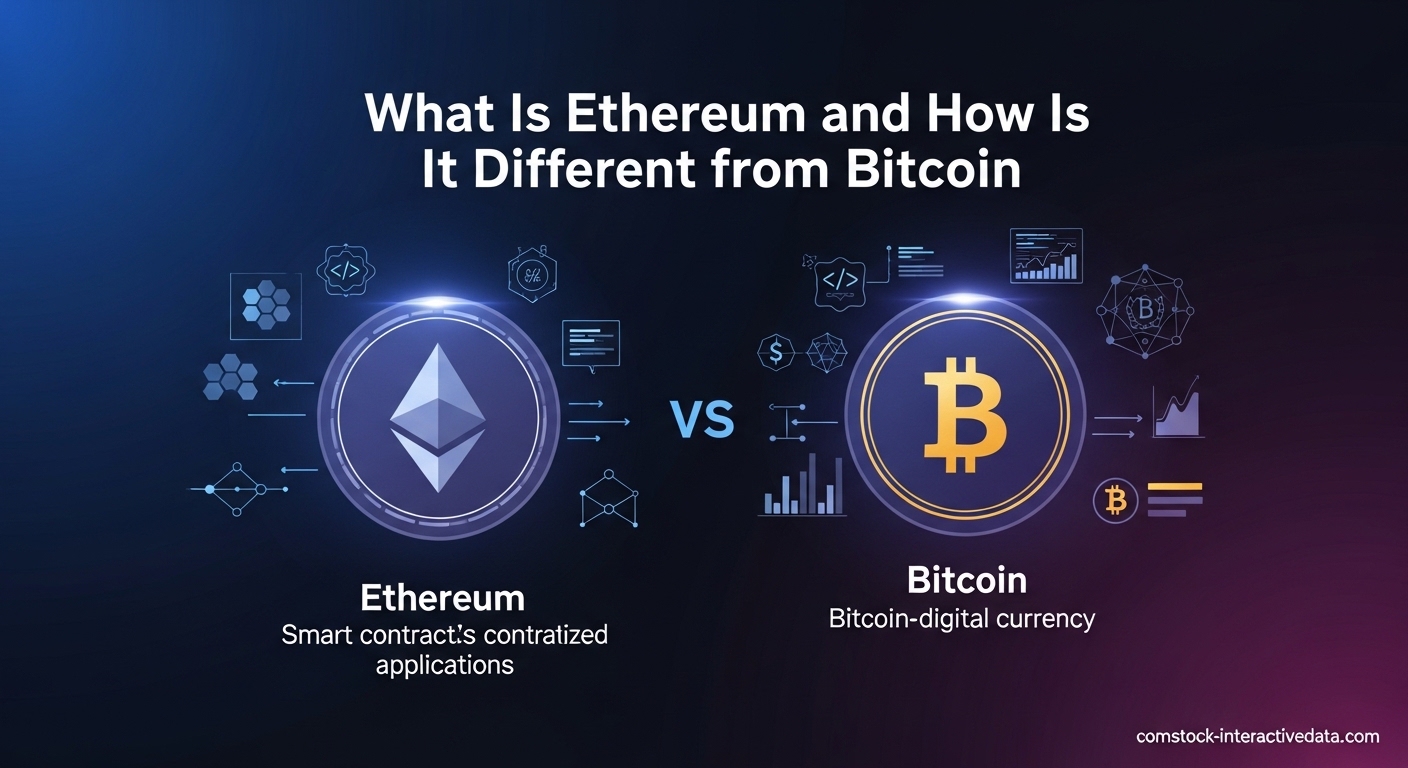
Bitcoin and Ethereum are the two largest cryptocurrencies by market capitalization, yet they serve fundamentally different purposes. Bitcoin was created as digital money and a store of value, functioning primarily as an alternative to traditional currencies. Ethereum was designed as a programmable blockchain platform that enables smart contracts and decentralized applications beyond simple payments.
Understanding what is Ethereum and how is it different from Bitcoin matters for anyone entering the cryptocurrency space. These networks represent different philosophies, technical architectures, and use cases that affect how you might use, invest in, or build upon each one.
Table of Contents
Key Takeaways
- Bitcoin functions as digital money and a store of value with a fixed supply of 21 million coins
- Ethereum operates as a programmable platform enabling smart contracts, DeFi protocols, and NFTs
- Bitcoin uses energy-intensive proof-of-work mining; Ethereum switched to energy-efficient proof-of-stake in 2022
- Ethereum processes transactions faster (12 seconds vs Bitcoin’s 10 minutes) but both face scalability challenges
- The two networks are complementary rather than direct competitors, serving different needs in the crypto ecosystem
Quick Comparison: Bitcoin vs Ethereum at a Glance
| Feature | Bitcoin | Ethereum |
|---|---|---|
| Primary Purpose | Digital money and store of value | Programmable platform for applications |
| Created By | Satoshi Nakamoto (pseudonym) | Vitalik Buterin and co-founders |
| Launch Date | January 2009 | July 2015 |
| Consensus Mechanism | Proof of Work (mining) | Proof of Stake (staking since 2022) |
| Block Time | ~10 minutes | ~12 seconds |
| Transaction Speed | ~7 transactions per second | ~15-30 transactions per second |
| Supply Cap | 21 million coins (fixed) | No fixed cap (dynamic issuance) |
| Smart Contracts | Limited scripting | Full Turing-complete support |
| Primary Use Cases | Payments, store of value, remittances | DeFi, NFTs, DAOs, dApps, Web3 |
| Energy Consumption | High (mining) | Low (staking) |
What Is Bitcoin?
Bitcoin is the first and most widely recognized cryptocurrency, created in 2008 by an anonymous person or group using the pseudonym Satoshi Nakamoto. The Bitcoin whitepaper, titled “Bitcoin: A Peer-to-Peer Electronic Cash System,” outlined a vision for a decentralized digital currency that operates without banks, governments, or central authorities.
The Bitcoin network launched in January 2009 with the mining of the genesis block. Since then, it has grown to become the largest cryptocurrency by market capitalization, often referred to as “digital gold” due to its properties as a store of value and hedge against inflation.
Bitcoin’s Core Purpose
Bitcoin was designed to solve a specific problem: creating a form of digital money that cannot be controlled, manipulated, or inflated by any central authority. The 21 million coin supply cap ensures scarcity, similar to gold, while its decentralized network ensures no single entity can freeze accounts, reverse transactions, or censor payments.
The network achieves consensus through proof-of-work mining, where specialized computers compete to solve mathematical puzzles and secure the blockchain. This process requires significant energy but provides robust security and immutability.
How Bitcoin Works (Simplified)
Think of the Bitcoin blockchain as a public ledger that records every transaction ever made. When you send Bitcoin to someone, that transaction is broadcast to the network and grouped with other transactions into a block. Miners compete to validate this block by solving a complex puzzle, and the winner adds the block to the chain, receiving newly minted Bitcoin as a reward.
Each block takes approximately 10 minutes to mine, which limits Bitcoin’s transaction throughput to about 7 transactions per second. This slow but deliberate pace prioritizes security and decentralization over speed.
ELI5: Bitcoin Explained Like You’re 5
Imagine Bitcoin as digital gold that lives on the internet. Just like gold is valuable because it is scarce and hard to find, Bitcoin is valuable because there will only ever be 21 million of them, and they require work to create.
You can send Bitcoin to anyone in the world, just like sending an email, but no bank or government controls it. Once you send it, the transaction cannot be reversed or blocked by anyone. It is money that truly belongs to you.
What Is Ethereum?
Ethereum is a decentralized, open-source blockchain platform that enables the creation and execution of smart contracts and decentralized applications (dApps). Proposed in 2013 by programmer Vitalik Buterin and launched in July 2015, Ethereum expanded the concept of blockchain technology beyond simple payments to create a global, programmable computer.
While Bitcoin asked “what if we had digital money without banks,” Ethereum asked “what if we could program that money to do anything we want?” This simple shift in thinking opened the door to an entirely new ecosystem of financial products, digital art markets, organizational structures, and internet services built on blockchain technology.
Ethereum’s Core Purpose
Ethereum was designed to be a world computer that anyone can use, running programs exactly as written without downtime, censorship, or third-party interference. The platform introduced the concept of smart contracts, self-executing agreements with the terms directly written into code, which automatically enforce themselves when conditions are met.
Unlike Bitcoin’s limited scripting language, Ethereum is Turing-complete, meaning it can run any computation given enough time and resources. This flexibility enables developers to build complex applications ranging from decentralized exchanges to automated lending protocols to virtual worlds.
How Ethereum Works (Simplified)
Ethereum operates similarly to Bitcoin in that it uses a blockchain to record transactions, but with a crucial difference: every node in the network runs a virtual machine called the Ethereum Virtual Machine (EVM) that can execute code. When you interact with a smart contract, you are essentially running a program on this global computer.
In September 2022, Ethereum completed “The Merge,” a historic upgrade that transitioned the network from proof-of-work mining to proof-of-stake consensus. Instead of miners using energy-intensive hardware, validators now stake 32 ETH as collateral to process transactions and secure the network, reducing energy consumption by over 99%.
ELI5: Ethereum Explained Like You’re 5
Imagine Ethereum as a magical vending machine that can do almost anything you program it to do. You put in some digital money (ETH), and the machine automatically gives you exactly what you asked for, no human needed.
Want to trade digital cards? The machine does it automatically. Want to borrow money without asking a bank? The machine handles the entire loan. Want to create a digital artwork that proves you own it? The machine makes that possible. Ethereum is like Bitcoin’s smart cousin that can run any program you can imagine.
10 Key Differences Between Bitcoin and Ethereum
While both Bitcoin and Ethereum use blockchain technology, they differ in fundamental ways that shape their capabilities, use cases, and investment characteristics. Understanding these differences is essential for anyone looking to use or invest in either network.
1. Core Purpose and Design Philosophy
Bitcoin was built with a singular focus: create a digital form of money that operates outside government control. Every design decision, from the 21 million supply cap to the 10-minute block time, serves this purpose. Bitcoin prioritizes security, stability, and predictability above all else. Changes to the protocol are rare and require overwhelming consensus because any modification could compromise its core function as reliable digital money.
Ethereum takes a fundamentally different approach. It was designed as a general-purpose platform where developers can build anything. The network embraces change and experimentation, with regular upgrades that introduce new features and capabilities. While this creates more complexity and occasional uncertainty, it enables rapid innovation and adaptation to new use cases.
This philosophical difference means Bitcoin evolves slowly and conservatively, while Ethereum changes frequently and aggressively. Neither approach is objectively superior; they simply serve different needs and risk tolerances.
2. Consensus Mechanism: Proof of Work vs Proof of Stake
Bitcoin uses proof-of-work (PoW) consensus, where miners compete to solve mathematical puzzles using specialized hardware called ASICs. The first miner to solve the puzzle gets to add the next block to the blockchain and receives newly minted Bitcoin as a reward. This process requires enormous computational power and electricity, intentionally making attacks economically infeasible.
Ethereum transitioned to proof-of-stake (PoS) in September 2022 during an event called “The Merge.” In this system, validators lock up (stake) 32 ETH as collateral. The protocol randomly selects validators to propose and attest to new blocks, rewarding honest behavior and slashing (destroying) the stake of validators who attempt to cheat. This approach eliminates the energy-intensive mining process entirely.
The security models differ significantly. Bitcoin’s security comes from the economic cost of acquiring enough hardware and electricity to attack the network. Ethereum’s security comes from the economic cost of acquiring enough ETH to control the validator set, combined with the threat of losing that stake if caught misbehaving. As of 2026, both networks have proven highly secure, with no successful attacks on their core consensus mechanisms.
3. Transaction Speed and Scalability
Transaction speed represents one of the most noticeable differences between the two networks. Bitcoin processes blocks approximately every 10 minutes, handling roughly 7 transactions per second. Ethereum produces blocks every 12 seconds and processes 15 to 30 transactions per second depending on network conditions.
Both networks face scalability challenges as adoption grows. Bitcoin’s Lightning Network, launched in 2018, enables instant, low-cost transactions by moving them off the main blockchain. Ethereum relies on Layer 2 scaling solutions like Arbitrum and Optimism, which batch thousands of transactions off-chain before submitting a single proof to the main Ethereum network.
Transaction finality also differs. A Bitcoin transaction is generally considered final after 6 confirmations (about 60 minutes), while Ethereum achieves comparable finality after 2 epochs (about 15 minutes) under proof-of-stake. For everyday use, both require additional time for true settlement security, though Ethereum’s faster block time provides quicker initial confirmation.
4. Supply Economics and Monetary Policy
Bitcoin’s monetary policy is famously simple and unchangeable: only 21 million coins will ever exist. New Bitcoin enters circulation through mining rewards, which halve approximately every 4 years in an event called the “halving.” As of 2026, over 19.5 million Bitcoin have been mined, leaving less than 1.5 million to be created over the next century. This fixed supply creates deflationary pressure as demand grows.
Ethereum’s monetary policy is more complex and dynamic. Unlike Bitcoin, Ethereum has no fixed supply cap. New ETH is issued to validators as rewards for securing the network, creating ongoing inflation. However, Ethereum also burns (permanently removes from circulation) a portion of transaction fees through a mechanism introduced in EIP-1559. When network usage is high, the burn rate can exceed issuance, making ETH temporarily deflationary.
This fundamental difference affects how investors view each asset. Bitcoin appeals to those seeking a predictable, fixed-supply store of value similar to gold. Ethereum attracts those who believe network utility and adoption will drive value regardless of supply dynamics.
5. Smart Contract Capabilities
Smart contracts represent the most significant technical distinction between Bitcoin and Ethereum. A smart contract is a program that runs on the blockchain, automatically executing actions when predetermined conditions are met without requiring intermediaries.
Ethereum is Turing-complete, meaning its smart contracts can perform any computational task given sufficient resources. Developers can write complex applications in high-level programming languages like Solidity that compile to EVM bytecode. This capability enabled the explosive growth of decentralized finance (DeFi), non-fungible tokens (NFTs), decentralized autonomous organizations (DAOs), and the entire Web3 ecosystem.
Bitcoin has limited smart contract capabilities through its Script language, which is intentionally non-Turing-complete for security reasons. While Bitcoin can handle basic conditional transactions like multisig (requiring multiple signatures to spend) and timelocks (preventing spending until a specific time), it cannot run complex applications. Recent upgrades like Taproot (2021) expanded Bitcoin’s smart contract flexibility slightly, but the network remains focused on simple, secure transactions.
6. Energy Consumption and Environmental Impact
Energy consumption became a major differentiating factor after Ethereum’s transition to proof of stake. Bitcoin mining consumes approximately 130-150 terawatt-hours annually, comparable to the electricity usage of entire countries like Argentina or the Netherlands. This consumption is a feature, not a bug, providing the economic security that makes attacks prohibitively expensive.
Ethereum’s proof-of-stake consensus reduced the network’s energy consumption by over 99%, dropping from roughly 112 terawatt-hours annually to less than 2.5 gigawatt-hours. A single Ethereum transaction now uses less energy than several credit card swipes. This dramatic reduction eliminated one of the most common criticisms of cryptocurrency and made Ethereum more palatable to environmentally conscious institutions and regulators.
Bitcoin proponents argue that mining increasingly uses renewable energy and stranded power that would otherwise go to waste. Studies from the Bitcoin Mining Council suggest 50-60% of mining uses renewable sources. However, the stark energy difference between the two networks remains a significant consideration for 2026 investors and users concerned with environmental impact.
7. Use Cases and Real-World Applications
Bitcoin’s use cases center on its function as money. Individuals use Bitcoin for remittances, particularly in countries with restricted capital flows or unstable currencies. Companies like MicroStrategy have added Bitcoin to their corporate treasury as an inflation hedge. El Salvador made Bitcoin legal tender in 2021, enabling citizens to pay taxes and buy goods with BTC. The primary value proposition remains straightforward: a censorship-resistant store of value and medium of exchange.
Ethereum’s use cases extend far beyond simple payments. Decentralized finance (DeFi) protocols enable lending, borrowing, trading, and yield generation without traditional banks. NFT marketplaces allow creators to sell unique digital assets directly to collectors. Decentralized autonomous organizations (DAOs) enable groups to coordinate and manage shared treasuries without traditional corporate structures. Supply chain tracking, gaming, identity verification, and countless other applications run on Ethereum.
As of 2026, Ethereum hosts over 4,000 decentralized applications with combined total value locked (TVL) in DeFi protocols exceeding $50 billion. Bitcoin’s ecosystem, while growing through Layer 2 solutions and sidechains, remains primarily focused on its core function as digital money.
8. Development Activity and Ecosystem
Ethereum boasts the largest and most active developer community in cryptocurrency. According to Electric Capital’s developer reports, Ethereum consistently maintains 5,000-7,000 monthly active developers, roughly 4-5 times more than Bitcoin. This activity translates to constant innovation, with thousands of dApps, protocols, and tools being built and improved continuously.
Bitcoin development is more conservative and focused. The core protocol receives fewer updates, with major changes requiring extensive review and consensus. Development concentrates on maintaining security, improving privacy, and enhancing Layer 2 solutions rather than expanding core functionality. Bitcoin’s development philosophy prioritizes reliability over rapid iteration.
The ecosystem sizes reflect these different approaches. Ethereum’s ecosystem includes thousands of tokens, protocols, and applications. Bitcoin’s ecosystem is smaller but includes significant infrastructure around exchanges, custody solutions, payment processors, and the growing Lightning Network. Both ecosystems continue expanding, but Ethereum’s programmable nature attracts more diverse development activity.
9. Network Upgrades and Governance
Bitcoin’s governance emphasizes stability and backward compatibility. Changes to the protocol require overwhelming consensus among miners, developers, and users. Contentious proposals often result in chain splits, where disagreement leads to the creation of new cryptocurrencies (as happened with Bitcoin Cash in 2017). This conservative approach means Bitcoin evolves slowly but maintains remarkable stability and reliability.
Ethereum embraces a more formalized but still decentralized governance process. Ethereum Improvement Proposals (EIPs) provide a structured way to suggest changes, with core developers, researchers, and the community debating proposals before implementation. Major upgrades like The Merge, which transitioned the network to proof of stake, demonstrate Ethereum’s ability to execute complex technical changes that would be nearly impossible on Bitcoin.
This difference affects risk profiles. Bitcoin’s stability makes it predictable but potentially less adaptable to future challenges. Ethereum’s flexibility enables innovation but introduces some uncertainty about future network states and potential upgrade complications.
10. Market Position and Institutional Adoption
As of 2026, Bitcoin maintains the largest cryptocurrency market capitalization, typically representing 50-60% of the total crypto market. This “Bitcoin dominance” reflects its position as the first and most recognized cryptocurrency. Institutional adoption has grown substantially, with companies like MicroStrategy holding billions in Bitcoin, traditional banks offering custody services, and spot Bitcoin ETFs trading on major exchanges.
Ethereum holds the second position by market cap, typically representing 15-20% of the total market. While smaller than Bitcoin, Ethereum has achieved significant institutional adoption through different channels. Major financial institutions use Ethereum for tokenization projects, settlement systems, and exploring DeFi applications. The Enterprise Ethereum Alliance includes hundreds of companies researching and building on the platform.
Both networks have achieved mainstream recognition, but Bitcoin’s simpler narrative as “digital gold” resonates more clearly with traditional investors. Ethereum’s more complex value proposition requires deeper technical understanding, potentially limiting but not preventing institutional growth.
Bitcoin vs Ethereum: Which Is the Better Investment
The question of whether Bitcoin or Ethereum is the “better” investment has no universal answer. Each asset carries distinct risk profiles, potential returns, and fits different investment strategies. Understanding these differences helps you make informed decisions aligned with your goals and risk tolerance.
Risk Profiles Compared
Bitcoin is generally considered the less risky cryptocurrency investment. Its longer track record (since 2009), larger market cap, fixed supply schedule, and simpler value proposition create more predictability. Bitcoin has survived multiple market cycles, regulatory challenges, and technical debates while maintaining its position as the leading cryptocurrency. For conservative crypto investors, Bitcoin often serves as the “anchor” allocation.
Ethereum carries higher risk but potentially higher reward. Its complex ecosystem, ongoing technical evolution, and dependence on network adoption create more variables. Smart contract bugs, regulatory uncertainty around DeFi and NFTs, and competition from newer blockchains pose real risks. However, Ethereum’s dominant position in smart contract platforms and the explosive growth of its ecosystem create significant upside potential if these trends continue.
Volatility and Correlation
Both assets are highly volatile compared to traditional investments like stocks or bonds. Daily price swings of 5-10% are common, and drawdowns of 50-80% have occurred during bear markets. Despite this volatility, Bitcoin and Ethereum have shown remarkably high correlation, often moving together during market cycles.
Historical data through 2026 shows that while both assets experience similar directional movements, Ethereum typically exhibits higher volatility. During bull markets, Ethereum often outperforms Bitcoin; during bear markets, it often falls further. This pattern reflects Ethereum’s smaller market cap and higher risk profile.
Portfolio Allocation Guidance
Rather than choosing between Bitcoin and Ethereum, many investors hold both as part of a diversified crypto allocation. Common approaches include:
- Conservative allocation: 70% Bitcoin, 30% Ethereum
- Balanced allocation: 50% Bitcoin, 50% Ethereum
- Growth-oriented allocation: 30% Bitcoin, 70% Ethereum
The appropriate allocation depends on your risk tolerance, investment timeline, and conviction in each network’s future. Bitcoin appeals to those prioritizing stability and store-of-value properties. Ethereum attracts those betting on smart contract platforms and decentralized application growth.
Questions to Ask Before Investing
Before allocating capital to either asset, consider these questions:
Do you understand what you’re buying? Bitcoin is relatively straightforward; Ethereum requires understanding smart contracts, DeFi, and network effects.
Can you handle the volatility? Both assets can lose 50% of value in months. If this would cause panic selling, consider a smaller allocation or avoiding crypto entirely.
What is your time horizon? Both assets reward long-term holders who weather volatility. Short-term trading is extremely difficult and risky.
Are you seeking asymmetric upside or capital preservation? Bitcoin leans toward preservation; Ethereum leans toward upside potential.
This article does not provide investment advice. Cryptocurrency investments carry substantial risk of loss, and you should never invest more than you can afford to lose completely.
Frequently Asked Questions
What makes Ethereum different from Bitcoin?
Ethereum differs from Bitcoin primarily in its purpose and capabilities. Bitcoin was designed as digital money and a store of value with a fixed supply of 21 million coins. Ethereum was designed as a programmable platform that enables smart contracts and decentralized applications. While Bitcoin focuses on being secure, stable money, Ethereum focuses on being a flexible foundation for building new types of applications.
What is the difference between Ethereum and Bitcoin for dummies?
Think of Bitcoin as digital gold that you can send to anyone in the world without a bank. It is scarce, valuable, and stores wealth over time. Think of Ethereum as a global computer that runs programs automatically. It can handle digital money plus loans, art, games, and organizations without intermediaries. Bitcoin does one thing extremely well; Ethereum can do almost anything programmers can imagine.
Is it better to buy Bitcoin or Ethereum?
Neither is objectively better; they serve different purposes and carry different risk profiles. Bitcoin is generally considered less risky with its longer track record, fixed supply, and simpler value proposition as digital gold. Ethereum carries more risk but offers exposure to smart contracts, DeFi, and the broader Web3 ecosystem. Many investors hold both rather than choosing one. The right choice depends on your risk tolerance, investment goals, and understanding of each technology.
Why use Ethereum instead of Bitcoin?
You would use Ethereum when you need programmability beyond simple payments. Ethereum enables decentralized finance applications, NFT creation and trading, participation in DAOs, and access to thousands of dApps. If you want to earn yield on your crypto, trade on decentralized exchanges, or use complex financial products, Ethereum is necessary. For simple value transfer and long-term savings, Bitcoin may be more appropriate.
Is ETH a better investment than Bitcoin?
Historical performance does not guarantee future results. Ethereum has outperformed Bitcoin during certain market cycles, particularly during periods of high DeFi and NFT activity. However, Ethereum has also experienced larger drawdowns during bear markets. Bitcoin typically shows lower volatility and maintains its position as the largest cryptocurrency by market cap. The better investment depends on market conditions, adoption trends, and your personal risk tolerance. Both carry substantial risk of loss.
Can Ethereum be 51% attacked?
Technically possible but economically infeasible. A 51% attack on Ethereum would require controlling over half of all staked ETH, currently valued at tens of billions of dollars. An attacker would need to acquire or compromise enough validators to control consensus, then would face slashing that destroys their staked ETH if detected. The cost and difficulty make such an attack impractical for any rational actor. Ethereum’s proof-of-stake consensus has operated securely since The Merge in 2022.
Why is Ethereum better than Bitcoin?
Ethereum is not objectively better than Bitcoin; they excel at different things. Ethereum surpasses Bitcoin in transaction speed, energy efficiency, and programmability. Ethereum enables smart contracts and hosts thousands of decentralized applications that Bitcoin cannot support. However, Bitcoin surpasses Ethereum in monetary policy predictability, simplicity, and store-of-value properties. Neither is universally superior; they are complementary technologies serving different needs within the cryptocurrency ecosystem.
Bottom Line
Bitcoin and Ethereum represent the two dominant approaches to blockchain technology in 2026. Bitcoin excels as digital money and a store of value, offering simplicity, stability, and a fixed supply that appeals to those seeking an alternative to inflationary fiat currencies. Ethereum excels as a programmable platform, enabling an entire ecosystem of decentralized applications that extend far beyond simple payments.
Understanding what is Ethereum and how is it different from Bitcoin helps you navigate the cryptocurrency landscape with clarity. Rather than viewing them as competitors in a winner-take-all battle, recognize that they serve complementary roles. Bitcoin provides the foundation of sound digital money; Ethereum provides the infrastructure for programmable finance and Web3 applications.
Whether you choose to use, invest in, or simply learn about these technologies, the key is understanding their distinct purposes and trade-offs. Neither is perfect; both are experiments in building new forms of money and coordination. Your journey into cryptocurrency should start with education, proceed with caution, and always respect the substantial risks involved in this emerging asset class.