
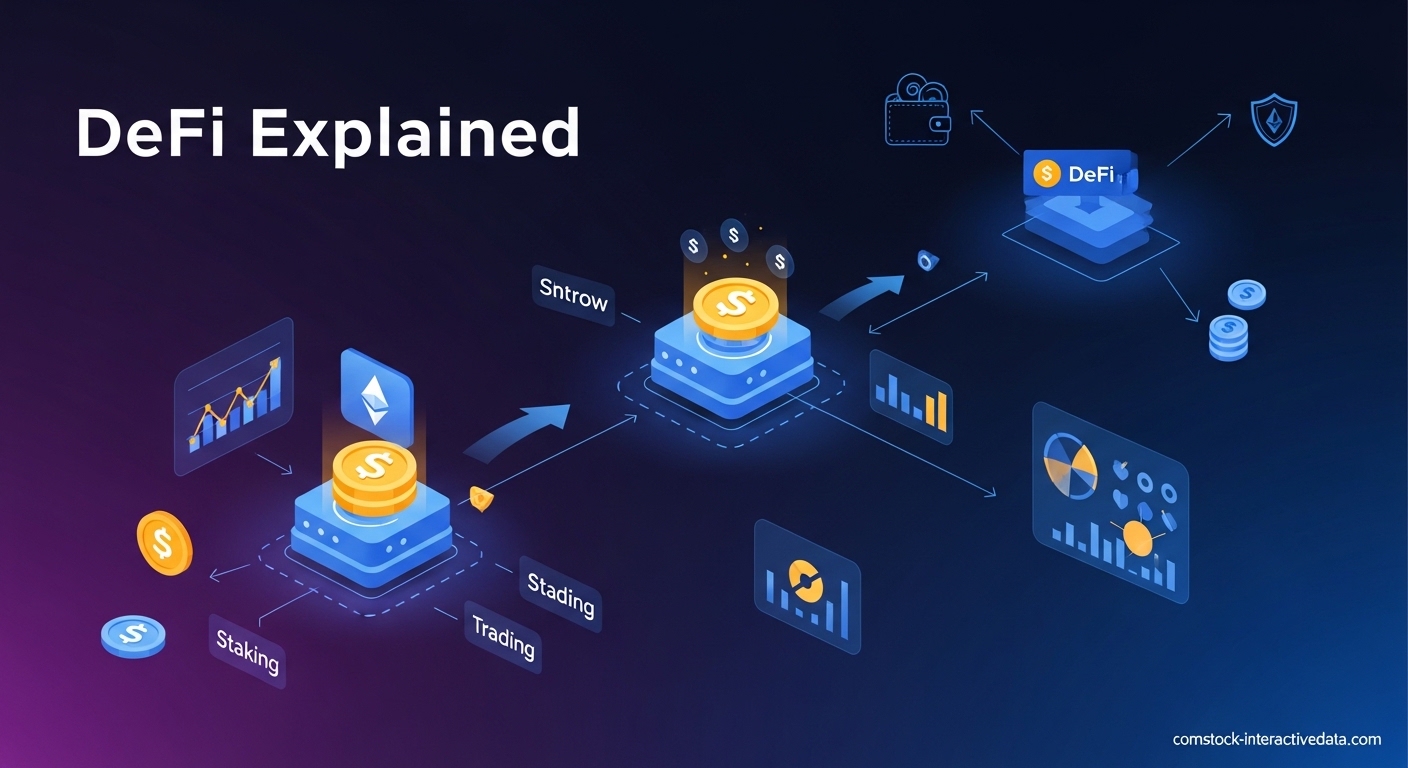
DeFi explained simply: it is a blockchain-based financial system that operates without traditional intermediaries like banks, brokers, or payment processors. Instead of relying on centralized institutions to manage your money, DeFi uses smart contracts and distributed ledger technology to let you lend, borrow, trade, and earn interest directly with other users. This emerging financial paradigm has grown from a niche experiment into a multi-billion dollar ecosystem that promises to reshape how we interact with money.
I spent months researching and testing DeFi protocols to understand how they actually work. The concept can seem intimidating at first, but the fundamentals are straightforward once you break them down. In this guide, I will walk you through everything you need to know about decentralized finance: from the technical architecture to real-world use cases, benefits, risks, and how to get started safely.
Whether you are curious about earning yield on your crypto, frustrated with traditional banking limitations, or simply want to understand what everyone is talking about, this comprehensive guide will give you the knowledge to participate confidently in the DeFi ecosystem.
Table of Contents
What Is DeFi? A Clear Definition
DeFi (decentralized finance) is an umbrella term for financial services built on public blockchains that operate without centralized intermediaries. These services include lending, borrowing, trading, asset management, insurance, and derivatives trading. All of this happens through code rather than institutions.
The core innovation of DeFi is that it replaces human gatekeepers with software. In traditional finance, a bank decides whether to give you a loan. In DeFi, a smart contract automatically executes the loan when you deposit sufficient collateral. No credit check, no paperwork, no approval process. The terms are transparent, immutable, and enforced by code running on a distributed network.
Most DeFi applications run on Ethereum, though other blockchains like Solana, Avalanche, and Polygon have emerged as alternatives. Each operates on similar principles: open-source code, permissionless access, and trustless execution. This means anyone with an internet connection can participate, regardless of location, credit history, or banking status.
The numbers tell a compelling story. According to DeFi Llama, the total value locked in DeFi protocols peaked at over $180 billion in late 2021. Even after market corrections, billions in assets remain actively used across thousands of protocols. This is not theoretical technology. Real people are using DeFi every day to earn interest, obtain loans, and trade assets.
How DeFi Works: The Technical Foundation
Understanding how DeFi works requires grasping three fundamental concepts: smart contracts, the DeFi stack architecture, and decentralized applications. Let me break down each component.
Smart Contracts: The Building Blocks
Smart contracts are self-executing agreements written in code and stored on a blockchain. Think of them as digital vending machines: you input something of value (like cryptocurrency), the contract verifies conditions are met, and it automatically outputs the agreed result (like a loan or swapped tokens).
These contracts are immutable once deployed. The code cannot be changed, which means the rules are fixed and transparent. Every transaction is recorded on the blockchain, creating a permanent, auditable history. This immutability is both a strength and a risk. While it prevents tampering, it also means bugs in the code cannot be easily fixed.
Most DeFi smart contracts run on the Ethereum Virtual Machine (EVM). This standardized environment ensures contracts execute predictably across the network. Developers write contracts in languages like Solidity, which compile to bytecode the EVM can execute. The result is a global, decentralized computer that can run financial applications without downtime or censorship.
The DeFi Stack: Technical Architecture
DeFi operates in layers, often called the DeFi stack. Understanding these layers helps clarify how different components interact.
The settlement layer is the blockchain itself, Ethereum in most cases. This layer provides the foundation for recording ownership and executing transactions. It is the base infrastructure that everything else builds upon.
The asset layer consists of tokens and digital assets that exist on the blockchain. These include native cryptocurrencies like ETH, stablecoins pegged to fiat currencies, and governance tokens that grant voting rights in protocols. Every asset has a standardized format (like ERC-20 for tokens) that ensures compatibility across applications.
The protocol layer contains the smart contracts that implement specific financial functions. Lending protocols like Aave, decentralized exchanges like Uniswap, and derivatives platforms like dYdX all exist at this layer. These protocols are modular and can be combined in novel ways.
The application layer is where users actually interact with DeFi. These are the websites and interfaces that connect to the underlying protocols. When you visit Uniswap.org and swap tokens, you are using an application layer interface that communicates with the protocol layer smart contracts.
The interface layer includes wallets, analytics tools, and aggregators that help users navigate the ecosystem. MetaMask is the most popular wallet interface, allowing users to connect their browser to DeFi applications securely.
dApps and Protocols
Decentralized applications (dApps) are the user-facing software that interacts with DeFi protocols. Unlike traditional apps, dApps do not run on centralized servers. Their backend code runs on the blockchain, while the frontend can be hosted anywhere or even run locally.
The permissionless nature of dApps means anyone can build on top of existing protocols. This creates powerful network effects. A developer can create a new application that combines lending from Aave with trading from Uniswap without asking permission from either protocol. This concept, called composability, allows innovation to compound rapidly.
Open-source code is standard in DeFi. Anyone can review how a protocol works, audit its security, or suggest improvements. This transparency builds trust in a trustless system. When you deposit funds into a DeFi protocol, you can verify exactly how those funds will be used.
DeFi vs Traditional Finance (CeFi): Key Differences
Understanding the differences between DeFi (decentralized finance) and CeFi (centralized finance) helps clarify why this technology matters. Here is a direct comparison across key dimensions:
| Feature | Traditional Finance (CeFi) | Decentralized Finance (DeFi) |
|---|---|---|
| Control | Banks and institutions control your funds | You maintain control via private keys |
| Access | Requires identity verification, credit checks | Permissionless; anyone can participate |
| Hours | Limited to business hours, holidays closed | 24/7/365 availability |
| Transparency | Opaque; you trust institutions | Fully transparent on public blockchain |
| Speed | Days for transfers, weeks for loans | Minutes or seconds |
| Cost | Multiple intermediaries take fees | Lower fees, only network costs |
| Custody | Bank holds your money | You hold your own assets |
| Recovery | Forgotten passwords can be reset | Lost private keys mean lost funds |
The most fundamental difference is custody. In traditional finance, when you deposit money at a bank, the bank legally owns that money and owes you a debt. In DeFi, you maintain ownership through cryptographic private keys. This self-custody model gives you complete control but also complete responsibility.
Access differences are equally significant. Opening a bank account requires identification, proof of address, and often a minimum deposit. Billions of people worldwide lack the documentation to meet these requirements. DeFi requires only an internet connection and a compatible wallet. This accessibility drives the push for financial inclusion in developing regions.
Speed and availability matter in practical terms. Sending an international wire transfer typically takes 1-5 business days and costs $15-50. A DeFi transaction settles in minutes (depending on the blockchain) and costs a fraction of that amount. When markets move fast, these differences compound.
DeFi Use Cases and Applications
DeFi is not just about speculation. Real applications are solving real problems. Here are the major use cases driving adoption.
Lending and Borrowing
DeFi lending protocols like Aave, Compound, and MakerDAO allow users to lend their crypto assets to earn interest or borrow against their holdings. The process is straightforward: deposit collateral (typically more than you borrow), receive a loan instantly, and repay when ready.
The innovation here is over-collateralization. Because there are no credit scores in DeFi, borrowers must deposit more than they borrow. If you want to borrow $100 worth of stablecoins, you might need to deposit $150 worth of ETH. This protects lenders while enabling instant, permissionless loans.
Interest rates adjust algorithmically based on supply and demand. When many people want to borrow a particular asset, rates rise to attract more lenders. When demand drops, rates fall. This creates efficient, market-driven pricing without a central bank setting rates.
Decentralized Exchanges (DEXs)
Decentralized exchanges allow users to trade cryptocurrencies without surrendering custody to an exchange. Platforms like Uniswap, PancakeSwap, and Curve use automated market makers (AMMs) rather than traditional order books.
AMMs work through liquidity pools. Users deposit pairs of tokens (like ETH and USDC) into a pool. Traders can then swap between these tokens, with the AMM algorithm determining the price based on the ratio of assets in the pool. The constant product formula (x * y = k) ensures the pool always has liquidity but prices adjust based on trade size.
Liquidity providers earn fees from traders using their pools. This creates passive income opportunities but introduces the risk of impermanent loss. When token prices diverge significantly, providers may end up with less value than if they had simply held the tokens.
Yield Farming and Staking
Yield farming involves lending or staking crypto assets to generate returns. These returns come from multiple sources: trading fees, lending interest, and protocol incentives. Sophisticated users move funds between protocols to maximize returns, a practice called liquidity mining.
Staking is the process of locking up tokens to support network security or protocol governance. Proof-of-stake blockchains reward users who stake their tokens to validate transactions. DeFi protocols often offer additional rewards for staking their governance tokens, giving holders voting rights on protocol changes.
Returns can be substantial compared to traditional savings accounts. Annual percentage yields (APYs) of 5-20% are common, though they vary widely based on market conditions and protocol incentives. These higher returns reflect the increased risk and early-stage nature of the technology.
Other Applications
Stablecoins maintain a peg to fiat currencies (usually the US dollar) and serve as the primary medium of exchange in DeFi. USDC, USDT, and DAI enable users to transact without crypto price volatility. DAI is particularly interesting as it is decentralized, created through collateralized debt positions on MakerDAO.
Decentralized insurance protocols like Nexus Mutual offer coverage against smart contract failures and other DeFi risks. Members pool funds and vote on claims, creating a community-driven alternative to traditional insurance.
Synthetic assets track the price of real-world assets like stocks, commodities, or fiat currencies without requiring ownership of the underlying asset. Synthetix and Mirror Protocol allow users to gain exposure to traditional markets through crypto.
Asset management protocols automate investment strategies. Yearn Finance, for example, automatically moves user funds between lending protocols to capture the highest yields, saving users the effort of manual optimization.
Benefits and Risks of DeFi
Like any technology, DeFi offers significant benefits while carrying real risks. Understanding both sides is essential before participating.
Key Benefits
Financial inclusion is perhaps the most profound benefit. DeFi is accessible to anyone with an internet connection, regardless of location or documentation status. The World Bank estimates 1.7 billion adults remain unbanked. DeFi offers these individuals access to savings accounts, loans, and investment opportunities previously unavailable.
Transparency builds trust through verifiability. Every transaction, every protocol rule, every governance decision is recorded on the public blockchain. Users can verify exactly how protocols work rather than trusting marketing claims. When a bank says they hold sufficient reserves, you must believe them. In DeFi, you can verify it yourself.
Permissionless access means no one can block your participation. There are no account approvals, no minimum balances, no geographic restrictions. This censorship resistance protects users from arbitrary exclusion by governments or institutions.
Composability enables rapid innovation. Developers can combine existing protocols like Lego blocks, creating new applications without rebuilding infrastructure. This open architecture has led to an explosion of financial products and services.
24/7 availability matches the global nature of crypto markets. Traditional markets close on weekends and holidays. DeFi never sleeps, allowing users to react to market events instantly regardless of timezone.
Reduced costs come from removing intermediaries. Without banks taking their cut, more value flows to users. Lending rates are typically better for both borrowers and lenders compared to traditional banking.
Risks and Challenges
Smart contract vulnerabilities represent the most technical risk. Code bugs can be exploited to drain funds. The DAO hack in 2016 saw $60 million stolen due to a recursive call vulnerability. More recently, the Nomad bridge lost $190 million to an exploit. Even audited contracts can contain undiscovered bugs.
Impermanent loss affects liquidity providers. When token prices in a pool diverge, providers may have less value than holding the tokens outright. This risk is manageable but requires understanding and monitoring.
Gas fees on Ethereum can be prohibitively expensive during network congestion. A simple token swap might cost $50-100 in extreme periods. Layer 2 solutions and alternative blockchains are addressing this, but costs remain a barrier for small transactions.
Market volatility affects all crypto assets. Collateral values can drop rapidly, triggering liquidations. Borrowers must monitor positions constantly or risk losing their collateral.
Regulatory uncertainty looms large. Governments worldwide are still determining how to regulate DeFi. New regulations could restrict access, require KYC compliance, or impose taxes in ways that affect profitability.
Complexity creates a steep learning curve. Users must understand wallets, private keys, gas fees, slippage, and protocol mechanics. Mistakes like sending funds to wrong addresses or interacting with malicious contracts can result in permanent loss.
No customer support means no one to call when things go wrong. Lost your private key? No recovery option. Sent funds to the wrong address? They are gone. This self-reliance requirement is empowering for some and terrifying for others.
How to Get Started with DeFi: A Beginner’s Checklist
Based on my experience and forum discussions with thousands of DeFi users, here is a practical checklist for getting started safely.
Step 1: Set up a non-custodial wallet. MetaMask is the most popular option for Ethereum-based DeFi. Download it as a browser extension or mobile app. Create a new wallet, write down your seed phrase on paper (never store it digitally), and store it somewhere secure. This seed phrase is your ultimate backup.
Step 2: Acquire cryptocurrency. You will need ETH for gas fees and whatever asset you want to use in DeFi. Purchase from a centralized exchange like Coinbase or Kraken, then withdraw to your MetaMask wallet. Start small. Even $100 is enough to learn the basics.
Step 3: Connect to a reputable DeFi protocol. Start with established platforms like Uniswap for trading, Aave for lending, or Compound for borrowing. These have operated for years with billions in total value locked. Type the URL directly or use a bookmark. Never click links from emails or social media.
Step 4: Start with small amounts. Your first transactions should be test amounts you are comfortable losing. Make mistakes with $10, not $10,000. Learn how gas fees work, how slippage settings affect trades, and how to read transaction confirmations.
Step 5: Track your transactions. Use portfolio trackers like Zapper or DeBank to monitor your positions across protocols. Keep records for tax purposes. Most jurisdictions require reporting crypto gains and income.
Additional tips from experienced users: Always verify contract addresses through official sources. Never share your seed phrase with anyone, including “support” staff. Be wary of projects promising unrealistic returns. If something sounds too good to be true, it probably is.
The Future of DeFi
DeFi is evolving rapidly. Several trends will shape its trajectory over the coming years.
Layer 2 scaling solutions are addressing the cost and speed limitations of Ethereum. Arbitrum, Optimism, and Base offer faster transactions at a fraction of mainnet costs. Zero-knowledge rollups promise even greater scalability. As these mature, DeFi becomes accessible to users with smaller portfolios.
Real-world asset tokenization is expanding DeFi beyond crypto-native assets. Real estate, stocks, bonds, and commodities are being brought on-chain. This connects traditional finance with DeFi infrastructure, potentially bringing trillions in value into the ecosystem.
Regulatory clarity will arrive eventually. Some jurisdictions like Singapore and Switzerland are creating crypto-friendly frameworks. Others like the US are taking enforcement approaches. Clear rules will enable institutional participation while potentially limiting some current DeFi freedoms.
Institutional adoption is accelerating. Major banks, hedge funds, and corporations are exploring DeFi for yield generation and operational efficiency. BlackRock, the world’s largest asset manager, has launched tokenized funds on Ethereum. This institutional interest brings credibility but also raises questions about decentralization.
User experience improvements are making DeFi more accessible. Account abstraction allows wallets to function more like traditional banking apps. Social recovery options reduce the risk of lost keys. These innovations lower the technical barrier while preserving decentralization benefits.
FAQs
What is decentralized finance (DeFi) and how does it work?
DeFi (decentralized finance) is a blockchain-based financial system that operates without traditional intermediaries like banks. It works through smart contracts, which are self-executing agreements stored on public blockchains like Ethereum. These contracts automatically execute financial transactions, lending, borrowing, and trading when predetermined conditions are met, eliminating the need for centralized institutions and enabling 24/7 global access to financial services.
Is DeFi safe for beginners?
DeFi carries significant risks for beginners but can be approached safely with proper education. The main risks include smart contract vulnerabilities, impermanent loss when providing liquidity, high gas fees, and the irreversible nature of transactions. Beginners should start with small amounts, use established protocols with long track records like Aave and Uniswap, thoroughly research before investing, and never invest more than they can afford to lose. The lack of customer support means personal responsibility is essential.
How do I get my money out of DeFi?
Withdrawing from DeFi depends on how you entered. If you deposited into a lending protocol like Aave or Compound, simply initiate a withdrawal transaction from the protocol’s interface. If you provided liquidity to a DEX pool, remove your liquidity tokens first. For assets in a wallet, send them to a centralized exchange where you can convert to fiat and withdraw to your bank account. Always account for gas fees, which are paid in the blockchain’s native currency like ETH for Ethereum.
What is the biggest challenge facing DeFi?
The biggest challenge facing DeFi is regulatory uncertainty combined with user experience complexity. Governments worldwide are still determining how to regulate decentralized protocols, creating risk of sudden restrictions. Meanwhile, the technical complexity of wallets, gas fees, and smart contract interactions creates a steep learning curve that limits mainstream adoption. Addressing these challenges requires both regulatory clarity and significant UX improvements while maintaining decentralization principles.
What are the risks of DeFi?
Key DeFi risks include: smart contract bugs and exploits that can drain funds, impermanent loss for liquidity providers when token prices diverge, high gas fees during network congestion, market volatility affecting collateralized positions, regulatory changes restricting access, phishing scams and malicious contracts, irreversible transactions sent to wrong addresses, and the lack of customer support or recovery options for lost private keys.
Is DeFi legitimate?
Yes, DeFi is a legitimate financial technology with billions in real value locked in protocols and major institutions actively participating. However, like any emerging technology, it attracts both innovation and scams. Legitimate DeFi projects have transparent, audited code, active development teams, and clear utility. Red flags include anonymous teams, promises of guaranteed high returns, unaudited contracts, and pressure to recruit others. Always verify protocol legitimacy through official channels and community reviews.
Conclusion
DeFi explained in simple terms represents a fundamental shift in how financial services can be delivered. By replacing intermediaries with code, it offers transparency, accessibility, and efficiency that traditional finance cannot match. The technology is still early, with real risks that demand education and caution. But the potential to create a more inclusive, open financial system is undeniable.
I believe DeFi will not replace traditional finance entirely but will exist alongside it, serving different needs and user preferences. Those comfortable with self-custody and technology will find compelling opportunities for yield and access. Others may prefer the safety nets of regulated institutions. Both options will improve through competition.
If you are interested in exploring DeFi, start small, learn continuously, and never risk more than you can afford to lose. The ecosystem rewards the curious and the careful. Begin with the checklist I provided, stick to established protocols, and expand your knowledge before your exposure.