
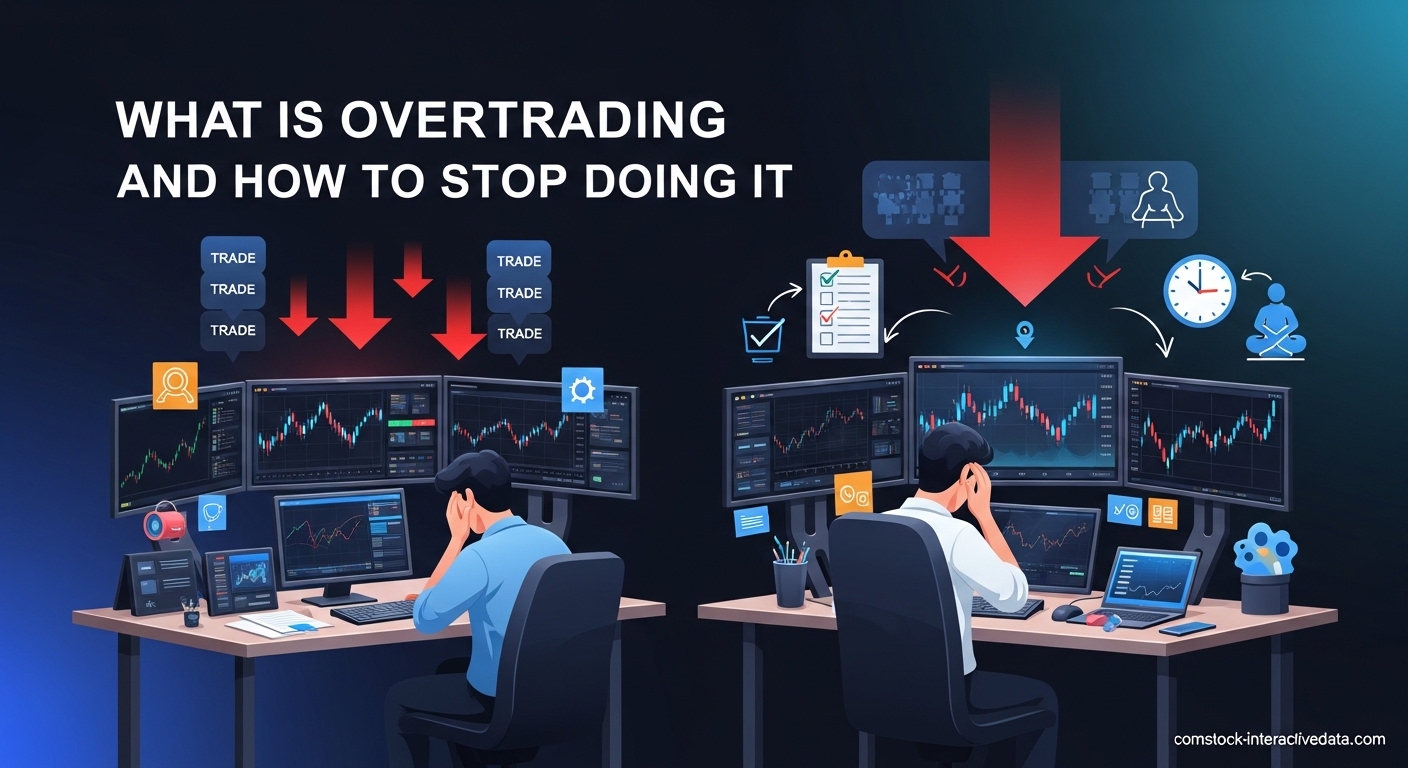
Overtrading is the excessive buying and selling of securities beyond what your strategy, risk tolerance, or financial situation supports, leading to increased costs and diminished returns. It is one of the most common reasons retail traders fail, often transforming profitable mornings into disastrous afternoons. If you have ever found yourself up 3% early in the day only to end flat or negative by the closing bell, you have experienced overtrading firsthand.
I have studied trading psychology for over a decade, and I can tell you that overtrading is not a strategy problem. It is a discipline problem that stems from emotional triggers, poor planning, and the false belief that more activity equals more profit. In this guide, you will learn exactly what overtrading is, why it destroys accounts, and the proven methods successful traders use to overcome it.
The statistics are sobering. Research consistently shows that the vast majority of day traders lose money, with many studies suggesting failure rates above 90%. While the exact percentage is debated, what is not debated is that overtrading sits at the core of most failures. Let us explore how to recognize it, understand it, and stop it.
Table of Contents
What Is Overtrading?
In simple terms, overtrading means trading too much. It happens when you execute more trades than your strategy calls for, when you take positions outside your predefined setup criteria, or when you continue trading after hitting your daily goals or limits. Overtrading is not just about the number of trades; it is about trading without a valid reason.
There are two distinct contexts where overtrading appears. The first involves brokers who excessively trade client accounts to generate commissions, a practice called “churning” that violates SEC Rule 15c1-7 and FINRA Rule 2111. The second, and the focus of this article, is individual traders who cannot stop themselves from clicking that buy or sell button.
Every trade carries costs. Commissions, spreads, and slippage eat away at your capital with each execution. When you overtrade, these costs compound rapidly. A trader making 50 trades per day pays significantly more in fees than one making 5 trades, yet studies show that higher frequency often correlates with lower profitability for retail traders.
Why Overtrading Destroys Profits
Overtrading destroys profits through three primary mechanisms. First, the direct cost of commissions and fees accumulates with every unnecessary trade. Second, each trade exposes you to risk, meaning more trades equal more opportunities for losses. Third, and most importantly, overtrading typically involves lower-quality setups, meaning you are taking trades with worse odds of success.
When you force trades, you abandon your edge. Trading requires patience and selectivity. The best traders I know spend most of their time waiting, not trading. They understand that capital preservation matters more than constant activity.
Types of Overtrading Every Trader Should Know
Understanding the specific type of overtrading you struggle with is the first step toward solving it. Not all overtrading looks the same, and different patterns require different solutions. Let us examine the four most common types.
Discretionary Overtrading
Discretionary overtrading occurs when traders ignore their written rules and trade based on gut feelings. You see a chart pattern that “sort of” looks like your setup, so you take it. Price moves slightly against your position, so you adjust your stop loss rather than exiting. You convince yourself that this trade is different, special, or justified.
This type stems from confirmation bias, the tendency to search for information that supports what you want to believe. When you want to trade, your brain finds reasons to justify entering. Discretionary overtrading feels flexible in the moment but proves destructive over time.
Technical Overtrading
Technical overtrading happens when traders add too many indicators to their analysis, creating conflicting signals that lead to excessive position adjustments. You are on the 5-minute chart and see a sell signal, but the 15-minute chart shows a buy signal, so you reverse your position. Then the hourly chart suggests something else entirely.
Flipping between time frames hunting for confirmation is a form of overtrading. It leads to micro-management, where you cannot leave your positions alone. Every tick becomes a reason to adjust, exit, or reverse.
Shotgun Trading
Shotgun traders throw money at multiple markets hoping something sticks. They might trade forex in the morning, switch to stocks at midday, and dabble in crypto by evening. There is no specialization, no deep understanding of any single market, just constant motion and activity.
This approach often masks a lack of confidence or preparation. Rather than developing expertise in one area, the shotgun trader chases opportunity everywhere, mastering nothing. In 2026, with markets more interconnected than ever, this approach has become increasingly common and increasingly dangerous.
Revenge Trading
Revenge trading is perhaps the most emotionally destructive form of overtrading. You take a loss, then immediately enter another trade to “make it back.” This trade loses too, so you increase your position size on the next one. Before you know it, you have wiped out weeks of gains in a single afternoon.
As one trader shared on Reddit, “Sometimes I am up 2% or similar and end up -4% by trying to get to 4% as a round number.” This pattern of chasing arbitrary profit targets after losses ruins accounts. Revenge trading is emotional, irrational, and often leads to the largest drawdowns traders experience.
The Psychology Behind Overtrading
Overtrading is rarely about the markets. It is about you. Understanding the psychological drivers behind excessive trading is essential for lasting change. Let us explore what really causes this behavior.
Boredom and Screen Addiction
Many traders overtrade simply because they are bored. They sit in front of their screens for hours, and trading becomes their entertainment. When quality setups do not appear, they manufacture trades just to have something to do. The markets become a video game, with real money as the score.
This screen-time addiction is reinforced by the intermittent rewards trading provides. Sometimes you win, sometimes you lose, but the action never stops. This variable reward schedule is the same mechanism that makes slot machines addictive. Traders become hooked on the activity itself, regardless of profitability.
Fear of Missing Out (FOMO)
FOMO drives traders to enter positions because they are afraid the market will move without them. They see a stock breaking out on Twitter and feel compelled to chase it. They watch others post gains and feel inadequate sitting in cash. The fear of missing the next big move overrides their better judgment.
FOMO-based overtrading typically results in poor entry prices and late-position timing. By the time the crowd is talking about a move, the easy profits have usually already been made.
Trading Ego and the Need to Be Right
Your ego wants to win every trade. It cannot accept being wrong, so it holds losing positions too long and takes immediate profits too early. It also drives you to trade more frequently because each trade is an opportunity to prove your intelligence and skill.
As one trader noted on LinkedIn, “To stop overtrading, you have to check your ego at the door. Humility is a trader’s bulletproof vest.” When you tame the need to always be right, you free yourself to follow your process rather than your pride.
Warning Signs You Are Overtrading
Recognizing overtrading in yourself requires honest self-assessment. Most overtraders know they have a problem but struggle to admit it. Here are the warning signs that indicate you are trading too much.
- You have made more than 10 trades in a single day without a specific, predefined reason for each one.
- You find yourself trading outside your stated strategy or taking setups you would not normally consider.
- You are glued to your screen, unable to step away even for meals or bathroom breaks.
- You experience emotional swings throughout the trading day, from euphoria to despair.
- You adjust stop losses or profit targets mid-trade without a clear technical reason.
- You trade from your phone while away from your desk, making impulsive decisions.
- You continue trading after hitting your daily profit target or daily loss limit.
- You feel anxious or restless when you are not in a position.
- You constantly flip between time frames hunting for a reason to enter or exit.
- You find yourself arguing with other traders on social media instead of focusing on your own analysis.
If three or more of these signs describe your trading behavior, you are likely overtrading. The sooner you acknowledge this, the sooner you can implement solutions.
Overtrader vs. Disciplined Trader
Understanding the difference between how overtraders and disciplined traders approach markets can help you identify where you need to improve. Let us compare their behaviors side by side.
| Behavior | Overtrader | Disciplined Trader |
|---|---|---|
| Daily trade count | 15+ trades | 1-3 quality setups |
| Screen time | 8+ hours, glued to charts | 2-4 hours with breaks |
| Entry criteria | Flexible, discretionary | Rigid, rules-based |
| After hitting target | Continues trading | Stops for the day |
| Response to losses | Revenge trades | Reviews and learns |
| Preparation | Minimal or none | Daily routine and checklist |
| Position management | Micro-manages constantly | Set-and-forget approach |
How to Stop Overtrading: 6 Proven Strategies
Stopping overtrading requires more than willpower. It requires systems, rules, and environmental changes that make overtrading difficult or impossible. Here are six strategies that have helped thousands of traders overcome this destructive habit.
Strategy 1: Apply the 80/20 Rule to Your Trading
The 80/20 rule, also known as the Pareto principle, states that roughly 80% of outcomes come from 20% of causes. In trading, this means that 80% of your profits likely come from 20% of your trades. Your goal should be to identify and focus exclusively on that high-value 20%.
Review your trading journal from the past three months. Which setups produced your best results? Which ones consistently lost money? You will likely discover that most of your gains came from a few specific patterns traded under certain market conditions. Your mission is to stop trading everything else.
As legendary trader Jack Schwager discovered in his Market Wizards interviews, the trades not taken were often more important than the trades taken. Eliminating low-quality setups from your repertoire is the fastest way to improve performance.
Strategy 2: Create and Follow a Trading Checklist
Pilots and surgeons use checklists to prevent catastrophic errors under pressure. Traders should do the same. A trading checklist forces you to slow down and verify that all your criteria are met before entering a position.
Your checklist should include items like: Is the market condition favorable? Does this setup match my edge? Is position size appropriate? Have I identified my stop loss and profit target? Am I emotionally neutral? If any item receives a “no,” you do not take the trade.
Print your checklist and keep it visible while trading. Make it a physical barrier between impulse and execution. This simple tool has transformed the results of countless overtraders.
Strategy 3: Set Hard Daily Trading Limits
One of the most effective ways to stop overtrading is to make it physically impossible. Many successful traders limit themselves to 3 trades per day, or set a maximum daily loss limit of 2% of their account. Once they hit either limit, they close their platform and walk away.
As one trader on Reddit advised, “Decrease the funds in your account. Literally make it so you either waste your settled cash on a dumb trade, or you will realize you have to be selective.” This physical constraint forces discipline when willpower fails.
I recommend setting three limits: a maximum number of trades per day, a maximum daily loss percentage, and a daily profit target after which you stop. These guardrails prevent the emotional decisions that lead to overtrading.
Strategy 4: Reduce Screen Time and Eliminate Boredom
Most overtrading happens during periods of boredom when quality setups are absent. The solution is simple but uncomfortable: step away from the screen. Create a watchlist of 5-10 markets you are interested in, set price alerts at key levels, and turn off your charts.
When an alert triggers, return to analyze the setup. If it meets your criteria, take it. If not, step away again. This approach transforms trading from constant monitoring to selective participation. You trade less but with higher quality.
The set-and-forget approach is professional methodology. Day traders who spend 8 hours glued to their screens are typically micro-managing, not trading. The best setups do not require constant supervision.
Strategy 5: Implement a Set-and-Forget Approach
Micro-management is the enemy of profitable trading. Constantly adjusting stops, moving profit targets, and second-guessing your decisions leads to overtrading behavior. The set-and-forget approach requires you to define your entire trade management plan before entry, then trust it.
Before entering any position, determine your entry price, stop loss, and profit target. Calculate your position size based on the risk. Place all orders simultaneously. Then close your trading platform or move to a different screen. Let the trade work without your interference.
This approach feels uncomfortable at first. Your ego wants to be involved, to prove its value through constant action. Resist this urge. The market does not care about your ego, and neither should your trading plan.
Strategy 6: Maintain a Detailed Trading Journal
You cannot improve what you do not measure. A trading journal provides objective feedback on your overtrading habits, making patterns visible that would otherwise remain hidden. Every trade should be logged with its setup, entry reason, emotional state, and outcome.
Review your journal weekly. Look for correlations between trade frequency and profitability. I guarantee you will discover that your 10th, 11th, and 12th trades of the day are almost always losers. This data becomes powerful motivation to stop overtrading.
Modern trading journal software can automate much of this process, calculating win rates, profit factors, and behavioral patterns. The key is reviewing the data regularly and making adjustments based on what you learn.
Risk Management Framework to Prevent Overtrading
Solid risk management is the foundation that supports all anti-overtrading efforts. Without proper position sizing and loss limits, even the best psychological strategies will fail under pressure. Let us build your protective framework.
Position Sizing Rules
Never risk more than 1-2% of your account on any single trade. This rule alone prevents catastrophic drawdowns that lead to revenge trading. If you have a $50,000 account, your maximum risk per trade should be $500-1000. This means adjusting your position size based on your stop loss distance.
Many overtraders use excessive position sizes to compensate for low-quality setups. They think a bigger position will make a mediocre trade worthwhile. This thinking is backwards. Large positions should only accompany the highest-probability setups with the clearest risk parameters.
Time-Based Trading Rules
Set specific times for trading and stick to them. For day traders, this might mean trading only the first two hours after market open when volatility is highest. For swing traders, it might mean analyzing markets only on weekends and making decisions Monday mornings.
End-of-day fatigue is a common overtrading trigger. After hours of screen time, decision quality degrades. Set a hard stop time for your trading day regardless of your P&L. The trades you take at 3:45 PM when you are mentally exhausted are rarely your best ideas.
Frequently Asked Questions About Overtrading
What is overtrading in simple terms?
Overtrading means trading too much – taking more trades than your strategy supports, continuing to trade after hitting daily limits, or entering positions that do not meet your criteria. It leads to increased costs, emotional decision-making, and typically results in lower overall profitability.
How do I stop myself from overtrading?
Stop overtrading by implementing strict daily trade limits, using a pre-trade checklist, reducing screen time with price alerts, and maintaining a trading journal to track your behavior. Many traders also find success by decreasing their account size to force selectivity and by applying the 80/20 rule to focus only on high-quality setups.
Is it true that 97% of day traders lose money?
Studies consistently show that the vast majority of day traders lose money, though the exact percentage varies by study. Research from financial regulators and academic institutions typically reports failure rates between 70-90%, with some studies suggesting even higher percentages over longer timeframes. Overtrading is frequently cited as a primary reason for these failures.
What is the 3 5 7 rule in trading?
The 3 5 7 rule is a risk management framework where traders limit themselves to 3 trades per day, a maximum 5% daily loss limit, and take a 7-day trading break if they hit their monthly drawdown limit. This structure prevents overtrading by creating hard boundaries around trading activity.
Conclusion: Breaking Free from Overtrading
Overtrading is a solvable problem, but it requires more than good intentions. It demands structural changes to how you approach the markets. By implementing the six strategies outlined in this guide – the 80/20 rule, trading checklists, daily limits, reduced screen time, set-and-forget management, and detailed journaling – you create an environment where overtrading becomes nearly impossible.
Remember that trading success is measured by profits, not activity. The trader who makes one excellent trade per week will outperform the trader who makes fifty mediocre trades. Quality beats quantity every time. Your goal is not to eliminate all overtrading immediately; that is unrealistic. Your goal is to make consistent progress, reducing your trade frequency while increasing your selectivity.
Start today. Choose one strategy from this guide and implement it in your next trading session. Then add another. Within weeks, you will notice the difference. Your account balance will reflect your discipline, and you will finally understand why the best traders trade less to make more. Overtrading is a habit, and like all habits, it can be broken with the right systems and commitment.