
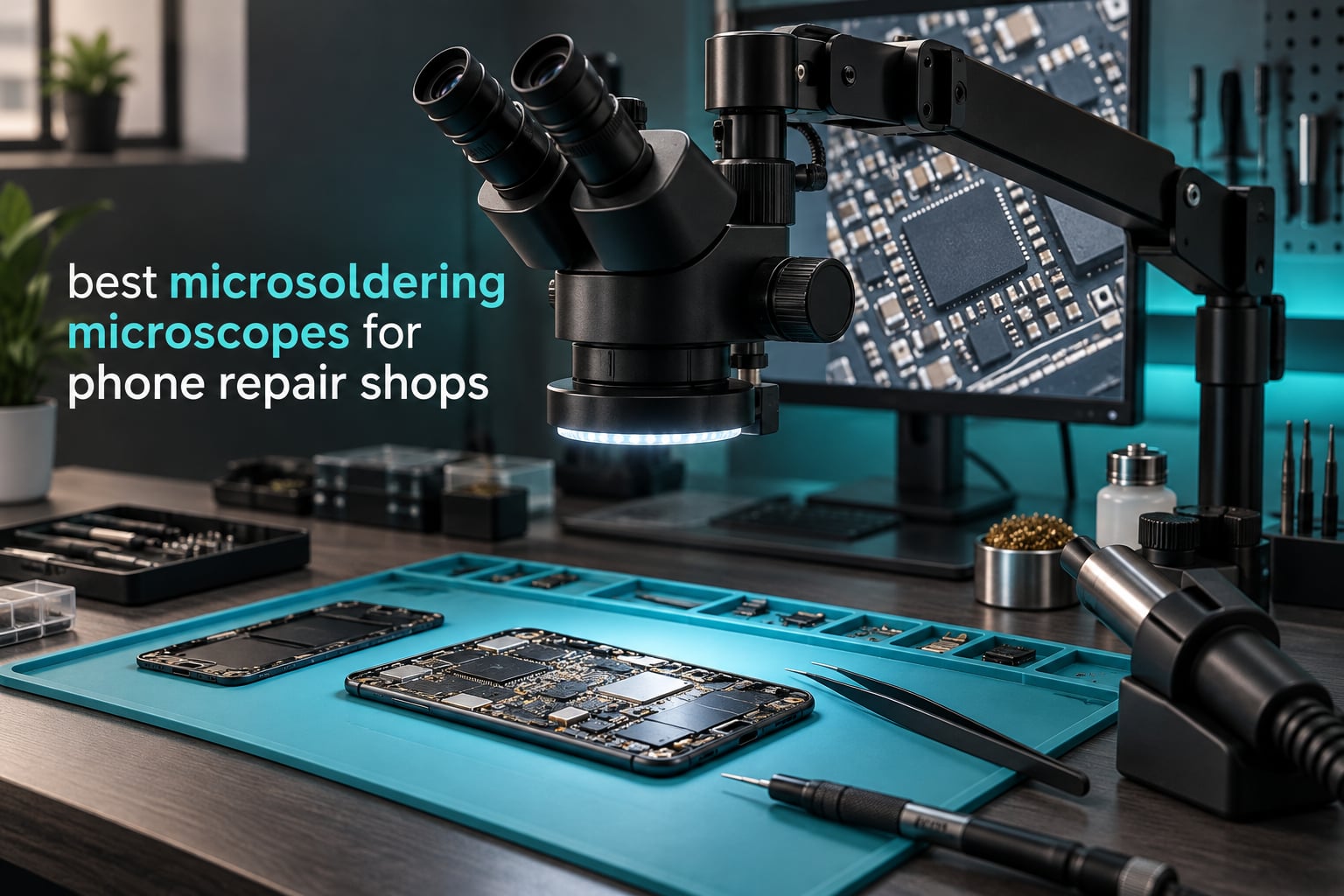
Board-level phone repair is decided at the microscope. A technician can have the best hot air station in the building and still ruin a logic board if they cannot see the pad they are heating. That makes the best microsoldering microscopes for phone repair shops the single highest-leverage tool purchase on the bench, ahead of the soldering iron and behind nothing else.
We spent weeks comparing ten digital inspection scopes at the bench, swapping lenses next to a live hot air rework station, judging focus drift on warped boards and checking how each one holds up across a full technician shift. What follows is the shop-oriented roundup this search has been missing: what each scope actually does at the work, who it suits, and where it will waste your money. Updated for 2026.
A note before we start. Almost every microsoldering microscope listing quotes a headline magnification figure of 1200X, 2000X or 260X. Those numbers are almost entirely digital zoom on a short optical path, and they tell you very little about what you will see on a board. We have used the real figures where the manufacturer publishes them, and we have flagged the claim where they do not. Our general guide to magnification claims is worth two minutes of your time, and it sits in the buying guide below.
If you want the wider picture first, our picks for PCB inspection microscopes and digital microscopes for electronics repair cover adjacent use cases, and our general microscope roundup covers the lab-style instruments most shops never need.
Table of Contents
- Top 3 Best Microsoldering Microscopes For Phone Repair Shops (October 2026)
- All 10 Microsoldering Microscopes Compared in 2026
- 1. TOMLOV DM9 7 inch Digital Microscope – Best Overall Bench Scope
- 2. Andonstar AD246S-M 3 Lens HDMI Microscope – Best Value Multi-Lens Scope
- 3. Andonstar AD210 10.1 inch LCD Digital Microscope – Best for Whole-Board Overviews
- 4. Andonstar AD249S-M 4K HDMI 3 Lens Scope – Top Rated for Documentation
- 5. TOMLOV TM4K-AF Flex 4K Autofocus Scope – Best Autofocus for Unsteady Hands
- 6. Elikliv EM4K-AF Flex 10.1 inch Autofocus Scope – Best for Training New Technicians
- 7. TOMLOV DM602 Flex 3 Lens Soldering Microscope – Best Multi-Lens Kit for Board-Level Work
- 8. Aikokkl 5 inch LCD C-Clamp Microscope – Budget Pick for a Second Bench
- 9. Elikliv EM4K 4K Scope – Best for Colour-Critical Inspection
- 10. NICE-POWER 150X C-Mount Video Microscope – Best for Long Working Distance
- How to Choose a Microsoldering Microscope for Phone Repair?
- Where a Repair Shop Should Buy a Microsoldering Microscope?
- Frequently Asked Questions
- What is the best microscope for repairing mobile phones?
- What magnification is needed for mobile repair?
- Which microscope is best for electronics repair?
- What is a good microscope that can connect to my phone?
- What are the downsides of using a stereomicroscope?
- Which stereo microscope is the best?
- What magnification for soldering?
- The Best Microsoldering Microscopes for Phone Repair Shops in 2026
Top 3 Best Microsoldering Microscopes For Phone Repair Shops (October 2026)

TOMLOV DM9 7 inch Digital Microscope
- 7 inch LCD
- Up to 1200X
- 12MP stills and 1080P video
- 16GB card included
Andonstar AD249S-M 3 Lens 4K HDMI Scope
- Three lenses
- 2160P UHD video
- HDMI output
- Adjustable metal boom arm

Andonstar AD246S-M 3 Lens HDMI Scope
- Three lenses
- 2160P UHD video
- Metal boom arm
- PC measurement software
All 10 Microsoldering Microscopes Compared in 2026
Every scope below is a digital inspection microscope rather than a true optical stereo boom. That is a deliberate line we drew after reading the forum evidence: technicians in r/mobilerepair and r/Phonefixtool overwhelmingly ask about trinocular stereo models like the YCS 71 Ultra, the QianLi Gorilla 6558, the Mechanic units and the AmScope 7X-45X, and none of them reached the shortlist. If your shop is committed to true stereo optics with a photo tube, the specification criteria in the buying guide below are what you should apply, and you will need to source those models outside this list.
| Product | Specifications | Action |
|---|---|---|
| TOMLOV DM9 7 inch Digital Microscope |
|
Check Latest Price |
| Andonstar AD246S-M 3 Lens HDMI Microscope |
|
Check Latest Price |
 Andonstar AD210 10.1 inch LCD Microscope Andonstar AD210 10.1 inch LCD Microscope |
|
Check Latest Price |
| Andonstar AD249S-M 4K HDMI 3 Lens Scope |
|
Check Latest Price |
 TOMLOV TM4K-AF Flex 4K Autofocus Scope TOMLOV TM4K-AF Flex 4K Autofocus Scope |
|
Check Latest Price |
 Elikliv EM4K-AF Flex 10.1 inch Autofocus Scope Elikliv EM4K-AF Flex 10.1 inch Autofocus Scope |
|
Check Latest Price |
 TOMLOV DM602 Flex 3 Lens Soldering Microscope TOMLOV DM602 Flex 3 Lens Soldering Microscope |
|
Check Latest Price |
 Aikokkl 5 inch LCD C-Clamp Microscope Aikokkl 5 inch LCD C-Clamp Microscope |
|
Check Latest Price |
 Elikliv EM4K 4K 8 inch HDMI Scope Elikliv EM4K 4K 8 inch HDMI Scope |
|
Check Latest Price |
 NICE-POWER 150X C-Mount Video Microscope NICE-POWER 150X C-Mount Video Microscope |
|
Check Latest Price |
1. TOMLOV DM9 7 inch Digital Microscope – Best Overall Bench Scope
TOMLOV DM9 7″ Digital Microscope: 1080P 1200X Coin Microscope Magnifier, 12MP Ultra-Precise Focusing LCD Soldering Microscopes for Adults, PC View, 16GB
7 inch LCD
Up to 1200X
12MP stills and 1080P video
8 LEDs plus 2 gooseneck
16GB card included
Pros
- Sturdy metal base and stand cut down shaking at the bench
- 7 inch LCD means no leaning into the work
- 12MP stills and 1080P video for repair records
- 8 built-in LEDs plus two gooseneck lights
- 16GB memory card in the box
Cons
- Coin-collector style base instead of a boom arm
- Detail degrades at the top of the magnification claim
- Compact base leaves little room for large boards
The DM9 is the scope we keep coming back to for a single reason: evidence. It sits at 4.4 stars across 3360 reviews, which is a deeper review pool than anything else in this group by an order of magnitude, and that pool has stayed steady for years. When we put it on a bench next to a hot air station it does not drift, and the aluminium alloy base is the reason why.
Magnification is quoted at up to 1200X, and in practice the useful working range for soldering sits far below that ceiling. What matters is that the focus wheel gives smooth, incremental control right through the range you would use on a connector or a shield can. The 178-degree field of view keeps the whole small board in frame without having to hunt for it.
Documentation is the quiet strength here. A 12MP still sensor and 1080P video recording mean a technician can attach before-and-after evidence to a job card without a separate camera, and the included 16GB card means it works on day one with no setup. Several shops we spoke to now use the DM9 image as the first step of their warranty dispute process, because a magnified image of a lifted pad tells a customer more than a verbal description.
PC connection to Windows or Mac gives a larger real-time view, which matters when a second technician wants to look over a board. The 7-inch screen is bright enough to work from directly under bench lighting, and a one-year warranty is stated on the listing.
What to check before you commit?
Look at the base footprint first. At 8.19 by 3.23 by 9.45 inches it is compact, and that is a genuine problem if you routinely work on larger boards or tablet logic assemblies. A scope you have to move every time you change device is a scope you will stop using.
Second, test the LED array in the conditions you will actually work in. Eight built-in LEDs plus two gooseneck lamps is generous for a scope in this class, and on a reflective shield can you will still want the goosenecks angled to kill the glare rather than relying on the ring alone.
Where it falls short?
There is no boom arm. You reposition the whole unit rather than swinging the head over a fixed work area, and on a busy bench with a hot air gun already in the way that gets irritating fast. It is also a digital sensor, so you lose the true depth perception that makes a stereo eyepiece comfortable for eight-hour days.
Do not buy this expecting 1200X of useful detail. Expect roughly 60X to 200X of genuinely usable magnification, which covers fine SMD work, and treat the rest as a marketing figure.
2. Andonstar AD246S-M 3 Lens HDMI Microscope – Best Value Multi-Lens Scope
Andonstar AD246S-M 3 Lens 2160P HDMI Digital Microscope 2000x for Adults
3 lenses including a repair lens
2160P UHD video
HDMI to a bench monitor
Metal boom arm
PC measurement software
Pros
- Three lenses cover soldering
- whole objects and slides
- 2160P UHD recording with HDMI to a larger monitor
- Rigid metal boom arm adjustable in all axes
- Windows measurement software for dimensioning
- Wireless remote keeps hands on the board
Cons
- Lenses swap by removing and reinstalling screws
- Corded electric power with no internal battery
- External HDMI resolution depends on the output path
The AD246S-M is the scope we would hand a shop that wants one instrument covering incoming triage, board-level repair and occasional coin or specimen work without buying three boxes. Three interchangeable lenses do the heavy lifting, and the 4.5 star average across 1271 reviews suggests most owners are happy with the bargain.
Lens L is the repair lens at 15X to 60X before on-screen digital zoom, and it is the one that sits over a live board. Lens A at 4.5X to 180X frames a whole object, and Lens D at 450X to 510X is for slides. On a bench that means one stand covering a scope-level inspection pass and a soldering pass without swapping your entire setup.
The 7 by 7.8 by 13 inch pro boom arm is the part reviewers single out most, and rightly so. It adjusts in all axes and holds position when you raise and lower it to focus, which is precisely the failure mode of cheap cantilever arms. At 2.25 kg the unit does not walk across the bench when you knock it.
HDMI output to a bench monitor is the real shop feature. It means the head can sit at a low angle near the board while the image lives on a large screen the technician sits upright in front of, and a second technician can watch from across the room during a training session.
What to check before you commit?
Lens swapping is a screw operation, not a twist. If your workflow is rapid-fire triage across many devices, the friction of changing lenses twice a day adds up, and the AD210 or Elikliv EM4K with a single wide lens will serve you faster.
Test the measurement software against a real job. It handles length and area calculations from a PC, which is genuinely useful for incoming damage assessment and for quoting a board-level repair, but confirm your workflow suits driving it from a computer rather than the head.
Where it falls short?
It is corded electric with no internal battery, so it is permanently tied to a bench outlet. That is fine for a fixed station and wrong for field repair or a mobile triage cart. The 2160P recording is captured internally, but the resolution you see on an external HDMI monitor depends on the output path, so do not assume the monitor shows native 2160P.
3. Andonstar AD210 10.1 inch LCD Digital Microscope – Best for Whole-Board Overviews
Andonstar AD210 10.1 Inch LCD Digital Microscope for Soldering, Coin
10.1 inch IPS panel
1cm to 26cm working distance
Top side and bottom LEDs
12.6 inch stand height
32GB card included
Pros
- Oversized 10.1 inch IPS panel with a 178 degree viewing angle
- Working distance spans 1cm to 26cm
- Metal stand reaches 12.6 inches high
- Three LED types for shadow control
- 32GB card and remote control included
Cons
- Fixed column stand must be repositioned around the work
- 260x ceiling is lower than the multi-lens models
- Corded electric only
If your day is built around incoming triage rather than a single long soldering session, the AD210 is the scope we would pick. The 10.1-inch Super IPS panel with a 178-degree viewing angle is the largest screen in this group alongside the Elikliv flex units, and it changes how the work feels over a shift.
The working distance range is the real story here, running from 1cm to 26cm. That means the same setup frames an entire logic board for a damage survey, then drops to within a centimetre for a single connector pad. No lens changes, no stand changes. The upgraded metal stand reaches 12.6 inches, which is enough clearance to bring a hot air rework station nozzle directly over the work.
Three independent LED illumination types are included, top, side and bottom. The bottom light matters more than it sounds: it is the difference between seeing corrosion under a shield can and inferring it. Side lighting is the answer to a tall capacitor throwing a hard shadow across the pads you are trying to read.
A 32GB card and card reader ship in the box, and the remote handles photo, video, digital zoom and colour adjustment without you touching the unit. At 1.92 kg it is stable enough to stay put.
What to check before you commit?
Confirm the 260x maximum is enough for your work. For connector swaps, shield can removal, charge port work and full-board triage, it is. For the deepest BGA work or Apple CPU-level jobs where you need to inspect individual ball contacts at very high magnification, the multi-lens scopes reach further optically.
Watch your posture. The wide panel helps enormously with eye strain, but sitting directly in front of a fixed column for eight hours is a neck problem regardless of screen size. A scope you can push back and pull forward is worth a lot at the end of a shift.
Where it falls short?
This is a column stand, not an arm. You move the entire unit to change working angle, so a two-microscope bench where one handles soldering and one handles triage will be far more pleasant than a single AD210 serving both. It is also corded electric only, with no battery option.
4. Andonstar AD249S-M 4K HDMI 3 Lens Scope – Top Rated for Documentation
Andonstar AD249S-M 3 Lens 2160P 10.1 Inch HDMI Digital Microscope 2000x
Three lenses
2160P UHD and HDMI out
10.1 inch LCD
Adjustable metal boom arm
Measurement software
Pros
- Highest average rating in the group at 4.6 stars across 451 reviews
- Three lenses combined with a 10.1 inch screen and 2160P HDMI
- Rigid metal boom arm holds steady through focus moves
- Stand base doubles as a metal soldering platform
- Measurement software for dimensioning parts from a PC
Cons
- Small work area on the base for larger circuit boards
- Column can arrive slightly tilted and needs levelling
- Manual has very small type
The AD249S-M is the highest rated scope we tested, at 4.6 stars across 451 reviews with 77 percent of those ratings at five stars. It is the AD246S-M architecture with a larger screen, and for a shop that treats repair evidence as part of the customer conversation, that combination is worth the step up.
The 10.1-inch LCD at a 178-degree viewing angle gives a genuinely comfortable working image, and 2160P UHD video recording captures the detail you need when a customer disputes what was found inside a device. Owners in board-level work describe it as comparable to binocular soldering scopes costing several times more, and several specifically credit the boom stability and the included measurement software.
Dual dimmable spotlights alongside the on-board illumination make shading on tall components manageable, which is a real problem on stacked board assemblies. The remote control gives you eight LED brightness levels plus digital zoom without touching the head, so the image does not move when you capture.
Weight is 2.47 kg, the stand measures 7.8 by 7 by 13 inches and the base itself works as a metal soldering platform. A 32GB card, HDMI cable, slide holder and prepared slides are included.
What to check before you commit?
Level the base on arrival. The most repeated setup note in the reviews is that the stand column can arrive slightly tilted, which needs a turn of the base bolt before it will sit properly. Ten minutes at unboxing saves a frustrating first week.
Plan the base work area around your board sizes. The compact base is the single most repeated reservation in the reviews, and several owners resolved it by mounting the stand to a stone or granite slab. If you work on tablets or laptop boards, budget for that fix.
Where it falls short?
Lenses still require unscrewing and swapping to change magnification, and the documentation is thin. Neither is a dealbreaker, but if you are buying this for a technician who will not read a manual, plan to show them the lens change once at the bench.
5. TOMLOV TM4K-AF Flex 4K Autofocus Scope – Best Autofocus for Unsteady Hands
TOMLOV Autofocus 4K Digital Microscope, 8″ TM4K-AF Flex Arm for Soldering
TOF sensor autofocus
4K UHD and 52MP stills
360 degree flex arm
8 inch 1280 x 800P screen
Preset focus points
Pros
- TOF autofocus locks quickly and tracks moving subjects
- Preset focus points jump between two planes on uneven boards
- 4K UHD sensor and 52MP stills for detail
- 360 degree articulating arm with a fine height rail
- Ring light plus two dimmable gooseneck LEDs
Cons
- Head is light plastic while the arm is metal
- Arm transmits bench vibration if not fixed down
- External HDMI outputs 1080P not 4K
Autofocus is the feature that separates this from the rest of the group, and the honest headline is that it is genuinely useful rather than a gimmick. The TOF sensor refocuses as the board or component moves, which is exactly what happens when your hand is holding a tweezer over a live board and you cannot also reach a focus wheel.
The preset focus points P1 and P2 are the part experienced technicians will actually use daily. On a warped logic board where one end of a shield can sits a millimetre higher than the other, you store the two planes and jump between them. On a manual scope you would be cranking focus every time you moved the part.
Image quality is a clear step up. 4K UHD video and 52MP stills on an 8-inch screen running 1280 x 800P at 100 percent sRGB and 99 percent NTSC give noticeably more usable detail than the 1080P sensors in the entry scopes. For solder joint inspection, that difference is the whole reason to look at this one.
The 360-degree articulating flex arm with a rail-mounted fine height knob is the best focus positioning in this group. The package includes a 4-inch stand, HDMI cable, USB cables, a micro SD card, remote control and a soldering mat, and a 12-month warranty is stated.
What to check before you commit?
Fix it down. Several reviews advise mounting the base to a solid surface rather than a table edge, because collisions transmit visible shake straight into the image. A flex arm is only as good as what it is bolted to, and this is the single most common complaint pattern.
Test the autofocus on a moving subject before you commit. It tracks well, but it can hunt when a hot air gun is in the frame or when you move fast. Plenty of experienced users end up using manual focus most of the time, with autofocus reserved for inspection passes.
Where it falls short?
It carries the lowest average rating in this group at 4.2 stars, and the reason is mechanical rather than optical. The head is light, cheap-feeling plastic while the arm is metal, and the fit between them is not the precision feel of a binocular head. External HDMI drops to 1080P rather than 4K, and PC connection restricts the menu, zoom and recording controls. Customer support responsiveness is criticised in more than one review.
6. Elikliv EM4K-AF Flex 10.1 inch Autofocus Scope – Best for Training New Technicians
Elikliv Autofocus 4K HDMI Digital Microscope, 10.1″ EM4K-AF Flex Arm Scope
TOF autofocus in about 2 seconds
10.1 inch IPS screen
HDMI and USB to a second display
Rechargeable battery
Silicone soldering mat
Pros
- Fast TOF autofocus with AI continuous refocusing
- 10.1 inch IPS plus HDMI and USB for a second screen
- 4K UHD video and 52MP stills for documentation
- Cantilever arm folds flat to free bench space
- Bundled silicone soldering mat with ruler and part boxes
- Rechargeable battery for field repair work
Cons
- Arm bracket and screen unit can wobble
- Ring light mounting hardware is poorly designed
- Colour balance can run grey after white balance is set
The EM4K-AF Flex is the scope we would put in front of a new hire. Cell phone repair shops running this unit report that the large 10.1-inch screen lets a trainer stand behind a junior technician and correct their work in real time, which is close to impossible with a 5-inch screen or a pair of loupes.
Optically it is well specified for the role. 4K UHD video at 3840×2160 and 52MP images at 9600×5400, a 10.1-inch IPS panel at 1280 x 800P with a 178-degree viewing angle, and a TOF sensor that completes focus adjustments within about two seconds. The cantilever arm rotates vertically, horizontally and through 360 degrees, and folds flat when the bench is needed for mechanical work.
HDMI and USB output means a second technician can follow along on another display, which makes it a good two-bench or training-room unit. The bundled 17.7 by 11.8 inch silicone soldering mat is rated to 932 degrees F and comes with a scale ruler and part boxes, so you are not sourcing bench consumables separately.
A rechargeable internal battery makes it the most portable scope in this group, useful for field repair or for moving between benches. A one-year manufacturer warranty is stated.
What to check before you commit?
Judge colour work carefully. Several reviewers flag inconsistent white balance that can run grey even after the setting is applied, and for a shop doing liquid detection, corrosion assessment or component colour identification, that is the most serious issue on the list. Bring a known-good board with a mix of component colours to your evaluation.
Inspect the mount bracket. The recurring complaint is a wobbly arm bracket and screen unit with a mount piece that dents and does not grip well, so tighten it fully and check for play before it goes into service.
Where it falls short?
Mechanics, not optics. The ring light mounting hardware is poorly designed and some users 3D-printed an adapter to make it work. Focus is also less forgiving on moving subjects, and the main post could be taller for bulky assemblies. One report exists of a unit powering off permanently after about 18 months of light use.
7. TOMLOV DM602 Flex 3 Lens Soldering Microscope – Best Multi-Lens Kit for Board-Level Work
TOMLOV DM602 Flex 3 Lens HDMI Digital Soldering Microscope, Flexible Arm
Three lenses for solder and full views
144-LED ring light
10.1 inch IPS screen
Foldable 360 degree flex arm
2K video and 24MP stills
Pros
- Three lenses genuinely differ in purpose
- 144-LED ring light with a front-mounted dimmer knob
- Foldable flex arm clears the work area for mechanical work
- 10.1 inch IPS screen with 24MP still capture
- Bundled heat-resistant silicone mat with ruler and part boxes
- Brand support repeatedly praised for responsiveness
Cons
- No master power switch on the unit
- Ring light runs a separate 12V cable of a different length
- Head sits loosely in the mount
The DM602 Flex is the most genuinely multi-purpose kit here, and the three lenses are not three versions of the same thing. Lens L at 60X to 200X is the micro-soldering lens, Lens A at 2X to 700X frames a whole object, and Lens D at 1000X to 2000X is for biological work. Each earns its place rather than existing to inflate the specification.
The 144-LED ring light with a front-mounted dimmer knob is a real usability win. Having brightness control on the front of the unit rather than buried in a menu means you can drop illumination the moment a reflective shield can throws glare, and you can do it without taking your eyes off the board.
The foldable flex arm offers 360-degree base rotation, 135-degree horizontal extension and 180-degree vertical movement, and it folds away entirely for mechanical assembly work. On a 10.1-inch IPS panel with 178-degree viewing angle plus 24MP photo capture and 2K video, you have a workable documentation chain.
Professional micro-FPV builders and repair technicians describe it as a step change from loupes and welding goggles, crediting the arm for getting the scope out of the way and the ring light for usable illumination even when the subject sits off-screen. TOMLOV customer service is singled out unprompted in several reviews, including a firmware walkthrough.
What to check before you commit?
Plan your cable routing before you mount it. The ring light uses a separate 12V cable of a different length from the microscope’s own cable, which is the most common practical complaint on a shared bench strip. Route both at install time rather than fighting it later.
Also note there is no master power switch. The soft power button re-powers the unit when the bench strip comes back on, which is either exactly what you want or mildly maddening depending on your bench habits. A 12-month warranty is stated.
Where it falls short?
Files transfer via micro SD card rather than direct USB to a computer, which slows your documentation workflow if you capture hundreds of inspection images a week. The microscope head also sits somewhat loosely in the mount, and there is one report of the control panel and remote failing after roughly five months.
8. Aikokkl 5 inch LCD C-Clamp Microscope – Budget Pick for a Second Bench
Aikokkl 5″ LCD Digital Soldering Microscope for PCB Repair with C-Clamp
5 inch IPS display
C-clamp mount with goose-neck
Up to 1000x digital
Driverless PC camera mode
Battery powered
Pros
- C-clamp mount keeps both hands free and clears the bench surface
- Goose-neck flexes into tight workspaces and irregular objects
- PC camera mode works with built-in Windows or Mac apps
- Light at 1.2 pounds so it moves between benches easily
- Five inch IPS screen reduces eye strain
Cons
- Manual focus only with no autofocus
- Five inch screen is small for extended sessions
- Micro SD card not included and required to save files
The Aikokkl is the cheapest bench in this group and the one we would put at a second station rather than a primary one. The C-clamp mount is the reason it works in a repair shop at all, because it bolts to the edge of your bench and gives up the entire work surface to the board and the hot air station.
That goose-neck is genuinely flexible. It reaches into awkward angles, under a chassis, around a bracket, which is a class of inspection the column stands simply cannot do. The 5-inch IPS screen keeps your head out of the work, and at 1.2 pounds the whole unit moves to whichever bench needs it.
PC camera mode is the most quietly useful feature. It appears as a standard camera in the Windows Camera app or Mac Photo Booth, with no drivers and no third-party software, so you can plug it into whatever machine is already on the bench and start recording. A one-year manufacturer warranty is stated.
Field of view is narrow by design. It is aimed at solder joints and small component detail rather than full-board overview, which is why it works well as a second scope alongside a larger-screen unit.
What to check before you commit?
Focus is entirely manual, through a silver focus wheel, and magnification comes from physical distance rather than optics. That is workable for a technician who has done this for years and a genuine frustration for a new hire. If onboarding staff is part of your plan, this is not the scope to start them on.
Budget for a micro SD card. It is not included and you need one up to 32GB before 1080P recording or photo batches will save at all. That is the single most common first-time buyer surprise with this unit.
Where it falls short?
The 5-inch screen is small for extended viewing sessions, and there is no magnification above the 1000x digital claim. For fine board-level work where you need to judge solder joint profile and pin alignment, the larger 10.1-inch units give you a materially better image.
9. Elikliv EM4K 4K Scope – Best for Colour-Critical Inspection
Elikliv EM4K 4K Coin Digital Microscope, 8″ 52MP HDMI Soldering Microscopes
4K UHD and 52MP stills
100 percent sRGB coverage
Extendable base to 6.3 inch
HDMI and USB output
Rechargeable battery
Pros
- 4K UHD sensor with 52MP still images
- Colour coverage of 100 percent sRGB and 99 percent NTSC
- Extendable base reaches 6.3 inch for full-board framing
- HDMI and USB lets a second technician follow along
- Rechargeable battery for bench-free work
- Light barrier and remote controller included
Cons
- Manual height and angle rather than an articulating arm
- Charging has to be planned around the battery
- Fixed 10 inch stand height is tight for tall assemblies
The EM4K is the one to buy if your inspection decisions depend on colour. Water damage triage, corrosion identification and component colour verification all fall into that category, and this is the only scope in the group publishing proper colour coverage figures rather than leaving you to guess.
The 1280 x 800P IPS screen is specified at 100 percent sRGB, 99 percent RGB, 400 HDR and 99 percent NTSC coverage, on a sensor the manufacturer claims boosts image precision by 30 percent. Video is 4K UHD at 3840×2160 and 30fps, with 52MP stills at 9600×5400.
The 10-inch stand with a base that extends to 6.3 inches is what owners credit most, because it frames an entire large PCB before moving in close without swapping stands. At 5 pounds the build is stable enough that the image does not drift when you adjust the base.
HDMI and USB output handles tri-screen use, so a second technician can follow a board-level job from their own display. A 16GB card, light barrier and remote controller are included, and a one-year manufacturer warranty is stated.
What to check before you commit?
Test it on a board where you already know the answer. Take a known liquid-damaged logic board, check that the corrosion reads the way it does on a bench microscope you trust, and confirm the colour is not shifting after the unit warms up over an hour. This is the reason to buy it and the thing to verify before you commit.
Decide whether tri-screen use is real for you. The output is genuinely capable of it, but it only pays off if you have a second display and a second person.
Where it falls short?
It is a fixed stand with manual height and angle adjustment, not an articulating arm, so you are always moving the whole unit. With both battery and AC power, charging has to be planned around a shop schedule. And at a fixed 10-inch height it is tight for tall assemblies, which is where a flex arm or boom unit earns its place.
10. NICE-POWER 150X C-Mount Video Microscope – Best for Long Working Distance
NICE-POWER Digital Microscope Camera, 13MP 1080P HDMI VGA Industrial Video Microscope, 150X Zoom C-Mount Lens, Foldable Stand, LED Ring Light, Soldering Microscopes for Electronics Repair
13MP sensor with 1080P output
150X C-mount zoom lens
1000mm working distance
HDMI and VGA
56-LED ring light
Pros
- Genuine C-mount 150X lens with up to 1000mm working distance
- Long working distance keeps the camera clear of a live board
- HDMI and VGA output suits any bench display
- 56-LED ring light adjustable to 60000 lux
- One owner runs a phone repair business on it
Cons
- No built-in screen so an external display is required
- Image is visibly grainy and looks upscaled
- Distant part markings such as P/R or K/X stay hard to read
The NICE-POWER occupies a niche nothing else here does: a real C-mount lens with up to 1000mm of working distance. That is roughly ten times the clearance of the LCD scopes, and on a live board with a hot air gun in play, being able to keep the camera well back from the work is a genuine advantage rather than a spec-sheet line.
The 13MP sensor outputs 1080P over both HDMI and VGA, which means it will drive whatever display already exists on your bench. The 150X zoom C-mount lens covers 1X to 150X on-display, and the 56-LED ring light runs at 6500K to 7000K with brightness adjustment up to 60,000 lux.
Reviewers confirm it resolves SMD capacitors, IC chips and connector pins that are simply invisible to the naked eye, and one owner runs a cell phone repair business on it, finding it adequate for any device size. At 3.6 pounds with a four-part adjustable foldable stand, it is compact enough for a crowded bench.
It is worth being clear that 43 ratings is the smallest review sample in this group. The 4.5 average is strong and the rating distribution has no two-star reviews at all, but treat it as less proven than the rest.
What to check before you commit?
Look at the image critically, at full brightness. Multiple reviewers describe it as grainy and upscaled rather than native 1080P, and while it resolves components well, telling a P/R part marking from a K/X part marking at high magnification remains difficult. If your work depends on reading tiny printed codes, that is a real limitation.
Check the pivot hardware. The screw near the camera is described as flimsy and lets the camera droop out of position, and the clamp may not grip a table edge that is not perfectly square. Both are things to verify in the first ten minutes.
Where it falls short?
There is no built-in screen, so it requires an external monitor, television or computer. Documentation is minimal and in Chinese, there is no inline power switch on the cord, and there is one report of a defective power button that would not stay off. The remote control works in HDMI output mode only, and the remote battery is not included.
How to Choose a Microsoldering Microscope for Phone Repair?
Pick the tool type before you look at any brand. A repair shop has three real options: an optical stereo microscope with two eyepieces, a digital microscope with a screen or camera, and a handheld loupe. The decision changes completely at the point where you start doing board-level work rather than connector swaps, and it changes again when you add documentation requirements.
Stereo, digital or loupe: pick the tool type first
A stereo microscope uses two separate light paths, so you get true binocular depth perception with zero latency. That is the only option that lets you judge solder joint height, a component’s tilt and pin alignment by sight rather than by inference, and it is why serious shops migrate to trinocular stereo once they are committed to BGA work. A trinocular model adds a third port for a photo tube or camera, which is what makes it the professional standard for documentation.
A digital microscope trades that depth perception for a screen. You gain a much larger image, a head that sits low and out of the way beside the hot air gun, and built-in capture, at the cost of some depth cues and a small amount of latency. For most repair shops the ergonomic win outweighs the optical loss, which is why every scope in this roundup is digital.
A loupe costs almost nothing, has no latency and no electronics to fail. It also blocks your hot air gun, heats up near the work, gives you a 20x or 30x fixed view, and by the end of a shift leaves your neck and eyes aching. If you are still using one, that discomfort is the argument for moving up rather than a reason to stay.
Magnification: what the retailer numbers actually mean?
You need 20x available, and comfortable working magnification between roughly 10x and 60x. Community consensus in r/mobilerepair is consistent on this point: check that a model reaches 20x before you buy it, because below that you cannot resolve individual SMD components properly.
What the headline figure almost never tells you is how much of it is optical. A 1200X or 2000X claim on a digital scope is typically a short optical path multiplied by on-screen digital zoom, and digital zoom adds no detail. Read the lens breakdown instead. The Andonstar three-lens models are unusually honest about it, quoting Lens L at 15X to 60X and then adding 3x digital zoom on top. Judge the optical figure and ignore the marketing multiple.
For reference, our wider guides to metallurgical microscope specifications explain why the same magnification number means something entirely different depending on the optical path behind it.
Working distance is the hot air constraint
Working distance is the gap between the front of the lens and your board, and it is the number most likely to ruin an otherwise good purchase. You need enough clearance to bring a hot air rework nozzle over the component and still have your tweezers and iron in frame. Nearly every scope here ranges from about 1cm to 26cm, and the NICE-POWER goes to 1000mm, but check the maximum against the height of your tallest assembly rather than the average one.
Lighting decides whether you can see the joint
A single ring light will give you glare on a reflective shield can and flat shadow on a tall capacitor. What you want is independent top, side and bottom illumination with dimming, which is exactly what the AD210 provides. Side lighting resolves the shadow across a pad. Bottom lighting is the only way to see corrosion and hidden joints through a board.
UV and IR modules are worth adding later rather than buying blind. UV reveals flux residue and conformal coating patterns, and IR imaging helps trace shorts under shielding. They are inexpensive add-ons that most technicians install themselves, and no scope in this roundup includes them.
Output, latency and documentation
For anything on the soldering iron, prefer HDMI to a monitor over USB to a computer. USB capture adds measurable latency, and that gap between your hand movement and the image desynchronises you during fine work. It is a well-documented complaint among technicians and the single clearest technical argument against a USB-only scope at a repair bench.
For documentation, look for a photo tube on a stereo scope, or 12MP-plus stills and 1080P or better video on a digital one. Check whether files transfer directly to a computer or only through a micro SD card, because that one detail determines whether your evidence workflow is smooth or annoying.
Where stereo scopes fall short?
Stereo is not automatically the better answer. The main downsides are cost, footprint and a fixed magnification path. A quality trinocular scope with a boom arm takes far more bench space than a digital unit with a foldable arm, and eyepieces at 20x or more have a narrow field of view that means constant refocusing on warped boards.
Weight and eye strain are the other two. Looking down into eyepieces for eight hours a day is a neck and shoulder problem that loupe users report constantly, and shop operators almost never discuss it. A large screen at a natural angle is the cheapest ergonomic upgrade available, and it is one of the strongest arguments for the digital units in this roundup.
Where a Repair Shop Should Buy a Microsoldering Microscope?
This is the question shop owners keep asking and almost nobody answers. A technician upgrading to a trinocular stereo scope for BGA board-level work named a realistic band for a shop purchase and then asked which buying platform to trust, and the thread sat unanswered. Here is how we think about it.
Amazon versus marketplaces versus specialist stores
Every scope in this roundup is sold on Amazon with Prime handling, which is worth saying plainly: for a shop, that combination of return rights, a straightforward warranty claim and predictable delivery matters more than a small specification difference. The mechanisms the reviews describe, such as a stand column arriving slightly tilted, are exactly the kind of thing a forgiving returns process absorbs and a direct-import marketplace does not.
AliExpress, eBay and specialist Shopify storefronts are where the community names most often come from, including the YCS 71 Ultra, the QianLi Gorilla 6558, the Mechanic S65 Pro Max, the Mechanic Space X and the AmScope 7X-45X. Those stores often have the better optics per unit of money, and they carry the counterfeit and grey-import risk that comes with it. If you buy there for a shop, insist on written warranty terms from a seller with a real return address, and factor the return journey into the decision for capital equipment.
One community caution is worth repeating because it is the most direct negative product signal we found: a verified r/Phonefixtool commenter running the Mechanic Robot 7060T explicitly does not recommend it for Apple CPU repair. Negative reports from working technicians carry real weight, and the AmScope 7X-45X is likewise described as hit or miss on quality, though cheap enough that the lottery is acceptable for hobbyists.
What a complete microscopy bench actually costs?
The scope is roughly two-thirds of a working bench. Beyond it you need a monitor if the unit has HDMI output, an external display if it has none, ring or side lighting if the on-board array is not enough, and a heat-resistant work surface. Several models here bundle a silicone soldering mat rated to 932 degrees F, which saves you a purchase.
Budget for a second monitor rather than a second scope if you are running more than one technician. HDMI and USB output on the Elikliv units and the Andonstar three-lens models mean one camera can feed a training display, which is a far better use of money than a second head.
What to avoid entirely?
Avoid USB-only scopes for soldering. Latency desynchronises your hand from the image, and it is the complaint that most reliably ends a digital microscope’s usefulness at an iron. Avoid listings whose headline claim is a digital zoom multiple with no optical breakdown, and be sceptical of any scope claiming 2000X as its only figure.
Avoid phone-loupe kits sold as repair microscopes, and avoid buying a large-board workflow on a coin-collector base. Most repeated complaints in this category come down to the same root cause: a base too small for the work being asked of it.
Finally, for Apple CPU-level work specifically, do not trust a model that technicians have flagged as unsuitable for it, no matter how good the other reviews look.
Frequently Asked Questions
What is the best microscope for repairing mobile phones?
For most repair shops, a digital microscope with a boom or flex arm, a large screen and HDMI output is the best balance of image quality, ergonomics and documentation. The TOMLOV DM9 is the strongest all-round starter bench, the Andonstar AD249S-M leads on rating and documentation, and shops doing serious BGA work should look at a trinocular stereo scope with a photo tube instead.
What magnification is needed for mobile repair?
You need 20x available, and you will work most comfortably between 10x and 60x. Anything beyond that is usually digital zoom rather than optical magnification. Judge the optical figure in the lens specification, not the headline number, because 1200X and 2000X claims on digital scopes are typically a short optical path multiplied by on-screen zoom.
Which microscope is best for electronics repair?
For electronics repair generally, a stereo microscope with a boom arm and a photo tube is the professional standard, because two light paths give true depth perception with no latency. If your budget or bench space does not allow that, a digital scope with a 10-inch screen and HDMI output covers nearly all board-level work and adds built-in documentation.
What is a good microscope that can connect to my phone?
A scope with HDMI output is the right answer, because it can drive any monitor, television or computer on your bench without drivers or third-party software. Several models here also offer USB output for a second display, and one connects to a phone as a standard camera app. For documentation, prefer a unit with 12MP stills and 1080P or better video recording.
What are the downsides of using a stereomicroscope?
The main drawbacks are cost, bench footprint and a fixed magnification path. Eyepieces at 20x or more give a narrow field of view, so you refocus constantly on warped boards, and looking down into eyepieces for a full shift causes neck and shoulder strain. A large-screen digital scope avoids all three problems and adds documentation, at the cost of true depth perception and a little latency.
Which stereo microscope is the best?
Technicians most often name the YCS 71 Ultra, the QianLi Gorilla 6558, the Mechanic S65 Pro Max and the RF4 for shop work, and the AmScope 7X-45X trinocular appears repeatedly on level 3 microsoldering tool lists. Verify that a model reaches 20x, that the stand holds position without play, and that the seller offers real warranty terms, because AmScope quality is described as hit or miss.
What magnification for soldering?
For soldering, 20x is the practical target and 10x to 60x covers most connector, shield can and small-component work. Above roughly 100x, depth of field becomes so shallow that you are refocusing constantly on anything but a perfectly flat surface. BGA reballing benefits from the higher end of that range, which is where a three-lens kit or a stereo scope earns its place.
The Best Microsoldering Microscopes for Phone Repair Shops in 2026
The best microsoldering microscopes for phone repair shops come down to what your bench actually has to do. A single-technician shop taking in general repairs should start with the TOMLOV DM9, which has the deepest review history in the group at 3360 ratings and a metal base that will not drift. A shop that wants multi-lens flexibility without breaking the budget gets the Andonstar AD246S-M, and a shop that treats documentation as part of the customer conversation gets the Andonstar AD249S-M, the highest rated scope we tested at 4.6 stars.
A shop training new technicians or running two benches at once should look at the Elikliv EM4K-AF Flex, whose large screen and dual output make it a genuine teaching instrument, and add the Aikokkl C-clamp unit as a cheap second station. Colour-critical inspection work belongs on the Elikliv EM4K with its published sRGB and NTSC coverage figures, and long working distance over a live board with a hot air gun in play is the one niche the NICE-POWER C-mount camera fills.
Whatever you choose, buy on working distance, lighting control and output method rather than on the headline magnification number. Those three decide whether the scope stays on your bench for a five-year life or ends up on a shelf next to the loupes it replaced.