

If you want one short answer for the best Orbi mesh systems in 2026, take the NETGEAR Orbi RBK852. Its dedicated tri-band backhaul, 5000 sq. ft. coverage claim and 4.3-star rating across 3441 reviews make it the safest all-round buy, while the RBK752 is the cheaper route to the same tri-band layout and the Orbi 970 leads on raw WiFi 7 speed.
A mesh system is simply a router plus one or more identical nodes. One box connects to your modem and hands the connection to the others, so your phone keeps the same network name and the same signal as you walk from the kitchen to the upstairs office. Orbi calls those extra boxes netnodes, and the link between the router and a netnode is called backhaul.
For this roundup I compared every Orbi kit that ships as a complete system, from the entry-level RBK13 up to the quad-band WiFi 7 Orbi 970. I weighted three things: the Wi-Fi generation and band count, whether the kit has a dedicated backhaul band rather than sharing spectrum, and the size of the review pool behind the hardware. That last one matters more than it sounds, because Orbi support and satellite pairing have changed a lot over the years and only a long review history tells you how a kit behaves after a year of ownership. If your needs are office-shaped rather than media-shaped, our guide to the best mesh WiFi systems for home office setups goes deeper on VPN and call quality.
One warning before the picks. Orbi model numbers are not readable: RBK means a kit, RBR is a router, RBS or RBE is a satellite, and the trailing digits tell you almost nothing about speed. We decode that scheme in the buying guide, because confusing an RBK with an RBE is the single most common mis-purchase we see in the question threads.
Table of Contents
Top 3 Best Orbi Mesh Systems (October 2026)
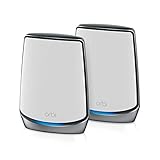
NETGEAR Orbi RBK852
- AX6000 tri-band WiFi 6
- Dedicated backhaul band
- Up to 5000 sq. ft. and 100 devices

NETGEAR Orbi RBK752
- AX4200 tri-band WiFi 6
- Up to 5000 sq. ft. and 40 devices
- 3 Gigabit ports on the router
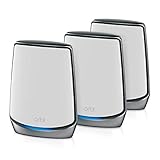
NETGEAR Orbi RBK853
- Router plus 2 satellites
- Up to 7500 sq. ft. and 100 devices
- 2.5 Gigabit Ethernet
Orbi Mesh Systems Compared Side by Side in 2026
Every kit below is a complete system, not a single add-on satellite. The table is the fastest way to see how generation, band count and coverage claims line up before you read the individual verdicts.
| Product | Specifications | Action |
|---|---|---|
| NETGEAR Orbi RBK852 Tri-Band WiFi 6 |
|
Check Latest Price |
 NETGEAR Orbi RBK13 Dual-Band WiFi 5 NETGEAR Orbi RBK13 Dual-Band WiFi 5 |
|
Check Latest Price |
| NETGEAR Orbi RBK752 Tri-Band WiFi 6 |
|
Check Latest Price |
| NETGEAR Orbi RBK853 Tri-Band WiFi 6 |
|
Check Latest Price |
 NETGEAR Orbi RBKE963 Quad-Band WiFi 6E NETGEAR Orbi RBKE963 Quad-Band WiFi 6E |
|
Check Latest Price |
 NETGEAR Orbi 970 Quad-Band WiFi 7 NETGEAR Orbi 970 Quad-Band WiFi 7 |
|
Check Latest Price |
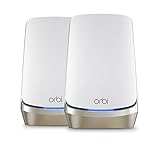 NETGEAR Orbi RBKE962 Quad-Band WiFi 6E NETGEAR Orbi RBKE962 Quad-Band WiFi 6E |
|
Check Latest Price |
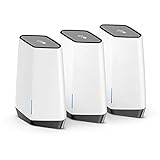 NETGEAR Orbi Pro SXK80B3 Tri-Band WiFi 6 NETGEAR Orbi Pro SXK80B3 Tri-Band WiFi 6 |
|
Check Latest Price |
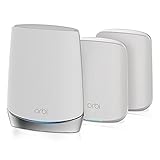 NETGEAR Orbi RBK653 Tri-Band WiFi 6 Renewed NETGEAR Orbi RBK653 Tri-Band WiFi 6 Renewed |
|
Check Latest Price |
1. NETGEAR Orbi RBK852 – The Best Orbi Mesh System Overall
NETGEAR Orbi Whole Home Tri-Band WiFi 6 Mesh Network System (RBK852) – Router with 1 Satellite Extender -Security Features – Coverage Up to 5,000 sq. ft., 100 Devices – AX6000 (Up to 6Gbps)
AX6000 tri-band WiFi 6
Up to 6 Gbps
5000 sq. ft. and 100 devices
Router plus 1 satellite
Pros
- Dedicated tri-band backhaul keeps satellites fast
- Coverage for 5000 sq. ft. and up to 100 devices
- 4 Gigabit Ethernet ports on router and satellite
- Large pool of long-term owner reviews
Cons
- Orbi app-only management frustrates power users
- Setup can stall until firmware is updated
- NETGEAR Armor is a paid subscription after the trial
- Tall bulky chassis
The RBK852 is the box I recommend when someone asks for one Orbi system and nothing more. It is AX6000 tri-band WiFi 6, which means two client bands plus one band reserved for backhaul, and that reserved band is the entire reason it behaves like a single network rather than three overlapping ones.
In the box you get an RBR850 router and an RBS850 satellite, along with a 2m Ethernet cable and two power adapters. Netgear rates coverage at up to 5000 sq. ft. for up to 100 devices, and each extra satellite you add later is credited with another 2500 sq. ft. Each unit weighs 2.9 pounds and measures 7.5 by 2.8 by 10 inches, so plan shelf space rather than a tucked-away corner.
What convinced me is the review pool, not the spec sheet. At 4.3 stars from 3441 reviews it has one of the longest ownership records of any kit here, and owners regularly report gigabit-class speeds close to a node and 400-650 Mbps at distance on gigabit service. That is a realistic number for a dedicated backhaul band, not the theoretical 6 Gbps headline.
Setup is app-driven, and the app is where the grumbling comes from. Advanced settings live in the browser interface rather than the phone app, and a share of buyers report setup stalling until both the router and satellite are updated, sometimes with a call to support to finish the job.
The subscription question comes up in nearly every long review. NETGEAR Armor ships with a 30-day trial and then becomes a paid security service that installs Bitdefender on client devices, which some owners treat as a reason to decline it outright rather than a reason to renew.
There is also a size issue worth naming early. These are tall white towers, not small boxes, and each one needs open airflow on more than one side. In a tight media cabinet the 10-inch chassis is the first thing that causes trouble.
What you get in a 2000 to 3500 sq ft home?
This is the sweet spot for the RBK852. In a two or three storey home it covers the main floor and one upper level cleanly, and the single included satellite can sit at the base of the stairs to cover a second floor with 40 to 100 connected devices.
It suits gigabit and faster plans. Each unit carries 4 Gigabit Ethernet ports, so a wired desktop, a couple of game consoles and a TV can all be plugged in rather than competing for wireless spectrum, and Netgear rates the kit as compatible with ISPs up to 2.5 Gbps.
Where the RBK852 falls short?
It is Wi-Fi 6, not Wi-Fi 6E or Wi-Fi 7, so newer phones and laptops get no 6 GHz headroom. If every device in your house supports Wi-Fi 6E you are leaving a band unused.
The warranty is one year, there is no multi-gig port above Gigabit, and management lives in the Orbi app. None of that is disqualifying, but buyers who want browser-level control or a longer warranty should look at the Orbi Pro kit instead.
2. NETGEAR Orbi RBK13 – Best Budget Coverage for Small Homes
NETGEAR Orbi Whole Home Mesh WiFi System (RBK13) – Router Replacement Covers up to 4,500 sq. ft. with 1 Router & 2 Satellites
AC1200 dual-band WiFi 5
Up to 1.2 Gbps
4500 sq. ft.
Router plus 2 satellites
Pros
- Cheapest way to cover a whole home with one network
- Three boxes in the kit for the money
- Two satellites included in the box
- Simple app-based setup
Cons
- WiFi 5 speed bottlenecks gigabit service
- Only one Gigabit Ethernet port in the kit
- Weaker through dense walls than tri-band kits
The RBK13 is the reason mesh exists as a category. It is a dual-band Wi-Fi 5 box with 1.2 Gbps of aggregate throughput, and for a family that just wants the dead zones gone, it does that job better than almost anything else at the entry level.
You get an RBR10 router and two RBS10 satellites, which is unusual at this tier. Three boxes means you can cover a ground floor and two upper rooms without buying anything else, and Netgear claims up to 4500 sq. ft. across the set.
The 4.3-star rating from 3374 reviews reflects exactly that bargain. Buyers treat it as a way to replace a pile of range extenders, and the roaming between the three boxes is reported as smooth once set up.
The processing is modest by design: a quad-core 710MHz processor with beamforming on both the 2.4 GHz and 5 GHz bands. That is plenty for browsing and streaming, and it is the first place you feel the age of the platform.
Only one Gigabit Ethernet port is included in the kit, so wired devices compete for a single socket. In a home office or a living room with a console, a smart TV and a printer, that runs out quickly.
Security features are included as 30-day trials for NETGEAR Armor and Smart Parental Controls, so you can try them before deciding. Setup is app-based and described as straightforward.
Who should actually buy the RBK13?
Apartment or small house dwellers on a sub-500 Mbps plan with 15 to 25 devices. You get one network name across every room, and you will not be leaving usable speed on the table.
It also works as a cheap extender replacement in a home where the wiring is a nightmare. Three boxes, one network, no cable runs.
Who should skip it?
If your plan is gigabit or faster, AC1200 will not keep up. Owners on gigabit service report the kit capping out well below the line rate, and a Wi-Fi 6 tri-band kit costs a modest amount more for a large jump.
Devices that need lots of Ethernet ports are also a poor fit. One port means a switch, which defeats part of the plug-and-play simplicity.
3. NETGEAR Orbi RBK752 – Best Value Tri-Band WiFi 6
NETGEAR Orbi Whole Home Tri-Band Mesh WiFi 6 System (RBK752) – Router with 1 Satellite Extender | Coverage up to 5,000 sq. ft., 40 Devices | AX4200 (Up to 4.2Gbps)
AX4200 tri-band WiFi 6
Up to 4.2 Gbps
5000 sq. ft. and 40 devices
Wired backhaul support
Pros
- Dedicated backhaul band at a lower spec tier
- Covers 2000 to 3000 sq. ft. with the included pair
- Supports wired backhaul on the satellite
- Strong 4.3-star record from 3261 reviews
Cons
- Occasional satellite drops reported
- Firmware mismatch can slow the system until updated
- No VPN server feature
It keeps the thing that matters most, a dedicated backhaul band, and trims elsewhere.
It is AX4200 tri-band Wi-Fi 6, rated up to 4.2 Gbps across a 2.4 GHz band and two 5 GHz bands, one of which is dedicated to backhaul. The box holds an RBR750 router and an RBS750 satellite, and Netgear rates the pair at up to 5000 sq. ft. and 40 devices.
Several owners report replacing it with a previous mesh kit and seeing an immediate improvement, and the 4.3-star average from 3261 reviews matches the RBK852 closely on satisfaction at a lower specification.
The satellite accepts a wired backhaul connection, which is a genuinely useful feature. If you can run one cable to a hallway or a second-floor landing, that node stops sharing wireless spectrum and its clients get much closer to line rate.
Wired and wireless are not the same here, though. The router carries 3 Gigabit Ethernet ports and the satellite carries 2, so the wired device count is modest compared with the 850-series kits.
The recurring negative in reviews is firmware. Owners who updated only the router, or only the satellite, saw poor performance until both were current, and a smaller group report satellite disconnects that need a reboot or a reconnect.
The 40-device ceiling explained
The 40-device figure is not a hard limit, it is a tested target. It covers a typical family home with phones, laptops, a few TVs, cameras and smart plugs, and you can add satellites to go further.
For a 2000 to 3000 sq. ft. home on a plan up to around 1 Gbps, this is the sweet spot. You keep the dedicated backhaul and lose very little real-world speed compared with the AX6000 kits.
Where it loses to the RBK852?
AX4200 versus AX6000 means less client throughput when many devices stream at once, and 4 Gigabit ports per unit becomes 3 on the router and 2 on the satellite. If you regularly run four 4K streams plus downloads, the RBK852 holds up better.
There is also no VPN server feature, which some buyers treat as a real gap for a home office or a small shop.
4. NETGEAR Orbi RBK853 – Best for Large Homes up to 7500 Sq Ft
NETGEAR Orbi Whole Home Tri-Band WiFi 6 Mesh Network System (RBK853) – Router with 2 Satellite Extenders, Security Features, Coverage Up to 7,500 Square Feet, 100 Devices, AX6000 (Up to 6Gbps)
AX6000 tri-band WiFi 6
Up to 6 Gbps
7500 sq. ft. and 100 devices
Router plus 2 satellites
Pros
- Three boxes cover a very large home in one network
- Users report 700 to 960 Mbps on fiber and cable
- 2.5 Gigabit Ethernet for local wired traffic
- 850-series app is better than older software
Cons
- Browser interface is slow and stripped of options
- Daily dropouts reported by a minority of owners
- Setup walkthrough is minimal
The RBK853 is the RBK852 with a second satellite in the box. That single difference changes who it is for: this is the large-home kit, rated at up to 7500 sq. ft. for 100 devices, with each added satellite credited with another 2500 sq. ft.
You get an RBR850 router and two RBS850 satellites, all AX6000 tri-band Wi-Fi 6 at up to 6 Gbps. Netgear rates it for ISPs up to 2.5 Gbps, and the LAN side includes 2.5 Gigabit Ethernet alongside the four Gigabit ports.
That 2.5 Gigabit port matters more than the headline suggests. On a gigabit fiber or cable line, wired clients on a wired backhaul routinely exceed 1 Gbps, and several owners report 700 to 960 Mbps on wireless clients elsewhere in the house.
Reviewers consistently describe this as a step up from the older 750-series, and the app is widely regarded as more stable. Remote monitoring and per-device control work as advertised for most people.
The criticism is aimed at the software rather than the radio. The browser interface is reported as slow and stripped of options compared with first-generation Orbi, and support beyond the trial period is limited or paid.
A minority of owners report dropped connections several times a day that need a reboot, and a few report Ethernet port failures. At 4.2 stars from 1283 reviews, this kit has slightly more friction in its reviews than the RBK852.
How many rooms you can realistically cover?
Three boxes handles a 3000 to 5000 sq. ft. home with a basement, or a four-storey townhouse where the stairs block signal. The two satellites are normally placed one per floor, on the same channel plan as the router.
For a home with a lot of wired devices, the 2.5 Gigabit port plus four Gigabit ports per node is the reason to pick this over the RBK852 at the same Wi-Fi generation.
Where it disappoints?
If your home is under 2500 sq. ft., two satellites are more than you need and you would be better served by the cheaper two-box kit. Coverage claims assume open, unobstructed floor plans.
The one-year warranty and the option-stripped web interface are the two things to weigh. Buyers who need advanced controls or a longer support commitment are better served by the Orbi Pro system.
5. NETGEAR Orbi RBKE963 – Most Versatile for Large Smart Homes
NETGEAR Orbi Quad-Band WiFi 6E Mesh Network System (RBKE963), Router + 2 Satellite Extenders, Security Features, Up to 10.8 Gbps, Coverage up to 9,000 sq. ft., 200 Devices, 10 Gig Internet Port
Quad-band WiFi 6E
Up to 10.8 Gbps
9000 sq. ft. and 200 devices
10 Gig internet port
Pros
- 10 Gig internet port for very fast fiber
- 6 GHz band serves WiFi 6E devices directly
- 200-device capacity suits large smart homes
- Wired backhaul support
Cons
- Satellites need manual re-pairing after a power cut
- Some owners report repeat disconnections
- Support path is slow and pushes paid plans
The RBKE963 is the first Orbi kit on this list with a 6 GHz band and a 10 Gig internet port. It is a quad-band Wi-Fi 6E system rated up to 10.8 Gbps, and that combination changes who the hardware is for.
The box holds an RBRE960 router and two RBSE960 satellites. Netgear rates coverage at up to 9000 sq. ft. for 200 devices, including front and back yard, and lists dedicated backhaul Wi-Fi alongside the 10 Gig port for fiber or cable service up to 10 Gbps.
Owners on gigabit fiber and cable report 600 to 950 Mbps on wireless clients, and wired clients exceed 1 Gbps on a wired backhaul. The 4.1-star average from 652 reviews is the lowest of the well-reviewed kits here, and the reason is stability rather than speed.
The most reported problem is recovery after a power event. Satellites do not self-heal after a breaker trip or an outage in some setups and have to be re-paired by hand, which is exactly the moment you least want to be troubleshooting at night.
Support is the other theme. Reviews describe long calls, upsells to paid support plans and slow callbacks, which matters more for this kit than for cheaper ones because you are paying for the ports and the band.
On the plus side, the app supports remote monitoring and control, and automatic firmware updates are built in, so security patches arrive without a manual step.
Best fit: 10 Gbps fiber with many devices
If your plan is multi-gig fiber and you run cameras, doorbells, a dozen smart devices and several 4K streams, the 10 Gig port and 200-device capacity line up with the load. The 6 GHz band also feeds newer phones and laptops their own clean spectrum.
It is also the first Orbi system we would consider for a home office running a VPN server or heavy local file transfers, because 2.5 and 10 Gigabit Ethernet are present.
Where it is not the answer?
On a plan of 1 Gbps or less, the extra bands and the 10 Gig port are mostly wasted. The RBK853 covers the same square footage at a lower spec for less money.
It is also a poor match for anyone who will not open a browser portal. The setup path and the recovery-after-outage behaviour both expect some patience.
6. NETGEAR Orbi 970 Quad-Band WiFi 7 – Best for 10 Gig Fiber
NETGEAR Orbi 970 Series Quad-Band WiFi 7 Mesh Network System (RBE973S), Router + 2 Satellite Extenders, Security Features, Up to 27Gbps, Covers Up to 10,000 sq. ft., 200 Devices, 10 Gig Internet Port
Quad-band WiFi 7
Up to 27 Gbps
10000 sq. ft. and 200 devices
10 Gig internet port
Pros
- Highest aggregate speed in the Orbi range
- Enhanced Dedicated Backhaul on quad-band radios
- Largest coverage claim at 10000 sq. ft.
- Backwards compatible with older Wi-Fi devices
Cons
- Lowest average rating here at 3.6 stars
- Multi-Gig port and configuration difficulties reported
- Support window is only 90 days
The Orbi 970 is the flagship and the only Wi-Fi 7 kit in this roundup. It is a quad-band system rated up to 27 Gbps, with a 10 Gig internet port, Enhanced Dedicated Backhaul and a coverage claim of up to 10000 sq. ft. for 200 devices.
The RBE973S package contains an RBE971 router and two RBE970 satellites, a 2m Ethernet cable and three power adapters. It also carries 4 GB of RAM and WPA2 or WPA3 security, and it is fully backwards compatible with older Wi-Fi devices, so your current phones and laptops are fine.
Then the honest part. At 3.6 stars from 409 reviews, this is the lowest-rated product here, with roughly a quarter of reviews at one star. The complaints cluster around multi-Gig port behaviour and configuration rather than raw throughput.
Several owners report ports that do not deliver the expected throughput, and more report difficulty getting the configuration right in the first place. On hardware this capable, that is an unusual complaint and it is worth reading the one-star reviews before buying.
Support is the sharpest edge. The warranty terms give 90 days of complimentary technical support and a limited manufacturer warranty, the shortest window of any kit in this roundup.
Advanced Router Protection and automatic firmware updates are included, and the quad-band radios are patented, which is what allows the enhanced backhaul link to stay fast with many concurrent devices.
Who should pay for the Orbi 970?
Homes on 10 Gbps fiber where the internet line genuinely exceeds 1 Gbps, with many Wi-Fi 7 devices in the household. That is a narrow group, and inside it this kit is hard to argue with on paper.
Large properties also benefit, because 10000 sq. ft. and 200 devices is the largest capacity claim in the range and the Enhanced Dedicated Backhaul is designed for busy multi-device homes.
Who should not?
Almost everyone else. On a 1 Gbps plan the speed difference will not reach your devices, and the 3.6-star average and 90-day support window make it a riskier purchase than the RBK852 or RBK853.
Owners who value set-and-forget stability should read the disconnection complaints first, because raw speed was never the problem with this kit.
7. NETGEAR Orbi RBKE962 – Best Mid-Size Step Into Wi-Fi 6E
NETGEAR Orbi Quad-Band WiFi 6E Mesh System (RBKE962), Router + 1 Satellite Extender, Security Features, Up to 10.8 Gbps Speed, Coverage up to 6,000 sq. ft, 200 Devices, 10 Gig Internet Port
Quad-band WiFi 6E
Up to 10.8 Gbps
6000 sq. ft. and 200 devices
10 Gig internet port
Pros
- 6 GHz band and 10 Gig port in a smaller package
- Dedicated backhaul between router and satellite
- Same 200-device capacity as the larger kit
- Covers up to 6000 sq. ft.
Cons
- Only 110 reviews means a thin long-term record
- One satellite covers less ground than a two-box kit
The RBKE962 is the two-box version of the 960 series. It keeps the same quad-band Wi-Fi 6E platform and the same 10 Gig internet port as the larger kit, with one router and one satellite instead of two satellites.
Aggregate speed is rated up to 10.8 Gbps, and coverage up to 6000 sq. ft. for 200 devices including front and back yard. The 6 GHz band gives Wi-Fi 6E clients their own throughput rather than sharing the 5 GHz space.
It is the more sensible pick for a medium home on a fast plan. The RBKE963 adds a satellite you may not need, and the price difference buys coverage you will not use.
The 4.2-star rating looks good, but 110 reviews is a small pool compared with the thousands behind the older kits. The track record is thinner, so you are buying on the platform reputation rather than on years of feedback.
Dedicated backhaul between the router and the single satellite keeps speed high across the link, which is the feature that matters most in a two-box layout. Wired backhaul is also supported for hard-to-reach areas.
Security is WPA3 with automatic firmware updates, and the kit is managed through the Orbi app rather than a separate utility.
A good fit for 1500 to 3000 sq ft homes
This is the size where two boxes genuinely cover the property, so you are not paying for a third node to fill a room that already has signal. It suits a two-storey home with a 1 Gbps or faster plan.
If most of your devices are recent phones and laptops, the 6 GHz band is a real advantage over a Wi-Fi 6 tri-band kit, and the 10 Gig port future-proofs a faster line.
Where the limits are?
A single satellite cannot match two for very large or awkward floor plans. If you have 4000 sq. ft. or more across three floors, step up to the RBKE963 or the RBK853.
The smaller review base is the quiet risk. There is no long ownership history to fall back on if firmware or satellite pairing misbehaves.
8. NETGEAR Orbi Pro SXK80B3 – Best for Small Business and VLAN Users
NETGEAR Orbi Pro WiFi 6 Tri-Band Mesh System for Business or Home (SXK80B3) – Router with 2 Satellite Extenders | 4 SSIDs, VLAN, QoS | Coverage up to 9,000 sq. ft., 80 Devices | AX6000 (Up to 6Gbps)
AX6000 tri-band WiFi 6
Up to 6 Gbps
4 separate SSIDs and VLAN
9000 sq. ft. and 80 devices
Pros
- Four separate SSIDs plus VLAN support
- 5-year warranty is the longest in the range
- Wall mounts included for router and satellites
- Strong throughput on wired and wireless clients
Cons
- Apps frequently fail during setup
- Node dropouts reported by some owners
- Not aimed at everyday consumers
The Orbi Pro SXK80B3 is the odd one out in this roundup because it is built for a small office rather than a living room. It runs AX6000 tri-band Wi-Fi 6 at up to 6 Gbps and, crucially, supports up to four separate SSIDs with VLAN support and QoS.
That means staff, guests, home devices and IoT gear can each sit on their own network on the same hardware, which is the single feature that makes it worth the premium. Coverage is rated up to 9000 sq. ft. for 80 devices, and the box includes an SXR80 router, two SXS80 satellites and three wall mounts.
The 5-year limited warranty is the longest of any kit here, and several users report throughput matching their full ISP bandwidth on both wired and wireless clients. At 3.9 stars from 91 reviews, the sample is small, so treat that as promising rather than proven.
Why a business might choose it?
Four isolated SSIDs with VLAN support and QoS is the headline. Guest devices and IoT gear can be quarantined from work devices without a second access point, and traffic can be prioritised.
Seamless roaming between floors with no bandwidth drop is the real upgrade over repeaters, and the included wall mounts make a proper install straightforward. A small office, a clinic waiting room or a home with heavy guest traffic all fit.
Why consumers are better served elsewhere?
Reviews are blunt about setup: the Netgear apps frequently fail during configuration, forcing you through the web portal and native firmware. That is a poor first impression for a general household.
Some owners also report worse range and roaming than older, cheaper Orbi generations, and granular parental-control scheduling and traffic monitoring are limited. Unless you need the VLAN and multi-SSID features, a standard Orbi kit does the same job more simply.
9. NETGEAR Orbi RBK653 – Best for Renewed-Unit Savings
NETGEAR Orbi Whole Home Tri-Band Mesh WiFi 6 System (RBK653) – Router with 2 Satellite Extenders, Coverage Up to 6,000 Square Feet, 40 Devices, AX3000 (Up to 3Gbps) (Renewed)
AX3000 tri-band WiFi 6
Up to 3 Gbps
6000 sq. ft. and 40 devices
90-day limited warranty
Pros
- Much cheaper than new tri-band WiFi 6 kits
- Three boxes cover a medium home
- Tri-band dedicated backhaul stabilises streaming
- Renewed units generally arrive working
Cons
- Renewed condition with a 90-day warranty
- AX3000 is the slowest WiFi 6 Orbi tier
- Thin review base for long-term confidence
The RBK653 is Orbi’s entry Wi-Fi 6 tri-band kit, and this listing is a renewed unit sold through Amazon Renewed. It is AX3000, rated up to 3 Gbps across three bands, with one band dedicated to backhaul.
The package is a router plus two satellites, rated up to 6000 sq. ft. for 40 devices. The router carries 3 Gigabit Ethernet ports and each satellite carries 2, and each extra satellite is credited with another 1750 sq. ft. of coverage.
The appeal is arithmetic. Tri-band dedicated backhaul in a three-box package is the feature that fixes dead zones, and getting it without paying new-unit money is the reason to consider this at all.
Owners of renewed units generally report hardware arriving in good working condition, and the 4.3-star average from 71 reviews reflects solid performance rather than any issue with the hardware itself.
What you give up is protection. The warranty is 90 days rather than a year, so a failure in month four is on you, and the smaller review base gives you less evidence about long-term reliability.
There is a second limit worth understanding. AX3000 is the slowest Wi-Fi 6 tier Orbi sells, so on a fast plan it can become the bottleneck rather than the fix.
When a renewed Orbi makes sense?
A 2000 to 3000 sq. ft. home on a plan up to about 500 Mbps, where the priority is coverage and a single network name rather than speed. Three boxes at this tier is a lot of coverage per unit.
It also suits a rental or a house where running cable between floors is not realistic, since all three boxes work wirelessly out of the box.
When a new kit is the better call?
If you are on gigabit service, buy new. The AX3000 tier will not deliver line rate, and the 90-day warranty adds risk to hardware that sits in a ceiling or a closet where access is awkward.
Buyers who want a longer support relationship and a cleaner warranty trail should also look at a new Wi-Fi 6 kit, where the extra cost buys a year of cover and a larger review history.
How to Choose an Orbi Mesh System in 2026?
Most wrong purchases come from matching a kit to a spec sheet instead of to a house. Work through the four questions below in order and the model almost picks itself.
How many Orbi nodes your home needs?
Netgear credits each additional satellite with roughly 1750 to 2500 sq. ft., depending on the series, and coverage claims assume an open floor plan. Under 1200 sq. ft. on one floor, a single strong router is usually enough and mesh is overkill.
From 1200 to 2500 sq. ft. or any home with a second storey, two boxes generally do it, which points at the RBK13, the RBK752 or the RBKE962. From 2500 to 4000 sq. ft. with three floors, three boxes such as the RBK853 or the RBK653 cover you well. Above 4000 sq. ft. with thick walls or a basement, the quad-band RBKE963 and Orbi 970 earn their extra radios.
Two rules that come up constantly in owner threads: keep the wireless hops to one, and no more than two. A fourth node chained to a third in the far corner will give you signal without usable speed. Our guides to mesh systems for multi-story homes and to mesh for three-storey houses expand on placement.
Wired backhaul versus wireless backhaul
Backhaul is the link between the router and each netnode, and it is the ceiling on how fast a satellite can serve its own clients. On a tri-band or quad-band kit one radio is reserved for it, so wireless backhaul is close to full speed, though never quite.
A wired backhaul connection removes that ceiling entirely, because the node is fed by cable rather than by radio. On a gigabit line, wired clients on a wired-backhaul node routinely exceed 1 Gbps. Every kit in this roundup supports wired backhaul on the satellite, but the RBKE963 and Orbi 970 also give you multi-gig ports, so a multi-gig cable connection is worth the extra effort on those.
If you can run one cable per floor, do it. If you cannot, a dedicated backhaul band is the next best thing, which is why the dual-band RBK13 is the one kit here where we think band count matters most.
Which Wi-Fi generation actually matters?
Wi-Fi 6, or 802.11ax, is what most of these kits deliver and it is still the sensible target for a gigabit plan. Wi-Fi 6E adds a 6 GHz band, which gives newer phones and laptops clean spectrum and is worth having on a fast connection in a crowded neighbourhood.
Wi-Fi 7, or 802.11be, brings wider channels and multi-link operation. The practical benefit is smaller than the aggregate numbers suggest, because those numbers sum every band together and no single client sees them. Compare BE11000 or BE21000 against AX6000 as a class difference, not as a tenfold speed difference.
Decoding Orbi model numbers
RBK means a kit, so RBK752 and RBK853 each contain a router plus satellites. RBR is a router on its own, RBS and RBE are satellites, and the trailing digits are generation codes rather than speed codes. That is why comparing an RBR50 to an Orbi 370, a very common question, compares an older standalone router against a complete current kit.
Series names are easier than part numbers. The 850 and 750 families are Wi-Fi 6 tri-band, the 960 family is quad-band Wi-Fi 6E, and the 970 is quad-band Wi-Fi 7. Orbi Pro uses the SXK prefix and is the business line.
Common Orbi problems and what helps
Owners report three things far more often than anything else. First, random client disconnects, sometimes several a day, usually traced to a node losing its link rather than the internet dropping. Checking for the latest firmware on every node, and power-cycling the router first, resolves a large share of cases.
Second, devices bouncing between netnodes during a call or a stream. Moving a satellite closer to the router reduces the overlap area and makes the handoff cleaner, and owners who report the best results tend to have one hop, not a chain.
Third, satellite nodes that do not re-pair after a power cut. On the quad-band kits this is a recurring review theme, so budget five minutes at the outlet after an outage rather than assuming the system is broken. If you run a home office over this link, our mesh picks for reliable video conferencing go deeper on the stability question.
Do you even need mesh?
If you live in a flat under about 1200 sq. ft. on a fast plan, a single modern router will beat a mesh system, because you remove the backhaul hop entirely. Mesh earns its place in larger homes, in buildings with concrete or brick, and anywhere a dead zone is a daily annoyance.
It is also worth being honest about the subscription model. The core router, the satellites and the parental controls work without paying for NETGEAR Armor. You are not locked in, but you will be prompted to start a trial, and long reviews mention the recurring cost as a reason some owners moved to a different brand.
Frequently Asked Questions
Which is the best Orbi mesh system?
The NETGEAR Orbi RBK852 is the best all-round Orbi system for most homes. It is AX6000 tri-band Wi-Fi 6 with a dedicated backhaul band, rated for up to 5000 sq. ft. and 100 devices, and it holds a 4.3-star rating across 3441 reviews. Choose the RBK752 for the same tri-band layout at a lower specification, the RBKE963 for 6 GHz and a 10 Gig port, and the Orbi 970 for 10 Gbps fiber.
Can Orbi use Ethernet backhaul?
Yes. Every Orbi kit in this roundup accepts a wired Ethernet connection between the router and a satellite. Plug one end into a LAN port on the router and the other into a satellite, and the node uses the cable instead of its wireless link. That removes the backhaul ceiling, so clients on that satellite can exceed 1 Gbps on a gigabit line. On the RBKE963 and Orbi 970 you can use a 2.5 or 10 Gigabit port for an even faster wired link.
What are the common problems with Orbi routers?
Three issues come up repeatedly in owner feedback. Random client disconnects, sometimes several times a day, usually traced to a node losing its wireless link rather than the internet dropping; updating the firmware on the router and every satellite resolves many cases. Devices bouncing between netnodes mid-call, which improves when you shorten the overlap by moving a satellite closer to the router. And satellite nodes that do not re-pair after a power cut on the quad-band kits, which needs a manual re-pair. App-only management is a fourth, less serious complaint.
Is Orbi a good mesh system?
Orbi is a good mesh system for medium to large homes, and the dedicated backhaul band is what separates it from cheaper dual-band kits. The trade-offs are management in the Orbi app rather than a full browser interface, a one-year warranty on most models, and a 30-day trial of NETGEAR Armor that becomes a paid security subscription. The core routing, roaming and parental controls work without paying for that subscription.
What is the life expectancy of an Orbi router?
A well-supported Orbi system commonly runs five years or more before a replacement is needed, and owners of older dual-band hardware report long trouble-free records on that timescale. Expect to replace sooner if you upgrade your internet plan to multi-gig, since Gigabit-only ports become the bottleneck, or if your phone and laptop upgrades push you toward Wi-Fi 6E or Wi-Fi 7. The 850-series kits are a common upgrade path from much older systems, and you can keep existing Orbi nodes in the same network while you transition.
The Best Orbi Mesh System in 2026: Our Final Word
For a typical family home of 2000 to 3500 sq. ft. on a plan up to about 1 Gbps, the Orbi RBK852 is the pick. It has the best combination of rating, review history and dedicated backhaul of anything in this roundup, and the three-box RBK853 covers it when you need more ground.
Go cheaper with the RBK752 for a mid-size home on a moderate plan, or the RBK13 if the only goal is killing dead zones on a small plan. Go wider with the RBKE963 for a large smart home or multi-gig service, and treat the Orbi 970 as a specialist choice for 10 Gbps fiber rather than a default one.
Whichever you choose, buy the box count your floor plan needs and no more, keep the hops to one where you can, and plug in Ethernet wherever a cable is available. If you are still torn between models, our picks for mesh systems for large homes go deeper on the coverage maths.