
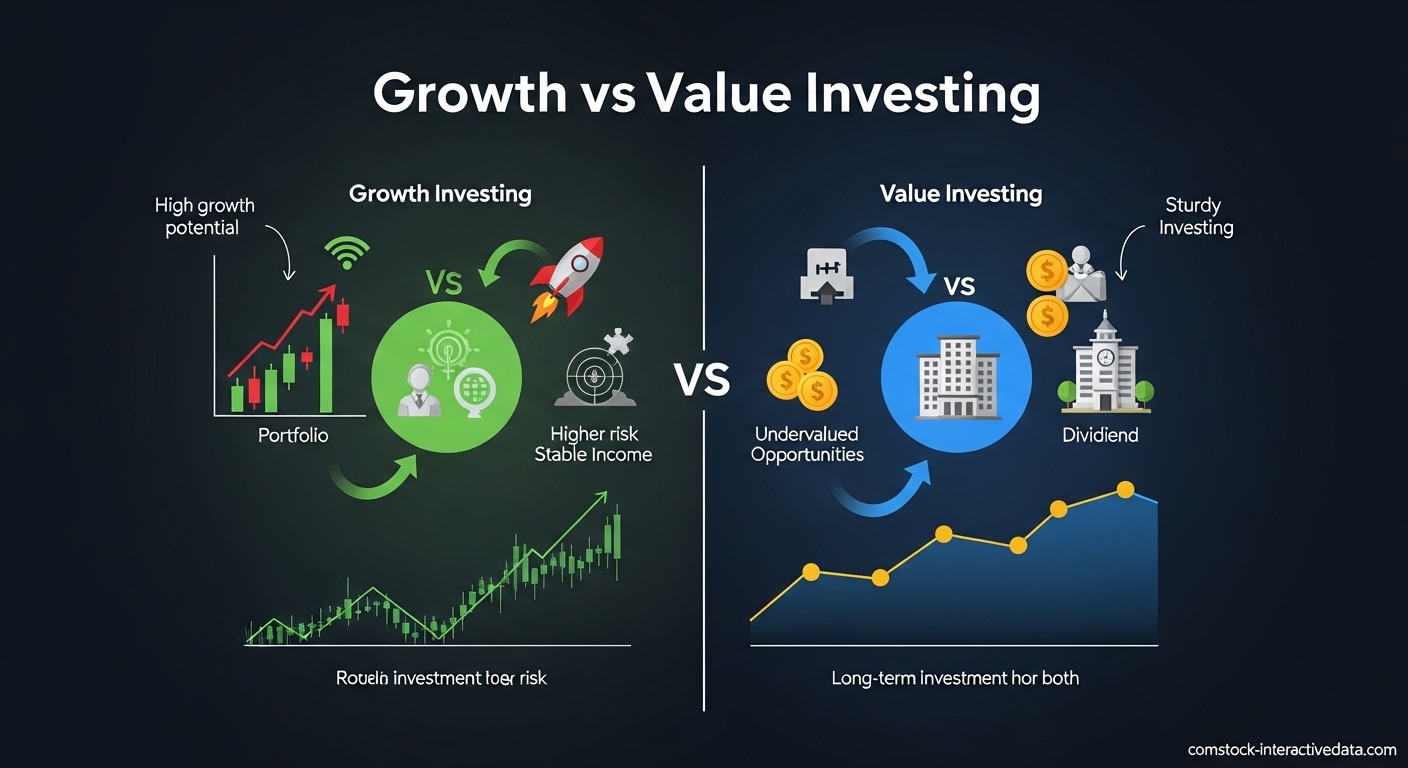
Growth investing vs value investing represents two fundamentally different approaches to building wealth in the stock market. Growth investing targets companies expected to grow faster than the overall market, while value investing focuses on stocks trading below their intrinsic worth. Understanding these differences helps you align your investment strategy with your personal risk tolerance, financial goals, and the current market environment.
In this guide, I will break down exactly how these strategies differ, when each performs best, and how to choose the right approach for your portfolio. Whether you are just starting your investment journey or looking to refine your existing strategy, this comparison will give you the clarity you need to make informed decisions.
Table of Contents
What Is Growth Investing?
Growth investing focuses on companies expected to grow revenues and earnings at an above-average rate compared to the broader market. These companies typically reinvest most or all of their profits back into the business to fuel expansion, rather than paying dividends to shareholders. Investors buy growth stocks expecting future price appreciation based on the company’s increasing fundamentals.
The core philosophy behind growth investing centers on identifying tomorrow’s market leaders today. Investors prioritize companies with strong competitive advantages, innovative products, and expanding market share. The strategy accepts paying higher valuations today in exchange for potentially superior returns tomorrow.
Key Characteristics of Growth Stocks
Growth stocks share several defining traits that distinguish them from the broader market. These companies typically show revenue growth rates of 15% or higher annually, often outpacing their industry peers significantly. They maintain high price-to-earnings ratios, frequently trading at 25x earnings or more, reflecting investor optimism about future growth.
Most growth companies reinvest retained earnings into research and development, expansion, or acquisitions rather than distributing cash to shareholders. You will find them concentrated in technology, consumer discretionary, healthcare, and communication services sectors. Their stock prices tend to be more volatile, with higher beta values that amplify market movements both up and down.
Where to Find Growth Stocks?
Technology companies dominate the growth investing landscape, with firms like NVIDIA, Tesla, and Amazon representing classic examples. Healthcare innovators, particularly in biotechnology and medical devices, also offer compelling growth opportunities. Consumer discretionary companies that tap into emerging trends frequently appear in growth portfolios.
Small-cap and mid-cap stocks often provide the highest growth potential, though they carry greater risk. International markets, particularly emerging economies, can offer growth opportunities unavailable in domestic markets. Exchange-traded funds focused on growth stocks provide diversified exposure without requiring individual stock selection.
What Is Value Investing?
Value investing involves buying stocks that appear underpriced relative to their intrinsic value, based on fundamental analysis. This strategy, pioneered by Benjamin Graham and popularized by Warren Buffett, seeks companies trading below their true worth due to market overreactions, temporary setbacks, or overlooked potential. The approach emphasizes margin of safety and long-term wealth preservation.
Value investors act as bargain hunters in the stock market, searching for quality companies the market has temporarily mispriced. They believe markets are emotional in the short term but rational in the long term, creating opportunities for patient investors. The strategy prioritizes capital preservation while seeking steady, consistent returns.
Key Characteristics of Value Stocks
Value stocks typically trade at low price-to-earnings ratios, often below 15x, and low price-to-book ratios compared to their industry peers. These companies frequently pay dividends, providing income even when stock prices remain flat. You will find established businesses with stable cash flows, mature operations, and predictable earnings patterns.
Most value companies operate in traditional industries like financial services, utilities, consumer staples, industrials, and energy. They often possess strong balance sheets with manageable debt-to-equity ratios and consistent free cash flow generation. Market capitalization tends toward large-cap and mega-cap stocks with proven business models.
How Value Investors Identify Opportunities?
Value investors rely heavily on financial ratio analysis to identify potential investments. They examine price-to-earnings ratios, price-to-book values, and enterprise value relative to earnings before interest, taxes, depreciation, and amortization. Free cash flow analysis helps determine whether a company generates sufficient cash to sustain and grow operations.
Fundamental analysis goes beyond numbers to assess competitive advantages, management quality, and industry positioning. Investors evaluate whether a company’s current troubles are temporary or structural. The goal involves buying dollar bills for fifty cents, then waiting for the market to recognize the true value.
Growth Investing vs Value Investing: Key Differences
Understanding the distinct characteristics separating these strategies helps investors make informed portfolio decisions. The following comparison table summarizes the essential differences between growth and value investing approaches.
| Characteristic | Growth Investing | Value Investing |
|---|---|---|
| Primary Goal | Capital appreciation through price gains | Total return with income and appreciation |
| Valuation Focus | Future earnings potential | Current intrinsic value |
| Typical P/E Ratio | Above 25x earnings | Below 15x earnings |
| Dividend Policy | Low or no dividends | Higher dividend yields common |
| Risk Profile | Higher volatility, greater upside potential | Lower volatility, downside protection |
| Reinvestment Strategy | Retained earnings reinvested in business | Earnings often distributed to shareholders |
| Market Conditions | Outperforms in bull markets and expansions | Outperforms in bear markets and downturns |
| Sector Concentration | Technology, healthcare, consumer discretionary | Financials, utilities, consumer staples, energy |
| Company Stage | Early to mid-stage expansion | Mature, established businesses |
| Time Horizon | Requires patience for growth realization | Requires patience for value recognition |
Valuation Metrics That Matter
Growth and value investors prioritize different financial metrics when evaluating potential investments. Growth investors focus on revenue growth rates, earnings per share growth, return on equity, and market expansion opportunities. They accept premium valuations if the growth trajectory justifies the price.
Value investors emphasize price-to-earnings ratios, price-to-book values, dividend yields, and free cash flow yields. They seek companies trading at discounts to their asset values or normalized earnings power. The margin of safety concept protects against analytical errors or unexpected downturns.
Risk and Return Profiles
Growth stocks offer higher upside potential but come with increased volatility and risk. When growth companies miss expectations, their stock prices can decline sharply. However, successful growth investments can deliver multi-bagger returns that transform portfolio performance.
Value stocks provide more downside protection during market corrections and economic downturns. Their established businesses and tangible assets create floors beneath stock prices. While individual returns may be modest, the compounded effect of dividends and steady appreciation builds wealth reliably over decades.
Historical Performance: Value vs Growth
Historical data reveals a cyclical relationship between growth and value performance that shifts with market conditions. From 1926 through the early 2010s, value stocks delivered superior risk-adjusted returns compared to growth stocks, a phenomenon academics call the value premium. This premium averaged approximately 2-3% annually over extended periods.
However, the past decade has challenged traditional assumptions. From 2010 through 2020, growth stocks significantly outperformed value stocks, driven by technology sector dominance and low interest rate environments. The S&P 500 Growth index delivered annualized returns exceeding 16%, while the S&P 500 Value index returned roughly 12% annually during this period.
Market Cycle Performance Patterns
Growth stocks typically lead during economic expansion phases and bull markets. Low interest rates particularly favor growth companies because future earnings become more valuable when discounted at lower rates. Technology breakthroughs and innovation cycles also drive growth outperformance.
Value stocks historically excel during economic downturns, recessions, and bear markets. Their stable cash flows and dividends provide ballast when markets decline. Rising interest rate environments often benefit value stocks as their current earnings become more attractive relative to distant growth promises.
Interest Rate Impacts
Interest rates significantly influence the relative performance of growth versus value strategies. When rates rise, growth stocks face headwinds as their future earnings get discounted more heavily. Value stocks, with their current earnings and dividends, become relatively more attractive in high-rate environments.
The 2026 interest rate environment continues reshaping historical performance patterns. Investors should monitor Federal Reserve policy and Treasury yields when allocating between growth and value exposures. This dynamic relationship between rates and style performance represents a critical consideration for portfolio construction.
Examples of Growth and Value Stocks
Concrete examples help illustrate the practical differences between growth and value investments. The following stocks represent typical characteristics of each category, though individual classifications can shift as companies evolve.
Prominent Growth Stock Examples
Technology giants dominate growth stock lists. NVIDIA (NVDA) exemplifies growth investing with its explosive revenue expansion in artificial intelligence and data centers. The company reinvests heavily in research while commanding premium valuations based on future potential rather than current earnings.
Amazon (AMZN) spent decades prioritizing market expansion over profitability, classic growth company behavior. Tesla (TSLA) disrupted the automotive industry with innovative technology and maintained high valuations despite traditional auto metrics. Meta Platforms (META) and Alphabet (GOOGL) continue showing growth characteristics despite their massive size.
Healthcare growth names include Moderna (MRNA) and other biotechnology firms with pipeline-dependent valuations. Shopify (SHOP) represents software-as-a-service growth companies expanding rapidly. These stocks trade at elevated P/E ratios because investors price in continued rapid expansion.
Prominent Value Stock Examples
Financial services companies frequently appear in value portfolios. Berkshire Hathaway (BRK.B), Warren Buffett’s conglomerate, owns diverse value-oriented businesses trading below their sum-of-parts valuation. JPMorgan Chase (JPM) and Bank of America (BAC) offer dividend yields and trade at reasonable earnings multiples.
Consumer staples companies like Procter & Gamble (PG), Coca-Cola (KO), and Johnson & Johnson (JNJ) represent defensive value plays. These dividend aristocrats have raised payouts for decades while maintaining stable businesses. Exxon Mobil (XOM) and Chevron (CVX) in the energy sector offer value characteristics with tangible asset backing.
Utility companies such as NextEra Energy (NEE) and Dominion Energy (D) provide income-focused value exposure. Industrial companies like 3M (MMM) and Caterpillar (CAT) occasionally trade at value valuations during cyclical downturns. These established businesses offer downside protection through dividends and asset values.
When Classifications Change
Companies can migrate between growth and value categories as their businesses mature. Microsoft (MSFT) transformed from a pure growth stock into a blend of growth and value characteristics as it matured. Apple (AAPL) similarly evolved, now offering dividends while maintaining growth elements.
Conversely, value stocks experiencing turnarounds can temporarily exhibit growth characteristics. Successful restructuring can transform struggling companies into growth stories. This fluidity requires ongoing portfolio monitoring rather than static categorization.
Which Strategy Is Right for You?
Choosing between growth and value investing requires honest assessment of your personal financial situation, psychological temperament, and investment timeline. Neither strategy is objectively superior; each excels under different conditions and appeals to different investor profiles.
Assessing Your Risk Tolerance
Growth investing suits investors comfortable with volatility and temporary losses. If you can withstand 30-50% portfolio declines without panic selling, growth stocks may fit your temperament. Younger investors with decades until retirement often favor growth for its higher long-term return potential.
Value investing appeals to those prioritizing capital preservation and income. Retirees and conservative investors often prefer value stocks for their dividends and stability. If market volatility causes you significant stress, value’s smoother ride may improve your sleep and prevent emotional decisions.
Time Horizon Considerations
Longer investment horizons favor growth investing because temporary setbacks have time to reverse. Growth stocks may underperform for years before their potential materializes. Investors with ten-year plus timelines can weather the volatility growth stocks deliver.
Shorter horizons or near-term income needs may favor value investing. The dividend payments value stocks provide generate returns even during flat price periods. Value stocks also tend to decline less during market crashes, preserving capital when you need it.
The Blended Approach
Many successful investors combine both strategies rather than choosing exclusively. Core-satellite approaches use index funds as a base with tilted growth or value exposures. GARP (Growth at a Reasonable Price) investing seeks companies with growth potential trading at moderate valuations.
ETFs like Vanguard Growth ETF (VUG) and Vanguard Value ETF (VTV) provide low-cost diversification across each style. Total market funds automatically include both growth and value stocks. Rebalancing between growth and value exposures based on market cycles can enhance risk-adjusted returns.
Frequently Asked Questions
Does value investing beat growth investing?
Historically, value investing has delivered superior risk-adjusted returns over very long periods, with the value premium averaging 2-3% annually from 1926 through the early 2010s. However, growth investing significantly outperformed value during the 2010-2020 decade due to technology sector dominance and low interest rates. Neither strategy consistently beats the other; they alternate leadership based on market cycles, economic conditions, and interest rate environments.
Does Warren Buffett use value investing?
Yes, Warren Buffett is the most famous practitioner of value investing, following principles he learned from Benjamin Graham at Columbia Business School. Buffett’s approach at Berkshire Hathaway emphasizes buying quality companies trading below intrinsic value, maintaining margin of safety, and holding investments for the long term. While he stayed true to value principles, Buffett evolved to focus more on wonderful companies at fair prices rather than just cheap companies.
What is Warren Buffett’s 70/30 rule?
Warren Buffett’s 70/30 rule refers to his estate planning directive for his wife’s inheritance: 90% in low-cost S&P 500 index funds and 10% in short-term government bonds. However, a related interpretation suggests holding 70% in equities and 30% in bonds for conservative long-term investing. Buffett advocates simplicity, low costs, and broad diversification through index funds for most individual investors.
Can a stock be both growth and value?
Yes, stocks can exhibit characteristics of both growth and value simultaneously, often called blended or core stocks. GARP (Growth at a Reasonable Price) investing specifically targets companies with above-average growth rates trading at reasonable valuations. Additionally, companies evolve over time; growth stocks may become value stocks as they mature, and value stocks may show growth characteristics during turnarounds or new product cycles.
How do interest rates affect growth vs value stocks?
Interest rates significantly impact growth and value stock performance differently. Low rates benefit growth stocks because future earnings become more valuable when discounted at lower rates. Rising rates favor value stocks because their current earnings and dividends become relatively more attractive compared to distant growth promises. This dynamic explains much of the growth vs value performance rotation during different Federal Reserve policy cycles.
Conclusion
Growth investing vs value investing offers two proven pathways to building long-term wealth, each with distinct advantages and tradeoffs. Growth investing provides higher upside potential and excels during economic expansions, while value investing offers downside protection, income generation, and historical outperformance over extended periods. Neither approach guarantees success, and both require patience, discipline, and realistic expectations.
The most effective strategy for most investors involves understanding both approaches and potentially blending them based on personal circumstances. Your risk tolerance, time horizon, income needs, and psychological comfort with volatility should drive your allocation between growth and value stocks. In 2026, with changing interest rate environments and evolving market conditions, maintaining flexibility between these styles may prove more valuable than rigidly adhering to either one.