
When I applied for my first mortgage three years ago, I was shocked to see three completely different numbers from Equifax, Experian, and TransUnion. My FICO score ranged from 720 to 745 across the bureaus, and I had no idea why. That confusion led me to spend months researching exactly how credit scores work, what makes up your FICO score, and why lenders care so much about these three-digit numbers.
Your FICO score affects almost every major financial decision in your life. From the interest rate on your mortgage to whether you qualify for that apartment rental, understanding how credit scores work puts you in control of your financial future. In this guide, I will break down exactly what makes up your FICO score, why your scores might differ between credit bureaus, and the common myths that trip people up.
Table of Contents
What Is a FICO Score?
A FICO score is a three-digit number ranging from 300 to 850 that predicts how likely you are to repay borrowed money. The name comes from Fair Isaac Corporation, the company that created this scoring model in 1989. Lenders use your FICO score to assess risk quickly without manually reviewing your entire credit report.
Think of your FICO score as a financial report card summary. While your credit report contains detailed information about every account, payment, and inquiry, your FICO score distills all that data into a single number lenders can use to make instant decisions. Most lenders rely on FICO scores because they have decades of proven accuracy in predicting repayment behavior.
Your FICO score is not the only credit score available, but it dominates the market. According to industry estimates, approximately 90% of top lenders use FICO scores when making lending decisions. When someone mentions their “credit score” in casual conversation, they are almost always referring to their FICO score.
How Credit Scores Work: What Makes Up Your FICO Score
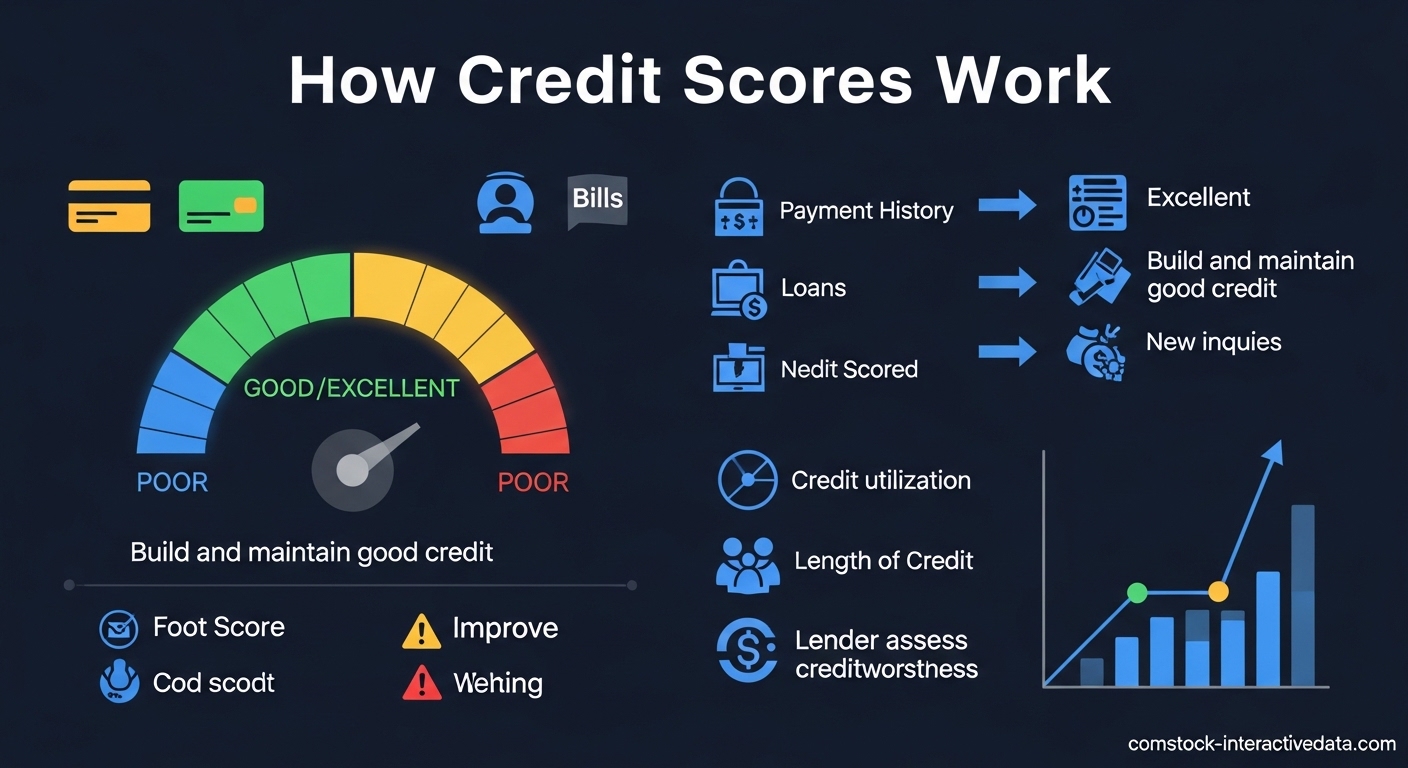
FICO scores are calculated using information from your credit reports at the three major credit bureaus: Equifax, Experian, and TransUnion. The scoring model groups your credit data into five main categories, each weighted by importance. Here is the exact breakdown:
Payment History (35%) – Whether you pay bills on time
Amounts Owed (30%) – How much credit you are using compared to your limits
Length of Credit History (15%) – How long your accounts have been open
Credit Mix (10%) – The variety of credit types you have
New Credit (10%) – Recent credit applications and hard inquiries
These percentages represent how heavily each factor influences your overall score. Payment history and amounts owed together account for 65% of your FICO score, making them by far the most important areas to focus on. The exact impact varies slightly from person to person based on their unique credit history, but these weights provide a reliable framework for understanding scoring priorities.
Payment History (35% of Your Score)
Payment history is the single most important factor in your FICO score, accounting for more than one-third of the total calculation. This category tracks whether you have paid past credit accounts on time, including credit cards, retail accounts, installment loans, finance company accounts, and mortgage loans.
Negative marks in this category include late payments, accounts sent to collections, bankruptcies, foreclosures, wage garnishments, and liens. The severity, recency, and frequency of these issues all matter. A single 30-day late payment from six months ago hurts less than multiple 90-day late payments from last year.
Here is how long negative items typically remain on your credit report:
Late payments: 7 years from the original delinquency date
Collections: 7 years from the date of first delinquency
Bankruptcies (Chapter 13): 7 years
Bankruptcies (Chapter 7): 10 years
Foreclosures: 7 years
Hard inquiries: 2 years (minimal impact after 12 months)
The good news is that positive payment history stays on your report indefinitely. As long as accounts remain open and in good standing, they continue building your payment history track record. This is why keeping old credit cards active, even with minimal use, helps maintain your score over time.
Amounts Owed (30% of Your Score)
The second biggest factor in your FICO score is amounts owed, commonly called credit utilization. This measures how much of your available credit you are currently using. The formula is simple: divide your current credit card balances by your total credit limits, then multiply by 100 to get a percentage.
For example, if you have a $5,000 balance on a card with a $10,000 limit, your utilization is 50%. FICO scoring models look at both your per-card utilization and your overall utilization across all revolving accounts. Both matter, but overall utilization tends to carry slightly more weight.
Most experts recommend keeping your credit utilization under 30% to maintain a healthy score. However, based on forum insights from credit enthusiasts and my own testing, the optimal range appears to be under 10% for the best possible scores. I noticed my score jumped 23 points when I paid down my utilization from 28% to 8% over a single billing cycle.
One common misconception is that carrying a small balance helps your score. This is false. Paying your statement in full each month actually yields the best results while saving you interest charges. The key is timing: you want low reported balances when your issuer sends data to the credit bureaus, typically once per month.
Length of Credit History (15% of Your Score)
FICO scoring models consider several time-based factors when calculating this portion of your score. The average age of all your accounts matters most, followed by the age of your oldest account and your newest account. The longer your credit history, the more data FICO has to assess your borrowing behavior.
This is where many young adults and credit newcomers struggle. If your oldest account is only two years old, you simply cannot compete with someone who has 20-year-old accounts. Patience is the only solution here, but there is one legitimate shortcut: becoming an authorized user on an older account.
When you are added as an authorized user to someone else’s credit card, that account’s entire history typically appears on your credit report. If your parent has a 15-year-old credit card with perfect payment history, becoming an authorized user can significantly boost your average account age. Just make sure the primary account holder maintains good habits, because their negative marks will also appear on your report.
Many people mistakenly believe closing old credit cards protects their score or simplifies their finances. In reality, closing your oldest accounts reduces your average account age and lowers your total available credit, both of which can hurt your score. Unless an old card has an annual fee you cannot justify, keep it open and make a small purchase every few months to keep it active.
Credit Mix (10% of Your Score)
Credit mix refers to the variety of credit types appearing on your credit report. FICO categorizes credit into two main types: revolving credit and installment credit. Revolving credit includes credit cards and lines of credit where you can borrow, repay, and borrow again. Installment credit includes auto loans, mortgages, student loans, and personal loans with fixed payments over a set term.
The scoring model rewards consumers who have successfully managed both types of credit. Someone with only credit cards may score lower in this category than someone with credit cards plus an auto loan or mortgage. However, this factor only represents 10% of your total score, so do not open new accounts solely to improve your credit mix.
According to FICO, consumers with the highest scores typically have a mix of credit types, but they did not get those scores by chasing variety. They got there by managing whatever credit they needed responsibly over many years. Focus on payment history and utilization first, and let credit mix develop naturally as your financial needs evolve.
New Credit (10% of Your Score)
Opening several new credit accounts in a short time period represents greater risk, especially for people with short credit histories. This factor tracks hard inquiries, new accounts opened, and recent credit-seeking behavior. Each hard inquiry typically reduces your score by 5 to 10 points, though the exact impact varies based on your overall credit profile.
A hard inquiry occurs when a lender checks your credit report to make a lending decision. This happens when you apply for a credit card, mortgage, auto loan, or even some apartment rentals. Soft inquiries, such as checking your own score or pre-approved credit card offers, do not affect your score at all.
FICO scoring models include a special rate shopping window that protects consumers comparing loan offers. Multiple inquiries for mortgages, auto loans, or student loans within a 14 to 45 day period (depending on the FICO version) count as a single inquiry. This allows you to shop for the best interest rate without repeatedly dinging your credit score.
The impact of hard inquiries fades quickly. After 12 months, inquiries have minimal effect on your score, and they drop off your credit report entirely after 24 months. New accounts also lower your average account age, which is why opening multiple cards in quick succession can cause a noticeable score dip that may take months to recover.
FICO Score Ranges and What They Mean
FICO scores range from 300 to 850, with higher scores indicating lower credit risk. While lenders set their own criteria, FICO provides general ranges to help consumers understand where they stand:
300-579: Poor – Well below average, borrowers in this range may be declined or require secured products
580-669: Fair – Below average, borrowers here often receive higher interest rates
670-739: Good – Near or slightly above average, most lenders consider this acceptable
740-799: Very Good – Above average, borrowers receive better than average rates
800-850: Excellent – Well above average, borrowers receive the best rates and terms
The median FICO score in the United States is currently around 716. Many lenders use 670 as a key cutoff point between prime and subprime lending. Crossing that threshold opens access to better credit cards, lower interest rates, and more favorable loan terms.
Mortgage lenders typically have stricter requirements than credit card issuers. Most mortgage programs require at least a 620 score, with the best rates reserved for borrowers above 740. Auto lenders may approve borrowers with scores in the 500s, but interest rates can exceed 20% for deep subprime applicants.
FICO Score vs Credit Score: Understanding the Difference
This is where many people get confused. A FICO score is a type of credit score, but not all credit scores are FICO scores. It is similar to how all facial tissues are often called Kleenex, even though multiple brands exist. FICO dominates the market so thoroughly that its name has become nearly synonymous with credit scoring.
VantageScore is the main competitor to FICO, developed jointly by the three credit bureaus in 2006. VantageScore uses a similar 300-850 range and considers many of the same factors, but weights them differently and can score people with limited credit history more easily. Free credit score services like Credit Karma typically provide VantageScore 3.0, which explains why those scores often differ from the FICO scores lenders actually use.
Beyond FICO and VantageScore, dozens of other credit scoring models exist. Some lenders develop proprietary scores for internal use. Insurance companies use credit-based insurance scores, which differ from standard credit scores. Each model emphasizes different factors based on the specific risk being predicted.
When checking your credit score, always ask which model is being used. If you are applying for a mortgage, you want to know your FICO Score 2, 4, or 5 (the mortgage-specific versions). For credit cards, FICO Score 8 or 9 are most commonly used. Knowing which score your lender checks helps you focus on the right number.
Why Your FICO Scores Vary Between Credit Bureaus?
If you have ever checked your credit scores from Equifax, Experian, and TransUnion on the same day, you have probably noticed they differ, sometimes by 20 points or more. This frustrates many consumers who expect consistency across bureaus. Understanding why these variations occur helps you interpret your scores correctly.
The primary reason for score differences is that credit bureaus do not share data. Each bureau maintains its own separate database of consumer credit information. Your credit card company might report to all three bureaus, but your local credit union might only report to one. A collection agency might report to Experian but not Equifax. These reporting differences create different credit reports, which generate different scores.
Timing also plays a role. Credit reports update continuously as lenders submit new information. If you pay off a credit card balance on Monday, that payment might reach Equifax by Wednesday, Experian by Friday, and TransUnion the following week. During that transition period, each bureau shows different account balances, resulting in different scores.
FICO scoring models also vary slightly between bureaus. While the underlying algorithm is consistent, each bureau has unique data handling procedures that can affect scoring. Additionally, some lenders use older FICO versions with different weightings, which can produce different results even with identical credit report data.
The forum insights I reviewed consistently show that Experian tends to update fastest with new positive information, while TransUnion sometimes lags behind. However, this varies by region and lender. The key takeaway: having three different scores is normal and expected, not a sign of errors in your credit report.
FICO Score Versions: 8, 9, 10, and 10T
FICO regularly updates its scoring models to improve accuracy and reflect changing consumer behavior. The versions most commonly used by lenders today are FICO Score 8, 9, and the newly released 10 and 10T. Each version treats certain credit behaviors differently, which means your score varies depending on which version your lender uses.
FICO Score 8, released in 2009, remains the most widely used version for credit card and auto lending decisions. It introduced stricter treatment of high credit card utilization and isolated late payments. In FICO 8, a single isolated late payment hurts less than the same late payment in FICO 7, but high utilization is penalized more severely.
FICO Score 9, released in 2014, made significant changes to medical debt and paid collections. Under FICO 9, unpaid medical collections hurt less than other types of collections, and paid collections of any type no longer count against you. This version also includes rental history when reported by landlords, potentially helping renters build credit.
FICO Score 10 and 10T, released in 2026, represent the newest models. FICO 10T uses trended data, analyzing how your credit balances have changed over 24 months rather than just looking at a single snapshot. Consumers who pay off debt over time are rewarded more than those who maintain high balances month after month. However, adoption of these newer versions has been slow, with most lenders still using FICO 8.
Beyond the base versions, FICO also produces industry-specific scores:
FICO Auto Scores (versions 2, 4, 5, 8, 9) – Optimized for auto lending, weighs auto loan history heavily
FICO Bankcard Scores (versions 2, 3, 4, 5, 8, 9) – Optimized for credit card decisions
FICO Mortgage Scores (versions 2, 4, 5) – The versions mortgage lenders actually use, older models required by Fannie Mae and Freddie Mac
This explains why your credit card company might show you a 760 FICO Score 8 while your mortgage lender pulls a 740 FICO Score 2. They are genuinely different scores calculated from the same underlying credit data using different algorithms optimized for different lending decisions.
Common FICO Score Myths Debunked
After spending months researching credit scoring and reviewing hundreds of forum discussions, I have noticed the same misconceptions appear repeatedly. Let me address the most common FICO score myths that trip people up:
Myth: Checking your own credit score hurts it.
Reality: Soft inquiries when you check your own score have zero impact. Only hard inquiries from loan applications affect your score, and even then the impact is small and temporary.
Myth: Your income affects your FICO score.
Reality: FICO scores do not consider your salary, employment history, or bank account balances. A person earning $30,000 per year can have a higher FICO score than someone earning $300,000. Income matters for loan approval amounts, but not for your credit score calculation.
Myth: Closing credit cards improves your score.
Reality: Closing accounts typically hurts your score by reducing your available credit (increasing utilization) and potentially lowering your average account age. Keep old cards open unless they have annual fees you cannot justify.
Myth: You need to carry a balance to build credit.
Reality: Paying your statement in full every month builds excellent credit while saving you interest charges. The credit bureaus receive the same positive payment history regardless of whether you pay in full or carry a balance.
Myth: Married couples share a credit score.
Reality: Each person maintains their own individual credit history and FICO score. Joint accounts appear on both reports, but the scores remain separate. Your spouse’s poor credit does not directly affect your score, though it can affect joint loan applications.
Myth: Your score drops when you pay off a loan.
Reality: While this can actually happen in some cases due to credit mix changes, it is usually temporary and minor. Paying off debt is almost always the right financial move, even if your score dips slightly in the short term.
How to Check Your FICO Score?
Knowing your actual FICO score before applying for credit helps you set realistic expectations and identify areas for improvement. Unfortunately, many free credit score services provide VantageScore rather than FICO, which can lead to confusion when your lender pulls a different number.
The most reliable way to get your real FICO scores is through myFICO.com, the official consumer division of Fair Isaac Corporation. Their service provides all three bureau FICO scores plus the versions used specifically for mortgages, auto loans, and credit cards. The basic plan costs around $20 per month, though they often offer free trials.
Many credit cards now offer free FICO scores as a cardholder benefit. Discover, Chase, Bank of America, Citi, and American Express all provide FICO Score 8 updates monthly. These scores typically come from one bureau (usually TransUnion or Experian) and give you a legitimate FICO number at no cost.
For free credit reports (not scores), use AnnualCreditReport.com, the government-mandated site providing free weekly reports from all three bureaus. Reviewing your reports regularly helps you spot errors and understand what data FICO uses to calculate your scores. Remember: you are entitled to free reports, but scores typically cost money unless provided by a credit card or banking service.
Frequently Asked Questions
How are FICO scores calculated?
FICO scores are calculated using five main factors from your credit report: Payment History (35%), Amounts Owed/Credit Utilization (30%), Length of Credit History (15%), Credit Mix (10%), and New Credit (10%). The scoring model analyzes your credit report data at one of the three major credit bureaus and produces a three-digit number ranging from 300 to 850.
What are the 5 factors that affect your credit score?
The five factors that affect your FICO score are: 1) Payment History (35%) – whether you pay on time, 2) Amounts Owed (30%) – how much credit you are using, 3) Length of Credit History (15%) – how long your accounts have been open, 4) Credit Mix (10%) – the variety of credit types you have, and 5) New Credit (10%) – recent applications and hard inquiries.
Is a FICO score the same as a credit score?
A FICO score is a type of credit score, but not all credit scores are FICO scores. FICO is the brand name for the most widely used credit scoring model, created by Fair Isaac Corporation. Other credit scores include VantageScore and proprietary lender-specific scores. When someone refers to their credit score, they usually mean their FICO score.
How often is your FICO score updated?
Your FICO score updates whenever new information is added to your credit report, typically every 30 to 45 days. Credit card companies and lenders usually report account activity to the bureaus once per month, often on your statement closing date. The exact timing varies by lender and bureau.
Why did my FICO score drop when I paid off a loan?
Paying off a loan can sometimes cause a small, temporary score drop because it may affect your credit mix. If the paid-off loan was your only installment account, your credit mix diversity decreases. Additionally, closed accounts eventually fall off your report, which can lower your average account age. These effects are usually minor and temporary.
What is a good FICO score for buying a house?
For buying a house, a FICO score of 740 or higher typically qualifies you for the best mortgage rates. Most mortgage programs require a minimum of 620, though FHA loans allow scores as low as 580 with higher down payments. Scores between 670 and 739 are considered good and qualify for standard rates, while scores above 740 get the best available rates.
How many points does a hard inquiry affect your credit score?
A single hard inquiry typically lowers your FICO score by 5 to 10 points, though the exact impact varies based on your overall credit profile. Multiple inquiries for the same type of loan (mortgage, auto, or student) within a 14-45 day window count as one inquiry. The effect of inquiries diminishes after 12 months and they drop off your report entirely after 24 months.
Final Thoughts
Understanding how credit scores work puts you in control of your financial future. The formula is not secret: payment history and credit utilization account for 65% of your FICO score, so focus your energy there first. Pay every bill on time, keep your credit card balances low, and let time work in your favor.
Your FICO score is not a judgment of your character or worth. It is simply a tool lenders use to assess risk quickly. Whether your current score is 600 or 800, you have the power to improve it through consistent, responsible credit behavior. The strategies in this guide have helped thousands of consumers raise their scores, and they will work for you too.
Start today by checking your free credit reports at AnnualCreditReport.com and reviewing your credit card statements. Identify one area to improve this month, whether that means setting up autopay to avoid late payments or paying down a high-balance card. Small steps compound into significant score improvements over time. Your future self will thank you when you qualify for that mortgage, auto loan, or premium credit card with the best possible terms.