
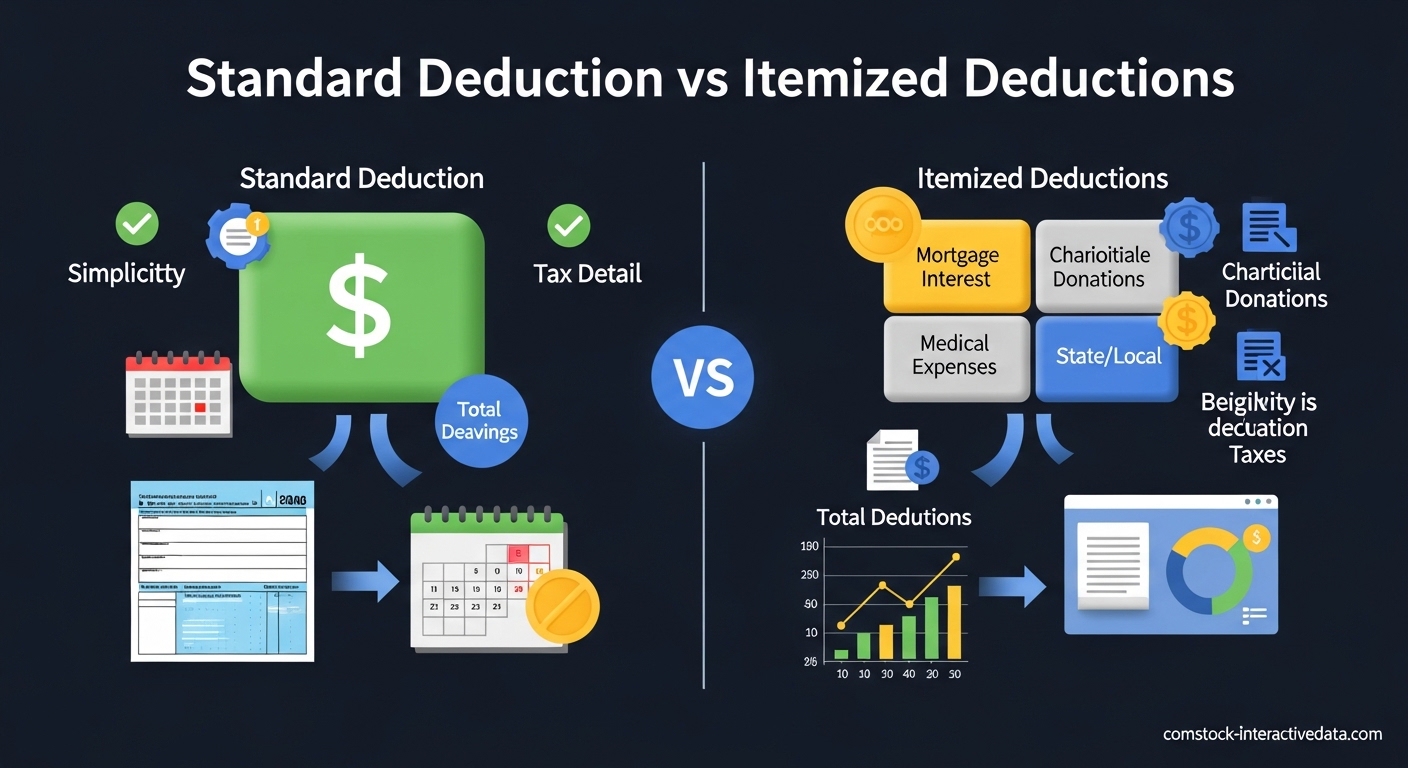
Choosing between the standard deduction vs itemized deductions is one of the most important tax decisions you will make each year. The choice directly impacts how much of your income gets taxed and can mean the difference between owing money or receiving a refund. Understanding how each option works and when to use them can save you hundreds or even thousands of dollars on your tax bill.
About 90% of taxpayers take the standard deduction because it is simpler and often provides a larger reduction in taxable income. However, if you have significant deductible expenses, itemizing could save you more money. This guide will walk you through everything you need to know to make the right choice for your situation in 2026.
Table of Contents
What Is the Standard Deduction?
The standard deduction is a fixed dollar amount that reduces the portion of your income subject to federal income tax. The government sets this amount based on your filing status, age, and vision status. You can claim this deduction without needing to keep receipts or document any specific expenses.
The standard deduction amount adjusts each year for inflation. The IRS announces the new figures each fall for the upcoming tax year. For 2026, the amounts have increased significantly compared to previous years.
2026 Standard Deduction Amounts by Filing Status
| Filing Status | 2026 Standard Deduction |
|---|---|
| Single | $15,000 |
| Married Filing Jointly | $30,000 |
| Married Filing Separately | $15,000 |
| Head of Household | $22,500 |
Additional Standard Deduction for Seniors and Blind Taxpayers
If you are age 65 or older, or if you are legally blind, you qualify for additional standard deduction amounts on top of the base figures. These additions help older taxpayers and those with vision impairments reduce their tax burden further.
For 2026, taxpayers who are 65 or older can claim an additional $1,950 if filing single or head of household, or $1,550 per qualifying person if married filing jointly. Legally blind taxpayers receive the same additional amounts. If you are both 65+ and blind, you get both additions.
One Big Beautiful Bill Act Senior Boost
The One Big Beautiful Bill Act, signed into law in 2026, introduced an additional standard deduction boost for seniors age 65 and older. Starting in 2026, qualifying seniors can claim an extra $6,000 above the regular standard deduction amount. This means a single senior taxpayer could deduct $21,000 total ($15,000 base + $6,000 senior boost) before adding any additional amounts for blindness.
This new provision significantly increases the threshold for when seniors should consider itemizing. With these higher standard deduction amounts, even fewer senior taxpayers will benefit from itemizing their deductions.
What Are Itemized Deductions?
Itemized deductions are specific expenses that the IRS allows you to subtract from your adjusted gross income. Instead of taking the fixed standard deduction, you list each qualifying expense on Schedule A of Form 1040. You should only itemize if your total itemized deductions exceed your standard deduction amount.
Itemizing requires more effort than taking the standard deduction. You must keep detailed records, save receipts, and complete additional tax forms. However, for taxpayers with significant deductible expenses, the extra work can result in substantial tax savings.
Common itemized deductions include mortgage interest, state and local taxes, charitable donations, and medical expenses that exceed certain thresholds. Not all expenses qualify, and many categories have limits or percentage thresholds based on your adjusted gross income.
Major Itemizable Deduction Categories
Understanding what expenses you can itemize is essential for deciding whether itemizing makes sense for you. Here are the main categories of itemized deductions available to most taxpayers.
Mortgage Interest Deduction
Homeowners can deduct interest paid on mortgage debt up to $750,000 for loans taken out after December 15, 2017. For loans originated before that date, the limit is $1 million. This deduction applies to your primary residence and one additional qualified residence, such as a vacation home.
Your mortgage lender will send you Form 1098 showing the total interest you paid during the year. You can also deduct points paid when obtaining your mortgage, though these usually must be deducted over the life of the loan rather than all at once. Private mortgage insurance premiums may also be deductible in some cases.
For homeowners with substantial mortgage balances, this deduction alone can make itemizing worthwhile. A $500,000 mortgage at 6% interest generates about $30,000 in deductible interest in the first year, which exceeds the standard deduction for single filers.
State and Local Tax (SALT) Deduction
The SALT deduction allows you to deduct state and local income taxes, property taxes, and either state income taxes or sales taxes. However, the Tax Cuts and Jobs Act capped this deduction at $10,000 per year ($5,000 if married filing separately) starting in 2018.
Starting in 2026, the SALT deduction cap increases to $40,000 per year for most taxpayers ($20,000 if married filing separately). This change, part of recent tax legislation, significantly benefits taxpayers in high-tax states like California, New York, and New Jersey.
When claiming this deduction, you can choose to deduct either state and local income taxes or general sales taxes, but not both. Most taxpayers benefit more from deducting income taxes unless they live in a state with no income tax but made major purchases during the year.
Charitable Contribution Deduction
Donations to qualified charitable organizations are deductible up to 60% of your adjusted gross income for cash contributions. Property donations have different limits, typically 30% of AGI for gifts to public charities. You must itemize to claim any charitable deduction.
For cash donations under $250, you need a bank record or receipt from the charity. For donations of $250 or more, you must obtain a written acknowledgment from the charity. Non-cash donations over $500 require Form 8283, and donations over $5,000 generally need a qualified appraisal.
Keep detailed records of all charitable giving throughout the year. Religious contributions, donations to nonprofit organizations, and even mileage driven for charitable purposes (14 cents per mile in 2026) can add up to meaningful deductions.
Medical and Dental Expenses
You can deduct qualified medical and dental expenses that exceed 7.5% of your adjusted gross income. This threshold means that only the portion of your medical costs above this percentage becomes deductible. For example, if your AGI is $100,000, only expenses exceeding $7,500 qualify.
Qualifying expenses include doctor and dentist fees, prescription medications, hospital stays, medical equipment, insurance premiums paid with after-tax dollars, and transportation for medical care. Cosmetic procedures generally do not qualify unless they correct a deformity from birth, accident, or disease.
To maximize this deduction, consider bunching medical procedures into a single tax year when possible. If you are close to the threshold, scheduling elective procedures in the same year can push your total over the 7.5% limit and make those expenses deductible.
How to Decide Between Standard Deduction and Itemizing?
The decision between taking the standard deduction and itemizing comes down to simple math. You should choose whichever option gives you the larger deduction, thereby reducing your taxable income the most.
Start by calculating your potential itemized deductions. Add up your mortgage interest, state and local taxes (up to the cap), charitable donations, and medical expenses exceeding the 7.5% threshold. Compare this total to your standard deduction amount based on your filing status and any additional amounts you qualify for.
The Simple Decision Rule
If your itemized deductions exceed your standard deduction, itemize. If your standard deduction is larger, take it. The larger deduction always saves you more in taxes. There is no benefit to itemizing if the total does not exceed the standard amount.
Important Rule for Married Filing Separately
If you are married and file separate returns, both spouses must use the same deduction method. If one spouse itemizes, the other must also itemize, even if their individual itemized deductions are less than their standard deduction. This synchronization rule can trap unprepared couples into higher tax bills.
Before deciding to file separately, calculate your taxes both ways. Often, filing jointly provides better overall results, but in some situations like when one spouse has high medical expenses, separate filing might help exceed the 7.5% AGI threshold for that spouse.
Quick Calculation Method
Gather your tax documents and receipts. Add up these key categories: mortgage interest from Form 1098, property taxes and state income taxes from your records (capped at $40,000 for 2026), charitable donation receipts, and medical expenses exceeding 7.5% of your AGI. Compare this sum to your standard deduction amount.
If you are a homeowner with a mortgage balance over $400,000, live in a high-tax state, or made significant charitable donations, you should seriously consider itemizing. Everyone else likely benefits more from the simplicity of the standard deduction.
Who Benefits Most from Itemizing?
Certain taxpayers consistently find that itemizing saves them more money than the standard deduction. Understanding whether you fall into one of these groups can help you plan your tax strategy throughout the year.
Homeowners with Mortgage Interest
Homeowners paying mortgage interest often benefit from itemizing, especially in the early years of their loan when interest payments are highest. A $400,000 mortgage at 7% interest generates about $28,000 in first-year interest, which alone exceeds the single filer standard deduction.
High Earners in High-Tax States
Taxpayers in states with high income taxes or property taxes, such as California, New York, New Jersey, and Connecticut, often benefit from itemizing. With the SALT cap raised to $40,000 in 2026, more taxpayers in these states will find itemizing advantageous.
People with Major Medical Expenses
Taxpayers who experienced serious illness, surgery, or chronic conditions requiring significant out-of-pocket costs may benefit from itemizing. The 7.5% threshold is high, but a major medical event can push expenses well above this limit, making the deduction substantial.
Generous Charitable Donors
Taxpayers who make significant charitable contributions, especially those who tithe or donate large portions of their income, often exceed the standard deduction when combining donations with other deductible expenses. The 60% of AGI limit is high enough that most donors will not hit it.
Real-World Example: The Homeowner in a High-Tax State
Consider a married couple in California with a $600,000 mortgage at 6.5% interest. They pay $39,000 in mortgage interest, $12,000 in state income taxes, $8,000 in property taxes, and made $6,000 in charitable donations. Their total itemized deductions equal $65,000 (capped at $40,000 for SALT), which far exceeds their $30,000 standard deduction.
By itemizing, they reduce their taxable income by an additional $35,000 compared to taking the standard deduction. In the 24% tax bracket, this saves them $8,400 in federal taxes. The extra effort of organizing receipts and completing Schedule A is clearly worth the savings.
Documentation and Record-Keeping Tips
If you plan to itemize, good record-keeping throughout the year is essential. You cannot claim deductions without proper documentation, and the IRS can disallow unsubstantiated deductions if you are audited.
Charitable Donation Documentation
Keep receipts, canceled checks, or bank statements for all cash donations. For donations of $250 or more, obtain a written acknowledgment from the charity stating the amount, date, and whether you received any goods or services in return. For non-cash donations over $500, file Form 8283 with your return.
Medical Expense Tracking
Save all medical bills, prescription receipts, and insurance explanation of benefits forms. Keep a mileage log for trips to medical appointments. Create a spreadsheet tracking expenses throughout the year so you know when you are approaching the 7.5% AGI threshold.
Property and State Tax Records
Keep property tax bills and proof of payment. Save state income tax withholding statements from your W-2 and estimated tax payment receipts. If you deduct sales taxes instead, save receipts for major purchases or use the IRS sales tax deduction calculator for an estimate.
Digital Organization Strategies
Use a dedicated folder on your computer or cloud storage for tax documents. Scan paper receipts immediately upon receiving them. Consider using tax preparation software or apps that can help track deductible expenses throughout the year. Having organized records makes tax preparation much faster and reduces stress at filing time.
Common Mistakes to Avoid
Taxpayers make several common errors when deciding between the standard deduction and itemizing. Avoiding these mistakes can save you money and prevent issues with the IRS.
Itemizing When the Standard Deduction Is Larger
Some taxpayers automatically itemize because they have always done so, without checking if the standard deduction now provides a larger benefit. Tax law changes have significantly increased standard deduction amounts in recent years. Always calculate both options before filing.
Ignoring the Married Filing Separately Rule
When married couples file separate returns, both spouses must use the same deduction type. If your spouse itemizes, you must itemize too, even if your standard deduction would be larger. Failing to coordinate this decision can cost you thousands in unnecessary taxes.
Not Tracking Medical Expenses Throughout the Year
The 7.5% AGI threshold for medical expenses is high, but many taxpayers do not realize they have crossed it because they failed to track expenses. Small copays, prescription costs, dental work, and mileage to appointments add up. Without records, you cannot claim the deduction even if you qualify.
Forgetting to Document Charitable Donations
Cash donations require documentation. The IRS disallows unsubstantiated charitable deductions. Get receipts for all donations, even small ones. For text message donations, keep your phone bill showing the charge. Never claim a deduction without proper backup.
Misunderstanding the SALT Cap
Some taxpayers mistakenly believe they can deduct all state and local taxes paid. The $40,000 cap for 2026 ($20,000 if married filing separately) limits this deduction regardless of how much you actually paid in property and state income taxes. Do not exceed this limit on your return.
Frequently Asked Questions
Should I claim standard or itemized deduction?
You should claim whichever deduction gives you the larger amount. Calculate your total itemized deductions by adding mortgage interest, state and local taxes up to the cap, charitable donations, and medical expenses exceeding 7.5% of your AGI. If this total exceeds your standard deduction, itemize. Otherwise, take the standard deduction.
How to decide between itemize or take standard deduction?
Follow these steps: First, identify your filing status and standard deduction amount. Second, gather records of mortgage interest, property taxes, state income taxes, charitable donations, and medical expenses. Third, add up your itemizable expenses, capping state and local taxes at $40,000. Fourth, compare the two totals and choose the larger deduction.
Do most people take standard or itemized deductions?
About 90% of taxpayers take the standard deduction. The Tax Cuts and Jobs Act significantly increased standard deduction amounts and capped SALT deductions at $10,000, making itemizing less beneficial for most people. With the SALT cap increasing to $40,000 in 2026, more taxpayers may find itemizing advantageous, but the majority will still benefit from the standard deduction.
Who benefits most from itemizing?
Homeowners with mortgage balances over $400,000, taxpayers in high-tax states, those with major medical expenses exceeding 7.5% of their income, and generous charitable donors benefit most from itemizing. High-income earners who pay significant state income taxes and property taxes often find that itemizing saves them thousands in federal taxes.
Can I switch between standard and itemized deductions each year?
Yes, you can choose each year which deduction method to use based on your current financial situation. There is no requirement to use the same method every year. Evaluate your deductions annually, as changes in mortgage interest, charitable giving, or medical expenses can make itemizing worthwhile one year but not the next.
What happens if my spouse itemizes and I file separately?
If you are married filing separately and your spouse itemizes deductions, you must also itemize, even if your individual itemized deductions are less than your standard deduction would be. This synchronization rule prevents one spouse from claiming the standard deduction while the other itemizes. Calculate your taxes both jointly and separately to determine the best approach.
Do I need receipts for every charitable donation?
For cash donations under $250, you need a bank record, credit card statement, or receipt from the charity. For donations of $250 or more, you must obtain a written acknowledgment from the charity. For non-cash donations over $500, you need to file Form 8283. Keep all documentation with your tax records for at least three years.
Conclusion
Making the right choice between standard deduction vs itemized deductions can significantly impact your tax bill in 2026. The standard deduction offers simplicity and generous amounts, especially with the new $6,000 senior boost for taxpayers 65 and older. For about 90% of taxpayers, this fixed deduction provides the best tax savings with minimal paperwork.
However, if you own a home with substantial mortgage interest, live in a high-tax state, had major medical expenses, or made significant charitable donations, itemizing could save you hundreds or thousands more. Calculate both options every year, keep good records, and choose the deduction that legally reduces your taxable income the most.
The key is preparation. Gather your documents early, understand the rules, and make an informed decision. Your wallet will thank you when tax season arrives.