
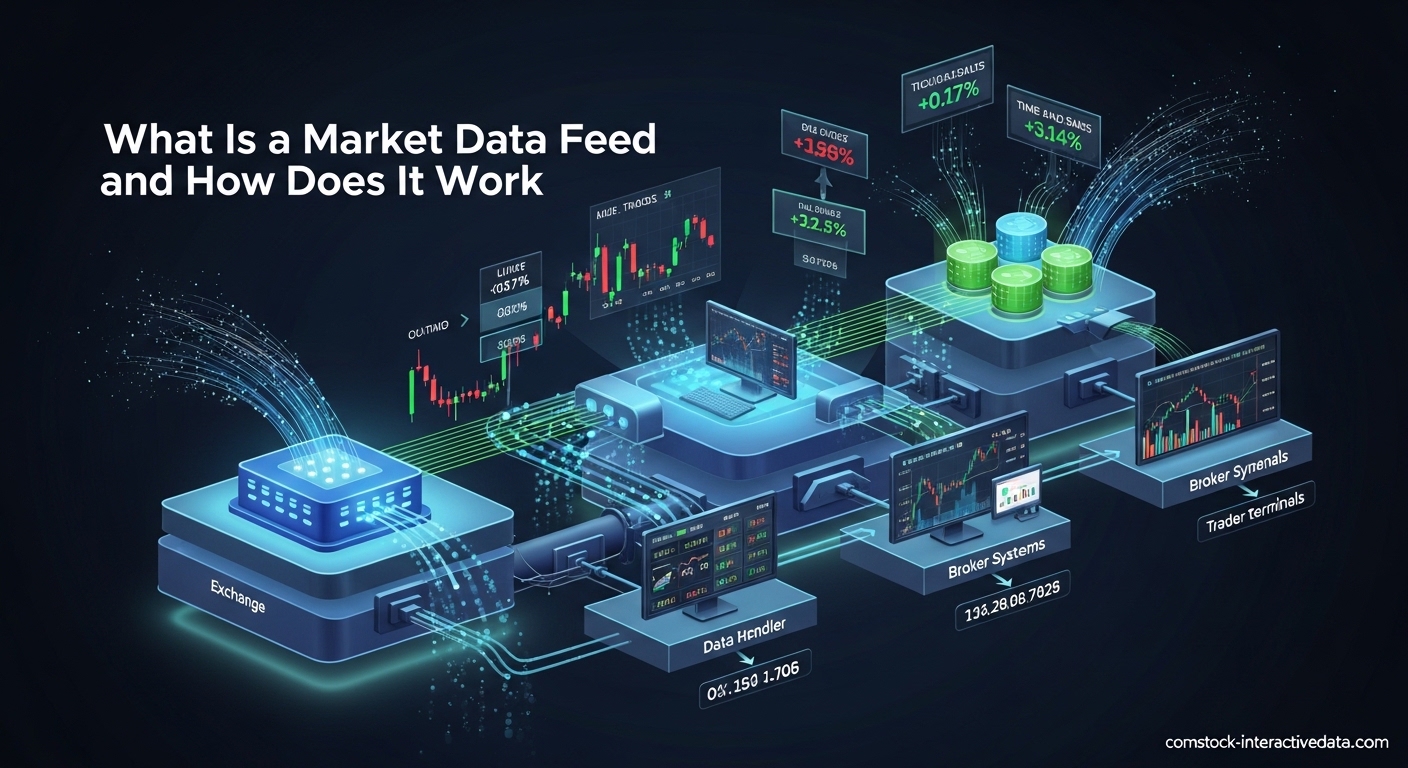
A market data feed is a real-time stream of financial information that delivers price quotes, trade volumes, bid and ask prices, and other market statistics for financial instruments like stocks, bonds, commodities, and currencies. It serves as the backbone of modern trading, providing the essential information market participants need to make informed buy and sell decisions in milliseconds. Whether you are a day trader monitoring momentum or an algorithmic system executing thousands of orders per second, access to reliable market data feeds is non-negotiable.
In this guide, I will explain exactly what market data feeds are, how they work under the hood, and why they matter for different trading strategies. Our team has analyzed how professional traders, retail investors, and institutional firms use these data streams to gain an edge in the markets. You will learn about the different types of market data available, how to choose the right feed for your needs, and what to consider when evaluating providers.
Table of Contents
What Is a Market Data Feed?
A market data feed is an electronic service that transmits continuous updates about financial markets from exchanges and trading venues to end users. These feeds contain structured information including current bid and ask prices, last traded prices, volume statistics, order book depth, and time and sales data. The data originates from exchanges like the NYSE, NASDAQ, and CME, as well as alternative trading systems and dark pools.
Every time a trade executes or someone places an order, that information flows through the market data infrastructure. Feed handlers at exchanges aggregate this information and broadcast it to subscribers via specialized protocols. The entire process happens in microseconds, ensuring that traders see market movements almost instantly.
How Market Data Feeds Work?
Understanding the mechanics of market data delivery helps explain why some feeds cost thousands of dollars monthly while others are free. The journey from exchange matching engine to your trading screen involves several technical layers.
Data Origination at Exchanges
Market data begins at the exchange matching engine, where buy and sell orders are matched. When a match occurs, the exchange generates a trade message containing the price, quantity, and timestamp. Simultaneously, changes to the order book, cancellations, and modifications generate update messages. These messages form the raw data stream that feeds into the broader market data infrastructure.
Major exchanges like NYSE and NASDAQ produce massive volumes of data. During high-activity periods, these venues can generate hundreds of thousands of messages per second across all their listed securities.
Delivery Protocols and Infrastructure
Exchanges distribute market data using two primary methods: TCP and UDP multicast. TCP connections provide reliable, ordered delivery suitable for applications where every message must be received. UDP multicast, however, dominates professional trading because it offers lower latency and can broadcast to multiple subscribers simultaneously.
Feed handlers play a critical role in the delivery chain. These specialized software systems receive raw exchange feeds, decode the binary protocols, and normalize the data into standardized formats. Normalization is essential because each exchange uses different message formats and symbology. A good feed handler translates these disparate formats into a unified structure your trading application can consume.
Many professional setups use FPGA-based feed handlers or kernel bypass technologies to reduce processing time. These approaches eliminate operating system overhead, bringing data directly from the network card to the application memory. Colocation services take this further by placing trading servers physically inside exchange data centers, minimizing the distance data must travel.
Types of Market Data
Not all market data feeds provide the same level of detail. Understanding the differences between data types helps you choose the right feed for your trading strategy and budget.
Level 1 Market Data (Top-of-Book)
Level 1 data provides the best bid and ask prices along with last trade information. This is the minimum data set most traders need to see current market prices. It includes the highest price someone is willing to pay (bid) and the lowest price someone will accept (ask), plus the size of those orders.
Many retail brokers provide Level 1 data at no cost or include it with standard accounts. This data works well for swing traders and investors who do not need to see the full order book structure. However, Level 1 does not reveal the market depth below the top prices.
Level 2 Market Data (Depth-of-Book)
Level 2 data expands on Level 1 by showing multiple price levels beyond the best bid and ask. You can see the next ten, twenty, or even hundred price levels in the order book, along with the size at each level. This visibility helps traders understand where support and resistance levels exist and how large orders might move prices.
Day traders and scalpers often require Level 2 data to read market sentiment and anticipate short-term price movements. Seeing the depth helps identify whether a large order will execute against existing liquidity or move the price significantly.
Full-Depth and Level 3 Data
Full-depth data, sometimes called Level 3 or MBO (Market By Order), provides the most granular view available. It shows every individual order in the book, including order IDs, rather than just aggregated sizes at price levels. This level of detail allows traders to track specific orders as they modify, cancel, or execute.
Full-depth feeds are essential for sophisticated algorithmic strategies, market making, and detailed market analysis. They require more bandwidth and processing power but provide the complete picture of market microstructure.
| Data Type | Information Included | Best For | Typical Cost |
|---|---|---|---|
| Level 1 | Best bid/ask, last trade | Swing trading, investing | Free to low cost |
| Level 2 | Multiple price levels, market depth | Day trading, scalping | $20-200/month |
| Full-Depth | Every order, MBO detail | Algorithmic trading, HFT | $500-5000+/month |
Real-Time vs Delayed vs Historical Data
The timing of market data delivery creates distinct categories with different use cases and pricing structures. Choosing the right timing option depends on how you plan to use the information.
Real-Time Market Data
Real-time data arrives with minimal delay, typically under 50 milliseconds for professional feeds. This immediacy is crucial for active trading strategies where every millisecond matters. Real-time feeds require exchange agreements and often involve monthly fees, especially for Level 2 and full-depth data.
Professional traders require real-time data for execution decisions. Without it, you cannot react to market movements as they happen, putting you at a significant disadvantage against competitors who have live feeds.
Delayed Market Data
Delayed data typically runs 15 to 20 minutes behind real-time markets. Exchanges provide this data at reduced cost or free because it lacks the immediacy required for live trading. Delayed feeds work well for analysis, education, and casual market monitoring.
If you are analyzing patterns after market close or building strategies that do not require instant execution, delayed data can save significant money. However, never attempt to trade live markets using delayed information.
Historical Market Data
Historical data consists of stored tick-by-tick or minute-by-minute records of past market activity. Traders use this data for backtesting strategies, analyzing market behavior, and training machine learning models. Historical data providers offer years or even decades of market activity across multiple asset classes.
Quality historical data includes not just prices but also order book snapshots, volume profiles, and market state information. This depth allows for realistic strategy testing before deploying capital in live markets.
How Traders Use Market Data Feeds?
Different trading styles place different demands on market data feeds. Understanding how professionals in each category use data helps clarify what you actually need.
Day Trading and Scalping
Day traders rely on real-time Level 2 data to identify short-term opportunities and execute rapid trades. They watch the order book for imbalances, large orders moving through the market, and shifts in bid-ask spreads. For scalpers holding positions for seconds or minutes, seeing depth-of-book information helps time entries and exits precisely.
Our team observed that successful day traders often use multiple data feeds simultaneously, comparing prices across exchanges to find the best execution venues.
Algorithmic and High-Frequency Trading
Algorithmic traders consume full-depth market data to power complex decision engines. These systems process millions of data points per second, identifying patterns and executing trades faster than any human could react. Low latency becomes paramount, with firms investing millions in colocation and specialized hardware to shave microseconds off their data feeds.
High-frequency traders particularly depend on the order book granularity that full-depth feeds provide. They model market microstructure to predict short-term price movements and provide liquidity to the market.
Risk Management and Portfolio Monitoring
Even buy-and-hold investors benefit from market data feeds for portfolio valuation and risk assessment. Real-time P&L calculations, position monitoring, and correlation analysis all require accurate price feeds. Risk managers use market data to calculate value-at-risk metrics and stress test portfolios against market scenarios.
Choosing the Right Market Data Feed
Selecting a market data provider involves balancing cost, data quality, and your specific trading requirements. After reviewing community discussions and professional recommendations, several factors consistently emerge as decision drivers.
Cost Considerations and Pricing Models
Market data pricing varies dramatically based on data depth, asset classes covered, and distribution method. Free options like the IEX cloud feed provide limited coverage, typically representing only a few percent of total market volume. While suitable for basic applications, free feeds lack the completeness professional strategies require.
Professional feeds range from $100 monthly for basic Level 2 equity data to thousands monthly for full-depth multi-asset feeds. Some providers charge per user, while others price based on bandwidth or number of instruments monitored. Exchange fees often add to vendor charges, particularly for real-time professional data.
When evaluating cost, consider the value the data provides to your strategy. A high-frequency trader might justify $5,000 monthly for microsecond latency, while a swing trader might find $50 monthly Level 2 data perfectly adequate.
Provider Reliability and Data Quality
Uptime and data accuracy matter as much as latency. A feed that drops during volatile markets or delivers incorrect prices can be worse than no feed at all. Professional providers invest heavily in redundant infrastructure and data validation to ensure continuous, accurate delivery.
Community discussions consistently highlight data completeness as a critical factor. Some budget providers filter or aggregate data to reduce costs, potentially missing important market events. Verify that your provider delivers unfiltered, complete exchange feeds if your strategy depends on seeing every tick.
API Documentation and Integration
The quality of API documentation significantly impacts development time and ongoing maintenance. Well-documented APIs with clear examples, SDKs in multiple languages, and responsive support teams reduce integration headaches. Some providers, like Databento, have earned praise specifically for their developer-friendly documentation and data format consistency.
Before committing to a provider, review their API reference and sample code. Test their sandbox environment if available to ensure the data format works with your existing infrastructure.
Latency Considerations for Different Strategies
Latency, the delay between market events and your receipt of that information, affects strategy performance differently depending on your holding period.
High-frequency traders compete on microsecond differences. They require direct market access, colocated servers, and FPGA-based feed handlers to minimize every possible delay. For these firms, reducing latency by even 10 microseconds can justify significant infrastructure investment.
Day traders operating on minute-level timeframes are less sensitive to microsecond differences but still benefit from low-latency feeds. A delay of 100 milliseconds might mean missing an entry point or paying a worse price. Most retail day traders find standard professional feeds adequate without specialized hardware.
Swing traders and position traders can tolerate higher latency since they hold positions for hours, days, or weeks. For these strategies, data completeness and accuracy matter more than shaving milliseconds off delivery time.
FAQ
What is a market data feed?
A market data feed is a real-time electronic stream of financial information from exchanges that includes price quotes, trade volumes, bid and ask prices, and order book data. It provides traders and systems with the current market status needed to make trading decisions.
How does a data feed work?
Market data feeds work by transmitting information from exchange matching engines to end users via protocols like UDP multicast. Feed handlers receive, decode, and normalize the raw data into standardized formats that trading applications can process and display.
What is the difference between Level 1 and Level 2 data?
Level 1 data shows only the best bid and ask prices plus last trade information. Level 2 data adds multiple price levels beyond the top of book, showing market depth and the size of orders at each price level, which helps traders understand supply and demand dynamics.
Do I need a real-time market data feed?
You need real-time market data if you actively trade during market hours and make decisions based on current prices. Delayed data works for after-hours analysis and education, but attempting to trade live markets with delayed data puts you at a significant disadvantage.
Conclusion
A market data feed is the essential infrastructure connecting traders to financial markets, delivering real-time price and order information that powers every trading decision. Understanding how these feeds work, the different types of data available, and how to choose the right provider for your strategy gives you a foundation for trading success in 2026.
Whether you need basic Level 1 data for long-term investing or full-depth feeds for algorithmic strategies, the key is matching your data requirements to your trading style and budget. Start by evaluating your current needs, test providers through trial offerings when possible, and remember that data quality and reliability matter as much as speed.