
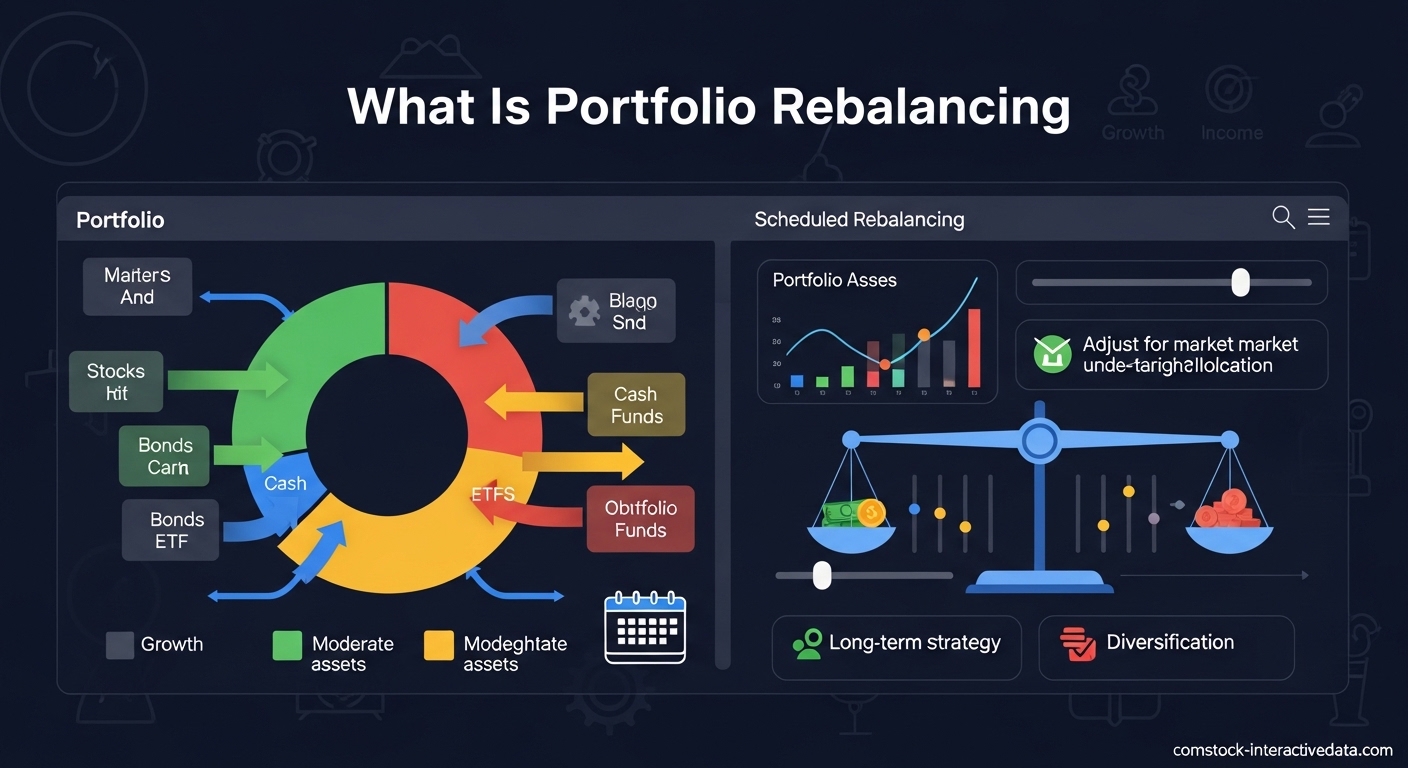
If you’ve ever checked your investment account and noticed your carefully planned mix of stocks and bonds has shifted dramatically, you’ve witnessed portfolio drift in action. This is exactly why portfolio rebalancing exists. It is the process of periodically adjusting your holdings to bring them back in line with your original target allocation.
Many investors set up their accounts with a perfect 60/40 or 70/30 split between stocks and bonds, then forget about it for years. Markets move. Some assets soar while others stagnate. Before you know it, what started as a balanced portfolio becomes something entirely different, often much riskier than you intended.
In this guide, I will explain what portfolio rebalancing actually means, why it matters for your long-term success, and most importantly, how often you should do it. You will learn practical strategies that work whether you are just starting out or nearing retirement.
Table of Contents
What Is Portfolio Rebalancing?
Portfolio rebalancing is the disciplined practice of buying and selling assets in your portfolio to maintain your desired asset allocation. Think of it as routine maintenance for your investments, similar to rotating the tires on your car or getting an annual physical.
When you first create an investment plan, you decide on a target allocation that matches your goals, time horizon, and risk tolerance. Perhaps you choose 60% stocks and 40% bonds. Over time, market movements cause these percentages to drift. A strong stock market might push your equity allocation to 75%, exposing you to more risk than you signed up for.
Rebalancing corrects this drift. You sell some of your winners, the assets that have grown beyond their target percentage, and buy more of the underperformers. This brings your portfolio back to its original target allocation and restores the risk profile you designed.
A Simple Example: The 60/40 Portfolio
Let me walk you through a concrete example to make this crystal clear. Imagine you have a $100,000 portfolio with a target allocation of 60% stocks and 40% bonds. This means $60,000 in stocks and $40,000 in bonds.
Now suppose the stock market has an excellent year. Your stock holdings grow by 25% to $75,000. Meanwhile, your bonds grow modestly by 3% to $41,200. Your portfolio is now worth $116,200.
But here is what changed. Your stocks now represent 64.5% of your portfolio, while bonds have shrunk to just 35.5%. Your portfolio has drifted significantly from your 60/40 target. You are now holding more risk than you originally intended.
To rebalance, you would sell approximately $5,320 worth of stocks and buy $5,320 worth of bonds. This brings you back to roughly $69,680 in stocks (60%) and $46,520 in bonds (40%). You have restored your target allocation and reset your risk level.
Why Rebalancing Matters?
Rebalancing is not just a technical exercise. It serves several crucial purposes that directly impact your financial future. Understanding these benefits helps you stay committed to the process, even when it feels counterintuitive.
Risk Management
The most important reason to rebalance is maintaining your intended risk level. Your original asset allocation was not chosen randomly. It was designed specifically for your goals, time horizon, and ability to handle market volatility.
When stocks run up and your allocation drifts toward 75% or 80% equities, you are taking on more risk than your plan allows. A sudden market correction will hurt much more than you anticipated. Rebalancing forces you to trim those winners and protect yourself.
I have seen investors ignore their portfolios during long bull markets, only to panic when a crash finally arrives. Their portfolios had become far too aggressive, and they suffered larger losses than they could emotionally or financially handle.
Buy Low, Sell High Discipline
Here is where rebalancing becomes powerful from a behavioral perspective. It forces you to do what every investor knows they should do but rarely accomplishes on their own. Buy low and sell high.
When you rebalance, you are systematically selling assets that have performed well and become expensive relative to your targets. You are taking profits. At the same time, you are buying assets that have lagged, which may be undervalued.
This is mechanical. It removes emotion from the equation. You are not trying to time the market or predict which asset will do best next. You are simply maintaining your plan, which naturally leads to contrarian behavior that historically pays off.
Staying on Track with Your Goals
Your target allocation exists for a reason. It reflects when you need the money and how much volatility you can tolerate. Rebalancing keeps you aligned with that plan through all market conditions.
Without rebalancing, successful bull markets silently increase your risk. Your portfolio drifts toward higher equity exposure right when you should potentially be getting more conservative. This is especially dangerous as you approach major financial goals like retirement.
How Often Should You Rebalance Your Portfolio?
This is the question most investors ask, and fortunately, research gives us clear answers. How often to rebalance your portfolio depends on the strategy you choose, but the good news is that you have flexibility. What matters most is consistency.
There are two main approaches to rebalancing frequency: time-based rebalancing and threshold-based rebalancing. Each has advantages, and many investors combine both for an optimal strategy.
Time-Based Rebalancing
With time-based rebalancing, you check your portfolio and make adjustments on a set schedule. The most common intervals are annually, semi-annually, or quarterly.
Annual rebalancing is the most popular choice for good reason. It requires minimal effort while keeping your portfolio reasonably aligned. Research from Vanguard and other institutions shows that annual rebalancing captures most of the risk-management benefits while minimizing costs and taxes.
Quarterly rebalancing keeps your portfolio closer to target but requires more effort and can generate more transaction costs and tax events. For most individual investors, quarterly is probably more frequent than necessary.
Monthly rebalancing is almost always overkill. The costs and tax implications usually outweigh any marginal benefit. I rarely recommend this unless you have a very specific reason.
Threshold-Based Rebalancing
Threshold rebalancing, also called threshold rebalancing or percentage-of-portfolio rebalancing, ignores the calendar entirely. Instead, you rebalance whenever an asset class drifts a certain percentage away from its target.
For example, with a 5% threshold and a 60% stock target, you would rebalance whenever your equity allocation hits 65% or drops to 55%. This triggers rebalancing based on actual market movements rather than arbitrary dates.
Common threshold levels are 5%, 10%, or 20% relative to the target allocation. A 5% threshold keeps your portfolio very close to target but triggers more frequent trades. A 10% or 20% threshold allows more drift but reduces trading costs.
A study by Advisor Perspectives found that a 10% drift threshold captured most of the risk-reduction benefits of more frequent rebalancing while minimizing transaction costs. This is the approach I personally favor.
Combining Both Approaches: The Hybrid Strategy
Many sophisticated investors use a hybrid approach that combines calendar rebalancing with threshold rebalancing. This offers the best of both worlds.
Here is how it works. You check your portfolio annually, perhaps around the new year or your birthday. If no asset class has drifted more than 5-10% from target, you skip rebalancing and check again next year. If an asset has drifted beyond your threshold, you rebalance immediately, regardless of the calendar.
This prevents unnecessary trading during calm markets while ensuring you rebalance promptly during volatile periods when drift happens quickly. It is the approach I recommend for most investors.
Tax-Efficient Rebalancing Strategies
Taxes can significantly eat into your returns if you rebalance carelessly. The good news is that several tax efficient rebalancing strategies can minimize or even eliminate the tax impact.
Start with Tax-Advantaged Accounts
Your first line of defense is rebalancing inside tax-advantaged accounts like 401(k)s, IRAs, and Roth accounts. Trades within these accounts generate no immediate tax consequences. You can buy and sell freely.
When rebalancing, always start with your tax-deferred or tax-free accounts. Rebalance them as needed without worrying about capital gains. This alone handles most rebalancing needs for many investors.
Only touch your taxable accounts if necessary after rebalancing tax-advantaged accounts. This simple ordering dramatically reduces the tax drag on your portfolio.
Use New Contributions Wisely
If you are still adding money to your portfolio, you have a powerful asset allocation rebalancing tool. Instead of selling winners and generating taxable gains, direct your new contributions to the underweight asset classes.
For example, if your stocks have run up and you are now 70% equities versus a 60% target, put 100% of your new contributions into bonds until balance is restored. This rebalances your portfolio without selling anything.
This works especially well for accumulators making regular contributions. You can often rebalance entirely through new money, avoiding sales and taxes.
Tax-Loss Harvesting
Tax loss harvesting is an advanced technique that can actually improve your tax situation while rebalancing. If you have positions sitting at a loss, you can sell them to realize the loss for tax purposes.
These losses offset gains elsewhere in your portfolio, reducing your tax bill. You can then use the proceeds to buy similar but not identical assets to maintain your allocation while staying within IRS wash-sale rules.
Many robo-advisors automate this process, but you can do it manually as well. It turns a necessary evil, taxes, into a tax-saving opportunity.
Rebalancing by Life Stage
Your ideal portfolio rebalancing strategy changes as you move through different life stages. A twenty-something just starting out has different needs than someone approaching retirement.
Accumulators: Ages 25-55
If you are in the accumulation phase, you probably do not need to rebalance as frequently. You have decades until you need the money, so short-term drift matters less.
Focus on making regular contributions and directing that money to underweight assets. Annual rebalancing checks are usually sufficient. Only rebalance if drift exceeds 10-15%.
Your priority should be consistent investing, not perfect allocation balance. Time in the market matters more than precise rebalancing at this stage.
Pre-Retirees: Ages 55-65
As you approach retirement, rebalancing becomes more important. You have less time to recover from market downturns, and your portfolio size makes drift more significant in dollar terms.
This is also when you should start gradually reducing equity exposure. A rebalancing rules-based glide path can help you systematically move from 70/30 to 60/40 or 50/50 over several years.
Consider rebalancing semi-annually with a 5% threshold at this stage. You want tighter control as you near your retirement date.
Retirees: Age 65 and Beyond
In retirement, you face a unique RMD rebalancing opportunity. Required Minimum Distributions from traditional IRAs and 401(k)s force you to withdraw money annually. Use these withdrawals strategically.
When taking RMDs, withdraw from your overweight asset classes. If stocks have run up, sell stocks for your RMD. If bonds are overweight, sell bonds. This naturally rebalances your portfolio while satisfying distribution requirements.
Maintain a conservative allocation aligned with your withdrawal needs. Annual rebalancing with a tight 5% threshold helps protect your nest egg during the fragile first decade of retirement.
Common Rebalancing Mistakes to Avoid
Even well-intentioned investors make mistakes when rebalancing. Here are the most common pitfalls I see and how to avoid them.
Rebalancing Too Frequently
Some investors rebalance monthly or even more often, thinking more precision is better. It is not. Frequent rebalancing increases transaction costs, tax drag, and can actually hurt returns by cutting off winning investments too early.
Research shows that quarterly or annual rebalancing captures almost all the risk-reduction benefits. Going more frequent adds complexity without meaningful benefit.
Ignoring Tax Implications
Rebalancing in taxable accounts without considering capital gains taxes is expensive. Always prioritize tax-advantaged accounts, use new contributions, and consider tax-loss harvesting opportunities.
Avoid year-end rebalancing that generates taxable gains right before tax season. If you must sell winners in taxable accounts, try to hold them at least one year to qualify for lower long-term capital gains rates.
Making Emotional Decisions
Market crashes are terrifying. Many investors freeze during downturns, refusing to rebalance because selling safe bonds to buy crashing stocks feels wrong. It is uncomfortable, but it is exactly what rebalancing requires.
Conversely, during bull markets, investors often let winners run, skipping rebalancing because they do not want to miss out. Both mistakes undermine your plan.
Write down your rebalancing rules in advance and follow them mechanically. Remove emotion from the equation.
Not Having a Written Plan
The biggest mistake is having no rebalancing rules at all. Without a written plan, you will make inconsistent decisions based on news headlines, gut feelings, or whatever the market happened to do that morning.
Document your target allocation, your rebalancing frequency, and your threshold rules. Then follow that document religiously. Your future self will thank you.
Frequently Asked Questions
Should I rebalance during a market crash?
Yes, absolutely. Market crashes are when rebalancing provides the most value. By selling bonds and buying stocks after a crash, you are purchasing assets at discounted prices. This feels scary but historically leads to better long-term returns. Stick to your plan and rebalance as scheduled.
Does rebalancing improve investment returns?
Not necessarily. Rebalancing primarily improves risk-adjusted returns by preventing your portfolio from becoming too aggressive. It often reduces absolute returns slightly because you are trimming winners. The benefit is controlling risk and avoiding catastrophic losses, not maximizing gains.
Can I automate portfolio rebalancing?
Yes. Many 401(k) plans offer automatic rebalancing options. Robo-advisors also automate rebalancing for their clients. Target-date funds automatically rebalance and glide toward conservative allocations over time. If you self-manage, set calendar reminders to check your allocation annually.
What if I only have a taxable account?
Rebalancing in a taxable account requires more care. Use new contributions to buy underweight assets whenever possible. If you must sell, consider tax-loss harvesting opportunities first. Hold winning positions at least one year to get long-term capital gains treatment. And keep rebalancing to a minimum, perhaps only when drift exceeds 10-15%.
Conclusion: Your Rebalancing Action Plan
Portfolio rebalancing is not the most exciting part of investing, but it is one of the most important disciplines for long-term success. It keeps your risk level consistent, enforces buy-low-sell-high behavior, and ensures you stay aligned with your goals through all market conditions.
For most investors, an annual check with a 5-10% threshold trigger offers the best balance of risk control and simplicity. Rebalance first in your tax-advantaged accounts. Use new contributions to minimize taxable sales. And write down your rules so you follow them mechanically, not emotionally.
Here is your immediate action plan. First, check your current allocation today and calculate how far each asset class has drifted from target. Second, write down your rebalancing policy including frequency, thresholds, and tax strategies. Third, set a calendar reminder to review your allocation annually or implement automatic rebalancing if your brokerage offers it.
The best rebalancing strategy is the one you will actually follow. Start simple, stay consistent, and adjust as your life circumstances change. Your future self, enjoying a retirement funded by disciplined investing, will be grateful you did.