
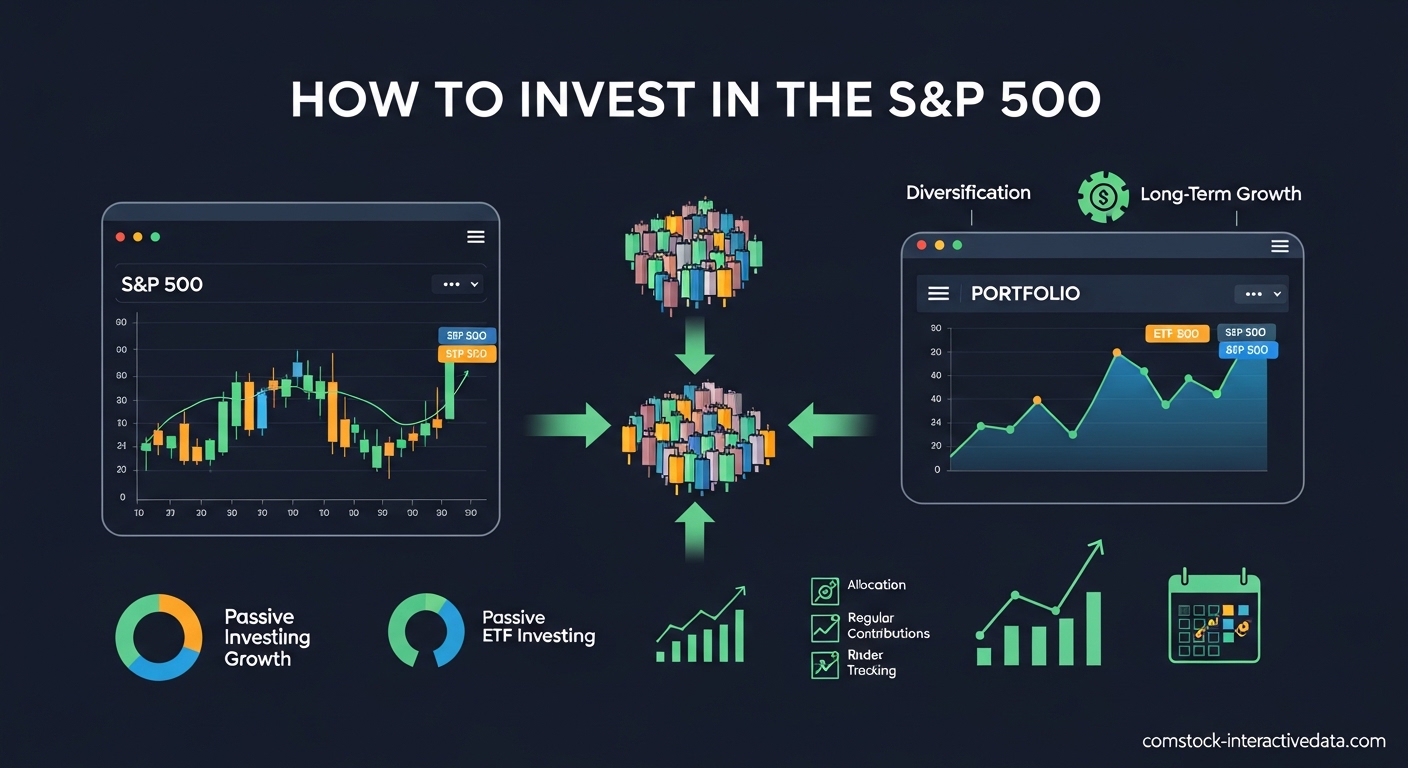
Want to build wealth without becoming a stock-picking expert? The S&P 500 has delivered an average annual return of about 10% over the past century. Warren Buffett himself has called low-cost S&P 500 index funds the best investment for most Americans.
I wrote this guide after helping dozens of friends and family members start their investing journeys. Our team has spent years researching the simplest paths to long-term wealth, and S&P 500 investing consistently rises to the top for beginners. You do not need a finance degree, a large pile of cash, or hours of free time to get started.
By the end of this guide, you will know exactly how to invest in the S&P 500 from opening your first brokerage account to making your first purchase. You will understand the difference between ETFs and mutual funds, know which brokers work best for beginners, and avoid the costly mistakes that trip up new investors. Let us dive into the simplest path to stock market wealth.
Table of Contents
What Is the S&P 500?
The S&P 500 is a stock market index that tracks the performance of 500 of the largest publicly traded companies in the United States. Think of it as a scoreboard that shows how America’s biggest businesses are performing collectively. These 500 companies represent approximately 80% of the total U.S. stock market value.
Standard and Poor’s, a financial services company, created this index in 1957. The companies included are not random selections. They are chosen based on market capitalization, which measures a company’s total value by multiplying its stock price by the number of outstanding shares.
The index includes household names you already know. Apple, Microsoft, Amazon, Tesla, and Berkshire Hathaway all sit within the S&P 500. The collection spans every major sector of the economy including technology, healthcare, finance, and consumer goods.
When you hear that “the market” went up or down on any given day, people usually refer to the S&P 500. It serves as the primary benchmark for U.S. stock market performance. Investors cannot buy the index directly, but they can invest in index funds and ETFs that mirror its performance by holding the same 500 stocks in the same proportions.
How to Invest in the S&P 500: A 4-Step Guide
Learning how to invest in the S&P 500 is simpler than most beginners expect. You do not need thousands of dollars to start, and the entire process takes less than 30 minutes once you know the steps. I have broken this down into four clear phases that anyone can follow.
Step 1: Choose a Brokerage Account
Your first decision involves selecting where to open an investment account. A brokerage account acts like a digital wallet that holds your investments. You deposit money into this account, then use that money to buy shares of S&P 500 funds.
For beginners, I recommend starting with one of these three beginner-friendly options. Fidelity offers zero minimum investment requirements, commission-free trades, and excellent customer support. Vanguard invented the index fund and offers rock-bottom expense ratios. Schwab provides a user-friendly interface and fractional shares starting at just $5.
Each broker offers slightly different features, but all three allow you to invest in S&P 500 index funds and ETFs with minimal fees. Look for commission-free trading, low or no account minimums, and an interface that does not overwhelm you with complexity.
Step 2: Open and Fund Your Account
Opening a brokerage account takes about 10 minutes online. You will need your Social Security number, a valid ID, and your bank account information for funding. The application asks basic questions about your income, investment experience, and risk tolerance.
Most brokers offer several account types. A taxable brokerage account provides the most flexibility for withdrawals but offers no special tax benefits. An Individual Retirement Account (IRA) provides tax advantages but limits when you can withdraw funds without penalties. A Roth IRA lets your investments grow tax-free if you follow the rules.
Start with whatever amount feels comfortable. Many beginners worry they need thousands of dollars to invest, but that is not true. Fidelity and Schwab both allow you to start with as little as $1 thanks to fractional shares. Even $100 invested monthly adds up to significant wealth over decades.
Step 3: Select Your S&P 500 Fund
Once your account has money, you need to choose which S&P 500 investment vehicle to buy. You have two main options: exchange-traded funds (ETFs) or mutual funds. Both track the same 500 companies but work slightly differently.
ETFs trade throughout the day like individual stocks. You buy shares at whatever price the market sets when you place your order. Mutual funds price once per day after markets close, and all orders execute at that single price. ETFs typically offer lower expense ratios and more tax efficiency, while mutual funds allow automatic investing in fixed dollar amounts.
Here are the most popular S&P 500 options for beginners:
| Fund Name | Ticker | Type | Expense Ratio | Minimum Investment |
|---|---|---|---|---|
| Vanguard S&P 500 ETF | VOO | ETF | 0.03% | Price of 1 share |
| SPDR S&P 500 ETF Trust | SPY | ETF | 0.09% | Price of 1 share |
| iShares Core S&P 500 ETF | IVV | ETF | 0.03% | Price of 1 share |
| Vanguard 500 Index Fund | VFIAX | Mutual Fund | 0.04% | $3,000 |
| Fidelity 500 Index Fund | FXAIX | Mutual Fund | 0.02% | $0 |
| Schwab S&P 500 Index Fund | SWPPX | Mutual Fund | 0.02% | $0 |
For beginners with limited funds, ETFs like VOO or IVV make the most sense. You can buy fractional shares at Fidelity or Schwab with as little as $1. If you prefer automatic investing where a fixed amount transfers from your bank each month, mutual funds work better since they allow dollar-based purchases.
Step 4: Buy Shares and Set Up Automatic Investing
With your fund selected, it is time to make your first purchase. Log into your brokerage account, search for your chosen ticker symbol, and place a buy order. For ETFs, you will enter the number of shares or dollar amount you want to purchase. For mutual funds, you enter the dollar amount.
I strongly recommend setting up automatic investing immediately after your first purchase. Most brokers allow you to schedule recurring transfers from your bank account. You choose the amount and frequency, typically monthly or biweekly to match your paycheck schedule.
Automatic investing removes emotion from your decisions. You buy consistently regardless of whether the market is up or down. This strategy, called dollar-cost averaging, reduces the risk of investing a large sum right before a market crash. It also builds the habit of investing before you spend money on other things.
Understanding Expense Ratios and Fees
Expense ratios represent the annual cost of owning a fund, expressed as a percentage of your investment. They cover the fund’s operating costs including management fees, administrative expenses, and marketing. Even passively managed index funds charge expense ratios, though they are dramatically lower than actively managed alternatives.
A 0.03% expense ratio means you pay $3 per year for every $10,000 invested. A 1% expense ratio costs you $100 per year on the same amount. That $97 annual difference compounds dramatically over decades. On a $100,000 portfolio growing at 7% annually over 30 years, a 1% fee costs you nearly $100,000 in lost growth compared to a 0.03% fee.
The S&P 500 funds I recommended earlier all charge 0.02% to 0.09% annually. These tiny fees mean you keep nearly all of your returns. Some actively managed funds charge 1% or more while failing to beat the market consistently. Expense ratio awareness separates smart investors from those who unknowingly give away their returns.
Benefits of Investing in the S&P 500
The S&P 500 offers advantages that few other investments can match. Understanding these benefits helps you stay committed during market downturns when emotions might tempt you to sell.
Instant Diversification Across 500 Companies
When you buy an S&P 500 index fund, you immediately own a tiny slice of 500 different companies. You gain exposure to technology giants, healthcare innovators, financial powerhouses, and consumer brands. If one company struggles or fails, the other 499 cushion the blow.
This diversification would cost a fortune to achieve by buying individual stocks. Purchasing even one share of each S&P 500 company would require hundreds of thousands of dollars. An index fund gives you the same exposure for the price of a single share.
Historical 10% Average Annual Returns
Over long periods, the S&P 500 has delivered average annual returns of approximately 10% before inflation. That means $10,000 invested 2026 years ago would have grown to roughly $25,000 today. Returns vary year by year, with some years showing losses and others showing gains exceeding 20%.
These returns beat most actively managed funds after fees. Study after study shows that the majority of professional money managers fail to beat the S&P 500 over long time horizons. By simply matching the market at minimal cost, you outperform most Wall Street professionals.
Passive Simplicity
S&P 500 investing requires virtually no ongoing maintenance. You buy shares, set up automatic investing, and let time do the work. The fund automatically adjusts its holdings as companies enter or leave the index. You never need to research individual stocks, read earnings reports, or time the market.
This passive approach saves you countless hours and removes the stress of investment decisions. You do not need to worry about whether Tesla is overvalued or if Apple will beat earnings estimates. Your investment spreads across all major companies automatically.
Risks and Beginner Mistakes to Avoid
No investment is perfect, and the S&P 500 carries real risks you must understand. Equally important is recognizing the behavioral mistakes that trip up new investors. Here is what to watch for.
Market Volatility and Downturns
The S&P 500 can drop significantly in short periods. During the 2008 financial crisis, the index fell nearly 57% from its peak. In March 2020, it plunged 34% in just a few weeks as COVID-19 fears spread. These declines feel terrifying when they happen.
However, the index has always recovered and reached new highs given enough time. The key is staying invested through downturns rather than panic-selling. Investors who sold during crashes and waited to re-enter often missed the subsequent recoveries and powerful rallies.
Lack of International Exposure
The S&P 500 only holds American companies. While many of these companies operate globally, you get no direct exposure to foreign markets like Europe, Japan, or emerging economies. International stocks sometimes perform better than U.S. stocks for extended periods.
As you build wealth beyond your first $50,000 or $100,000, consider adding international index funds to your portfolio. A total world stock market fund provides broader diversification across thousands of global companies.
Five Common Beginner Mistakes
After observing hundreds of new investors, I see the same errors repeatedly. Avoid these pitfalls to maximize your success:
1. Trying to time the market. Beginners often wait for the “perfect” time to invest, convinced the market will crash soon. They sit on cash for months or years while markets climb higher. Time in the market beats timing the market. Start now with whatever you can afford.
2. Checking prices daily. Watching your portfolio constantly creates anxiety and tempts impulsive decisions. The S&P 500 fluctuates daily, sometimes dramatically. Checking monthly or quarterly keeps you focused on long-term growth rather than short-term noise.
3. Selling during crashes. Market downturns trigger fear, and fear leads to selling at the worst possible time. Investors who held through the 2008 crisis recovered fully by 2012 and then enjoyed a decade of gains. Those who sold at the bottom locked in permanent losses.
4. Chasing hot sectors. When tech stocks soar or crypto grabs headlines, beginners often abandon their index fund strategy to chase quick profits. This usually ends badly. Stick with your boring but reliable S&P 500 strategy rather than gambling on trends.
5. Ignoring fees at their broker. Some beginners open accounts at brokers charging $5 or $10 per trade or maintenance fees. These costs eat into returns, especially for small accounts. Use commission-free brokers like Fidelity, Vanguard, or Schwab instead.
ETF vs Mutual Fund: Which Should You Choose?
Both ETFs and mutual funds let you invest in the S&P 500, but subtle differences matter depending on your situation. Understanding these distinctions helps you pick the right vehicle for your goals.
| Feature | ETF | Mutual Fund |
|---|---|---|
| Trading | Throughout the day | Once daily after close |
| Minimum Investment | One share or fractional | Typically $1,000-$3,000 |
| Automatic Investing | Limited at some brokers | Easy dollar-based setup |
| Expense Ratios | Usually slightly lower | Admiral shares competitive |
| Tax Efficiency | More tax-efficient | May distribute capital gains |
| Best For | Small starting amounts | Hands-off automation |
Choose an ETF if you are starting with less than $1,000 or want maximum tax efficiency. ETFs work great in taxable brokerage accounts where you might sell shares someday. They also allow you to place specific order types like limit orders.
Choose a mutual fund if you want to set up automatic investing with specific dollar amounts. Many investors prefer the simplicity of transferring $500 monthly into their mutual fund without calculating how many shares that buys. Mutual funds also eliminate the bid-ask spread that can slightly impact ETF purchases.
Tax Considerations for S&P 500 Investing
Where you hold your S&P 500 investment impacts your tax bill significantly. Understanding account types helps you keep more of your returns.
Taxable brokerage accounts offer flexibility but no special tax treatment. You pay taxes on dividends received each year, and you pay capital gains taxes when you sell shares at a profit. These accounts work best for money you might need before retirement age.
Traditional IRAs provide tax deductions on contributions, reducing your current tax bill. Your investments grow tax-deferred, meaning you pay no taxes on dividends or gains until withdrawal. You pay ordinary income tax on withdrawals during retirement.
Roth IRAs work oppositely. You contribute after-tax dollars with no immediate deduction, but your investments grow completely tax-free. Withdrawals in retirement cost you nothing in taxes. Roth accounts benefit young investors who expect higher tax rates in the future.
Many investors use both account types. They max out tax-advantaged retirement accounts first, then invest additional money in taxable accounts for flexibility. The S&P 500 works well in any account type thanks to its tax-efficient structure.
Frequently Asked Questions
How should a beginner invest in the S&P 500?
Beginners should open a brokerage account with a commission-free broker like Fidelity, Vanguard, or Schwab. Fund the account with whatever amount you can afford, even $100 or less. Purchase shares of a low-cost S&P 500 ETF such as VOO or IVV. Set up automatic recurring investments to build wealth consistently over time without trying to time the market.
Can I put $100 into the S&P 500?
Yes, you can invest $100 in the S&P 500 through fractional shares offered by brokers like Fidelity and Schwab. These brokers allow you to buy partial shares of ETFs like VOO with as little as $1. Alternatively, some mutual funds like FXAIX have no minimum investment requirement. The key is starting with whatever you can afford and adding consistently over time.
What if I invested $1000 in the S&P 500 10 years ago?
If you invested $1,000 in the S&P 500 ten years ago, your investment would have grown to approximately $3,000 by 2026, assuming average historical returns. This represents roughly a 200% total return or about 11.6% annualized. The power of compound growth means your money tripled without adding a single additional dollar. Regular monthly investments during that same period would have generated even more impressive results.
Is the S&P 500 worth it for beginners?
The S&P 500 is one of the best investments for beginners because it offers instant diversification, historically strong returns, and extremely low costs. Warren Buffett has repeatedly recommended S&P 500 index funds for most investors, including his own family. The passive nature requires no stock-picking expertise or ongoing research. Beginners get exposure to 500 major companies with a single purchase, making it the ideal starting point for long-term wealth building.
What does Warren Buffett think of the S&P 500?
Warren Buffett strongly endorses S&P 500 index funds, calling them the best investment for most people. In his 2013 annual letter to shareholders, he instructed his estate to put 90% of his money in a low-cost S&P 500 index fund for his wife. He has consistently argued that these funds outperform most actively managed portfolios after fees. Buffett believes the average investor should buy and hold S&P 500 index funds rather than trying to pick individual stocks.
How much money do I need to invest to make $3000 a month?
To generate $3,000 monthly from S&P 500 investments, you would need approximately $900,000 to $1,080,000 invested, assuming the historical 4% safe withdrawal rate. This assumes your portfolio grows at historical averages and you withdraw 4% annually without depleting the principal. Building this amount requires consistent investing over many years, typically $1,000 to $2,000 monthly for 20-30 years depending on returns. Focus first on reaching smaller milestones like $100,000 before worrying about full retirement income.
What if I invested $1000 a month in the S&P 500?
Investing $1,000 monthly in the S&P 500 for 30 years would grow to approximately $1.97 million by 2026, assuming 10% average annual returns. Your total contributions would equal $360,000, meaning compound growth added over $1.6 million. Even at a more conservative 7% return, you would accumulate roughly $1.2 million. This demonstrates why consistent monthly investing is often called the most reliable path to millionaire status.
What does Dave Ramsey say about the S&P 500?
Dave Ramsey recommends investing in growth stock mutual funds rather than pure S&P 500 index funds for retirement accounts. He suggests finding funds with long track records of outperforming the market. However, he agrees that low-cost index funds like those tracking the S&P 500 are acceptable options, especially for beginners. Ramsey emphasizes aggressive investing, typically recommending 100% stock allocation including a mix of growth, growth and income, aggressive growth, and international funds rather than S&P 500 alone.
Conclusion: Start Your Journey Today
Learning how to invest in the S&P 500 is one of the most valuable financial skills you can acquire. You now understand the simple four-step process: choose a broker, open an account, select your fund, and start investing automatically. You know which funds offer the lowest fees, how to avoid beginner mistakes, and why experts like Warren Buffett recommend this approach.
The best time to start investing was yesterday. The second best time is today. You do not need thousands of dollars to begin, and you do not need to understand every financial concept immediately. Open your brokerage account this week with $100 or whatever amount feels comfortable. Set up automatic investing so you consistently add to your portfolio every month.
Remember that building wealth is a marathon, not a sprint. The S&P 500 has weathered recessions, wars, pandemics, and countless crises over its history. Patient investors who stayed the course were rewarded handsomely. Time in the market beats timing the market every single time. Your future self will thank you for starting now.