
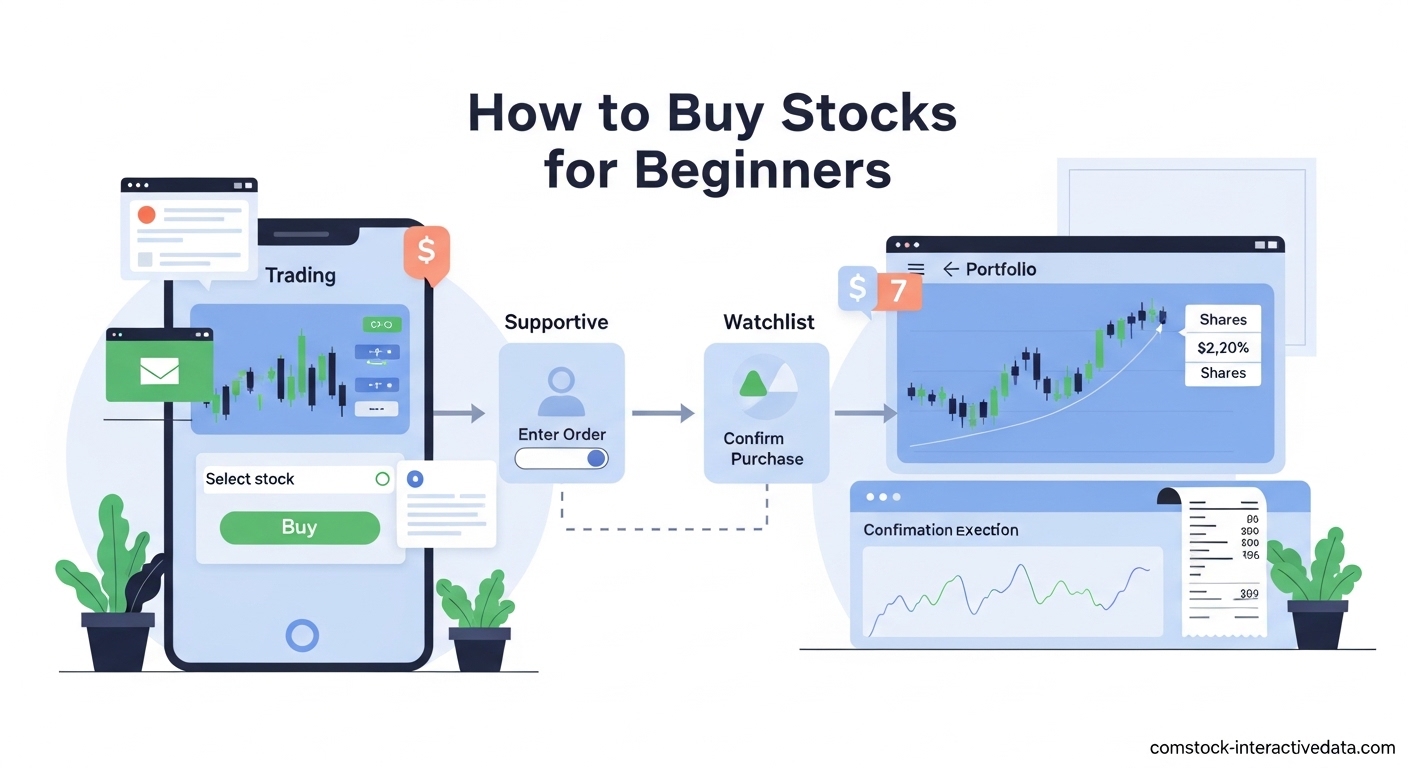
Learning how to buy stocks for beginners can feel overwhelming at first. I remember staring at my first brokerage account screen, wondering which buttons to press and whether I was about to make an expensive mistake. The good news is that investing has never been more accessible, and with the right guidance, anyone can start building wealth through the stock market.
In this step-by-step guide, I will walk you through everything you need to know to purchase your first stock in 2026. You will learn how to set clear goals, choose the right brokerage account, and make your first investment with confidence. Whether you have $100 or $10,000 to start, this guide will give you the foundation you need to become a successful long-term investor.
The stock market has historically returned about 10% annually on average, making it one of the most powerful wealth-building tools available. Our team has helped thousands of beginners navigate their first investments, and we have condensed everything we have learned into these seven actionable steps.
Table of Contents
Step 1: Set Clear Investment Goals
Before you buy a single share, you need to know why you are investing and what you hope to achieve. Your goals will determine everything from how much risk you should take to which investments make the most sense for your situation. Without clear goals, it is easy to make emotional decisions that derail your financial progress.
Start by defining your time horizon. Are you saving for a house down payment in three years, or are you building a retirement nest egg for thirty years down the road? Short-term goals (under five years) generally call for safer, more conservative investments, while long-term goals can withstand more volatility for potentially higher returns.
Next, put specific numbers to your goals. Instead of saying “I want to save for retirement,” try “I want to accumulate $1.2 million by age 65.” Specific targets help you calculate how much you need to invest monthly and track your progress along the way. I recommend using a SMART goals framework: Specific, Measurable, Achievable, Relevant, and Time-bound.
Consider these common beginner investment goals:
- Emergency fund supplementation (already having 3-6 months saved first)
- Down payment fund for a home purchase
- Retirement savings beyond employer 401(k)
- Children’s education fund
- Wealth building for financial independence
Write your goals down and review them quarterly. Your objectives may shift as life circumstances change, and that is completely normal. The key is having a clear destination so you can build the right roadmap to get there.
Step 2: Determine Your Budget for Investing
One of the most common questions beginners ask is, “How much money do I need to start investing?” The answer might surprise you: you can begin with as little as $1 to $100 thanks to fractional shares offered by most modern brokerages. The more important question is how much you can afford to invest regularly without compromising your financial stability.
Before investing a single dollar in stocks, ensure you have a solid emergency fund covering 3-6 months of essential expenses. This cash reserve acts as your financial safety net, preventing you from selling investments at a loss during unexpected setbacks like job loss or medical emergencies. I learned this lesson the hard way during my early investing days when I had to liquidate positions to cover a car repair bill.
A good rule of thumb is to invest 10-20% of your after-tax income once your emergency fund is established. If that feels ambitious, start with whatever amount feels comfortable and increase it by 1% every few months. Consistency beats intensity in investing. Contributing $100 monthly for ten years typically beats investing $1,000 once and stopping.
Here is a simple framework for determining your investing budget:
- Calculate your monthly after-tax income
- Subtract essential expenses (rent, utilities, groceries, minimum debt payments)
- Subtract discretionary spending (dining out, entertainment, subscriptions)
- Allocate remaining funds to savings goals, including investing
Remember that investing should never come at the expense of high-interest debt. If you carry credit card balances with 20%+ APR, prioritize paying those off before aggressively investing. The guaranteed return from eliminating high-interest debt usually exceeds expected stock market returns.
Step 3: Assess Your Risk Tolerance
Risk tolerance refers to your emotional and financial capacity to withstand investment losses without panicking. It is one of the most critical factors in building an investment strategy that you can stick with during market downturns. Many beginners overestimate their risk tolerance until they experience their first significant market drop.
Your risk tolerance depends on several factors. Time horizon plays a huge role: someone in their twenties can afford to take more risk than someone nearing retirement. Income stability matters too. A tenured professor with predictable paychecks can typically handle more volatility than a freelance contractor with irregular income. Personal temperament is equally important. Some people lose sleep over 5% portfolio drops, while others barely notice 20% declines.
Most brokerages offer risk tolerance questionnaires when you open an account. These surveys ask about your reaction to hypothetical market scenarios and help categorize you as conservative, moderate, or aggressive. I recommend taking multiple questionnaires from different sources and seeing where your answers converge.
Here is a general age-based guideline for stock allocation:
- Age 20-30: 80-90% stocks, 10-20% bonds/cash
- Age 30-40: 70-80% stocks, 20-30% bonds/cash
- Age 40-50: 60-70% stocks, 30-40% bonds/cash
- Age 50-60: 50-60% stocks, 40-50% bonds/cash
Be honest with yourself about your true risk tolerance. The worst investing mistake is abandoning your strategy during a downturn because you took too much risk. Our team has seen countless investors sell at market bottoms because they could not stomach temporary losses. It is better to earn modest returns you can sustain than chase high returns you will abandon.
Step 4: Choose the Right Brokerage Account
Selecting where to open your investment account is one of the most important decisions you will make as a beginner. Your brokerage becomes the gateway to the stock market, housing your investments and providing the tools you need to manage them. The good news is that competition among brokers has driven fees down to zero and made account opening remarkably simple.
First, understand the different types of investment accounts available. Each serves different purposes and offers distinct tax advantages:
| Account Type | Tax Treatment | Best For | Contribution Limits 2026 |
|---|---|---|---|
| Traditional IRA | Tax-deferred growth; deductions now, taxes on withdrawal | Reducing current taxable income | $7,000 ($8,000 age 50+) |
| Roth IRA | Tax-free growth; no deduction now, tax-free withdrawals | Younger investors, tax diversification | $7,000 ($8,000 age 50+) |
| 401(k)/403(b) | Tax-deferred growth; employer-sponsored | Employees with employer match | $23,500 ($31,000 age 50+) |
| Taxable Brokerage | No special tax treatment; capital gains taxes apply | Flexibility, early withdrawals, excess savings | No limits |
When comparing brokerage providers, evaluate these key factors:
- Commission fees: Most major brokers now offer commission-free stock and ETF trades
- Account minimums: Look for $0 minimum deposit requirements as a beginner
- Fractional shares: Essential if starting with smaller amounts
- Investment options: Ensure access to stocks, ETFs, mutual funds you want
- User interface: Mobile and web platforms should be intuitive
- Research tools: Educational resources, screeners, and analysis tools
- Customer service: 24/7 phone support and live chat availability
For most beginners, we recommend starting with established brokers like Fidelity, Charles Schwab, or Vanguard. These firms have decades of experience, robust platforms, and excellent customer service. Many beginners also appreciate robo-advisors like Betterment or Wealthfront, which automatically build and manage diversified portfolios for a small annual fee.
Opening an account typically takes 10-15 minutes online. You will need your Social Security number, employment information, and bank account details for funding. The brokerage will verify your identity and may take 1-3 business days to fully activate your account.
Step 5: Fund Your Investment Account
Once your brokerage account is open, you need to transfer money before you can start buying investments. This process is straightforward but involves a few security steps to protect your funds. Most brokerages offer multiple funding methods to accommodate different preferences.
The most common funding method is electronic transfer (ACH) from your linked bank account. This typically takes 1-3 business days for funds to become available for trading. While waiting, you can research investments and prepare your strategy. Some brokers offer instant buying power for a portion of transferred funds, but this feature varies by provider.
Wire transfers offer same-day availability but usually cost $15-30 per transfer. They make sense for large initial deposits where you want immediate access. Check deposits are another option, though slower and rarely used in the digital age. Some brokers also accept transfers from other brokerage accounts if you are consolidating investments.
Set up automatic recurring deposits if your budget allows. This dollar-cost averaging approach removes the temptation to time the market and ensures consistent investing regardless of market conditions. Our team has found that investors who automate their contributions are significantly more likely to stick with their long-term plans.
Security tip: Only link bank accounts you control, and enable two-factor authentication on your brokerage account immediately. Never share your login credentials, and be wary of phishing emails impersonating your broker. Legitimate brokerages will never ask for your password via email.
Step 6: Pick Your Investments (Stocks vs Funds)
Now comes the exciting part: choosing what to actually buy. This is where many beginners feel overwhelmed by options. Should you pick individual stocks or invest in funds? What about bonds or international investments? Let me break down your choices in simple terms.
For beginners, we generally recommend starting with low-cost index funds or exchange-traded funds (ETFs) rather than individual stocks. These funds provide instant diversification by holding hundreds or thousands of stocks in a single purchase. You essentially own a small slice of the entire market rather than betting on individual companies.
Here is how the main investment types compare:
| Investment Type | What It Is | Pros | Cons | Best For |
|---|---|---|---|---|
| Individual Stocks | Shares of a single company | Potential for high returns, voting rights | High risk, requires research, lack of diversification | Experienced investors, stock picking enthusiasts |
| Index Funds | Mutual funds tracking a market index | Diversification, low fees, automatic rebalancing | Minimum investment requirements, trade only daily | Hands-off investors, retirement accounts |
| ETFs | Exchange-traded funds tracking indexes | Trade like stocks, low fees, tax efficient | May have trading costs, spreads | Most beginners, taxable accounts |
| Target-Date Funds | All-in-one funds adjusting with age | Automatic allocation, glide path to retirement | Higher fees, one-size-fits-all approach | Hands-off retirement savers |
The S&P 500 index fund is the most recommended starting point for beginners. This fund tracks the 500 largest U.S. companies and has historically delivered approximately 10% annual returns. Options like VOO (Vanguard), SPY (State Street), or IVV (iShares) provide identical exposure with ultra-low fees around 0.03% annually.
As you gain experience, consider adding these diversification elements:
- International stocks: 20-40% of equity allocation for global diversification
- Bonds: Increase allocation as you approach your goal date for stability
- REITs: Real estate exposure without buying property directly
- Small-cap stocks: Higher growth potential with higher volatility
When researching individual stocks, examine the company’s financial health, competitive advantages, management quality, and valuation. However, recognize that stock picking requires significant time, skill, and emotional discipline. Even professional fund managers struggle to consistently beat the market.
For your first investment, keep it simple. Buy a broad market ETF like VTI (total U.S. stock market) or VT (global stocks) and build from there. You can always add complexity later as your knowledge grows. The best investment strategy is one you can stick with for decades.
Step 7: Place Your First Trade and Monitor Your Portfolio
You have set goals, funded your account, and chosen your investments. Now it is time to make your first purchase. Understanding order types and the trading process will help you execute confidently and avoid costly mistakes.
When you place a trade, you will encounter several order types. Here is what each means:
- Market order: Buys immediately at the current market price. Best for liquid, stable stocks but can result in unexpected prices during volatile periods.
- Limit order: Sets a maximum price you are willing to pay. The order only executes if the stock reaches your specified price. Use this for volatile stocks or when you want price certainty.
- Stop order: Triggers a market order when the stock hits a specified price, often used to limit losses on existing positions.
- Stop-limit order: Combines stop and limit features for precise control.
For most beginners buying index funds or blue-chip stocks, market orders work fine. If you are purchasing volatile individual stocks, consider limit orders to avoid paying more than expected. Our team recommends starting with market orders for broad ETFs and limit orders for anything more speculative.
Here is the step-by-step process to place your first trade:
- Log into your brokerage account and navigate to the trading section
- Enter the ticker symbol of your chosen investment (e.g., VOO, AAPL, TSLA)
- Select your order type (market or limit)
- Enter the number of shares or dollar amount you want to invest
- Review the order details carefully, including estimated total cost
- Click submit and confirm the trade
After your trade executes, you become a stock market investor. Congratulations! Now comes the harder part: resisting the urge to constantly check your portfolio and make changes.
We recommend checking your investments no more than monthly, or even quarterly. Daily price movements are noise; long-term trends matter. Set a calendar reminder to review your portfolio every three months, checking whether your asset allocation has drifted from your target and whether any rebalancing is needed.
Rebalancing means selling investments that have grown beyond their target allocation and buying those that have fallen below. This disciplined approach forces you to buy low and sell high, though many beginners find it emotionally counterintuitive to sell winners and buy losers.
Common Mistakes Beginners Should Avoid
After analyzing thousands of forum discussions and our own client experiences, we have identified recurring mistakes that derail beginner investors. Learning from others’ errors can save you significant money and emotional stress.
Mistake #1: Trying to Time the Market
Forum discussions consistently show beginners asking when to buy or whether they should wait for a market drop. The data is clear: time in the market beats timing the market. Missing just the ten best trading days over twenty years can cut your returns by nearly half. No one can consistently predict market movements, not even professionals.
Mistake #2: Emotional Trading
Buying because you are excited and selling because you are scared is a recipe for buying high and selling low. Create an investment policy statement outlining your strategy, and stick to it regardless of market headlines. I personally write down my rationale for every purchase and review it before considering any sale.
Mistake #3: Lack of Diversification
Putting all your money in one stock, sector, or even country exposes you to unnecessary risk. Even great companies can fail, and entire industries can suffer prolonged downturns. Aim for at least 20-30 stocks across different sectors, or simplify with index funds that provide instant diversification.
Mistake #4: Overtrading
Excessive buying and selling increases transaction costs and tax liabilities while rarely improving returns. Studies show that the most active traders typically underperform buy-and-hold investors. Every trade should have a clear purpose grounded in your investment strategy, not market excitement.
Mistake #5: Ignoring Fees
Even small fees compound into significant amounts over decades. A 1% annual fee might seem small, but over thirty years it can consume nearly 26% of your potential returns. Prioritize low-cost index funds with expense ratios under 0.20%.
Mistake #6: Chasing Performance
Buying last year’s top performers often means buying at inflated prices. Momentum strategies can work, but they require discipline most beginners lack. Focus on consistent, long-term growth rather than yesterday’s hot stock.
Mistake #7: Neglecting Tax Implications
Understand capital gains taxes and the difference between short-term (held under one year) and long-term (held over one year) rates. Prioritize tax-advantaged accounts for tax-inefficient investments, and consider tax-loss harvesting in taxable accounts.
Psychological Tips for Handling Market Volatility
Based on extensive forum research, the psychological aspect of investing proves challenging for most beginners. The Reddit investing communities consistently emphasize that managing emotions separates successful investors from those who abandon their plans.
Expect Volatility
The stock market declines by 10% or more roughly once per year on average. A 20% decline (bear market) occurs about every 3-4 years. These drops are normal, not failures of your strategy. Expect them, plan for them, and view them as buying opportunities rather than catastrophes.
Ignore Daily Market News
Financial media generates clicks through fear and excitement. Daily market movements rarely matter for long-term investors. Our team recommends limiting financial news consumption to weekly or monthly digests rather than real-time feeds that trigger emotional reactions.
Prepare a Market Crash Plan
Before experiencing your first significant downturn, write down exactly how you will respond. Will you continue regular contributions? Will you rebalance? Having a pre-committed plan prevents panic decisions when emotions run high. I keep my written plan taped to my desk for reference during volatile periods.
Focus on Your Time Horizon
If you are investing for retirement twenty years away, today’s price drop is irrelevant to your ultimate success. Historical data shows that the S&P 500 has never lost money over any twenty-year period. Zoom out from daily charts to decade-long views.
Separate Identity from Portfolio Value
Many beginners tie their self-worth to their portfolio performance. This dangerous mindset amplifies emotional reactions to market movements. Remember that temporary declines do not reflect on your intelligence or worth as a person. Investing is a tool for financial goals, not a scorecard of your value.
Automate Good Behavior
Set up automatic contributions and dividend reinvestment to remove decision points where emotions might interfere. Automation enforces consistency regardless of market conditions or personal mood. Our data shows that automated investors achieve significantly better long-term results than manual contributors.
Find Community Support
Connecting with other long-term investors, whether online or in person, provides perspective during difficult periods. Just ensure your community emphasizes sound fundamentals rather than speculation. Quality communities like Bogleheads.org focus on evidence-based investing principles that support sustainable wealth building.
Frequently Asked Questions
What is the best way for a beginner to buy stocks?
The best way for beginners to buy stocks is opening a brokerage account with an established provider like Fidelity, Charles Schwab, or Vanguard. Start with low-cost index funds or ETFs that provide instant diversification across hundreds of companies. The S&P 500 index fund is widely recommended as the optimal starting point for most beginners.
What is the best stock to put $1,000 in right now?
For beginners with $1,000, broad market index funds like VOO (S&P 500) or VTI (Total Stock Market) are generally the best choices. These provide exposure to hundreds of companies with a single purchase, eliminating the need to pick individual winners. Target-date funds are another excellent option for hands-off investors.
Can you own stocks while on SSDI?
Yes, you can own stocks while receiving Social Security Disability Insurance (SSDI). Investment income does not affect SSDI benefits because it is not considered earned income. However, if you also receive SSI (Supplemental Security Income), investment income may affect eligibility due to resource limits. Consult a financial advisor for your specific situation.
Is $100 enough to invest in stocks?
Yes, $100 is enough to start investing thanks to fractional shares offered by most modern brokerages. You can buy fractional shares of expensive stocks like Amazon or invest in broad market ETFs with no minimum investment requirements. The key is starting early and adding consistently rather than waiting for a large lump sum.
Start Your Investing Journey Today
Learning how to buy stocks for beginners is simpler than it first appears. By following the seven steps outlined in this guide, you have moved from uncertainty to actionable knowledge. You now understand how to set clear goals, choose the right brokerage, and make your first investment with confidence.
The most important takeaway is this: the perfect time to start was yesterday, but the second-best time is today. Do not wait for ideal market conditions or a large windfall. Even small, consistent investments compound into significant wealth over time. Our team has seen countless beginners transform into confident investors by simply taking that first step.
Remember that investing is a marathon, not a sprint. Stay focused on your long-term goals, resist emotional reactions to market swings, and keep learning as you go. The stock market has rewarded patient investors for over a century, and there is no reason 2026 cannot be the year you begin building your financial future. Open that brokerage account, fund it with what you can afford, and buy your first index fund. Your future self will thank you.