
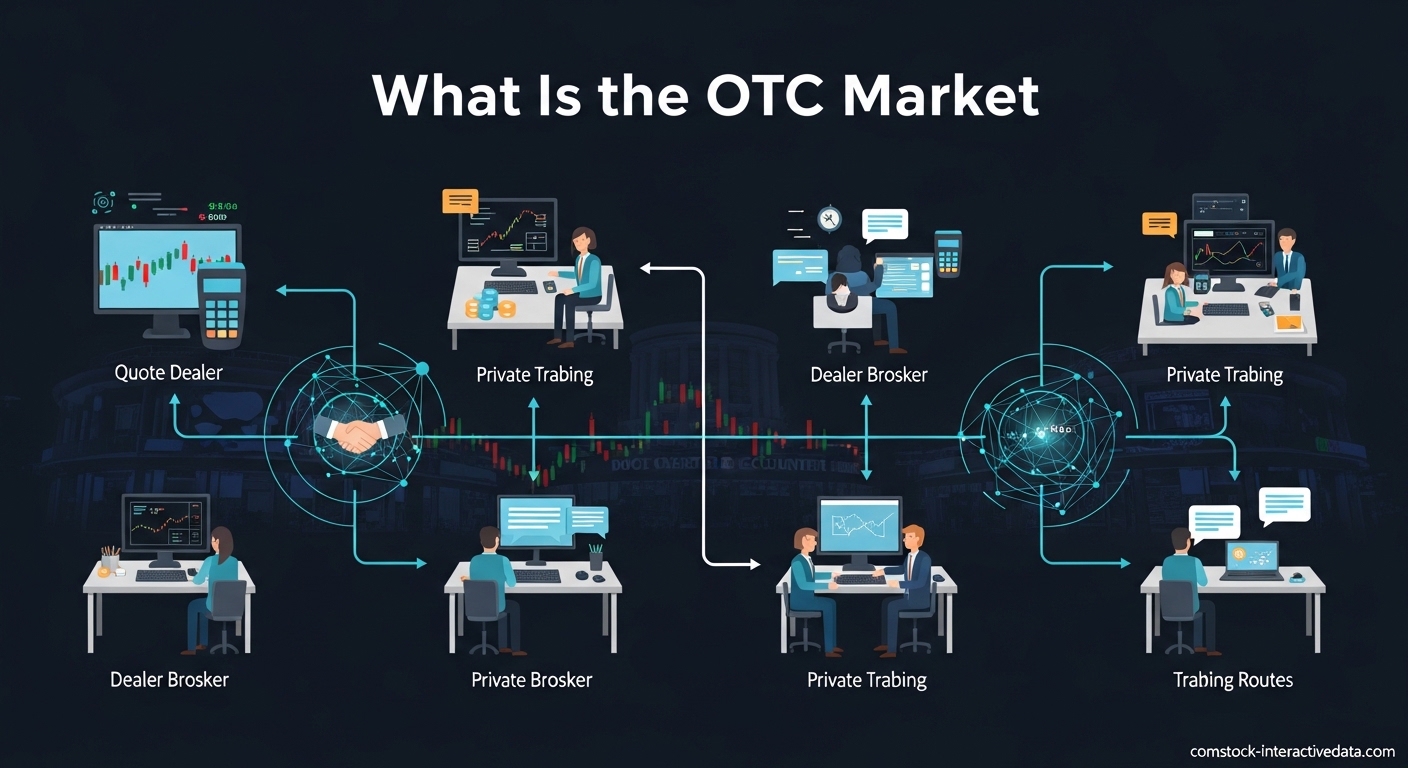
The OTC market is a decentralized marketplace where securities trade directly between two parties without a central exchange like the NYSE or Nasdaq. Unlike traditional stock exchanges, OTC trading happens through broker-dealer networks that connect buyers and sellers. Understanding these differences helps investors make informed decisions about where and how to trade.
Our team has analyzed how both markets operate to give you a clear picture of what separates them. Whether you are curious about penny stocks or want to understand why some companies trade off-exchange, this guide breaks down everything you need to know.
Table of Contents
What Is the OTC Market?
The OTC (over-the-counter) market is a decentralized trading system where financial securities change hands directly between two parties without going through a centralized exchange. Instead of matching buyers and sellers on a single platform, OTC markets rely on networks of broker-dealers who act as market makers.
These broker-dealers quote prices at which they will buy (bid) and sell (ask) securities. When you want to trade an OTC stock, your broker contacts these market makers to execute your order. This bilateral trading approach differs fundamentally from the auction-style matching used by stock exchanges.
The term “over-the-counter” dates back to when trades literally happened across store counters. While technology has transformed how these transactions occur, the core concept remains. Deals happen directly between participants rather than through a central order book.
Types of Securities Traded OTC
OTC markets handle securities that do not meet the listing requirements of major exchanges or choose not to list there. This includes small company stocks, often called penny stocks or microcap stocks, that lack the market capitalization or track record for NYSE or Nasdaq listing.
Foreign companies also use OTC markets to reach American investors without the cost and complexity of a full U.S. exchange listing. These often trade as American Depositary Receipts (ADRs). Additionally, derivatives, certain bonds, and forex currency pairs commonly trade over the counter.
How OTC Markets Work?
Understanding the mechanics of OTC trading helps explain why it differs from exchange trading. The process involves several key participants and steps that create a less centralized but more flexible marketplace.
The Role of Market Makers
Market makers are broker-dealers who commit to buying and selling specific securities. They maintain inventories of stocks and quote both bid and ask prices throughout the trading day. When you place an order, these market makers provide the liquidity to complete your trade.
Unlike exchanges where multiple buyers and sellers compete openly, OTC trading often involves negotiating with a single market maker. This relationship can affect the price you receive, especially in less active securities where only one or two market makers operate.
Bid-Ask Spreads and Price Discovery
The bid-ask spread represents the difference between what buyers will pay and what sellers will accept. In OTC markets, these spreads are typically wider than on major exchanges. This happens because fewer participants compete on pricing, and market makers need compensation for the additional risk they take.
Price discovery in OTC markets works differently too. Without a central limit order book showing all pending trades, prices form through direct negotiations between parties. This can lead to less transparent pricing, especially for thinly traded securities where transaction data may be limited.
What Happens When a Stock Goes to OTC?
Companies sometimes move from major exchanges to OTC markets. This typically happens when a stock fails to meet exchange requirements, such as maintaining a minimum share price above $1 or meeting market capitalization thresholds.
When a stock goes OTC, trading mechanics change significantly. Liquidity often drops, spreads widen, and investor attention decreases. The company must still file reports with the SEC if they want to maintain any tier status above Pink Sheets, but disclosure requirements become less stringent.
Key Differences Between OTC Markets and Stock Exchanges
OTC markets and stock exchanges differ in fundamental ways that affect trading experience, risk levels, and investor protection. Here are the main distinctions every investor should understand.
Centralized vs Decentralized Structure
Stock exchanges like the NYSE and Nasdaq operate as centralized marketplaces with physical or virtual trading floors where all orders flow. This centralization creates a single point of price discovery and ensures all participants see the same quotes.
OTC markets have no central location or matching engine. Trading occurs through dispersed broker-dealer networks, creating a more fragmented system. This decentralization offers flexibility but reduces the uniformity that exchange trading provides.
Regulation and Oversight
Exchanges operate under strict SEC oversight with comprehensive listing standards. Companies must meet financial requirements, disclose information regularly, and maintain compliance with ongoing obligations. The exchange itself enforces rules and can delist companies that fail to comply.
OTC markets have varying levels of regulation depending on the tier. While all OTC trading falls under FINRA and SEC oversight, the specific requirements differ significantly from exchange standards. Lower tiers may have minimal disclosure obligations, creating information gaps for investors.
Transparency and Information Availability
Exchanges provide real-time trade data, order book depth, and comprehensive company information. This transparency helps investors make informed decisions and spot potential problems early. Regulatory filings are standardized and readily accessible.
OTC markets offer less transparency, particularly in lower tiers. Some companies provide minimal financial information, and trading data may be delayed or incomplete. This information asymmetry creates additional risk for investors who cannot fully research their investments.
Liquidity and Trading Volume
Exchange-listed securities generally enjoy higher liquidity with more buyers and sellers active at any time. This makes entering and exiting positions easier and typically results in better prices for investors. Large orders can often be filled without significantly moving the price.
OTC securities often suffer from lower liquidity. Thinly traded stocks may have wide gaps between trades, making it difficult to sell quickly without accepting a lower price. This liquidity risk becomes especially important during market stress or when you need to exit a position urgently.
Comparison: Exchange vs OTC Trading
| Feature | Stock Exchanges (NYSE/Nasdaq) | OTC Markets |
|---|---|---|
| Structure | Centralized marketplace | Decentralized broker-dealer network |
| Listing Requirements | Strict financial and reporting standards | Varies by tier, minimal for Pink Sheets |
| Transparency | High – real-time data, full disclosure | Variable – depends on tier |
| Liquidity | Generally high | Often lower, varies by stock |
| Bid-Ask Spreads | Tight (pennies for liquid stocks) | Wider (can be significant percentage) |
| Regulatory Oversight | Extensive SEC and exchange regulation | FINRA/SEC oversight with tier variations |
| Trading Hours | Set exchange hours (9:30 AM – 4:00 PM ET) | Broker-dependent, often limited |
| Counterparty Risk | Minimal – clearinghouse guarantees | Higher – bilateral settlement |
| Price Discovery | Centralized auction mechanism | Negotiated between parties |
| Typical Securities | Established companies, large caps | Small companies, foreign stocks, derivatives |
Understanding the Different OTC Market Tiers
Not all OTC markets are created equal. The OTC Markets Group operates several tiers with different standards and disclosure requirements. Understanding these distinctions helps investors assess the relative risk of different OTC securities.
OTCQX: The Premium Tier
OTCQX represents the highest quality tier of OTC markets. Companies listed here meet stringent financial standards and provide comprehensive disclosure to investors. Many are established international companies that choose OTC access over full U.S. exchange listing.
To qualify for OTCQX, companies must meet minimum bid price requirements, have audited financials, and maintain ongoing disclosure compliance. This tier excludes penny stocks, shell companies, and firms with limited public information. While not equivalent to exchange listing, OTCQX offers more transparency than lower tiers.
OTCQB: The Venture Market
OTCQB serves as a venture market for early-stage and developing companies. Firms here must be current in their reporting to the SEC or a U.S. banking regulator. This tier requires a minimum bid price of one cent and includes a management certification process.
Companies on OTCQB often represent growing businesses that have not yet achieved the scale or history for higher tiers. While riskier than OTCQX, this tier still requires meaningful disclosure, helping investors research these emerging companies.
Pink Open Market
The Pink Open Market, historically known as Pink Sheets, includes securities with no continuous disclosure requirements. This tier contains everything from legitimate foreign companies to shell corporations and defunct businesses. The lack of reporting standards makes thorough due diligence essential.
Pink Sheet companies fall into several subcategories based on information quality. Current information companies provide some disclosure, while limited information firms offer minimal data. Caveat emptor warnings appear on stocks with public interest concerns or promotional activity.
Grey Market and Expert Market
The Grey Market includes securities that are not quoted by broker-dealers. Trading here is sporadic and information extremely limited. The Expert Market serves as a restricted tier for securities that do not meet current public disclosure standards.
OTC Market Tiers Comparison
| Tier | Disclosure Requirements | Company Types | Risk Level |
|---|---|---|---|
| OTCQX | Comprehensive, audited financials | Established international companies, quality domestic firms | Lower |
| OTCQB | SEC current reporting | Developing companies, early-stage ventures | Moderate |
| Pink Current | Some ongoing disclosure | Varied, including foreign and domestic companies | Higher |
| Pink Limited | Minimal information | Often distressed or inactive companies | High |
| Grey Market | No quotation, little data | Sporadic trading, very limited information | Very High |
Advantages and Disadvantages of OTC Trading
OTC markets serve important functions in the financial system despite their risks. Understanding both benefits and drawbacks helps investors decide if OTC securities belong in their portfolios.
Advantages of OTC Markets
OTC markets provide access to securities unavailable on major exchanges. Investors can buy shares in international companies without dealing with foreign brokerage accounts or currency conversions. ADRs trade OTC, offering exposure to global businesses.
Small companies and startups use OTC markets to raise capital before they qualify for exchange listing. This creates opportunities for early investors willing to accept higher risk for potential growth. Companies benefit from lower listing costs and less stringent requirements.
Derivatives and customized financial instruments often trade over the counter. This allows parties to negotiate specific terms, settlement dates, and contract sizes that standardized exchange products cannot accommodate. Large institutions use OTC derivatives for hedging and speculation.
Disadvantages of OTC Trading
Lower liquidity in OTC markets means wider bid-ask spreads and more difficulty executing large orders without affecting prices. Investors may pay significantly more when buying and receive less when selling compared to exchange-traded securities.
Limited transparency makes research challenging. Some OTC companies provide minimal financial information, and promotional schemes can artificially inflate prices before insiders sell. The lack of continuous disclosure creates information asymmetry favoring insiders.
Counterparty risk increases because no clearinghouse guarantees trades. While broker-dealers manage settlement, the bilateral nature of OTC trading means each party must trust the other to fulfill obligations. This risk becomes acute during financial stress.
Key Risks of Trading in OTC Markets
OTC markets present specific risks that investors must understand before trading. These risks do not mean avoiding OTC securities entirely, but they do require additional caution and due diligence.
Fraud and Manipulation
OTC markets have historically attracted fraudulent schemes, particularly pump-and-dump operations. Promoters artificially inflate a stock price through misleading positive statements, then sell their shares at the peak, leaving other investors with losses as the price collapses.
Shell companies with no real business operations sometimes trade on OTC markets. These entities exist primarily to attract investor money through promotional campaigns. Without the disclosure requirements of exchange listing, identifying legitimate businesses becomes more difficult.
Counterparty and Settlement Risk
When you trade on an exchange, a clearinghouse guarantees the transaction, eliminating concern that the other party will fail to deliver. OTC trades lack this protection. Settlement occurs bilaterally between broker-dealers, creating potential for default if one party faces financial distress.
This counterparty risk contributed to problems during the 2008 financial crisis when OTC derivatives markets froze. Participants became uncertain about their trading partners’ solvency, reducing market activity and amplifying the crisis.
Liquidity and Exit Risk
The risk of being unable to sell at a reasonable price concerns many OTC investors. Thin trading means your sell order might wait days to fill or require accepting a price well below recent quotes. During market downturns, this liquidity can dry up completely.
Investors who need to access cash quickly may find themselves trapped in OTC positions. Planning for longer holding periods and only investing money you will not need immediately helps manage this risk.
Due Diligence Checklist for OTC Investing
Before buying any OTC security, verify the company actually operates a real business with revenue and assets. Check SEC filings for financial statements and look for audited results from reputable accounting firms. Research management backgrounds and check for any regulatory enforcement actions.
Be skeptical of promotional materials and unsolicited recommendations. Verify any claims about products, contracts, or partnerships through independent sources. Check the OTC tier status and understand what disclosure requirements apply to that specific security.
Set position size limits for OTC investments, never risking more than you can afford to lose completely. Use limit orders rather than market orders to control the price you pay. Monitor positions regularly and be prepared to exit quickly if red flags appear.
Frequently Asked Questions
How is the OTC market different from the exchanges?
The OTC market differs from exchanges in several key ways: it operates as a decentralized broker-dealer network rather than a centralized marketplace, has less stringent disclosure requirements, offers lower transparency, typically has wider bid-ask spreads, and carries higher counterparty risk because no clearinghouse guarantees trades.
What is the OTC market in simple terms?
The OTC market is a decentralized marketplace where securities trade directly between two parties through broker-dealer networks rather than on a centralized exchange like the NYSE or Nasdaq. It connects buyers and sellers without a formal trading floor or central order matching system.
Is it good to trade on the OTC market?
OTC trading can be appropriate for experienced investors with high risk tolerance seeking access to small companies, international stocks, or specialized securities. However, the lower liquidity, reduced transparency, and higher fraud risk make OTC markets unsuitable for beginners or those investing essential funds.
What happens when a stock goes to OTC?
When a stock moves to OTC markets from a major exchange, it typically experiences reduced liquidity, wider bid-ask spreads, and less investor attention. The company faces lower disclosure requirements depending on the tier, and trading mechanics shift from centralized exchange matching to broker-dealer negotiations.
What is the difference between stock exchanges and the OTC market?
Stock exchanges are centralized marketplaces with strict listing requirements, high transparency, tight bid-ask spreads, and clearinghouse guarantees. OTC markets are decentralized networks with varying disclosure standards, lower liquidity, wider spreads, and bilateral settlement without central clearing protection.
What is the difference between OTC and exchange traded?
Exchange-traded securities trade on centralized platforms with standardized contracts, continuous price discovery, and regulatory oversight. OTC securities trade directly between parties through dealers, often with customized terms, negotiated pricing, and less standardized information disclosure.
What are the disadvantages of OTC trading?
Major disadvantages include lower liquidity making it harder to exit positions, wider bid-ask spreads that increase transaction costs, limited transparency and information availability, higher risk of fraud and manipulation, counterparty settlement risk without clearinghouse protection, and greater volatility in thinly traded securities.
Conclusion
The OTC market serves a vital role in the financial ecosystem by providing access to securities that do not fit within the rigid structure of major exchanges. Small companies gain access to capital, international businesses reach American investors, and institutions trade customized derivatives that standardized products cannot accommodate.
However, these benefits come with meaningful trade-offs. Lower liquidity, reduced transparency, and higher fraud potential demand greater caution from investors. Understanding the differences between OTC markets and stock exchanges helps you evaluate whether these securities belong in your portfolio.
OTC trading suits experienced investors with strong research skills and high risk tolerance. If you are new to investing or rely on your investment funds for near-term needs, sticking with exchange-traded securities offers better protection and easier execution. For those willing to do the work, OTC markets provide opportunities unavailable elsewhere, but never invest more than you can afford to lose completely.