
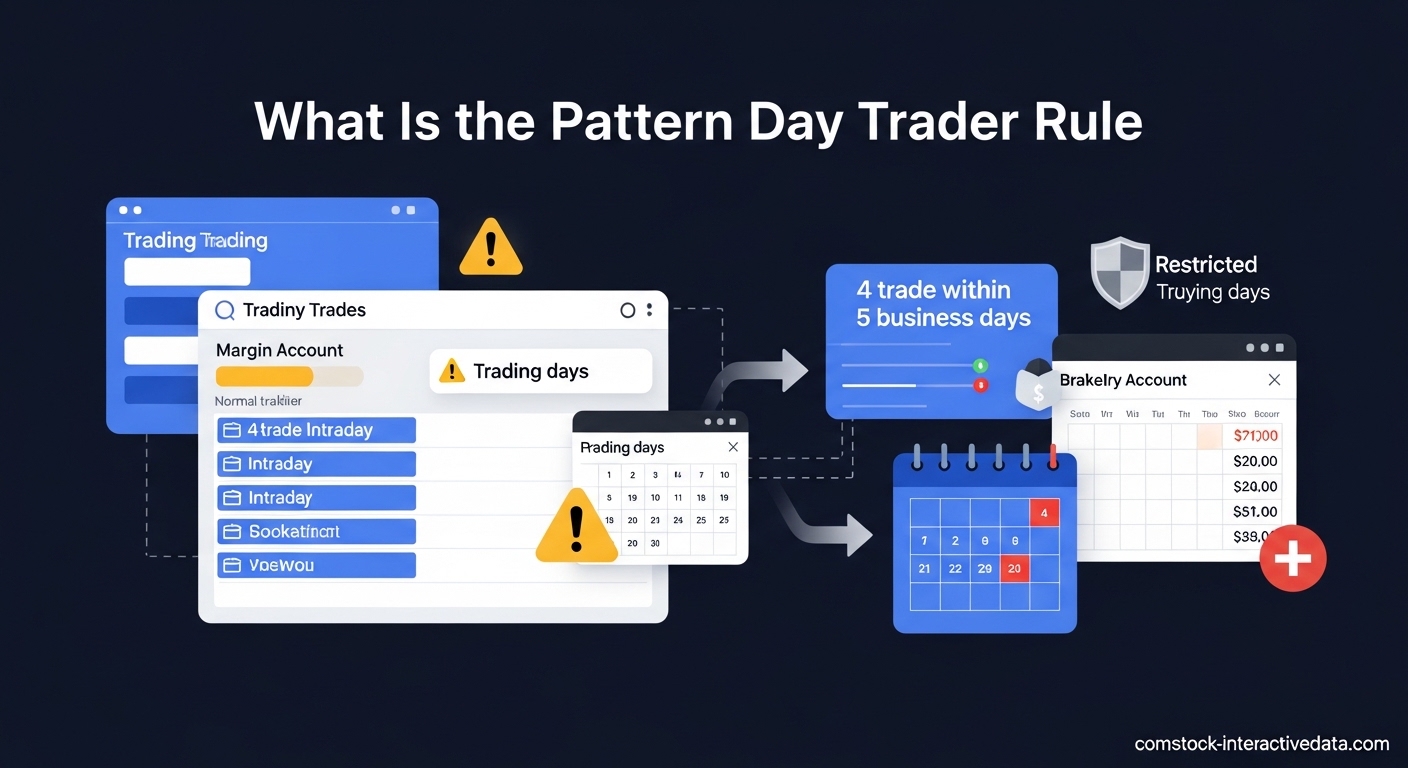
The pattern day trader rule is a FINRA regulation that designates any margin account customer who executes four or more day trades within five business days as a pattern day trader, provided those trades represent more than 6% of total account activity. Once flagged, the account must maintain a minimum equity of $25,000 to continue day trading. This rule, officially FINRA Rule 4210, was established to protect traders and brokerage firms from the extreme risks associated with frequent day trading.
I remember when I first started trading and stumbled into this rule completely by accident. After my third day trade of the week, my broker sent me a warning message that I did not understand until I researched what the PDT rule actually meant. That experience taught me how important it is to know these regulations before you start actively trading.
In this guide, I will walk you through everything you need to know about the pattern day trader rule. You will learn exactly what qualifies you as a pattern day trader, how the $25,000 requirement works, what happens if you get flagged, and legitimate ways to work within or around the restrictions. Whether you are trading with $5,000 or $50,000, this information will help you avoid costly mistakes and unexpected account restrictions.
Table of Contents
What Is a Pattern Day Trader?
A pattern day trader (PDT) is a regulatory classification created by the Financial Industry Regulatory Authority (FINRA) to identify customers who engage in frequent day trading activity. Under FINRA Rule 4210, you become classified as a pattern day trader when you meet two specific criteria in a margin account.
First, you must execute four or more day trades within five consecutive business days. Second, those day trades must represent more than 6% of your total trading activity during that same five-day period. Both conditions must be true for the PDT classification to apply.
What Counts as a Day Trade?
A day trade occurs when you buy and sell, or sell short and buy to cover, the same security on the same day in a margin account. This applies to stocks and options traded on the same trading session. If you buy shares on Tuesday and sell them on Wednesday, that is not a day trade. If you buy at 10 AM and sell at 2 PM on the same day, that counts as one day trade.
Opening and closing a position counts as one day trade, regardless of how many shares you trade. If you buy 100 shares of Apple in the morning and sell 50 at noon and 50 in the afternoon, that still counts as just one day trade. However, if you buy 100 shares, sell them, then buy another 100 shares and sell those same day, that counts as two day trades.
The 6% Threshold Explained 2026
The 6% threshold often confuses new traders. This rule means that your day trades must represent more than 6% of your total trading volume during the five-day period to trigger PDT status. If you make 100 total trades in five days and 4 of them are day trades, that is only 4%, so you would not be flagged. If you make 50 total trades and 4 are day trades, that is 8%, so you would meet the threshold.
In practice, most brokers automatically flag any account with four or more day trades in five days because the majority of traders who hit the four-trade mark also exceed the 6% threshold. However, high-volume traders should understand this calculation, especially if you make dozens of trades per week.
How Does the Pattern Day Trader Rule Work?
The pattern day trader rule works by automatically flagging accounts that meet the trading frequency criteria, then imposing specific requirements and restrictions on those accounts. Understanding the mechanics helps you plan your trading strategy and avoid unexpected limitations.
The Five-Day Rolling Window
The five business day window is a rolling calculation, not a calendar week. This means brokers look at any five consecutive trading days, not just Monday through Friday. If you make a day trade on Wednesday, it counts toward your limit until the following Wednesday passes.
Here is how the rolling window works in practice. Imagine you make day trades on Monday, Tuesday, and Thursday of week one. You have used three day trades. On Monday of week two, you make another day trade. Your broker now counts trades from the previous Tuesday, Thursday, and current Monday, plus any new trades. Once Wednesday of week two passes, your first Monday trade drops off the calculation.
This rolling window creates a moving calculation that requires constant awareness. Many trading platforms display your day trade count prominently on your dashboard to help you track where you stand.
Margin Accounts vs Cash Accounts
The pattern day trader rule only applies to margin accounts, not cash accounts. This distinction is crucial for traders with smaller accounts who want to avoid restrictions. Let me break down the key differences between these account types.
A margin account allows you to borrow money from your broker to purchase securities, effectively trading with leverage. With a margin account, you can buy stocks immediately after selling others without waiting for settlement. This flexibility makes day trading possible but subjects you to PDT regulations.
A cash account requires you to pay in full for securities using settled funds only. When you sell stock in a cash account, you must wait for the trade to settle, typically two business days (T+2), before using those funds again. While this limits your trading frequency, cash accounts have no PDT restrictions regardless of how many day trades you make.
| Feature | Margin Account | Cash Account |
|---|---|---|
| PDT Rule Applies | Yes | No |
| Minimum Balance for Day Trading | $25,000 | None |
| Leverage Available | Up to 4x (PDT) or 2x (regular) | None |
| Settlement Period | Immediate (with margin) | T+2 (2 business days) |
| Day Trade Limit (Under $25k) | 3 per 5 days | Unlimited |
| Options Trading | Yes (if approved) | Yes (cash-secured) |
Day Trade Buying Power (DTBP)
Once classified as a pattern day trader with at least $25,000 in equity, you receive something called Day Trade Buying Power (DTBP). This is a significant advantage that allows you to trade with up to four times your maintenance margin excess, effectively giving you 4:1 leverage on day trades.
Here is how DTBP works with real numbers. If you have $30,000 in your margin account and hold $5,000 in overnight positions, your maintenance margin excess is $25,000. Your day trade buying power would be $100,000 (4 x $25,000). This means you could day trade up to $100,000 worth of securities in a single day, even though your account value is only $30,000.
However, if your account equity falls below $25,000, your day trade buying power disappears completely. You can only trade with standard margin buying power (2:1) for overnight positions, and you are prohibited from making new day trades until your equity returns to $25,000.
The $25,000 Minimum Equity Requirement
The $25,000 minimum equity requirement is the most well-known and often most frustrating aspect of the pattern day trader rule. This requirement exists for specific regulatory and risk management reasons that trace back to the early 2000s.
Why $25,000? The Historical Context
The pattern day trader rule was established by FINRA in 2001, shortly after the dot-com bubble burst. During the late 1990s, online trading became widely accessible, and millions of inexperienced investors began day trading tech stocks with little understanding of the risks involved.
When the bubble burst in 2000, countless day traders lost their entire accounts and more. Many had traded on margin, amplifying their losses beyond their initial deposits. Brokerage firms faced significant losses from customers who could not cover their margin calls. The $25,000 requirement was designed to ensure that only traders with sufficient capital, and presumably some financial cushion, could engage in this high-risk activity.
The specific $25,000 figure was not arbitrary. Regulators analyzed the average losses experienced during the crash and determined that this amount provided a reasonable buffer to absorb typical day trading losses without creating systemic risk to brokerage firms or triggering catastrophic personal financial disasters.
What Counts Toward the $25,000?
The $25,000 minimum equity requirement includes cash and the market value of securities in your margin account. This includes stocks, options, and other marginable securities. However, it does not include non-marginable securities or funds that have not yet settled.
Your equity fluctuates throughout the trading day as your positions change value. If you start the day with $26,000 and your positions decline in value, you could temporarily fall below the $25,000 threshold. Brokers calculate this in real-time, and if you drop below $25,000, your day trading privileges are immediately suspended until you restore the minimum equity.
The Buffer Zone Strategy
Many experienced pattern day traders maintain a buffer above the $25,000 minimum to avoid accidentally falling below the threshold during volatile trading sessions. A common rule of thumb is to maintain at least $27,000 to $28,000 in account equity.
This buffer protects you from normal market fluctuations that could temporarily push your account below $25,000. If you trade with exactly $25,100 and your positions drop 1% during the day, you could suddenly find yourself restricted from making new trades. That buffer eliminates this risk and gives you peace of mind to focus on your trading strategy rather than your account balance.
What Happens If You’re Flagged as a Pattern Day Trader?
Getting flagged as a pattern day trader triggers a specific set of restrictions and requirements that can significantly impact your trading activity. Understanding these consequences helps you prepare and respond appropriately.
Immediate Restrictions When Flagged
When your broker flags your account as a pattern day trader, several things happen immediately. First, your account is placed under enhanced monitoring. Second, you must maintain the $25,000 minimum equity at all times to continue day trading. Third, you receive day trade buying power if you meet the equity requirement.
If your account has less than $25,000 when flagged, or if your equity drops below $25,000 after being flagged, you face severe restrictions. You cannot execute any new day trades. Your account is restricted to closing transactions only, meaning you can sell existing positions but cannot open new ones that would constitute day trades. You must deposit funds or wait for your existing positions to appreciate enough to bring your equity back above $25,000.
The 90-Day Cash Account Restriction
If you are flagged as a pattern day trader and your account falls below $25,000, some brokers impose a 90-day restriction period. During this time, your account may be restricted to liquidating trades only, and you may be prohibited from opening new margin positions.
This 90-day restriction is one of the most frustrating consequences for traders who accidentally trigger the PDT rule. I have seen forum posts from traders who did not realize they had made four day trades until they received the restriction notice. For active traders, being unable to trade for 90 days feels like an eternity.
The One-Time Exception
Many brokers offer a one-time exception to remove the pattern day trader flag from your account. This policy varies by broker, so you should check your broker’s specific rules. Some brokers allow you to request removal once per account lifetime. Others may allow it once per year.
To use the one-time exception, you typically need to contact customer service and request removal of the PDT flag. You must agree not to engage in pattern day trading activity going forward. If you trigger the rule again after using your exception, the flag becomes permanent and the restrictions apply immediately.
Margin Calls and Minimum Equity Calls
If your account equity drops below $25,000, you may receive a minimum equity call from your broker. This is similar to a margin call but specifically relates to the PDT requirements. You typically have five business days to deposit additional funds to meet the $25,000 requirement.
If you fail to meet the call within the specified timeframe, your account may be further restricted. Some brokers convert margin accounts to cash accounts when calls are not met. Others may liquidate positions to bring the account into compliance. The specific actions depend on your broker’s policies and the severity of the deficiency.
How to Avoid or Work Around the PDT Rule?
If you have less than $25,000 and want to trade actively, you have several legitimate options to either work within the PDT restrictions or avoid them entirely. Each approach has advantages and disadvantages that you should understand before choosing your strategy.
Strategy 1: Use a Cash Account
The simplest way to avoid the pattern day trader rule is to trade in a cash account rather than a margin account. The PDT rule does not apply to cash accounts, meaning you can make unlimited day trades regardless of your account balance.
However, cash accounts have their own limitations. You must wait for trades to settle before using the proceeds for new trades. Stock trades settle in two business days (T+2). Options trades settle in one business day (T+1). This means if you sell a stock on Monday, you cannot use those funds to buy another stock until Wednesday.
Pros: No PDT restrictions, no $25,000 minimum, no risk of margin calls.
Cons: Settlement delays limit trading frequency, no leverage available, good faith violations possible.
Strategy 2: Trade Futures or Forex
Futures and forex markets are not subject to the pattern day trader rule. These markets are regulated by the CFTC (Commodity Futures Trading Commission) rather than FINRA, and they have different margin requirements and trading rules. You can day trade futures or forex with accounts much smaller than $25,000 without triggering PDT restrictions.
Futures trading offers significant leverage, sometimes 20:1 or higher depending on the contract. Some brokers allow you to open futures accounts with as little as $500 to $2,000. However, this high leverage amplifies both gains and losses, making futures trading extremely risky for inexperienced traders.
Forex trading similarly offers high leverage, often 50:1 for major currency pairs. The forex market operates 24 hours a day, providing flexibility for traders in different time zones. However, forex markets can be highly volatile and unpredictable.
Pros: No PDT rule, high leverage available, 24-hour markets (forex), lower capital requirements.
Cons: Extremely high risk due to leverage, different market dynamics, steep learning curve, potential for rapid losses.
Strategy 3: Use Multiple Brokerage Accounts
Some traders open accounts at multiple brokerage firms to effectively triple their day trading allowance. Since the PDT rule applies per account rather than per person, you could theoretically make three day trades per week at Broker A, three at Broker B, and three at Broker C.
However, this strategy has significant drawbacks. You must maintain sufficient capital in each account to make meaningful trades. Splitting a $10,000 account across three brokers leaves you with minimal buying power at each. You also face the logistical challenge of monitoring multiple platforms and tracking your trades across different accounts.
Pros: Effectively increases day trade allowance, diversification across platforms.
Cons: Capital fragmentation reduces buying power, logistical complexity, account maintenance fees may apply.
Strategy 4: Swing Trading
Swing trading involves holding positions for multiple days, avoiding the definition of a day trade entirely. By holding overnight, you sidestep the PDT restrictions while still capturing short to medium-term price movements. This approach works particularly well for traders who analyze technical patterns that play out over several days.
Swing trading requires different skills than day trading. You must be comfortable holding through overnight gaps and news events that can cause significant price movements before the market opens. Risk management becomes even more critical since you cannot exit positions immediately if adverse news breaks after hours.
Pros: No PDT restrictions apply, captures larger price moves, less stressful than intraday trading.
Cons: Overnight risk exposure, requires different analysis approach, gaps can cause larger than expected losses.
Strategy 5: Prop Trading Firms
Proprietary trading firms, or prop firms, provide funded accounts to traders who pass their evaluation processes. These firms typically have no PDT restrictions because you trade the firm’s capital rather than your own margin account. You pay an evaluation fee, demonstrate your trading skills on a simulator, and receive access to a funded account if you meet their criteria.
Popular prop firms include FTMO, Topstep, and Earn2Trade. Each has different evaluation criteria, profit splits, and account sizes. Most require you to prove consistent profitability while following risk management rules before funding your account.
Pros: Access to large accounts ($50k-$200k), no PDT restrictions, professional trading environments.
Cons: Evaluation fees required, profit sharing reduces earnings, strict risk rules, evaluation pressure.
| Workaround | Min Capital | PDT Applied | Leverage | Best For |
|---|---|---|---|---|
| Cash Account | $0 | No | None | Patient traders |
| Futures Trading | $500-$2,000 | No | High (20:1+) | Experienced traders |
| Forex Trading | $100-$500 | No | Very High (50:1) | Currency specialists |
| Multiple Accounts | $3,000+ per account | Yes (per account) | 2:1 | Organized traders |
| Swing Trading | $0 | No | 2:1 (margin) | Multi-day holders |
| Prop Firm | $100-$500 (eval fee) | No | Varies | Skilled traders |
Practical Examples and Scenarios
Let me walk you through some real-world scenarios to illustrate how the pattern day trader rule works in practice. These examples show different account sizes and trading patterns so you can see exactly how the rule might affect you.
Scenario 1: The $10,000 Account
Sarah has a $10,000 margin account and wants to actively trade. She makes three day trades on Monday, Tuesday, and Wednesday. On Thursday, she wants to exit a position she opened that morning, but she realizes this would be her fourth day trade.
If Sarah makes that fourth trade, she becomes a pattern day trader. Since her account is below $25,000, her broker will immediately restrict her account. She will receive a margin call requiring her to deposit $15,000 to bring her account to $25,000. If she cannot deposit the funds within five business days, her account may be restricted to liquidating trades only for 90 days.
Sarah’s options at this point are limited. She could hold her position overnight, turning it into a swing trade rather than a day trade. She could deposit $15,000 to meet the minimum equity requirement. Or she could contact her broker and request a one-time PDT flag removal if she has not used it before.
Scenario 2: The $30,000 Pattern Day Trader
Michael has a $30,000 margin account and has been flagged as a pattern day trader. He receives $100,000 in day trade buying power (4x his maintenance margin excess of $25,000). On a volatile Monday, he makes several day trades using his full DTBP.
During the trading session, some of Michael’s positions move against him. By 2 PM, his account equity has temporarily dropped to $24,500 due to unrealized losses. His broker immediately restricts his account from making new day trades. Even though his positions might recover by market close, the real-time equity calculation prevents him from opening new positions.
Michael must either deposit additional funds to bring his equity back above $25,000 or wait for his existing positions to recover. This illustrates why experienced traders recommend maintaining a buffer above the $25,000 minimum.
Scenario 3: The Cash Account Trader
David has a $5,000 cash account and wants to avoid PDT restrictions entirely. He trades in a cash account where settlement rules apply but PDT rules do not. On Monday morning, he buys $2,000 worth of stock A and sells it that afternoon for a profit. This is a day trade, but since he is in a cash account, no PDT flag occurs.
However, David cannot use those proceeds until Wednesday (T+2 settlement). If he tries to buy stock B on Tuesday with the funds from Monday’s sale, he commits a good faith violation. Three good faith violations in 12 months result in a 90-day restriction to settled-cash-only trading.
To trade daily in a cash account, David must carefully manage his settled cash. He could split his $5,000 into two portions, trading $2,500 on Monday and $2,500 on Tuesday, then returning to the Monday proceeds on Wednesday when they settle. This approach effectively limits him to trading half his account each day.
Scenario 4: The Rolling Window Calculation
Let me show you exactly how the five-day rolling window works with a specific calendar example. Jessica tracks her day trades carefully to stay under the PDT threshold with her $15,000 account.
Week 1: Monday (Trade 1), Wednesday (Trade 2), Friday (Trade 3). She has used three day trades. Week 2: On Monday, her first trade from the previous Monday falls off the rolling window. She now has trades from Wednesday, Friday (last week), and can make one new trade on Monday without triggering PDT.
If Jessica makes a trade on Monday of week 2, her count becomes: Wednesday (week 1), Friday (week 1), Monday (week 2) = three active trades. On Tuesday of week 2, her Wednesday trade from week 1 falls off. She could make another trade, maintaining three active trades in the rolling window.
This rolling calculation means Jessica can theoretically make one day trade every other trading day while staying under the four-trade threshold. Over a month with 22 trading days, she could make approximately 11 day trades while staying PDT-compliant.
Checklist: Am I a Pattern Day Trader?
Use this checklist to determine if you are currently classified as a pattern day trader or at risk of becoming one. Answer yes or no to each question.
Account Type Check:
Do you have a margin account? (If no, PDT rules do not apply to you)
Is your account equity currently above $25,000?
Trading Activity Check (Last 5 Business Days):
Have you made 4 or more day trades? (Buy and sell same security same day)
Do your day trades represent more than 6% of your total trades?
Have you received a PDT warning or flag notification from your broker?
Current Status Check:
Does your broker platform show “Pattern Day Trader” on your account?
Have you been restricted from opening new positions?
Have you received a minimum equity call?
Scoring:
If you answered yes to having a margin account AND yes to 4+ day trades in 5 days, you are likely flagged as a pattern day trader.
If your equity is below $25,000 and you are flagged, you face trading restrictions.
If you have a cash account, you are exempt from PDT classification regardless of your trading activity.
Frequently Asked Questions
Can I get around the pattern day trader rule?
Yes, there are several legal ways to work around the PDT rule. You can use a cash account instead of a margin account, which exempts you from PDT restrictions entirely. You can trade futures or forex, which are regulated by the CFTC and not subject to FINRA’s PDT rule. You can open multiple brokerage accounts to increase your available day trades (3 per account). You can join a prop trading firm that provides funded accounts without PDT restrictions. Or you can focus on swing trading by holding positions overnight to avoid the day trade definition entirely.
Why is $25,000 required to day trade?
The $25,000 minimum equity requirement was established by FINRA in 2001 after the dot-com bubble burst. The requirement exists to protect both traders and brokerage firms from the extreme risks of day trading. Day trading has a high failure rate, and the $25,000 cushion helps absorb losses without creating systemic risk. The rule was designed to ensure only traders with sufficient capital and financial cushion could engage in high-frequency trading, reducing the likelihood of catastrophic personal losses and broker-dealer defaults.
What gets you flagged as a pattern day trader?
You get flagged as a pattern day trader when you execute four or more day trades within five consecutive business days in a margin account, provided those day trades represent more than 6% of your total trading activity during that period. A day trade is defined as buying and selling, or selling short and buying to cover, the same security on the same trading day. Brokers automatically flag accounts that meet these criteria, and the designation typically persists even if you stop day trading.
Is it true that 97% of day traders lose money?
Research consistently shows that a very high percentage of day traders lose money over time. While the exact statistic varies by study, academic research indicates that 70-97% of active day traders fail to achieve consistent profitability over extended periods. One comprehensive study of Brazilian futures traders found that 97% of individuals with more than 300 days of active trading lost money. Another study of Taiwanese traders found that 80% lost money. This high failure rate is a primary reason why the PDT rule exists, to protect inexperienced investors from significant losses.
How much money do day traders with $10,000 accounts make per day on average?
Day traders with $10,000 accounts cannot legally day trade under the PDT rule, as the minimum equity requirement is $25,000. Traders with accounts under $25,000 are restricted to a maximum of three day trades within any five business day period. Those who attempt to exceed this limit will have their accounts flagged and restricted. For traders above the $25,000 threshold, results vary dramatically, but research shows most day traders do not achieve consistent profitability. The few who do succeed typically treat trading as a full-time profession with extensive education and risk management systems.
How long does pattern day trader status last?
Pattern day trader status typically lasts indefinitely once assigned. The designation does not automatically expire after a certain period of inactivity. Even if you stop day trading entirely, most brokers maintain the PDT flag on your account permanently. However, many brokers offer a one-time exception that allows you to request removal of the PDT flag if you contact customer service. This exception can typically be used once per account lifetime. If you trigger the PDT rule again after using your exception, the flag becomes permanent.
Does the PDT rule apply to cash accounts?
No, the pattern day trader rule does not apply to cash accounts. The PDT rule only applies to margin accounts. In a cash account, you can make unlimited day trades regardless of your account balance. However, cash accounts have different restrictions: you must wait for trades to settle (T+2 for stocks, T+1 for options) before using the proceeds for new trades. Attempting to trade with unsettled funds can result in good faith violations. After three good faith violations in 12 months, your cash account may be restricted to settled-cash-only trading for 90 days.
Can I remove the pattern day trader flag from my account?
Many brokers offer a one-time exception that allows you to remove the pattern day trader flag from your account. Contact your broker’s customer service and request removal of the PDT designation. You will typically need to agree not to engage in pattern day trading activity in the future. Some brokers allow this exception once per account lifetime, while others may permit it once per calendar year. If you trigger the PDT rule again after using your exception, the flag usually becomes permanent. Policies vary by broker, so check your specific broker’s PDT removal policy.
Conclusion
The pattern day trader rule is one of the most important regulations any active trader must understand. Whether you have $5,000 or $50,000 in your account, knowing how FINRA Rule 4210 works can save you from unexpected restrictions and frustration. The rule requires pattern day traders to maintain $25,000 minimum equity in margin accounts and limits those with smaller accounts to three day trades per five-day period.
If you are trading with less than $25,000, you have legitimate options. Cash accounts offer unlimited day trades without PDT restrictions, though settlement periods apply. Futures and forex trading operate outside PDT regulations entirely. Swing trading avoids the day trade definition by holding positions overnight. Each approach has tradeoffs, but all provide viable paths for active trading.
Remember that the PDT rule exists because day trading carries extreme risk. Research consistently shows that the vast majority of day traders lose money. Before pursuing any strategy to work around or within the PDT rule, invest time in education, practice with paper trading, and never risk capital you cannot afford to lose completely. The markets will always be there tomorrow. Your trading capital might not be if you approach this profession unprepared.