
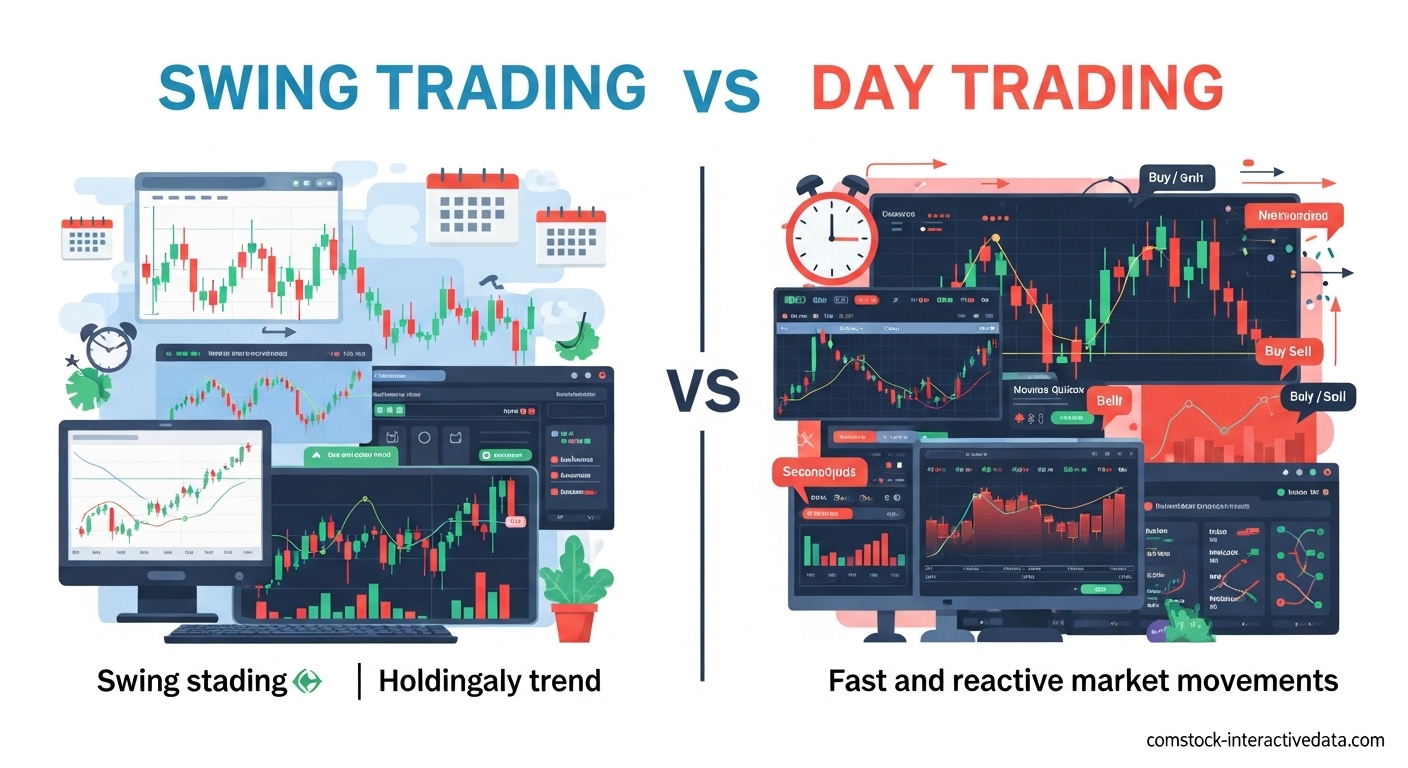
Swing trading vs day trading represent two fundamentally different approaches to profiting from financial markets. Day trading involves opening and closing positions within a single trading session, requiring constant market monitoring and rapid decision-making. Swing trading allows you to hold positions for several days or weeks, capturing larger price movements with less time-intensive monitoring requirements. If you thrive in high-pressure environments with full-time availability and at least $25,000 in capital, day trading may suit you; otherwise, the methodical, flexible approach of swing trading is likely a better fit for your lifestyle.
In this guide, I will break down everything you need to know about both trading styles. You will learn the exact differences in time commitment, capital requirements, risk profiles, and psychological demands. By the end, you will have a clear framework for determining which strategy aligns with your personality, schedule, and financial goals.
Table of Contents
What Is Day Trading?
Day trading is an active trading style where you open and close positions within the same trading day, never holding investments overnight. All trades are completed during market hours, with the goal of profiting from intraday price movements in stocks, forex, futures, or other financial instruments.
The defining characteristic of day trading is the timeframe. Positions typically last anywhere from a few seconds to several hours, but never extend beyond the closing bell. You aim to capture small price movements multiple times per day, accumulating profits through high-frequency trading activity.
Day traders rely heavily on technical analysis, using tools like Level 2 data, time and sales feeds, moving averages, VWAP, and candlestick patterns. Execution speed matters enormously. Many day traders use hotkeys and multiple monitors to enter and exit positions within seconds.
This trading style demands your full attention during market hours. You cannot day trade effectively while working another job or managing distractions. The market requires complete focus from the opening bell at 9:30 AM EST until the close at 4:00 PM EST for stock traders, or during active forex sessions for currency traders.
What Is Swing Trading?
Swing trading is a medium-term trading style where you hold positions for several days to several weeks, aiming to capture larger price movements than day trading allows. This approach bridges the gap between day trading and long-term investing, offering a balance between activity level and time commitment.
The holding period defines swing trading. You typically maintain positions for 2 days to 6 weeks, depending on market conditions and the strength of the trend you are following. Unlike day traders, swing traders embrace overnight exposure and seek to profit from multi-day price swings.
Swing traders use a combination of technical and fundamental analysis. You will analyze daily and 4-hour charts to identify support and resistance levels, trend direction, and entry points. Common tools include Fibonacci retracement, MACD, RSI, moving averages, and chart patterns like head and shoulders or flags.
This style fits part-time schedules. You can analyze markets after work, set your entry and exit orders, and let positions develop while you sleep or work your day job. Swing trading requires 1-2 hours of analysis per day rather than the constant monitoring demanded by day trading.
Swing Trading vs Day Trading: Key Differences
Understanding the core distinctions between these strategies helps you make an informed decision about your trading approach. Let us examine each critical dimension in detail.
| Factor | Day Trading | Swing Trading |
|---|---|---|
| Holding Period | Seconds to hours (same day) | Days to weeks |
| Time Commitment | 6-8 hours daily during market hours | 1-2 hours daily, flexible timing |
| Minimum Capital (US Stocks) | $25,000+ (PDT rule) | $500-$2,000 recommended |
| Overnight Risk | None | Significant exposure |
| Transaction Costs | High (frequent trades) | Lower (fewer trades) |
| Primary Analysis | Technical, intraday charts | Technical + fundamental, daily/weekly charts |
| Stress Level | High, rapid decisions required | Moderate, more time to analyze |
| Profit Target per Trade | Small, frequent gains | Larger, less frequent gains |
| Best For | Full-time traders, high risk tolerance | Part-time traders, methodical personalities |
Timeframe and Holding Period
The most obvious difference lies in how long you hold positions. Day traders close everything before the market closes, eliminating overnight risk but limiting profit potential per trade. Swing traders accept overnight exposure in exchange for capturing larger price movements.
Day trading timeframes range from 1-minute charts for scalpers to 15-minute or hourly charts for momentum traders. You are looking for quick intraday momentum and volatility. Swing traders focus on daily and 4-hour charts, identifying trends that develop over multiple sessions.
Capital Requirements and the PDT Rule
The Pattern Day Trader rule creates a significant barrier for aspiring day traders in the United States. FINRA regulations require a minimum of $25,000 in your account to make more than three day trades within a rolling five-day period. This rule does not apply to swing trading.
If you have less than $25,000, day trading US stocks becomes extremely restrictive. You are limited to three trades per week unless you use a cash account with settled funds only, which slows your ability to trade. Swing trading allows you to start with much smaller amounts, typically $500 to $2,000 for stock trading, though more capital provides better risk management flexibility.
Forex and futures markets have different margin requirements. Day trading forex requires less capital, sometimes as little as $500, though $2,000 to $5,000 is more practical. Futures day trading typically requires $5,000 to $10,000 depending on the contracts you trade.
Time Commitment and Lifestyle Fit
Day trading is essentially a full-time job. You must be present and focused during all market hours, analyzing charts, watching for setups, and executing trades. This makes it incompatible with standard employment or other daytime responsibilities.
Swing trading accommodates working professionals. You can perform your analysis in the evening after work, set orders for the next day, and check positions briefly during lunch breaks. Many successful swing traders maintain full-time careers while building their trading accounts.
Risk Management: Overnight vs Intraday
Day traders avoid overnight risk entirely. You sleep with no open positions, protected from earnings announcements, economic data releases, or geopolitical events that might cause gap moves against your positions. This zero overnight exposure is a major psychological benefit.
Swing traders accept overnight and weekend risk. Stocks can gap down 10% or more overnight on bad news. You manage this through position sizing, stop losses, and avoiding holding through major news events like earnings reports.
The 2% rule applies to both styles but manifests differently. Day traders risk 1-2% per trade but might take multiple trades per day. Swing traders also risk 1-2% but hold fewer positions, making each trade more significant to overall performance.
Technical Analysis Tools Comparison
Day traders need real-time data and fast execution tools. Essential tools include Level 2 quotes showing the order book, time and sales data for transaction flow, VWAP for intraday trend analysis, and hotkeys for rapid order entry. Charting focuses on 1-minute to 15-minute timeframes.
Swing traders use end-of-day data effectively. Your toolkit includes trend indicators like moving averages, momentum oscillators like RSI and MACD, Fibonacci retracement for support and resistance, and chart pattern recognition. Multi-timeframe analysis helps confirm trends across daily and weekly charts.
Emotional and Psychological Demands
Day trading tests your emotional control constantly. You make rapid decisions with real money on the line, watching positions move against you within seconds. The pressure requires exceptional discipline to avoid revenge trading after losses or overtrading out of boredom.
Swing trading offers more time for analysis and less moment-to-moment stress. You have hours or days to evaluate positions rather than seconds. However, holding through drawdowns overnight requires patience and tolerance for temporary losses that day traders never experience.
Pros and Cons of Day Trading
Advantages of Day Trading
You face no overnight risk, which means you avoid gap moves, earnings surprises, and weekend geopolitical events. Every day starts fresh with no carryover positions affecting your sleep or morning routine.
Compounding works faster with day trading. You can take multiple trades per day, reinvesting profits immediately. A successful day trader might execute 10 to 50 trades per week, building account equity through high-frequency activity.
Leverage is more readily available for intraday positions. Many brokers offer 4:1 intraday margin, allowing you to control larger positions with less capital. This magnifies both gains and losses, requiring careful management.
You see results immediately. There is no waiting weeks to know if your analysis was correct. Each day provides feedback on your strategy and execution, accelerating your learning curve if you review your trades properly.
Disadvantages of Day Trading
The $25,000 Pattern Day Trader rule creates a significant barrier to entry for US stock traders. Without this capital, you face restrictive trade limits that make day trading impractical.
Transaction costs accumulate rapidly. Even with commission-free brokers, you pay spreads and potentially exchange fees on dozens of trades daily. These costs eat into profits, making consistent profitability harder to achieve.
Day trading demands complete focus during market hours. You cannot check email, take phone calls, or handle other responsibilities while trading. This intensity leads to burnout for many traders.
The statistics are sobering. Studies suggest 70% to 97% of day traders lose money, with only a small percentage achieving consistent profitability. The combination of costs, leverage, and emotional pressure creates a challenging environment.
Pros and Cons of Swing Trading
Advantages of Swing Trading
You can start with modest capital. Without the PDT rule restricting your activity, accounts of $1,000 to $5,000 can trade effectively while managing risk appropriately.
Swing trading fits around a full-time job. Analysis happens after market hours, orders execute automatically, and you check positions briefly during the day. This makes it accessible to anyone with a day job.
Transaction costs are lower. Taking 2 to 10 trades per month instead of daily reduces commission expenses and spread costs significantly. Lower overhead means you keep more of your profits.
Larger profit targets per trade mean you can capture meaningful moves. A successful swing trade might yield 5% to 20% versus the 0.5% to 2% typical for day trades. Fewer, larger wins can be psychologically easier to manage.
You have time to analyze thoroughly. No rush means better decision quality. You can research setups, check multiple timeframes, and wait for optimal entry points rather than forcing trades.
Disadvantages of Swing Trading
Overnight and weekend risk exposure is unavoidable. Gap moves can take positions well beyond your stop loss levels, creating larger losses than anticipated. Earnings reports, economic data, and unexpected news events work against you while you sleep.
Capital remains tied up for days or weeks. While a day trader recycles capital daily, your swing trade money stays in positions, limiting your ability to pursue other opportunities that arise.
Swing trading requires patience that many traders lack. Watching profitable positions fluctuate into temporary losses tests your resolve. The slower pace can feel boring compared to the excitement of day trading.
Fundamental factors influence your positions more. Company news, sector rotation, and broader market trends affect multi-day positions significantly. You must consider more variables than pure technical day traders.
Which Strategy Is Better for Beginners?
After analyzing both approaches, I consistently recommend swing trading for beginners. The combination of lower capital requirements, flexible scheduling, reduced stress, and more forgiving learning curve makes it the superior starting point for most new traders.
Beginners face enough challenges learning technical analysis, risk management, and emotional control without adding the pressure of split-second decision-making. Swing trading gives you time to think, research, and execute properly while maintaining your income from employment.
The statistics support this recommendation. Many successful traders report starting with day trading, failing, then finding success after switching to swing trading. The Reddit trading community overwhelmingly prefers swing trading for non-professionals, citing the impossibility of day trading with a full-time job.
Self-Assessment: Which Trading Style Fits Your Profile?
Ask yourself these questions honestly. Your answers reveal which strategy aligns with your circumstances.
Do you have $25,000 in risk capital dedicated to trading? If no, day trading US stocks is effectively closed to you due to the PDT rule. Yes answers allow both styles.
Can you dedicate 6-8 hours daily during market hours to trading? Day trading requires this commitment. Swing trading works with 1-2 hours of evening analysis.
How do you handle pressure and rapid decisions? Day trading demands comfort with high-stress, fast-paced environments. Swing trading suits methodical personalities who prefer careful analysis.
Do you have a full-time job or daytime responsibilities? If yes, day trading is impractical. Swing trading accommodates working professionals.
How do you feel about overnight risk? If losing sleep over positions sounds miserable, day trading eliminates this concern. If you can tolerate uncertainty for larger profit potential, swing trading works.
Are you seeking excitement or consistent profits? Day trading provides thrills but often leads to emotional trading. Swing trading is less exciting but more sustainable for most personalities.
Getting Started Recommendations
Begin with paper trading or a simulator to practice your chosen strategy without risking real money. Spend 3 to 6 months developing consistency before trading live capital. TradingSim and similar platforms offer realistic practice environments for both styles.
Start with swing trading even if you eventually want to day trade. The skills transfer directly, and you will build account size while learning. Once consistently profitable with swings and adequately capitalized, transition to day trading if desired.
Focus on education before execution. Learn technical analysis, risk management, and trading psychology through books, courses, and mentorship. The market will take your money while you learn; minimize this tuition by studying first.
Risk Management Essentials for Both Styles
Success in trading depends more on risk management than picking winning trades. Both day trading and swing trading require disciplined approaches to preserving capital.
The 2% Rule Explained
The 2% rule states you should never risk more than 2% of your total trading account on any single trade. With a $10,000 account, your maximum loss per trade is $200. This rule protects you from catastrophic drawdowns during losing streaks.
Many experienced traders use 1% or even 0.5% risk per trade for additional safety. The key is consistency. Risking 2% on most trades then 10% on a “sure thing” eliminates the protective benefit of the rule.
Position Sizing Differences
Day traders calculate position size based on tight stop losses, often 10 to 50 cents for stocks. With a $200 risk limit and $0.50 stop, you can trade 400 shares. This precise sizing is crucial when taking multiple daily positions.
Swing traders use wider stops, often 2% to 5% of the stock price, to accommodate normal market fluctuation. With a $200 risk limit and 4% stop, you limit position size to $5,000 worth of stock regardless of share count.
Stop Loss Strategies
Day traders use hard stops placed immediately upon entry. Mental stops fail under pressure; automated stops execute without emotion. Place stops at technical levels where your trade thesis proves wrong, not arbitrary dollar amounts.
Swing traders must account for overnight gaps. Stops might be wider, or you might use options for protection. Consider reducing position size before major news events like earnings rather than relying solely on stop orders.
Risk Tolerance Assessment
Be honest about your emotional capacity for losses. If losing $200 creates panic, reduce risk to $100 or $50 per trade. The goal is staying in the game long enough to develop skills, not maximizing returns through excessive risk.
Drawdown periods affect both styles. Day traders face daily losing streaks. Swing traders might experience weeks of sideways performance. Size your risk to survive the inevitable rough patches without abandoning your strategy.
Frequently Asked Questions
Is swing trading more profitable than day trading?
Neither style is inherently more profitable. Success depends on your skill, discipline, and market conditions. Day trading offers more frequent opportunities but faces higher costs and pressure. Swing trading captures larger moves with lower overhead. Studies suggest higher success rates among swing traders, but exceptional day traders can achieve impressive returns. Your profitability depends on execution quality, not the style itself.
Is it true that 97% of day traders lose money?
Academic studies consistently show high failure rates among day traders, with estimates ranging from 70% to 97% depending on methodology. A comprehensive Brazilian study found 97% of day traders with 10 days of experience lost money, and only 1% earned more than minimum wage. These statistics reflect the difficulty of overcoming transaction costs, emotional pressures, and market efficiency. However, dedicated traders who survive the learning curve can achieve profitability.
What is the 2% rule in swing trading?
The 2% rule states you should never risk more than 2% of your total trading account on a single trade. With a $10,000 account, maximum risk per trade is $200. This prevents catastrophic losses during inevitable losing streaks. Many traders use 1% or 0.5% for additional safety. The rule applies to both day trading and swing trading as a fundamental risk management principle.
How much money do day traders with $10,000 accounts make per day on average?
Day traders with $10,000 accounts face significant challenges due to the Pattern Day Trader rule limiting them to three trades per week in US stocks. Assuming consistent profitability of 1% daily returns, which is exceptionally rare, theoretical earnings are $100 daily. Reality differs dramatically. Most day traders at this account size lose money, and consistent daily profits are unrealistic for beginners. Success typically requires years of practice and larger capital bases.
What is a day trader?
A day trader is someone who buys and sells financial instruments within the same trading day, closing all positions before market close. Day traders profit from intraday price movements using technical analysis and rapid execution. They never hold positions overnight, eliminating gap risk but requiring constant market monitoring during trading hours. Day trading demands significant time, capital, and emotional discipline.
What is a swing trader?
A swing trader holds positions for several days to several weeks, aiming to capture larger price movements than day trading allows. Swing traders use technical and fundamental analysis to identify trends and entry points on daily charts. This style accommodates part-time schedules and requires less capital than day trading. Swing traders accept overnight risk in exchange for larger profit targets and greater flexibility.
Is it better to day trade or swing trade?
Swing trading is generally better for beginners due to lower capital requirements, flexible scheduling, and reduced stress. Day trading suits those with $25,000+ capital, full-time availability, and comfort with high-pressure environments. Choose day trading if you want rapid results and can dedicate market hours entirely to trading. Choose swing trading if you have a day job, prefer methodical analysis, or have less than $25,000 in risk capital.
Is day trading riskier than swing trading?
Day trading carries different risks rather than necessarily more risk. Day traders face high transaction costs, rapid decision pressure, and emotional challenges that lead to poor choices. Swing traders face overnight gap risk and fundamental exposure during market closures. Day trading uses more leverage, amplifying both gains and losses. For most beginners, day trading is riskier due to the speed and intensity overwhelming developing skills.
Conclusion
Swing trading vs day trading offers two valid paths to market profits, but they suit very different personalities and circumstances. The choice ultimately depends on your available capital, time commitment, risk tolerance, and emotional makeup rather than which strategy is objectively superior.
Most beginners should start with swing trading. The lower capital requirements, flexible schedule, and reduced pressure create a more forgiving environment for developing skills. Once consistently profitable and adequately capitalized, you can always transition to day trading if your situation allows.
Take the self-assessment seriously. Honest answers about your available time, emotional control, and financial resources will guide you to the right choice better than any external recommendation. Remember that successful trading requires years of practice, regardless of the style you choose. Start with education, practice with simulators, and begin small when you transition to live trading.