
Every forex trade you make starts with a hidden cost that most beginners overlook. This cost is called the spread, and it affects every single position you open, regardless of whether you win or lose. Understanding what is the spread in forex and how to calculate it can save you hundreds of dollars over your trading career.
I have spent years trading currency pairs across different sessions and broker types. One thing became clear quickly: spreads are not just numbers on a screen. They represent real money leaving your account before your trade even has a chance to move in your favor.
In this guide, you will learn exactly how spreads work, how to calculate them for any currency pair, and most importantly, how to minimize their impact on your profitability. Whether you are scalping for quick profits or holding positions for weeks, this knowledge is essential for 2026.
Table of Contents
What Is the Spread in Forex?
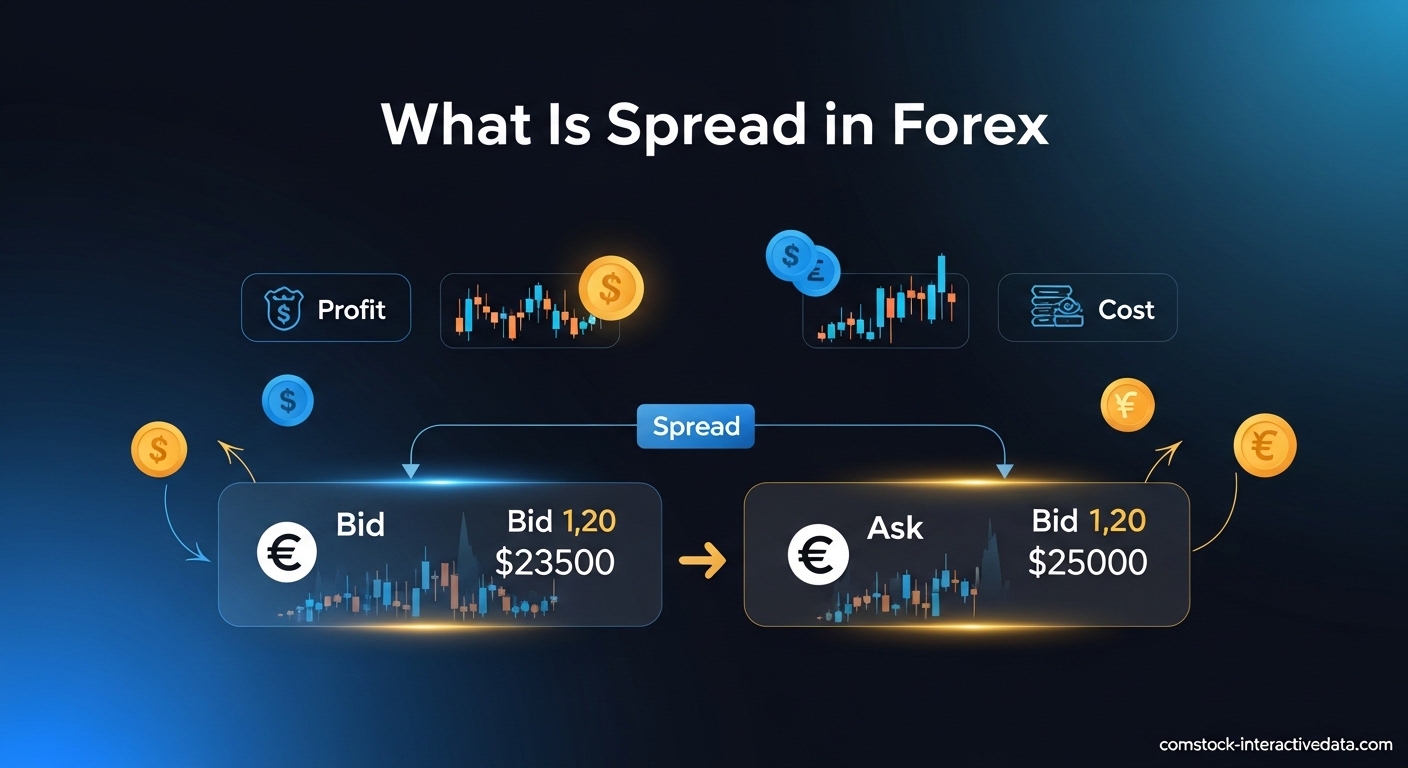
The spread in forex is the difference between the bid price and the ask price of a currency pair. It represents the transaction cost you pay to enter and exit trades.
When you look at any currency quote, you see two prices. The bid price is what buyers are willing to pay for the currency. The ask price is what sellers are demanding. Your broker quotes EUR/USD at 1.0850/1.0852. The spread is 2 pips.
This difference is how brokers make money without charging direct commissions. Every time you buy at the ask price and sell at the bid price, the broker keeps the spread as compensation for facilitating your trade.
Why Every Trade Starts at a Loss?
Here is something that confuses many new traders. When you open a buy position, you immediately see a small negative number in your profit column. This is not a bug or an error. It is the spread cost.
You bought at the ask price, which is always higher than the bid price. For your trade to break even, the bid price must rise to match what you paid. Only then do you start seeing positive returns.
I remember my first week of trading. I kept wondering why every position started negative, even when the market moved in my direction immediately. Understanding that this was simply the spread cost changed how I viewed my trading strategy.
Bid Price vs Ask Price Explained 2026
The bid price represents the highest price a buyer will pay for a currency pair. If you want to sell EUR/USD, you receive the bid price.
The ask price represents the lowest price a seller will accept. If you want to buy EUR/USD, you pay the ask price.
The bid is always lower than the ask. This difference exists because buyers want to pay less and sellers want to receive more. The spread bridges this gap and compensates the market maker or broker for matching these orders.
How to Calculate the Spread in Forex?
Calculating the spread in forex requires three simple steps. First, identify the bid and ask prices from your broker quote. Second, subtract the bid price from the ask price. Third, convert the result into pips.
For most currency pairs, one pip equals 0.0001. For JPY pairs like USD/JPY, one pip equals 0.01 due to the different decimal placement. This distinction matters when calculating your exact trading costs.
Step-by-Step Spread Calculation
Step 1: Find your broker quote. Look for the two prices displayed for any currency pair. The first number is the bid. The second is the ask.
Step 2: Subtract the bid from the ask. If GBP/USD shows 1.3089/1.3091, calculate 1.3091 minus 1.3089. The result is 0.0002.
Step 3: Convert to pips. Divide the result by the pip value. For GBP/USD, divide 0.0002 by 0.0001. Your spread is 2 pips.
Calculation Examples for Major Pairs
EUR/USD Example: Your broker quotes EUR/USD at 1.0850/1.0853. The difference is 0.0003. Divided by 0.0001 equals 3 pips. If you trade one standard lot (100,000 units), each pip is worth $10. Your spread cost is $30.
GBP/USD Example: The quote shows 1.3089/1.3092. The spread equals 3 pips. On a mini lot (10,000 units), each pip is worth $1. Your entry cost is $3.
USD/JPY Example: For JPY pairs, remember that one pip is 0.01. If USD/JPY quotes at 149.50/149.53, the difference is 0.03. Divided by 0.01 equals 3 pips. The pip value in JPY pairs varies with the exchange rate, typically around $0.67 to $0.75 per pip for standard lots at current levels.
Understanding Pipettes and Fractional Pips
Modern brokers often quote prices with five decimal places for most pairs and three for JPY pairs. The fifth decimal is called a pipette, representing one-tenth of a pip.
If EUR/USD quotes at 1.08502/1.08508, the spread is 0.6 pips or 6 pipettes. These fractional spreads are common with ECN brokers and can significantly reduce trading costs for high-frequency traders.
Types of Spreads in Forex Trading
Forex brokers offer two main types of spreads: fixed and variable. Understanding the difference helps you choose the right broker and account type for your trading style.
Fixed spreads remain constant regardless of market conditions. Variable spreads fluctuate based on liquidity, volatility, and time of day. Each type has distinct advantages and disadvantages that affect your bottom line.
Fixed Spreads: Pros and Cons
Fixed spreads are set by market makers and dealing desk brokers. They guarantee a specific spread width, typically 2-3 pips for EUR/USD, regardless of market conditions.
The main advantage is predictability. You always know your entry cost before trading. This makes risk management easier, especially for beginners. Fixed spreads also protect you during news events when variable spreads often widen dramatically.
However, fixed spreads usually run wider than variable spreads during normal market conditions. You pay a premium for stability. During volatile periods, fixed spread brokers may experience requotes, refusing your order at the requested price and offering a new, less favorable rate.
Variable Spreads: Pros and Cons
Variable spreads, also called floating spreads, change in real-time based on market conditions. During the London-New York overlap, EUR/USD spreads can drop to 0.1-0.5 pips. During low-liquidity periods, they might widen to 3-5 pips.
The advantage is lower costs during liquid sessions. Active traders benefit significantly from these tight spreads. ECN and STP brokers typically offer variable spreads because they route orders directly to liquidity providers.
The disadvantage is unpredictability. Your trading costs vary, making precise risk calculations harder. During major news releases like Non-Farm Payroll reports, variable spreads can explode from 1 pip to 10-20 pips instantly.
| Feature | Fixed Spreads | Variable Spreads |
|---|---|---|
| Spread Range (EUR/USD) | 2-3 pips (constant) | 0.1-5 pips (fluctuates) |
| Best For | Beginners, news traders | Scalpers, day traders |
| During News Events | Remains stable | Often widens significantly |
| Typical Broker Type | Market makers | ECN, STP brokers |
| Additional Fees | Usually none | May charge commission |
| Requote Risk | Higher during volatility | Lower, but slippage possible |
Raw Spreads and Commission Accounts
Some brokers offer raw spreads starting at 0.0 pips plus a flat commission per lot. This hybrid model appeals to high-volume traders.
A raw spread account might show EUR/USD at 0.2 pips plus $7 commission per round turn lot. For frequent traders, this often works out cheaper than standard variable spread accounts with higher built-in spreads.
Factors That Affect Forex Spreads
Spreads are not random. Multiple factors influence their width at any given moment. Understanding these factors helps you time your trades for lower costs.
Market Liquidity
Liquidity refers to how easily a currency pair can be bought or sold without affecting its price. Major pairs like EUR/USD, GBP/USD, and USD/JPY have the highest liquidity and tightest spreads.
Exotic pairs such as USD/TRY or EUR/ZAR have low liquidity. Fewer buyers and sellers exist, so brokers widen spreads to compensate for the risk of holding these positions. Exotic pair spreads often range from 5-50 pips compared to 0.5-2 pips for majors.
Market Volatility
Volatility measures how much prices move over time. High volatility means rapid price changes. Low volatility means stable, slow-moving prices.
During volatile periods, spreads widen because brokers face higher risk. They need extra protection against sudden price movements that could leave them exposed. Major economic announcements, geopolitical events, and unexpected news all increase volatility and spreads.
Trading Sessions and Market Hours
The forex market operates 24 hours, but liquidity varies by session. Three main trading sessions exist: Asian (Tokyo), European (London), and North American (New York).
The Asian session typically has the lowest liquidity and widest spreads. The London session brings increased volume. The overlap between London and New York sessions (8:00 AM to 12:00 PM EST) offers the highest liquidity and tightest spreads.
I consistently see EUR/USD spreads drop from 2 pips during Asian hours to 0.5 pips or less during the London-New York overlap. Timing your trades during these hours saves money.
Economic News and Events
Scheduled economic releases cause predictable spread widening. Non-Farm Payroll reports, central bank interest rate decisions, and GDP announcements all trigger volatility.
Brokers typically widen spreads 5-15 minutes before major releases and maintain wider spreads for 15-30 minutes after. Some traders avoid this period entirely. Others specifically trade the news volatility, accepting the higher spread costs as part of their strategy.
Weekend Gaps and Rollover
Spreads behave unusually around weekends. Sunday evening when markets reopen, spreads are often 3-5 times wider than normal. Low liquidity and catching up on weekend news events cause this.
Friday afternoons also see spread widening as liquidity providers reduce exposure before the weekend. If you hold positions through the weekend, be aware that your effective spread cost at exit may be higher than when you entered.
Spread Cost Examples for Different Lot Sizes
Understanding spread costs in dollar terms helps you plan your risk management. Here are concrete examples for different trade sizes.
Micro Lot (1,000 Units)
A micro lot represents 1,000 units of the base currency. For EUR/USD at current prices, each pip equals approximately $0.10.
If you trade with a 2-pip spread, your entry cost is $0.20. This makes micro lots ideal for beginners learning to trade without significant risk. Even with a 5-pip spread on exotic pairs, your cost is only $0.50.
Mini Lot (10,000 Units)
A mini lot equals 10,000 units. Each pip is worth approximately $1 for most USD-denominated pairs.
Trading EUR/USD with a 1.5-pip spread costs $1.50 per trade. If you make ten trades daily, spread costs total $15. Over a month with 20 trading days, that equals $300 in spread costs alone. This demonstrates why tight spreads matter for active traders.
Standard Lot (100,000 Units)
A standard lot represents 100,000 units. Each pip equals approximately $10.
A 2-pip spread on a standard lot EUR/USD trade costs $20. For swing traders holding positions for days, this one-time cost becomes less significant. For scalpers making 20 trades daily, spread costs reach $400 per day. This explains why professional scalpers demand sub-1-pip spreads.
Calculating Total Spread Costs
To find your total monthly spread costs, multiply your average spread by your pip value by your number of trades.
Example: You trade mini lots (pip value $1) with an average 2-pip spread. You make 5 trades daily, 20 days monthly. Calculation: 2 pips × $1 × 5 trades × 20 days = $200 monthly spread costs. This is money deducted from your account regardless of winning or losing trades.
Why Spreads Matter for Your Trading Strategy?
Your trading style determines how much spreads affect your profitability. Scalpers face the biggest challenge. Swing traders worry less about entry costs.
Impact on Scalping
Scalpers aim for 5-10 pip profits per trade. If your spread is 2 pips, you need the market to move 7-12 pips just to hit your target. The spread consumes 20-40% of your potential profit.
This is why scalpers exclusively use ECN brokers with raw spreads plus commission. Paying 0.3 pips plus $7 commission beats paying 2 pips built into a standard account. Every fraction of a pip matters when your profit targets are small.
Impact on Day Trading
Day traders typically target 20-50 pips per trade. A 2-pip spread represents 4-10% of the profit target. While significant, this is more manageable than scalping scenarios.
Day traders should avoid the first 30 minutes of major sessions when spreads are widest. Waiting for the London-New York overlap provides better liquidity and lower costs without sacrificing trading opportunities.
Impact on Swing Trading
Swing traders hold positions for days or weeks, targeting 100-500 pip moves. A 2-pip spread becomes negligible when your profit target is 200 pips.
However, swing traders must consider rollover costs and weekend spread risk. If you enter Friday afternoon with a 3-pip spread and exit Monday morning with a 5-pip spread, your effective cost is higher than the quoted spread suggests.
Tips to Minimize Your Spread Costs
You cannot eliminate spreads, but you can reduce their impact on your trading account. Here are practical strategies that have saved me money over years of trading.
Trade During High-Liquidity Hours
Schedule your trading during the London-New York overlap (8:00 AM to 12:00 PM Eastern Time). This four-hour window offers the tightest spreads and highest volume.
Avoid trading during the Asian session unless you specifically trade JPY pairs. Even then, wait for the Tokyo session to fully open at 7:00 PM EST rather than trading Sunday evening when spreads are widest.
Choose the Right Broker and Account Type
Match your broker to your trading style. Scalpers need ECN accounts with raw spreads. Beginners might prefer fixed spreads for predictability.
Compare total costs, not just advertised spreads. A broker offering 0.0 pips with $10 commission may cost more than one offering 1 pip with no commission, depending on your trade size.
Focus on Major Currency Pairs
Stick to EUR/USD, GBP/USD, USD/JPY, and USD/CHF for the tightest spreads. These pairs have the deepest liquidity and most competitive pricing.
Exotic pairs like USD/TRY or EUR/ZAR offer exciting volatility but at a cost. Spreads of 10-50 pips make profitable trading difficult unless you capture massive moves. Master the majors before exploring exotics.
Avoid Trading During News Releases
Check an economic calendar daily. Avoid opening new positions 15 minutes before and 15 minutes after high-impact news events. Spreads widen dramatically during these periods, eating into your potential profits.
If you trade news specifically, accept wider spreads as part of your strategy. Set wider stop losses to account for spread volatility and initial price spikes.
Use Limit Orders Instead of Market Orders
Limit orders can help you avoid the worst spread moments. By setting your entry price, you wait for the market to come to you rather than accepting whatever spread exists at the moment.
This strategy works best in ranging markets. In fast-moving trends, limit orders might never fill while the market runs away from you. Balance cost savings against opportunity costs.
Frequently Asked Questions
How to calculate spread on forex?
To calculate the spread in forex: 1) Identify the bid price (sell price) and ask price (buy price) from your broker’s quote. 2) Subtract the bid price from the ask price. 3) Express the result in pips (0.0001 for most pairs, 0.01 for JPY pairs). Example: If GBP/USD is quoted at 1.3089/1.3091, the spread is 1.3091 – 1.3089 = 0.0002 (2 pips).
What does 1 spread mean in forex?
A 1 pip spread in forex means the difference between the bid and ask price is 0.0001 (or 0.01 for JPY pairs). This represents the transaction cost you pay to enter a trade. For example, EUR/USD at 1.0850/1.0851 has a 1 pip spread, meaning you start the trade 1 pip in the negative. On a standard lot, this equals approximately $10 in immediate cost.
What is 0.6 spread in forex?
A 0.6 pip spread (also called 6 tenths of a pip or 6 pipettes) means the difference between bid and ask is 0.00006. This is considered a very competitive spread for major pairs like EUR/USD. For a mini lot trade (10,000 units), a 0.6 pip spread equals $0.60 in transaction cost. For a standard lot, it equals $6. These fractional spreads are common with ECN brokers.
What is a good spread in forex trading?
A good spread in forex trading is typically 1 pip or less for major pairs like EUR/USD during normal market conditions. For GBP/USD, 1-2 pips is competitive, while USD/JPY often ranges 0.5-1.5 pips. Exotic pairs naturally have wider spreads of 5-20+ pips. Spreads below 1 pip are considered excellent for active traders and essential for scalpers.
What is the 3 5 7 rule in forex?
The 3-5-7 rule in forex is a risk management framework: limit individual trade risk to 3% of account, total portfolio risk to 5%, and maintain a profit-to-loss ratio of at least 7:1. This helps traders preserve capital while maximizing profitable opportunities. While not directly related to spreads, factoring spread costs into your risk calculations ensures these targets remain achievable.
What is the 5 3 1 rule in forex?
The 5-3-1 rule in forex is a focused trading approach: learn 5 currency pairs thoroughly, master 3 trading strategies, and trade at 1 consistent time each day. This helps traders build expertise and routine rather than constantly switching approaches. For spread optimization, focusing on 5 major pairs ensures you trade only the most liquid instruments with the tightest spreads.
Conclusion
Understanding what is the spread in forex transforms how you approach currency trading. Every trade carries this built-in cost. Recognizing it helps you choose better brokers, time your entries, and manage realistic profit expectations.
You now know how to calculate spreads for any currency pair. You understand why spreads change throughout the day and how to minimize their impact on your account. You can distinguish between fixed and variable spreads and select the right type for your trading style.
The spread is not your enemy. It is simply the cost of doing business in the world’s largest financial market. Factor it into your risk management, trade during liquid hours, and choose appropriate currency pairs. These habits will keep more money in your account where it belongs.
Start applying these principles today. Check your broker’s current spreads. Calculate what you paid in spreads last month. Then make adjustments. Small improvements in spread costs compound into significant savings over a trading career.