
I remember the first time I opened my Robinhood account back in 2015. The question hit me immediately: how does Robinhood make money if trading is completely commission-free? It seemed too good to be true. Stock trading used to cost $7-10 per trade at traditional brokerages, yet here was this fintech company offering the same service for zero dollars.
The answer isn’t magic—it’s a sophisticated business model that has transformed the entire brokerage industry. In this guide, I’ll break down exactly how Robinhood generates billions in revenue while keeping trading free for its 23+ million users. Understanding this matters because it affects your trades, even if you never pay a direct commission.
Table of Contents
How Does Robinhood Make Money? A Complete Revenue Breakdown
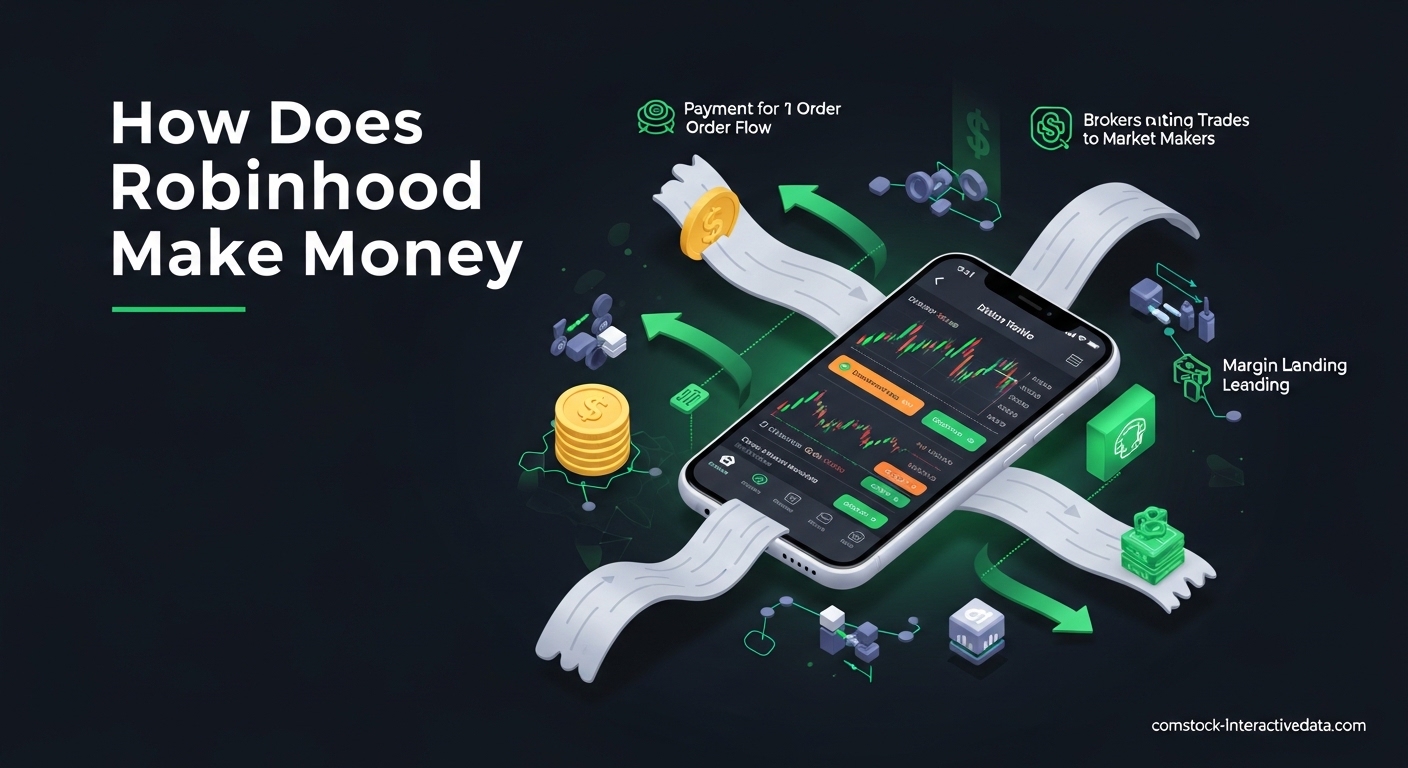
Robinhood operates on a multi-revenue stream model that generated over $1.8 billion in 2026. The company makes money through six primary channels, with payment for order flow leading the pack. Here’s the simple answer: instead of charging you directly, Robinhood earns money from the infrastructure behind your trades.
The commission-free trading revolution Robinhood started in 2013 forced every major brokerage to eliminate fees. But “free” doesn’t mean “without cost”—it means the costs are hidden in the mechanics of how your orders get executed.
Payment for Order Flow: The Primary Revenue Engine
Payment for order flow (PFOF) represents Robinhood’s largest revenue source, accounting for roughly 40-45% of total revenue in recent quarters. When you place a trade on Robinhood, your order doesn’t go directly to the stock exchange. Instead, it gets routed to market makers—sophisticated trading firms like Citadel Securities and Virtu Financial.
These market makers pay Robinhood for the privilege of executing your trades. Why would they pay? Because retail order flow is valuable. Individual investors tend to trade less strategically than institutional traders, giving market makers opportunities to profit on the bid-ask spread.
The process works like this: you tap “buy” on your phone. Robinhood’s smart order router sends your order to a market maker instead of a public exchange. The market maker executes your trade and pays Robinhood a small fraction—usually fractions of a penny per share. With millions of trades daily, these fractions add up to hundreds of millions in annual revenue.
Here’s where it gets controversial. Critics argue that PFOF creates conflicts of interest. Robinhood might route orders to the highest bidder rather than the venue offering best execution for you. The SEC and FINRA have scrutinized this practice extensively, leading to a $65 million settlement Robinhood paid in 2020 for failing to disclose its PFOF arrangements and execution quality.
Despite the controversy, Robinhood maintains that its execution quality meets or exceeds industry standards. The company publishes execution quality reports showing price improvement statistics—meaning you sometimes get a slightly better price than the quoted market price.
However, some users have legitimate concerns about whether they’re getting optimal execution compared to direct market access at traditional brokerages. Studies have shown mixed results, with some indicating slightly worse execution quality at PFOF-dependent brokers compared to those that don’t accept payment for order flow.
Net Interest Revenue: Profiting from Your Cash and Loans
Net interest revenue has become Robinhood’s fastest-growing income stream, especially during 2026‘s higher interest rate environment. This category includes multiple sub-revenue sources that most users never think about.
First, there’s interest on uninvested cash. When you deposit money into Robinhood but haven’t bought stocks yet, that cash sits in your account. Robinhood pools this idle cash and earns interest on it—interest they keep rather than passing to you. With millions of users holding billions in uninvested funds, this generates substantial income.
Second, margin lending generates significant revenue. Robinhood Gold subscribers can borrow money to invest beyond their cash balance. The margin rates Robinhood charges—currently ranging from 5.7% to 12% depending on account size—are well above what the company pays to borrow that capital. The spread between what Robinhood pays for capital and what it charges users creates healthy profit margins.
Third, securities lending contributes to interest revenue. Robinhood can lend out your stocks to short sellers and other market participants, earning fees in the process. While some brokerages share these lending revenues with customers, Robinhood typically retains the bulk of these fees.
In 2026, net interest revenue surpassed transaction-based revenue as Robinhood’s largest income source. This shift reflects both the interest rate environment and Robinhood’s growing cash management business. When rates were near zero, this revenue stream was minimal. Now it represents hundreds of millions in quarterly income.
Robinhood Gold: Premium Subscription Revenue
Robinhood Gold represents the company’s push toward recurring, subscription-based revenue. Priced at $5 per month (or $50 annually), Gold subscriptions provide enhanced features that active traders find valuable.
Gold members receive several benefits: access to margin investing at reduced rates, instant deposits up to $50,000 instead of the standard $1,000, Level II market data from NASDAQ, and higher interest on uninvested brokerage cash. The subscription also includes access to retirement accounts with IRA contributions and matching benefits.
With an estimated 1.7 million Gold subscribers as of 2026, this revenue stream generates approximately $100 million annually in pure subscription fees. More importantly, Gold subscribers tend to be more active traders with larger account balances, making them more valuable across all revenue categories.
The genius of the Gold model lies in its stickiness. Once users subscribe for margin access or enhanced features, they rarely downgrade. This creates predictable monthly recurring revenue that smooths out volatility from trading activity.
Other Revenue Streams You Might Not Know About
Beyond the big three revenue sources, Robinhood operates several smaller but meaningful income channels that collectively add hundreds of millions to its bottom line.
Interchange fees come from the Robinhood Cash Card. When you use the debit card linked to your brokerage account, merchants pay interchange fees to process the transaction. Robinhood keeps a portion of these fees—typically 1-2% of each purchase. With users spending billions through their Cash Cards annually, these fees add up quickly.
Cryptocurrency trading generates revenue through spreads rather than commissions. When you buy or sell Bitcoin, Ethereum, or other cryptocurrencies on Robinhood, the price you pay includes a markup over the actual market price. This spread-based model, while technically “commission-free,” effectively charges users through less transparent pricing.
OTC securities and ADRs (American Depositary Receipts) generate additional transaction revenue. While standard stock and ETF trades rely on PFOF, certain over-the-counter securities and international stocks traded as ADRs carry small fees that Robinhood collects directly.
Foreign exchange fees apply when you trade international securities. Robinhood charges a small percentage (around 0.03%) on currency conversions for international trades. This is standard across the industry but contributes meaningfully to revenue given Robinhood’s expanding international presence.
Finally, the company earns revenue from its credit card offerings, including the Robinhood Gold Card launched in 2026. These products generate interchange fees and interest income from carried balances, diversifying revenue beyond the core brokerage business.
Is Robinhood Safe? Understanding Your Protection
One of the most common questions I see in forums and receive from readers: “Is it safe to keep large amounts in Robinhood?” The short answer is yes, with important caveats.
Robinhood is regulated by both the SEC and FINRA, the same regulatory bodies that oversee all major U.S. brokerages. The company must follow strict capital requirements, reporting obligations, and compliance standards. As a publicly traded company (ticker: HOOD), Robinhood faces additional scrutiny from shareholders and must disclose financial details quarterly.
More importantly, Robinhood provides SIPC protection on all brokerage accounts. The Securities Investor Protection Corporation covers up to $500,000 in securities (including $250,000 for cash claims) per account. This protection applies if Robinhood fails financially—not if your investments lose value.
For users asking about keeping $1,000,000 or more in Robinhood: SIPC coverage has limits. While the first $500,000 is fully protected, amounts above that depend on Robinhood’s solvency. Many high-net-worth investors prefer splitting large balances across multiple brokerages to maximize SIPC coverage.
The GameStop trading restrictions in 2021 damaged user trust significantly. While those restrictions were driven by clearinghouse requirements rather than Robinhood’s choice, the communication failures were real. The company has since improved its infrastructure and transparency, but some users remain skeptical.
How Robinhood’s Model Compares to Traditional Brokers?
Before Robinhood’s launch, stock trading typically cost $7-10 per trade at firms like E*Trade, Charles Schwab, and TD Ameritrade. Robinhood’s zero-commission model forced the entire industry to eliminate trading fees. But there are still meaningful differences worth understanding.
Traditional brokers without PFOF often route orders directly to exchanges or use different routing arrangements. Some research suggests this can result in slightly better execution quality, particularly for large orders. The difference is usually pennies per trade—negligible for small investors but potentially meaningful for active traders moving large volumes.
Traditional brokers also tend to offer more comprehensive research tools, retirement planning services, and access to international markets. Robinhood’s streamlined interface works beautifully for simple stock and ETF trading but lacks the depth sophisticated investors might need.
The trade-off is clear: you save on commissions with Robinhood, potentially sacrifice tiny amounts on execution quality, and get a simpler platform. For buy-and-hold investors making occasional trades, this is an excellent trade-off. For day traders or those moving large blocks, traditional brokers might still offer advantages.
Frequently Asked Questions
Is Robinhood really commission free?
Yes, Robinhood charges no commissions for buying or selling stocks, ETFs, and options. However, the platform generates revenue through other means including payment for order flow, spreads on cryptocurrency trades, and interest on uninvested cash. While you won’t see a commission charge on your trades, the platform is not operating at zero cost to the company.
Does Robinhood sell my order data?
Robinhood does not sell your personal data like name or account details to third parties. However, the company does sell your order flow to market makers—meaning the actual trade orders you place are routed to specific trading firms that pay for this access. This is called Payment for Order Flow and is disclosed in Robinhood’s regulatory filings.
Am I getting worse execution prices because of PFOF?
Studies show mixed results on execution quality at PFOF-dependent brokers versus traditional brokers. Robinhood publishes execution quality reports showing price improvement statistics. For most retail investors making small trades, any difference is negligible—usually fractions of a penny per share. However, for large orders or active traders, traditional brokers may offer slightly better execution in some cases.
Is it safe to have $1,000,000 in Robinhood?
Accounts are protected by SIPC insurance up to $500,000 (including $250,000 for cash). Amounts above $500,000 are not covered by SIPC if Robinhood fails. Many investors with large balances choose to spread money across multiple brokerages to maximize protection. Robinhood is regulated by the SEC and FINRA and is a publicly traded company, providing additional oversight.
What’s the downside to using Robinhood?
The main downsides include limited research tools compared to traditional brokers, restricted access to certain investment types like international stocks and bonds, and past controversies around trading restrictions during high volatility. Some users also prefer avoiding brokers that rely heavily on payment for order flow for ethical reasons. Customer service has also been criticized, particularly during high-demand periods.
Is Robinhood profitable as a company?
Robinhood became profitable on a GAAP basis starting in 2026, posting its first full year of profitability. The company achieved this through diversified revenue streams including net interest income, payment for order flow, and growing subscription revenue from Robinhood Gold. However, profitability remains sensitive to trading volumes and interest rate environments.
Conclusion: Should You Use Robinhood?
Understanding how Robinhood makes money helps you make an informed decision about whether it’s the right platform for you. The company generates revenue through payment for order flow, net interest income, Gold subscriptions, interchange fees, and cryptocurrency spreads—allowing them to offer commission-free trading.
For most casual investors and beginners, Robinhood’s model works well. You save on commissions that would cost hundreds or thousands at traditional brokers over time. The execution quality differences are negligible for small trades, and the platform’s simplicity encourages investing participation.
However, if you’re managing large sums (over $500,000), trading frequently with large orders, or need sophisticated research tools, traditional brokers might serve you better. The key is understanding the trade-offs and choosing what aligns with your investing style and values.
The commission-free revolution Robinhood started has permanently changed the brokerage industry. Whether you use Robinhood or a competitor, understanding how does Robinhood make money helps you become a more informed investor who sees through marketing to understand the mechanics behind the platforms you use.