
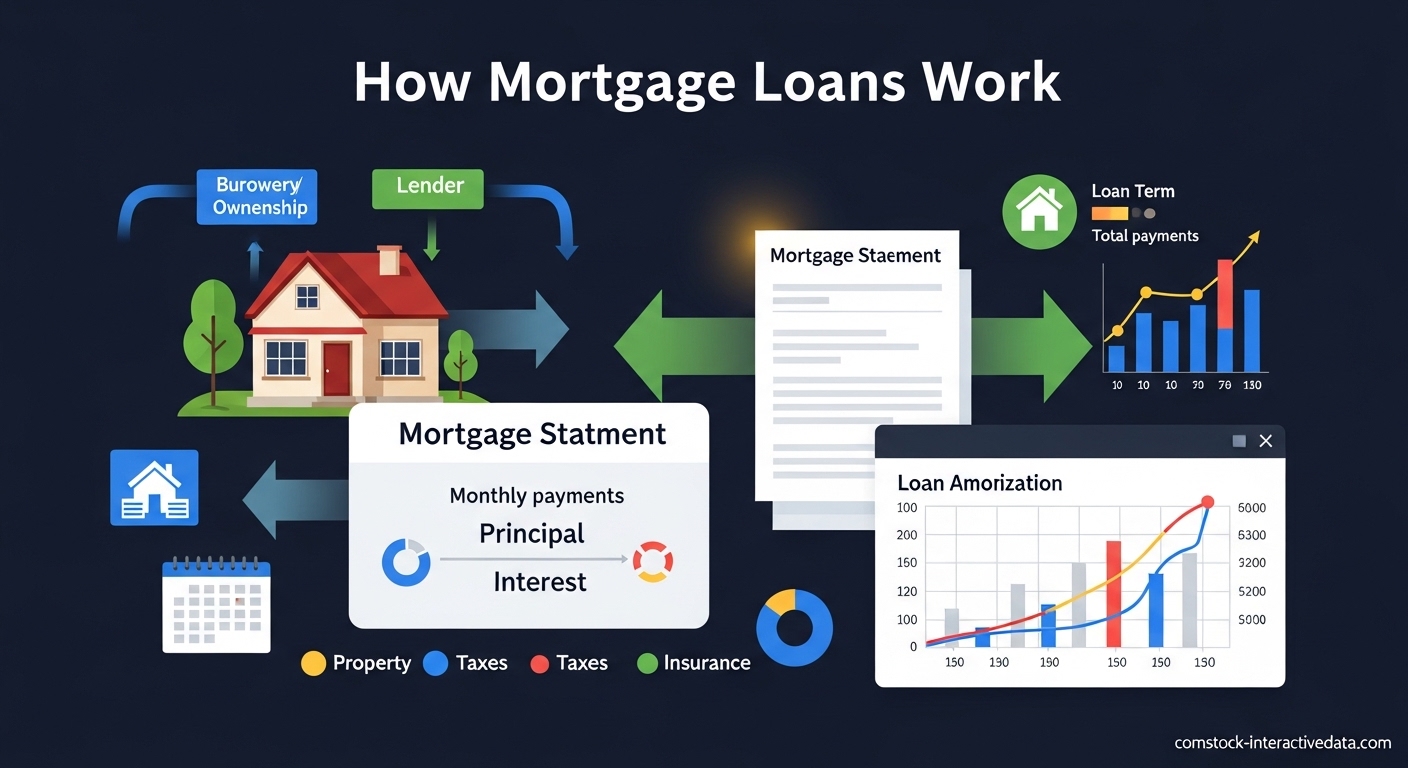
Buying your first home is one of the biggest financial decisions you will ever make. For most people, that dream becomes reality through a mortgage loan – a type of secured financing that uses the home itself as collateral. Understanding how mortgage loans work can save you thousands of dollars, prevent costly mistakes, and give you confidence as you navigate the homebuying process from start to finish.
This guide breaks down the entire mortgage process into eight clear steps. I will walk you through everything from checking your credit score to signing closing documents. Whether you are months away from buying or just starting to explore homeownership, you will find practical answers to your questions here.
Table of Contents
What Is a First-Time Homebuyer?
A first-time homebuyer is not necessarily someone who has never owned a home before. According to HUD guidelines, you qualify as a first-time buyer if you have not owned a principal residence in the past three years. This definition also includes single parents who previously owned a home with a spouse, displaced homemakers, and people who owned only mobile homes not permanently affixed to a foundation.
First-time buyers make up about 32% of all homebuyers in 2026, and they typically face unique challenges. You are navigating unfamiliar terminology, complex financial decisions, and a process that can feel overwhelming. The good news? There are special programs, grants, and educational resources designed specifically to help first-time buyers succeed.
Step 1: Get Your Finances Ready (Credit, DTI, and Savings)
Before you start browsing home listings, you need a clear picture of your financial health. Lenders will scrutinize three main areas: your credit score, your debt-to-income ratio (DTI), and your savings for a down payment and closing costs.
Check Your Credit Score
Your credit score is one of the most important factors in mortgage approval. Most lenders require a minimum score of 620 for conventional loans, though FHA loans may accept scores as low as 580. A higher score means better interest rates, which can save you tens of thousands over the life of your loan.
Check your credit reports from all three bureaus (Experian, Equifax, and TransUnion) at AnnualCreditReport.com. Look for errors and dispute any inaccuracies immediately. Paying down credit card balances can quickly boost your score by improving your credit utilization ratio.
Calculate Your Debt-to-Income Ratio (DTI)
Your DTI ratio compares your monthly debt payments to your gross monthly income. Lenders use two types of DTI calculations. Your front-end ratio looks only at housing expenses and should not exceed 28% of your gross income. Your back-end ratio includes all monthly debt payments (credit cards, student loans, car payments, plus housing) and should stay below 43%.
Here is how to calculate your back-end DTI: add up all monthly debt payments, divide by your gross monthly income, then multiply by 100. If you earn $5,000 per month and have $1,500 in debt payments, your DTI is 30%.
Save for Down Payment and Closing Costs
Down payment requirements vary by loan type. Conventional loans typically require 3-20%, FHA loans require 3.5%, VA loans require 0% for eligible veterans, and USDA loans require 0% for qualifying rural properties. First-time buyer programs may offer down payment assistance.
Closing costs add another 2-5% of the purchase price. These include loan origination fees, appraisal fees, title insurance, attorney fees, and prepaid taxes and insurance. You will also need cash reserves after closing – most lenders want to see at least two months of mortgage payments in savings.
Step 2: Choose the Right Mortgage Type for You
Not all mortgage loans work the same way. The type you choose affects your down payment, interest rate, monthly payment, and whether you will pay mortgage insurance.
| Loan Type | Down Payment | Credit Score Min | Best For |
|---|---|---|---|
| Conventional | 3-20% | 620 | Buyers with good credit |
| FHA | 3.5% | 580 | First-time buyers, lower credit |
| VA | 0% | 580-620 | Veterans and active military |
| USDA | 0% | 640 | Rural area buyers |
Fixed-Rate vs. Adjustable-Rate Mortgages
A fixed-rate mortgage keeps the same interest rate for the entire loan term – usually 15 or 30 years. Your principal and interest payment never changes, making budgeting predictable. Most first-time buyers choose 30-year fixed loans for the lower monthly payments.
An adjustable-rate mortgage (ARM) starts with a lower rate that changes after an initial fixed period. A 5/1 ARM stays fixed for five years, then adjusts annually. ARMs can save money if you plan to sell or refinance before the rate adjusts, but they carry risk if rates rise significantly.
Conventional vs. Government-Backed Loans
Conventional loans follow standards set by Fannie Mae and Freddie Mac. If your down payment is less than 20%, you will pay private mortgage insurance (PMI) until you build 20% equity. Conventional loans offer competitive rates for buyers with strong credit.
FHA loans are insured by the Federal Housing Administration. They allow lower credit scores and smaller down payments but require mortgage insurance premiums (MIP) for the life of the loan in most cases. VA loans, guaranteed by the Department of Veterans Affairs, offer zero down payment and no mortgage insurance for eligible service members. USDA loans help moderate-income buyers in eligible rural areas with no down payment required.
Step 3: Get Pre-Approved (Not Just Pre-Qualified)
Many first-time buyers confuse pre-qualification with pre-approval. Pre-qualification is an informal estimate based on information you provide. Pre-approval is a conditional commitment from a lender after verifying your financial documents.
Pre-approval carries weight with sellers and real estate agents. It shows you are serious and capable of securing financing. In competitive markets, sellers often reject offers from buyers who are not pre-approved.
What You Need for Pre-Approval?
During pre-approval, the lender will request documentation including: pay stubs from the last 30 days, W-2 forms from the past two years, federal tax returns from the past two years, bank statements from the past two months, proof of other assets, and documentation of any gift funds. Self-employed borrowers need additional documentation including profit and loss statements.
The lender will also run a hard credit check, which temporarily lowers your score by a few points. Multiple mortgage credit checks within a 14-45 day window count as one inquiry, so shop lenders within a concentrated timeframe.
Understanding the Loan Estimate
Within three business days of your application, the lender must provide a Loan Estimate. This three-page document details your estimated interest rate, monthly payment, closing costs, and cash needed to close. It also shows whether your rate is locked or can still change.
Compare Loan Estimates from at least three lenders. Look at the annual percentage rate (APR), which includes fees and gives a better comparison than interest rate alone. The Loan Estimate makes comparison shopping easier by using a standardized format.
Step 4: Find a Real Estate Agent
While you can technically buy a home without an agent, working with a buyer’s agent costs you nothing and provides significant protection. The seller typically pays both agents’ commissions from the sale proceeds.
A good buyer’s agent helps you find properties that match your criteria, negotiates on your behalf, recommends reliable inspectors and contractors, and guides you through complex paperwork. They also provide market insights about neighborhoods, school districts, and property values that you might miss researching on your own.
Interview at least two or three agents before choosing. Ask about their experience with first-time buyers, their familiarity with your target neighborhoods, and their availability. You want someone responsive who explains things clearly and does not pressure you into decisions.
Step 5: House Hunting and Making an Offer
With pre-approval in hand and an agent by your side, you are ready to start viewing homes. Create a clear list of must-haves versus nice-to-haves before you start touring. This prevents emotional decisions that stretch your budget.
Making a Competitive Offer
When you find the right home, your agent will help you draft a purchase offer. This includes the offer price, earnest money deposit, contingencies (conditions that must be met), proposed closing date, and items included in the sale.
Your earnest money deposit, typically 1-3% of the purchase price, shows the seller you are committed. This money goes into an escrow account and applies toward your closing costs or down payment. If you back out without a valid contingency, you risk losing this deposit.
Common Contingencies to Include
Protect yourself with contingencies. The financing contingency lets you cancel if you cannot secure a mortgage. The inspection contingency lets you renegotiate or walk away based on inspection findings. The appraisal contingency protects you if the home appraises below your offer price. Some buyers also include a home sale contingency if they need to sell their current home first.
In competitive markets, you might feel pressure to waive contingencies. Never waive the inspection contingency as a first-time buyer. Hidden problems can cost far more than losing a bidding war.
Step 6: Get a Professional Home Inspection
A home inspection is your chance to uncover problems before you commit. The inspector examines the home’s structure, roof, plumbing, electrical systems, HVAC, and more. They provide a detailed report with photos and recommendations.
The inspection typically costs $300-500 and occurs within a week of your offer being accepted. Attend the inspection if possible. Walking through with the inspector teaches you about the home and lets you ask questions in real-time.
What Happens After Inspection?
If the inspection reveals major issues, you have options. You can ask the seller to make repairs, request a credit toward closing costs so you can fix items yourself, negotiate a lower purchase price, or walk away if problems are severe. Your agent handles these negotiations using the inspection contingency.
Even if you do not request repairs, the inspection report is valuable. It serves as a roadmap for future maintenance and helps you budget for upcoming repairs.
Step 7: Mortgage Application and Underwriting
Once your offer is accepted, you officially apply for your mortgage. This starts the underwriting process – the lender’s thorough review of your financial situation and the property you are buying.
What Happens During Underwriting?
Underwriting typically takes 3-7 business days but can stretch longer in busy periods. The underwriter verifies your income, assets, and employment. They review your credit history for red flags. They order an appraisal to confirm the home’s value supports the loan amount. They also order a title search to ensure the seller can legally transfer ownership.
During this time, avoid major financial changes. Do not open new credit cards, change jobs, make large purchases, or move money between accounts. These actions can delay or derail your approval.
Conditional Approval and Clear to Close
The underwriter may issue conditional approval, meaning you are approved pending certain requirements. Common conditions include providing updated pay stubs, explaining large bank deposits, or obtaining homeowners insurance. Once you satisfy all conditions, you receive “clear to close” – the green light to schedule your closing.
Step 8: Closing Day – What to Expect
Closing is the final step where ownership officially transfers from seller to buyer. This typically happens 30-45 days after your offer is accepted, though cash purchases can close faster.
Reviewing Your Closing Disclosure
At least three business days before closing, your lender provides the Closing Disclosure. This document shows your final loan terms, monthly payment, and exact closing costs. Compare it carefully to your Loan Estimate. While some costs can increase, others should match or decrease.
The Final Walkthrough
Within 24 hours of closing, do a final walkthrough of the property. Verify that agreed-upon repairs were completed, all included appliances and fixtures remain, the home is clean, and no new damage has occurred. If problems arise, your agent can address them before closing or hold funds in escrow.
What to Bring to Closing?
Bring a government-issued photo ID, proof of homeowners insurance, any outstanding documentation requested by your lender, and a cashier’s check or wire transfer for your closing costs and down payment. You will sign dozens of documents including the promissory note (your promise to repay), the mortgage or deed of trust (securing the loan with the property), and the closing disclosure.
After signing, the lender funds the loan. The title company records the deed with the county, making you the official owner. You receive the keys and can move into your new home.
How Mortgage Loans Actually Work: Amortization, Interest, and Payments
Now that you understand the homebuying process, let us look at how your mortgage actually works after closing. Understanding amortization helps you see where your money goes each month and how to build equity faster.
What Is Amortization?
Amortization is the process of paying off your loan through regular payments over time. Each monthly payment is split between principal (the amount you borrowed) and interest (the cost of borrowing). In the early years, most of your payment goes toward interest. Over time, more goes toward principal.
Here is a simplified example for a $300,000 loan at 6.5% interest over 30 years. Your monthly principal and interest payment would be approximately $1,896. In month one, $1,625 goes to interest and only $271 to principal. By year 15, about $1,000 goes to interest and $896 to principal. By the final payment, almost the entire amount reduces principal.
How Interest Is Calculated?
Mortgage interest is calculated on your remaining principal balance. As you pay down the loan, the interest portion of each payment decreases. This is why extra payments toward principal early in the loan save so much interest over time.
Your interest rate might be fixed (unchanging) or adjustable (changing periodically). Fixed rates provide predictability. Adjustable rates often start lower but carry uncertainty about future payments.
Understanding PITI: The Components of Your Payment
Most homeowners pay PITI: Principal, Interest, Taxes, and Insurance. Principal and interest repay your loan. Property taxes fund local services and are often paid through an escrow account managed by your lender. Homeowners insurance protects against disasters and is also typically escrowed. If you put less than 20% down, you will also pay private mortgage insurance (PMI) until you reach 20% equity.
Your escrow account holds funds for taxes and insurance. The lender pays these bills when due and adjusts your monthly payment annually based on actual costs. If taxes increase, your payment rises even with a fixed-rate loan.
Building Equity Over Time
Home equity is the portion of your home you truly own – the current value minus your mortgage balance. Equity grows in two ways: as you pay down principal and as your home appreciates in value. A $300,000 home with a $250,000 mortgage has $50,000 equity.
Once you reach 20% equity, you can request cancellation of PMI on conventional loans. FHA loans require refinancing to remove mortgage insurance in most cases. Building equity gives you financial flexibility – you can borrow against it through home equity loans or lines of credit, or cash it out when selling.
Frequently Asked Questions
What is the 3 3 3 rule for mortgages?
The 3 3 3 rule is a helpful guideline for first-time buyers. It suggests having 3 months of mortgage payments saved as reserves, spending no more than 3 times your annual gross income on a home’s purchase price, and having at least 3 established credit accounts before applying. For example, if you earn $60,000 annually, look at homes under $180,000 and have $5,700 in reserves assuming a $1,900 monthly payment. While not a strict requirement, following this rule helps ensure you can comfortably afford your home without financial stress.
How do home loans work for first time buyers?
Home loans for first-time buyers work through a 10-step process: (1) Assess your finances including credit score and DTI ratio, (2) Choose the right mortgage type for your situation, (3) Get pre-approved by a lender, (4) Find a real estate agent, (5) Shop for homes and make an offer, (6) Get a professional home inspection, (7) Complete the mortgage application and underwriting process, (8) Review the Closing Disclosure, (9) Do a final walkthrough, and (10) Attend closing and receive your keys. First-time buyers often qualify for special programs with lower down payments, down payment assistance grants, and favorable loan terms through FHA, VA, or USDA programs.
What is the 3 7 3 rule for a mortgage?
The 3 7 3 rule refers to TRID (TILA-RESPA Integrated Disclosure) requirements that protect borrowers. Lenders must provide the Loan Estimate within 3 business days of receiving your mortgage application. They must deliver the Closing Disclosure at least 7 business days before your scheduled closing date. You then have 3 business days to review the Closing Disclosure before signing final loan documents. This rule ensures you have adequate time to compare loan offers and understand final terms before committing. If the Closing Disclosure is not delivered on time, your closing date must be pushed back.
Can I afford a $300k house on a $50k salary?
Affording a $300,000 home on a $50,000 salary would be challenging for most buyers. Using the 28% rule, your maximum monthly housing payment should be about $1,167 on a $4,167 monthly gross income. With a 10% down payment ($30,000) and a 6.5% interest rate, your principal and interest payment would be approximately $1,700. Adding property taxes, insurance, and potential PMI would push your total monthly payment to around $2,100 or more – well above the recommended limit. To make this work, you would need a larger down payment (20% or more), a lower interest rate, additional income sources, or you should look at homes in the $175,000-200,000 range instead.
What is the difference between pre-qualification and pre-approval?
Pre-qualification is an informal estimate based on information you provide verbally to a lender. It gives you a rough idea of how much you might borrow but carries no weight with sellers. Pre-approval is a thorough process where the lender verifies your income, assets, and credit by reviewing documentation like pay stubs, tax returns, and bank statements. Pre-approval results in a conditional commitment letter showing sellers you are a serious, qualified buyer. In competitive markets, offers without pre-approval are often rejected. Always get pre-approved before starting your house hunt seriously.
How long does the mortgage process take from start to finish?
The complete mortgage process typically takes 30-45 days from application to closing, though it can range from 15 days for well-prepared buyers to 60+ days in complex situations. Pre-approval usually takes 1-3 days. House hunting duration varies widely. Once you have an accepted offer, underwriting takes 3-7 business days. The appraisal adds another 3-10 days. Scheduling closing requires at least 7 days after the Closing Disclosure is issued. You can speed up the process by having all documents ready, responding quickly to lender requests, avoiding major financial changes, and choosing a lender with efficient processing times.
What are closing costs and how much should I expect to pay?
Closing costs are fees and expenses you pay when finalizing your mortgage and transferring property ownership. They typically range from 2-5% of your loan amount. On a $300,000 home, expect $6,000-15,000 in closing costs. These include loan origination fees (0.5-1% of loan amount), appraisal fee ($300-500), credit report fee ($30-50), title search and insurance ($500-1,500), attorney fees (varies by state), recording fees ($100-250), and prepaid items like property taxes and homeowners insurance. You can sometimes negotiate for the seller to pay part of your closing costs, or look for lender credits that trade a slightly higher rate for lower upfront fees. Some first-time buyer programs also offer closing cost assistance.
What credit score do I need to buy a house?
Credit score requirements vary by loan type. Conventional loans typically require a minimum score of 620, though better rates come with scores of 740 or higher. FHA loans accept scores as low as 580 with a 3.5% down payment, or 500-579 with 10% down. VA loans often require 580-620 depending on the lender. USDA loans typically need 640 or higher. Higher scores unlock better interest rates. A borrower with a 760+ score might get a rate a full percentage point lower than someone with a 620 score, saving thousands over the loan’s life. If your score is below these thresholds, work on improving it before applying by paying down credit card balances and correcting report errors.
How much should I save for a down payment?
Down payment requirements range from 0-20% depending on your loan type and situation. Conventional loans require as little as 3% for first-time buyers, though 20% avoids PMI. FHA loans require 3.5%. VA and USDA loans allow 0% down for eligible borrowers. On a $300,000 home, that means anywhere from $0 to $60,000. Beyond the down payment, you need 2-5% for closing costs and at least two months of mortgage payments in reserves. Many financial advisors recommend saving 20% to avoid PMI and secure better rates, but first-time buyer programs can help you buy sooner with less upfront cash. Consider your timeline, monthly budget, and available assistance programs when deciding.
What is private mortgage insurance (PMI) and can I avoid it?
Private mortgage insurance (PMI) protects the lender if you default on a conventional loan with less than 20% down. It typically costs 0.3-1.5% of your loan amount annually, or $75-300 per month on a $300,000 loan. PMI automatically drops off when you reach 22% equity through regular payments, or you can request cancellation at 20% equity based on your home’s original value. You can avoid PMI by putting 20% down, choosing a piggyback loan (80-10-10 structure), using lender-paid PMI (which trades a higher rate for no monthly PMI), or selecting VA loans which do not require mortgage insurance. FHA loans have MIP (Mortgage Insurance Premium) instead, which usually lasts the full loan term unless you refinance.
Your Next Steps to Homeownership
You now understand how mortgage loans work from application through closing and beyond. The homebuying process involves eight major steps: preparing your finances, choosing a mortgage type, getting pre-approved, finding an agent, house hunting and making offers, completing inspections, navigating underwriting, and finally closing on your new home.
Start by checking your credit report and calculating your DTI ratio. These two numbers will tell you where you stand and what you need to improve. If your credit score needs work, focus on paying down credit card balances and correcting errors before applying. If your DTI is too high, pay off smaller debts or look for ways to increase your income.
Remember that millions of first-time buyers successfully navigate this process every year. With the knowledge from this guide, you are better prepared than most. Take it one step at a time, ask questions when something is unclear, and do not let the complexity intimidate you. Your path to homeownership starts with a single step – and you have already taken it by learning how mortgage loans work.