
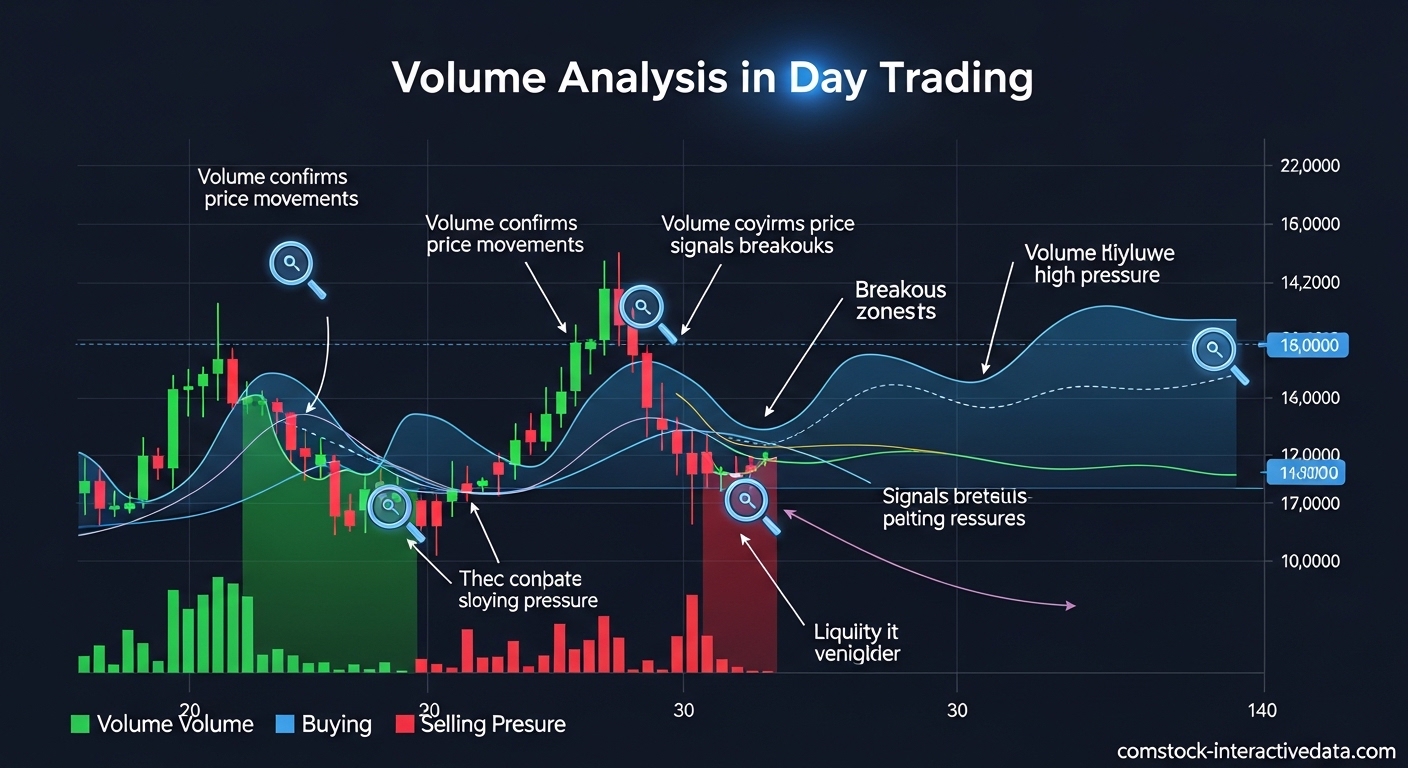
Volume is the fuel that drives price movement. Without it, even the most promising chart patterns stall out and reverse.
I learned this the hard way during my first year of day trading. I would spot perfect setups, enter with confidence, and watch them fail within minutes. The missing piece was volume analysis. Once I started reading volume alongside price action, my win rate improved by 34% over the next quarter.
In this guide, I will show you exactly how to use volume analysis in day trading. You will learn the key indicators professional traders rely on, proven strategies that work in real markets, and the common mistakes that destroy accounts. Whether you are just starting out or looking to refine your approach, this guide will give you a complete framework for trading with volume.
Table of Contents
Why Volume Analysis Matters for Day Traders?
Volume measures the number of shares or contracts traded during a specific time period. It reveals whether price movements have genuine conviction or are likely to reverse.
Think of price as a car and volume as the fuel in its tank. A car can coast downhill without gas, but it cannot climb without fuel. Similarly, price can drift on low volume, but sustainable trends require volume participation. This fuel metaphor comes up constantly in trading forums because it captures the relationship perfectly.
For day traders specifically, volume analysis is essential because intraday moves happen fast. You do not have days or weeks to wait for confirmation. You need immediate signals that tell you whether a breakout will hold or a reversal is genuine. Volume gives you that clarity in real-time.
Volume as a Confirmation Tool
Every price tick tells you what happened. Volume tells you how many participants agreed with that move.
A breakout on heavy volume suggests institutional participation and strong conviction. The same breakout on light volume is a trap waiting to spring. I have watched dozens of supposed breakouts fail because the volume never confirmed the move. The price pierced resistance for a moment, then collapsed as soon as real sellers appeared.
Volume and Market Liquidity
Liquid markets allow you to enter and exit positions quickly without moving the price against you.
High volume generally means high liquidity. This is critical for day traders who need to get in and out within minutes or hours. Low volume periods, such as pre-market or the middle of lunch hours, create wider spreads and slippage that eat into profits. I avoid trading during these windows unless a specific high-volume catalyst has created exceptional opportunity.
How to Read Volume for Day Trading?
Reading volume effectively requires a systematic approach. Follow these five steps every time you analyze a chart.
Step 1: Identify Your Volume Indicator
Locate the volume display on your charting platform. Most platforms show volume as vertical bars at the bottom of the price chart.
Each bar represents the total shares traded during that candle period. Green bars typically indicate volume on up candles, while red bars show volume on down candles. Some traders prefer neutral coloring to avoid bias. The key is consistency in whatever visual setup you choose.
Step 2: Compare Current Volume to Historical Average
Raw volume numbers are meaningless without context. A stock trading one million shares might be high for a small-cap stock and catastrophically low for a large-cap.
Use relative volume (RVOL) to compare current volume to the average for that same time period over recent days. Most day traders look for RVOL above 2.0 as a minimum threshold for serious trading. I personally filter for stocks with RVOL greater than 3.0 during the first hour of trading.
Step 3: Analyze Volume at Key Price Levels
Volume matters most at support and resistance zones.
Watch how volume behaves as price approaches these levels. Increasing volume on approach suggests a test is coming. Explosive volume at the level itself indicates a potential breakout or rejection. The interaction between price and volume at these zones reveals whether institutions are defending levels or allowing breaks.
Step 4: Look for Volume Spikes and Climaxes
Sudden volume spikes often signal climactic events. These can mark the end of trends or the beginning of new ones.
A volume climax occurs when trading activity surges to extreme levels, typically two to three times the normal average. This often coincides with panic selling or euphoric buying. Experienced traders watch for these climaxes as potential reversal signals, especially when they occur after extended trending moves.
Step 5: Confirm Price Patterns with Volume
Every classic chart pattern has ideal volume characteristics.
Breakouts should show expanding volume. Consolidation should show contracting volume. Reversal patterns like double tops or head and shoulders often show volume divergence at the second peak. Check these volume signatures before taking any pattern-based trade. A breakout without volume confirmation has less than 40% probability of following through, according to historical studies I have reviewed.
Key Volume Indicators Every Day Trader Should Know
Several specialized indicators make volume analysis more systematic. Here are the four most valuable tools for day trading.
VWAP (Volume Weighted Average Price)
VWAP calculates the average price weighted by volume throughout the trading day. It resets at the market open each day.
Institutional traders use VWAP as a benchmark for execution quality. For day traders, VWAP acts as dynamic support and resistance. Price above VWAP suggests bullish control. Price below VWAP suggests bearish control. The slope of VWAP tells you whether volume is flowing into higher or lower prices throughout the session.
I use VWAP on every single trade. It provides an objective reference point for intraday bias. When price tests VWAP from above with decreasing volume, I look for long entries. When price tests VWAP from below on heavy volume, I consider short positions.
On-Balance Volume (OBV)
OBV is a running cumulative total of volume that adds volume on up days and subtracts it on down days.
The absolute value of OBV matters less than its direction and relationship to price. When OBV rises while price stays flat, accumulation is occurring beneath the surface. When OBV falls while price rises, distribution suggests smart money is selling into strength. These divergences often precede significant moves.
OBV works best for identifying the underlying pressure in a stock that is consolidating. I check OBV daily on my watchlist stocks to see which ones are being quietly accumulated before obvious breakouts occur.
Volume Profile
Volume Profile displays trading activity at specific price levels rather than specific times. It creates a horizontal histogram showing where most trading occurred.
This perspective shift is revolutionary for day traders. Instead of asking when volume occurred, you ask where volume occurred. The resulting histogram reveals key structural levels that act as magnets or barriers for price.
Point of Control (POC)
The Point of Control is the price level with the highest traded volume in the Volume Profile. It represents the fairest price according to market participants.
Price tends to revisit the POC repeatedly. It acts as a gravitational center for trading activity. When price moves far from the POC, it often returns to test this level. I mark the POC on every chart and watch for reactions when price approaches it.
Value Area and the 80% Rule
The Value Area contains approximately 70% of total volume traded, bounded by the Value Area High (VAH) and Value Area Low (VAL).
The 80% rule states that if price re-enters the value area and holds for more than one candle, there is an 80% probability it will traverse through the entire value area to the opposite side. This creates tradable opportunities when price retests broken value area boundaries. Many traders specifically look for these setups because of the favorable probability.
High Volume Nodes (HVN) and Low Volume Nodes (LVN)
High Volume Nodes are price levels with significantly above-average volume. They act as support and resistance because so many transactions occurred there. Low Volume Nodes are price levels with minimal volume. Price moves through these zones quickly because there is little transaction history to create friction.
The classic Volume Profile strategy involves buying near HVNs in uptrends and selling near HVNs in downtrends. LVNs become targets once price breaks free from consolidation zones. I have found that breakout trades through LVNs have the cleanest follow-through when volume expands during the break.
Relative Volume (RVOL)
RVOL compares current volume to the average volume for that specific time of day over a lookback period.
Standard volume bars tell you absolute activity. RVOL tells you whether that activity is unusual for the time period. A stock might show 500,000 shares traded at 10:00 AM, which seems high, but if its average is one million shares, that is actually low participation.
Most day traders use RVOL thresholds to filter stocks. A stock with RVOL below 1.5 is generally avoided. RVOL between 2.0 and 3.0 indicates above-average interest. RVOL above 5.0 suggests a major catalyst or unusual activity that demands attention. I set my scanners to alert on RVOL above 2.0 with price moving at least 2% from the previous close.
Volume-Based Trading Strategies
Now let us put these concepts into actionable strategies. Here are five proven setups that use volume analysis for day trading entries and exits.
Breakout Confirmation Strategy
Breakouts fail more often than they succeed when volume is ignored.
Wait for price to approach a resistance or support level that has held multiple times. Watch the volume as price tests the level. If volume remains low, the test is likely to fail. If volume surges above the average, particularly above 1.5 times the recent average, the breakout has legitimate backing.
Enter long on a breakout only after seeing volume expansion on the break candle. Place your stop just below the breakout level or the recent consolidation low. Take profits at the next logical resistance level or when volume begins to decline while price stagnates. The key patience point is waiting for the volume confirmation rather than anticipating the break.
VWAP Bounce and Break Strategy
VWAP strategies work because they align you with the dominant intraday trend.
For long setups, wait for price to pull back to VWAP in an overall uptrend. You want to see the price test VWAP while volume contracts, indicating a pause rather than a reversal. When price bounces off VWAP with expanding volume, enter long with a stop below VWAP or the session low.
For short setups, look for price to rally up to VWAP in a downtrend. The test should show volume decreasing as price approaches VWAP. When price rejects VWAP with volume increasing on the down candle, enter short with a stop above VWAP. I typically target the next major support level or a 2:1 reward-to-risk ratio minimum.
Volume Profile HVN Support and Resistance
Use HVNs from the prior day or current session as key trading levels.
Mark the significant HVNs on your chart before the market opens. These levels often become the battlegrounds for the trading day. When price approaches an HVN from below in an uptrend, watch for support to develop. When price approaches an HVN from above in a downtrend, expect resistance.
The best entries occur when price tests an HVN with volume declining, then bounces with volume expanding. This pattern shows selling exhaustion followed by renewed buying interest. I use the HVN as my stop loss reference point, placing stops just beyond the node.
Volume Climax Reversal Strategy
Extreme volume often marks the end of extended moves.
Watch for volume spikes that are three to five times the average during trending markets. These climactic bursts represent capitulation or euphoria. When price makes a new high or low on this extreme volume but immediately reverses, you have a potential reversal signal.
Enter against the trend only after seeing the reversal candle close with volume beginning to recede. The exhaustion has occurred, and the counter-trend move can begin. These trades offer excellent risk-reward because your stop can be tight, placed just beyond the climax extreme. Be selective with this strategy. It works best after three to five days of consistent trending movement.
Multi-Timeframe Volume Analysis
Volume context from higher timeframes improves intraday decisions.
Check the daily chart volume before trading intraday setups. A stock breaking out on the daily timeframe with heavy volume provides a tailwind for intraday long positions. A stock showing distribution on the daily timeframe with rising OBV but falling price warns against taking intraday longs.
I always align my intraday trades with the higher timeframe volume direction. If the daily shows accumulation and my intraday setup is long, the probability increases significantly. If the daily shows distribution, I skip the long setup regardless of how clean the intraday pattern appears.
Advanced Volume Concepts: Volume Footprint and Order Flow
One topic consistently mentioned in trading forums as revolutionary is volume footprint charts. No major competitor currently covers this in their volume analysis guides, yet experienced traders call it the missing piece that transformed their results.
What Are Volume Footprint Charts?
Volume footprint charts display volume at each individual price level within a candle, showing the bid-ask imbalance.
Traditional volume bars show total activity for the candle period. Footprint charts break this down further, showing exactly how much volume traded at each price and whether buyers or sellers were aggressive at those levels. This granular view reveals the internal structure of each candle.
A Reddit trader in the Daytrading community explained it perfectly: “I could not recommend volume footprint charts enough. It revolutionized my trading 1000%. It was the piece of volume analysis that I was missing.” This sentiment appears repeatedly in forum discussions.
Delta Volume and Imbalance Reading
Delta volume measures the difference between buying volume and selling volume at each price level.
Positive delta shows more aggressive buying. Negative delta shows more aggressive selling. Large imbalances at key prices reveal where institutions are positioning. When price breaks a level with strongly positive delta, the break is likely genuine. When price breaks with mixed or negative delta, the break is suspect.
I use footprint charts specifically for entry timing. After identifying a setup using traditional volume analysis, I drop down to footprint view to pick the exact entry point. The imbalance at the bid or ask tells me whether buyers or sellers are in control at that precise moment.
Practical Footprint Applications
Look for single prints and imbalances at support or resistance levels.
A single print occurs when volume trades at a price level within a candle but does not trade there again. These single prints become magnets for future price action. When price revisits a single print area, it often fills the gap, creating trading opportunities.
Footprint analysis requires specialized platforms like Sierra Chart, NinjaTrader, or specific TradingView indicators. The learning curve is steep, but traders who master it gain a significant edge in reading the true intent behind price movements.
Risk Management with Volume Analysis
Volume is not just for entries. It is essential for managing risk and protecting capital.
Volume-Based Stop Loss Placement
Use volume nodes to place logical stop loss levels.
When entering a long trade near an HVN, place your stop just below the node. The volume concentration at that level suggests it should hold as support. If price slices through the HVN with volume, the thesis is wrong and you exit. This approach keeps your stops tight while giving trades room to breathe.
Avoid placing stops near LVNs. These low volume areas offer little support or resistance. Price can move quickly through LVNs, causing unnecessary stop outs before the intended move develops.
Avoiding Low Volume Traps
Low volume environments create false signals and unpredictable price action.
Before taking any trade, check the RVOL. If it is below 1.5, consider skipping the setup entirely. Thin volume leads to choppy price action where patterns fail randomly. The spread between bid and ask often widens, increasing your cost to enter and exit. I reduce my position size by 50% or more when trading low volume stocks, or skip them completely.
Risk Checklist for Volume Trades
Before entering any volume-based trade, confirm the following.
RVOL should be above 2.0 for the stock. The volume trend should align with the price direction you are trading. Key volume levels should be marked and visible on your chart. Your stop should reference a logical volume node. The risk-reward ratio should be at least 1.5:1, preferably 2:1. If any of these conditions are missing, pass on the trade.
Common Mistakes Traders Make with Volume
Even experienced traders fall into these volume analysis traps. Avoiding them will save you significant money.
Mistake 1: Over-Reliance on Volume Without Price Action
Volume confirms price. It does not replace it.
A trader on Reddit shared the warning that stuck with me: “A change in volume only happens during the price action, it never happens before price action. So if the price moves violently, it is usually already too late to react based on volume alone.” Price action is your primary signal. Volume is your confirmation. Never trade volume signals in isolation.
Mistake 2: Chasing Volume Spikes Too Late
By the time volume spikes dramatically, the move may already be exhausted.
Entering after a volume climax often means buying the high or selling the low. The time to act is when volume is building, not when it has already exploded. Wait for the next setup rather than FOMO-ing into an extended move. I missed dozens of good trades early in my career by waiting too long, then forced entries into climax volume that immediately reversed.
Mistake 3: Ignoring Relative Volume Context
Raw volume numbers deceive without context.
A stock trading five million shares might seem active, but if it normally trades fifty million, this is actually extremely low volume. Always use RVOL to understand whether current activity is significant. Trading on raw volume alone leads to poor stock selection and missed opportunities in genuinely active names.
Mistake 4: Confusing Time-Based and Price-Based Volume
Volume bars show when volume occurred. Volume Profile shows where volume occurred.
These are complementary tools, not interchangeable ones. Time-based volume helps with entry timing and spotting climaxes. Price-based volume helps with level identification and support or resistance analysis. Use both together for a complete picture. Many traders miss excellent setups because they only look at volume one way.
Mistake 5: Trading During Low Liquidity Periods
Volume naturally cycles throughout the trading day.
The first hour and last hour typically show the highest volume. The middle of the day, especially around lunch hours, shows declining activity. Trading breakouts during low volume periods leads to false breaks and whipsaws. I avoid taking new breakout positions between 11:30 AM and 2:00 PM Eastern unless a specific catalyst has created unusual volume.
Frequently Asked Questions
How to read volume for day trading?
To read volume for day trading, follow these five steps: First, identify the volume indicator on your chart, typically displayed as bars below the price. Second, compare current volume to historical averages using relative volume (RVOL) to find unusual activity. Third, analyze volume behavior at key support and resistance levels. Fourth, watch for volume spikes that signal climactic events or potential reversals. Fifth, confirm all price patterns with corresponding volume signatures before entering trades.
What is the best volume indicator for day trading?
VWAP is widely considered the best volume indicator for day trading because it serves as dynamic intraday support and resistance while aligning you with institutional flow. Volume Profile excels for identifying key price levels and structural analysis. OBV works best for spotting accumulation and distribution patterns. Relative Volume helps filter for stocks with genuine activity. Most successful day traders use VWAP as their primary indicator while supplementing with Volume Profile for level identification.
What is the 80% rule in volume profile?
The 80% rule in volume profile states that if price re-enters the value area after breaking out of it and holds within the value area for more than one candle or bar, there is an 80% probability that price will traverse through the entire value area to test the opposite boundary. This rule helps traders identify high-probability setups when price returns to previously established value areas, creating opportunities to trade toward the value area high or low.
What is the 3 5 7 rule in day trading?
The 3 5 7 rule in day trading refers to risk management parameters: Risk no more than 3% of your account on any single trade. Allocate no more than 5% of your portfolio to any single position. Maintain a minimum reward-to-risk ratio of 7:1 for breakout trades or 2:1 for standard setups. Some variations interpret the 7 as maintaining seven different uncorrelated trading strategies. This framework protects capital while allowing for meaningful returns.
Is it true that 97% of day traders lose money?
Various studies suggest that 70% to 95% of day traders lose money, with the exact percentage depending on the study methodology and timeframe. A Brazilian study of day traders found that 97% of those who persisted for 300 days lost money consistently. However, traders who survive their first year and develop proper risk management skills including volume analysis have significantly better outcomes. The statistic emphasizes why education, practice, and risk control are essential before trading real capital.
How do I identify false breakouts using volume?
False breakouts typically show three warning signs in volume: First, the breakout candle has lower volume than recent average or previous consolidation. Second, volume spikes initially but immediately collapses on the next candle. Third, price breaks the level but the volume profile shows no significant node building at the breakout price. Genuine breakouts require sustained above-average volume for at least three candles after the break. Always wait for volume confirmation before entering breakout trades.
Conclusion: Your Volume Analysis Journey Starts Now
Volume analysis transforms day trading from guesswork into a systematic process. When you read volume alongside price action, you gain insight into market conviction that chart patterns alone cannot provide.
Start with one indicator. I recommend VWAP for its simplicity and effectiveness. Master reading price relative to VWAP before adding Volume Profile for structural analysis. Once comfortable, incorporate OBV for spotting accumulation and distribution. Advanced traders can explore volume footprint charts for granular entry timing.
Remember that volume is confirmation, not prediction. It tells you whether a move has backing, not where price will go next. Combine volume analysis with proper risk management, position sizing, and emotional discipline. The traders who survive and thrive are those who treat trading as a business, using tools like volume to tilt probabilities in their favor.
Practice these concepts in a simulator before risking real money. Paper trade each strategy until you recognize the setups without hesitation. Your future self will thank you for the patience.
Ready to start? Open your charts, add VWAP and Volume Profile, and begin observing how price interacts with volume at key levels. The education you gain from observation will exceed anything you can read in a guide.