
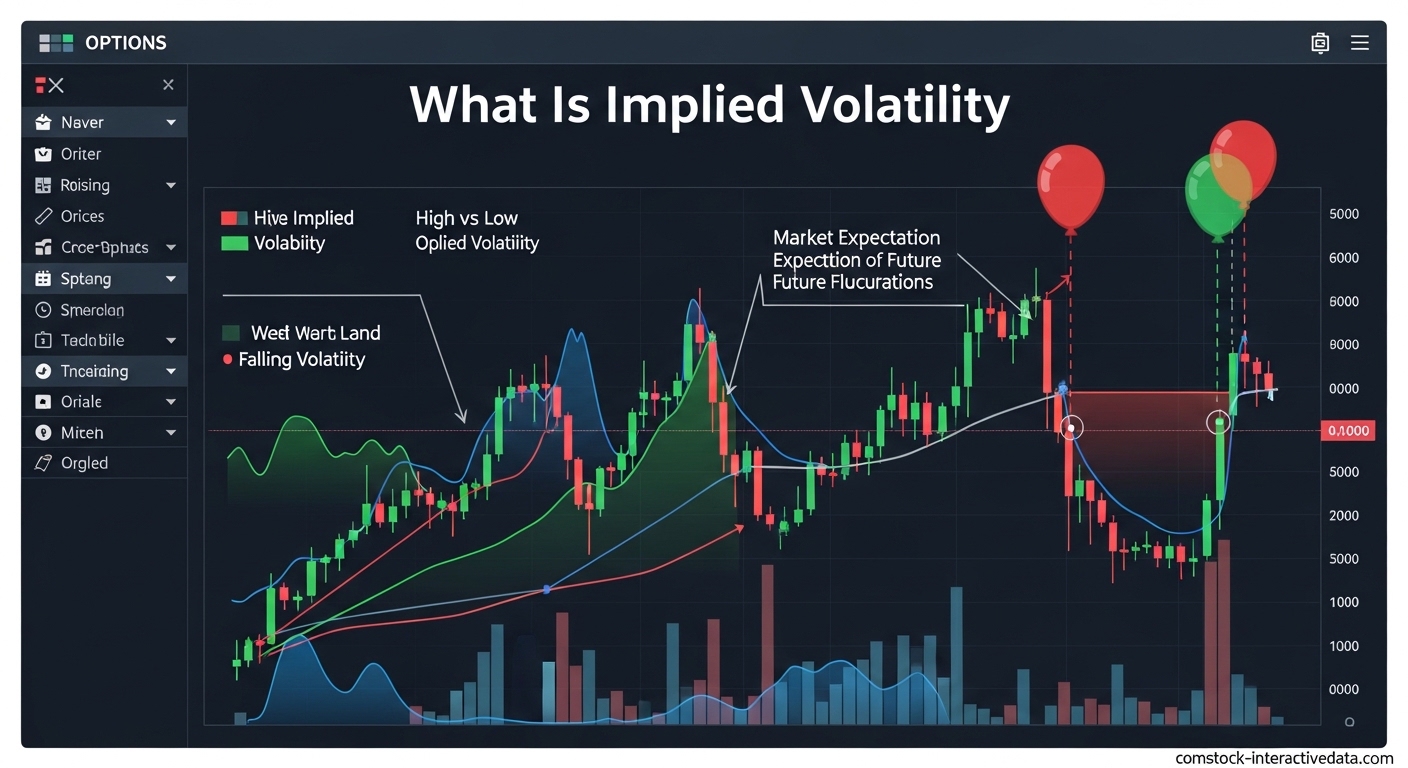
Implied volatility is the market’s forecast of potential price movements for an underlying asset, expressed as an annualized percentage. It represents the expected magnitude of price swings, not the direction. Understanding implied volatility is essential for options traders because it directly affects how much you pay or receive for option contracts.
I remember my first options trade. I bought calls on a stock before earnings, expecting a big move. The stock went up, but my options actually lost value. What happened? Implied volatility collapsed after the earnings announcement. That expensive premium I paid? It evaporated overnight. This is the IV crush phenomenon, and it taught me a painful but valuable lesson: direction alone does not guarantee options profits.
In this guide, I will explain what implied volatility really means, how it affects options prices, and how you can use this knowledge to make smarter trading decisions. We will cover the mathematics behind IV (without overwhelming you), the difference between high and low IV environments, and practical strategies for each scenario.
Table of Contents
What Is Implied Volatility?
Implied volatility is a forward-looking metric that represents the market’s expectation of how much a stock or other underlying asset might move over the next year. Expressed as an annualized percentage, IV tells you the expected magnitude of price changes, but critically, not the direction.
Here is the key insight: implied volatility is derived from option prices, not the other way around. Many beginners get this backwards. They think IV determines option prices. In reality, traders set option prices through supply and demand, and we use mathematical models like Black-Scholes to work backward and extract the implied volatility figure.
Think of IV like insurance premiums. When a hurricane is approaching Florida, home insurance costs spike because the risk of damage increases. Similarly, when the market expects big price swings in a stock, options become more expensive, which shows up as higher implied volatility.
Implied Volatility vs Historical Volatility
Historical volatility (also called realized volatility) looks backward. It measures how much a stock actually moved in the past, typically over 20 or 30 trading days. Historical volatility is factual, it already happened.
Implied volatility looks forward. It reflects what the market thinks will happen. IV represents the collective wisdom (and fear) of all options traders. This distinction matters because IV often overstates actual realized volatility. Studies consistently show that implied volatility tends to be higher than the volatility that actually materializes, which is why selling options premium can be profitable over time.
The Annualized Percentage Concept
When you see a stock with 30% implied volatility, that figure is annualized. It means the market expects the stock to move within a range of roughly plus or minus 30% over the next year, with about 68% confidence (one standard deviation).
To translate this to shorter timeframes, we use the square root of time rule. For a 30-day period, you would divide 30% by the square root of 12 (since 30 days is roughly 1/12 of a year). This gives an expected monthly move of about 8.7%. Understanding this scaling is crucial for setting realistic price targets and strike selections.
How Implied Volatility Works?
Implied volatility functions as the market’s fear gauge and opportunity detector. When uncertainty increases, IV rises. When calm returns, IV falls. This mechanism operates through the fundamental economic forces of supply and demand in the options marketplace.
The Black-Scholes Model Connection
The Black-Scholes model, developed in 1973 by Fischer Black and Myron Scholes, remains the primary framework for options pricing. The model takes several inputs: stock price, strike price, time to expiration, risk-free interest rate, dividends, and implied volatility. With all other variables known, we can solve for the unknown IV when we know the market price of an option.
This backward derivation is important. The model does not predict option prices. Instead, it helps us understand what the current option price implies about future volatility expectations. When you see IV quoted at 45%, that means 45% is the volatility input required in the Black-Scholes formula to produce the current market price of the option.
Supply and Demand Dynamics
Option prices, like all market prices, reflect supply and demand. When more traders want to buy options than sell them, prices rise. This increased premium translates to higher implied volatility. Several factors drive this demand:
Upcoming earnings announcements create demand for options because traders expect larger price moves. Economic uncertainty, such as Federal Reserve meetings or inflation reports, increases demand for portfolio protection through put options. Individual stock news, mergers, or product announcements can spike demand for specific names.
On the supply side, market makers and institutional sellers provide liquidity. When they sense higher risk or when demand surges, they raise their asking prices. This widening of bid-ask spreads contributes to higher IV readings.
Relationship with Option Greeks
Vega measures an option’s sensitivity to changes in implied volatility. A vega of 0.10 means the option’s price will increase by approximately $0.10 for every 1% increase in IV, all else being equal. Long options (calls and puts) have positive vega, they benefit from rising IV. Short options have negative vega, they benefit from falling IV.
This relationship explains why understanding your position’s vega exposure matters. If you buy options when IV is elevated and IV subsequently drops, your position loses value even if the stock moves in your favor. This vega risk is particularly acute around earnings announcements, where IV often collapses immediately after the news releases.
How Does Implied Volatility Affect Options Prices?
Implied volatility directly impacts option premiums through the extrinsic value component. Higher IV means higher option prices. Lower IV means lower option prices. This relationship is positive and consistent across all option types and strikes.
Intrinsic vs Extrinsic Value
Every option price consists of two components. Intrinsic value is the amount by which an option is in-the-money. A $50 call on a $55 stock has $5 of intrinsic value. This portion is unaffected by implied volatility.
Extrinsic value (also called time value or time premium) represents everything else. It accounts for time remaining until expiration, interest rates, dividends, and critically, implied volatility. A $50 call on a $50 stock has zero intrinsic value but may trade for $3 due entirely to extrinsic value. This $3 figure fluctuates directly with changes in IV.
The IV Premium Relationship
When implied volatility increases, extrinsic value expands. When IV decreases, extrinsic value contracts. This explains why you can lose money on an options position even when you correctly predict the stock’s direction. If you buy an option at 40% IV and IV drops to 25% while you hold the position, the time value erosion can offset gains from the stock movement.
Consider a real example. Stock XYZ trades at $100. A 30-day $100 call might cost $4.00 with 30% implied volatility. If IV jumps to 50% (perhaps before earnings), that same call might cost $6.50 even with the stock still at $100. The $2.50 difference represents pure extrinsic value expansion driven by volatility expectations.
Magnitude vs Direction
Perhaps the most important concept for options traders: implied volatility measures expected magnitude, not direction. High IV means the market expects big moves, but it does not tell you whether those moves will be up or down. This is why straddles and strangles (buying both calls and puts) become popular when IV rises. Traders bet on movement itself, not direction.
When IV is low, the market expects range-bound behavior. This favors directional strategies where you pick a side, or income strategies where you sell premium. Understanding whether current IV reflects high or low expectations for price movement helps you select appropriate strategies.
Expected Moves and Standard Deviation
Implied volatility translates into practical trading information through expected move calculations. These calculations help you set strike prices, determine profit targets, and assess probability of success.
The Expected Move Formula
The expected move represents the price range within which the underlying stock is expected to remain until expiration, with approximately 68% probability (one standard deviation). The formula is:
Expected Move = Stock Price x Implied Volatility x Square Root of (Days to Expiration / 365)
For example, with a $100 stock, 30% IV, and 30 days to expiration: Expected Move = $100 x 0.30 x sqrt(30/365) = $100 x 0.30 x 0.287 = $8.61. This means the market expects the stock to stay within roughly $91.39 to $108.61 over the next 30 days, with 68% confidence.
Standard Deviation Probabilities
Statisticians use standard deviations to describe probability ranges. The 68-95-99.7 rule provides a useful framework:
One standard deviation (1SD) encompasses approximately 68% of expected outcomes. Two standard deviations (2SD) covers about 95% of outcomes. Three standard deviations (3SD) includes approximately 99.7% of outcomes.
Translating to options trading: if the 1SD expected move on a $100 stock with 30% IV is plus or minus $8.61, then there is a 68% probability the stock stays between $91.39 and $108.61 at expiration. There is a 95% probability it stays within $82.78 to $117.22 (2SD). These probabilities inform strike selection and risk management decisions.
Practical Applications
I use expected move calculations for every trade. When selling a credit spread, I typically place my short strike outside the 1SD expected move. This gives me approximately 68% probability of profit at expiration. When buying options, I compare the expected move to my price target. If I expect a stock to move $15 but the 1SD expected move is only $5, the options market is underpricing the move relative to my analysis, suggesting a potential opportunity.
Most trading platforms now display expected moves directly on the options chain. TastyTrade, thinkorswim, and OptionStrat all show these calculations, saving you from manual math. However, understanding how the numbers are derived helps you use them more effectively.
High Implied Volatility vs Low Implied Volatility
Recognizing whether current implied volatility is high or low relative to historical norms helps you choose appropriate strategies. IV is not absolute. A 40% IV reading might be high for a stable ETF but low for a biotech stock awaiting FDA approval.
| Characteristic | High IV Environment | Low IV Environment |
|---|---|---|
| Option Premiums | Expensive | Cheaper |
| Market Sentiment | Fear, Uncertainty | Complacency, Calm |
| Best Strategies | Selling Premium | Buying Options |
| Strategy Examples | Covered Calls, Credit Spreads, Iron Condors | Long Calls, Long Puts, Debit Spreads |
| Risk/Reward Profile | Higher Probability, Lower Payout | Lower Probability, Higher Payout |
| IV Outlook | Tends to Decrease (Mean Reversion) | Tends to Increase (Mean Reversion) |
| VIX Level | Above 25 | Below 15 |
Using IV Rank and IV Percentile
IV rank tells you where current implied volatility sits relative to the past year’s range, expressed as a 0-100 scale. An IV rank of 80 means IV is higher than 80% of readings over the past year. This context helps you assess whether current levels represent genuine opportunity or potential trap.
IV percentile is similar but accounts for how often IV traded at each level. It answers: what percentage of days had IV lower than today? Both metrics help normalize IV across different underlying assets. A 35% IV on SPY might represent high volatility for that ETF, while 35% IV on a tech stock might be relatively low.
Typical IV Ranges by Asset Type
Understanding typical IV ranges helps you quickly assess opportunity:
Major index ETFs (SPY, QQQ, IWM) typically trade with IV between 15% and 35%. Large-cap stable stocks (KO, JNJ, PG) often range from 20% to 40%. Growth stocks and tech names (AAPL, MSFT, NVDA) commonly show IV from 30% to 60%. Small-cap biotechs and meme stocks can regularly exceed 100% IV, especially around events.
When IV spikes above these typical ranges for a given asset, selling premium becomes attractive. When IV compresses below normal levels, buying options offers better value. The key is comparing current IV to that asset’s historical behavior, not comparing across different asset types.
Trading Strategies for Different IV Environments
Your strategy selection should adapt to the volatility environment. Buying expensive options in high IV conditions stacks the odds against you. Selling cheap options in low IV conditions limits your profit potential. Match your approach to the market conditions.
High IV Strategies
When implied volatility is elevated, selling options premium offers the highest probability of profit. The elevated extrinsic value provides a cushion against adverse moves and generates immediate income.
Covered calls work well in high IV environments because you collect larger premiums while capping upside. Cash-secured puts similarly benefit from inflated put premiums, letting you enter stock positions at effective discounts or collect income if the put expires worthless.
Credit spreads (both call and put spreads) capitalize on elevated IV while defining risk. Iron condors, which combine a call credit spread and put credit spread, profit from range-bound movement when IV is high. These strategies benefit from both time decay and the IV mean reversion tendency.
Low IV Strategies
When implied volatility is depressed, buying options becomes more attractive. Lower extrinsic value means you pay less for time premium, and any IV expansion adds value to your position.
Long calls and puts offer defined risk with unlimited upside. Debit spreads reduce cost basis while maintaining directional exposure. Calendar spreads (selling near-term options and buying longer-dated options) profit from IV expansion in the back month.
Straddles and strangles work best when IV is low but you expect a volatility expansion event. You buy both calls and puts, betting that a significant move will occur without needing to pick direction. These positions have positive vega, meaning IV increases boost their value.
Understanding IV Crush
IV crush describes the rapid decline in implied volatility after anticipated events pass. Earnings announcements, FDA decisions, and economic reports often cause IV to spike beforehand as traders hedge uncertain outcomes. Once the news releases and uncertainty resolves, IV collapses.
This crush can devastate long options positions. A stock might move in your favor directionally, but if IV drops from 80% to 35% after earnings, the extrinsic value loss can exceed intrinsic value gains. Before entering pre-earnings trades, calculate how much IV crush might cost you. If the expected move is $10 but the stock only moves $5, your long options will likely lose money despite the correct directional bet.
Frequently Asked Questions
What is a good implied volatility for options pricing?
There is no universal good implied volatility level. It depends entirely on the underlying asset. ETFs like SPY typically trade with 20-30% IV, while individual stocks vary widely from 30% to over 100%. Instead of looking at absolute IV numbers, use IV rank or IV percentile to compare current levels to historical ranges for that specific asset. An IV rank above 50 suggests relatively expensive options, while below 50 suggests relatively cheap options.
Does implied volatility increase option prices?
Yes, implied volatility and option prices have a direct positive relationship. Higher IV leads to higher option premiums because it increases the extrinsic (time) value component. When IV rises, both call and put prices increase. When IV falls, both call and put prices decrease. This relationship holds true across all strikes and expiration dates.
Is 30% IV high?
Whether 30% IV is high depends on the underlying asset. For broad market ETFs like SPY, 30% represents above-average volatility, typically seen during periods of market stress. For individual stocks, 30% might actually be relatively low, especially for growth stocks or names approaching earnings. Always compare current IV to historical ranges using IV rank or percentile rather than judging absolute numbers.
Is it better to buy options when IV is low or high?
Generally, it is better to buy options when implied volatility is low and sell options when IV is high. Low IV means cheaper premiums and potential for IV expansion to add value. High IV means expensive premiums that often decline through mean reversion. However, high IV also indicates the market expects larger price moves, so if you anticipate a significant move that exceeds expectations, buying in high IV can still work. Match your strategy to your market outlook and the specific volatility environment.
Conclusion
Implied volatility represents the market’s collective forecast of future price movements, and understanding it separates successful options traders from struggling ones. Remember that IV affects option prices through the extrinsic value component, higher IV means higher premiums, and that IV measures expected magnitude, not direction.
Apply this knowledge by checking IV rank before every trade. In high IV environments, favor selling strategies like covered calls and credit spreads. In low IV environments, consider buying strategies like long options and debit spreads. Always calculate expected moves to inform your strike selection and use the standard deviation framework to assess probability of profit.
Implied volatility is not a prediction of what will happen. It is a reflection of what the market thinks might happen, priced into options through supply and demand. By understanding this distinction and adapting your strategies accordingly, you put probability on your side. Start incorporating IV analysis into your trading routine today, and watch your decision-making improve with every trade.