
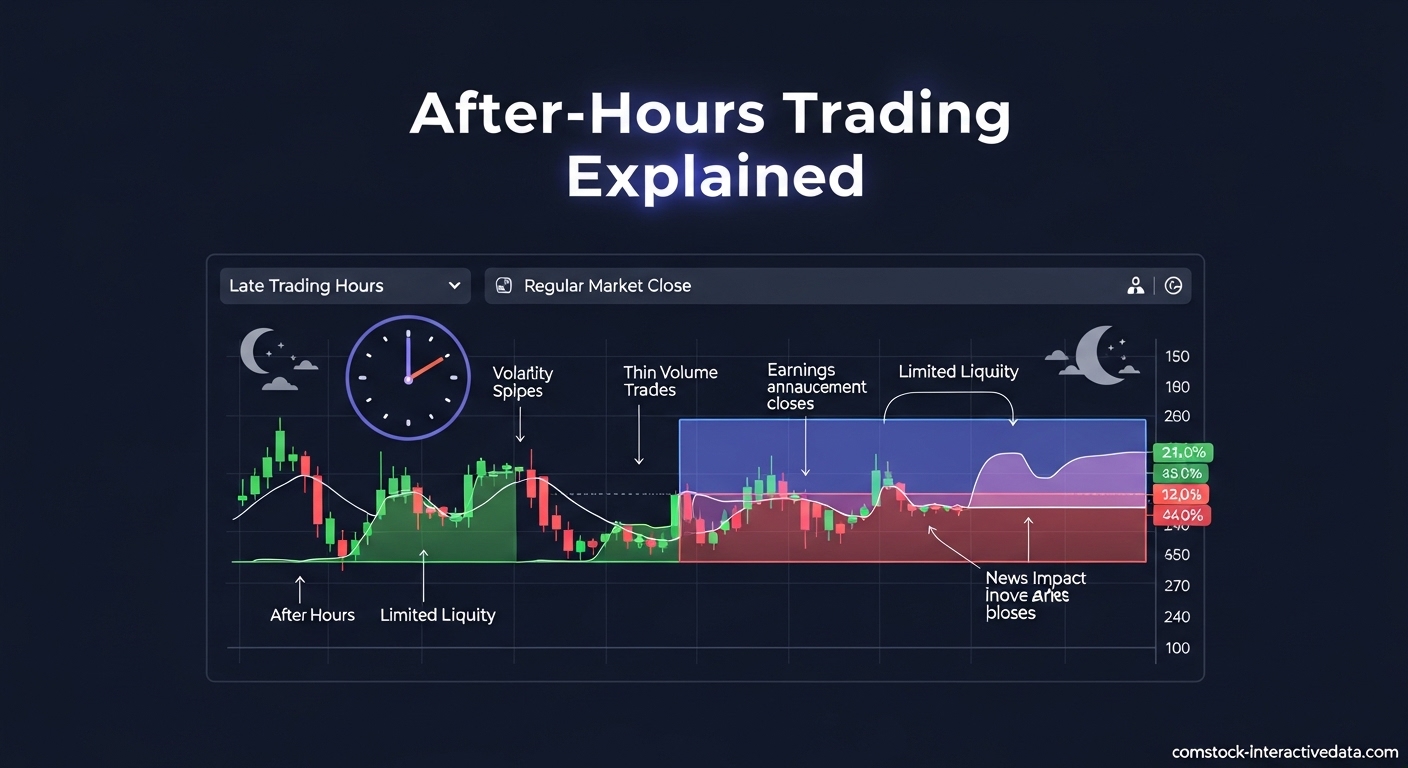
After-hours trading is the buying and selling of stocks outside regular market hours, typically occurring between 4:00 p.m. and 8:00 p.m. ET through electronic communication networks. This extended trading window allows investors to react to earnings reports, breaking news, and other market-moving events that happen after the closing bell. While it offers unique opportunities, after-hours trading carries distinct risks that every investor should understand before placing their first extended-hours order.
In this guide, I will explain exactly how after-hours trading works, when it can benefit your investment strategy, and what risks you need to watch out for. I have reviewed research from financial institutions, SEC publications, and real trader experiences to give you a complete picture of extended-hours trading in 2026.
Table of Contents
What Is After-Hours Trading?
After-hours trading refers to securities transactions that occur after the official closing bell of major stock exchanges. The New York Stock Exchange and Nasdaq typically close at 4:00 p.m. Eastern Time, but trading continues through electronic communication networks for several additional hours.
This practice became widely available to retail investors in the late 1990s as electronic trading systems evolved. Before then, after-hours trading was primarily reserved for institutional investors and high-net-worth individuals. Today, most major brokerage firms offer extended-hours trading to all account holders, though specific rules and availability vary by broker.
It is important to distinguish between after-hours trading and pre-market trading. Pre-market sessions occur before the regular market opens, typically from 4:00 a.m. to 9:30 a.m. ET. Together, these sessions make up what is called extended-hours trading, allowing investors to access the market for up to 16 hours each day.
How After-Hours Trading Works?
After-hours trading operates through electronic communication networks, commonly called ECNs. These are automated systems that match buy and sell orders without the need for a traditional exchange floor or market makers. When you place an order during extended hours, your broker routes it to an ECN rather than to the NYSE or Nasdaq directly.
Electronic Communication Networks (ECNs)
ECNs display orders from various participants and match them based on price and time priority. Major ECNs include Nasdaq OMX, NYSE Arca, and Instinet. Each ECN maintains its own order book, which means liquidity is fragmented across multiple systems rather than consolidated in one place.
This fragmentation creates one of the key challenges of after-hours trading. You might see one price on your broker’s platform while another ECN displays a different quote for the same stock. During regular hours, exchanges consolidate this data to give you the best available price. In extended hours, you only see what your specific ECN or broker shows you.
Order Types and Restrictions
Most brokers only accept limit orders during after-hours sessions. Market orders, which execute immediately at the best available price, are typically prohibited because the risk of unfavorable execution is too high. Limit orders let you specify the maximum price you are willing to pay when buying, or the minimum price you will accept when selling.
Some brokers offer specialized order types for extended-hours trading. Schwab, for example, provides EXTO orders (Extended Hours Overnight) that remain active through both after-hours and pre-market sessions. Good-Till-Canceled Extended (GTC_EXT) orders can remain open for up to 120 days across multiple extended sessions.
Price Discovery Process
Price discovery in after-hours trading works differently than during regular hours. Without market makers and with lower overall volume, prices can move more dramatically on relatively small order sizes. A single large order can shift the price significantly, especially for less liquid stocks.
The after-hours price you see may or may not reflect where the stock will open the next trading day. While major moves often carry over, smaller fluctuations frequently reverse once the regular session begins and more participants enter the market.
Trading Hours and Schedule
Understanding the complete trading schedule helps you plan your strategy. Here is the breakdown of available trading sessions:
Pre-Market Session: 4:00 a.m. to 9:30 a.m. ET. This session allows investors to react to overnight news and international market developments before the U.S. market opens. Volume tends to be lowest in the early morning hours and increases significantly after 8:00 a.m.
Regular Market Hours: 9:30 a.m. to 4:00 p.m. ET. This is when the majority of trading volume occurs, with the highest liquidity and most participants active in the market.
After-Hours Session: 4:00 p.m. to 8:00 p.m. ET. This session sees peak activity immediately after the close as earnings reports are released. Volume typically tapers off significantly after 6:00 p.m.
Some brokers now offer 24-hour trading on select securities, though this is not true after-hours trading in the traditional sense. These overnight sessions carry even lower liquidity and are generally not recommended for retail investors.
Benefits of After-Hours Trading
Extended-hours trading offers several advantages for the right type of investor. Understanding these benefits helps you determine whether after-hours trading fits your investment approach.
React to Earnings Reports Immediately
Most publicly traded companies release their quarterly earnings reports after the market closes at 4:00 p.m. ET. This timing allows companies to present results when all market participants can digest the information simultaneously. After-hours trading lets you react to these announcements immediately rather than waiting for the next opening bell.
I have seen stocks move 10 to 20 percent within minutes of an earnings surprise. If you believe the market is misinterpreting the results, after-hours trading gives you the opportunity to position yourself before the broader market reacts. This can be particularly valuable for active traders who follow earnings seasons closely.
Convenience for Working Professionals
Not everyone can monitor the markets during regular business hours. If you work a full-time job, you might miss trading opportunities that occur while you are in meetings or focused on your career. After-hours trading provides flexibility to manage your portfolio on your schedule.
Our team spoke with several retail investors who use after-hours sessions exclusively because of their work commitments. One software engineer told us he does all his trading between 7:00 p.m. and 8:00 p.m. after putting his children to bed. Without extended hours, he would need to trade during work hours or miss opportunities entirely.
Early Positioning Opportunities
Breaking news does not follow market hours. Major geopolitical events, economic data releases, and corporate announcements happen around the clock. After-hours trading allows you to adjust your positions before the next regular session begins, potentially getting ahead of the broader market reaction.
This early positioning can work both ways. You might buy a stock after positive news breaks in the evening, or exit a position to limit losses if concerning information emerges. The key is having the discipline to act only when you have a clear thesis, not simply because you can trade.
Price Opportunity During Volatility
The increased volatility of after-hours trading creates both risk and opportunity. Experienced traders sometimes find favorable entry points during extended hours when prices temporarily disconnect from fundamental value. Wide bid-ask spreads also mean that patient limit orders can occasionally execute at better prices than would be available during regular hours.
Flexibility for International Investors
If you live outside the United States, regular U.S. market hours might fall in the middle of your night. After-hours trading aligns better with European and Asian time zones, allowing international investors to participate during their waking hours. This global accessibility has made U.S. markets more attractive to foreign capital.
Risks and Disadvantages of After-Hours Trading
Besides low volume, there is also limited liquidity during extended hours, which can lead to increased volatility, larger spreads, and greater price uncertainty. Before you consider after-hours trading, understand these significant risks:
- Lower liquidity makes it harder to execute large orders without moving the price
- Wider bid-ask spreads increase trading costs on every transaction
- Increased volatility can lead to rapid, unexpected losses
- Information asymmetry puts retail traders at a disadvantage
- Execution uncertainty means orders may not fill or fill at unfavorable prices
Low Liquidity and Trading Volume
Trading volume during after-hours sessions is typically less than 10 percent of regular-hours volume. This reduced activity means fewer buyers and sellers in the market at any given time. You might find yourself unable to exit a position quickly without accepting a significantly lower price.
Liquidity varies dramatically by stock. Large-cap stocks like Apple and Microsoft maintain reasonable liquidity after hours. Small-cap stocks and those with low institutional ownership may see virtually no activity. I have seen stocks go hours without a single trade during extended sessions.
High Volatility and Price Gaps
With fewer participants and lower volume, prices can swing dramatically on relatively small orders. A few thousand shares can move a stock several percentage points when the normal market would absorb that volume without noticeable price impact. This volatility creates risk for traders using market orders or stop-loss orders.
Gap risk is particularly concerning. A stock might close at $50 and open the next day at $45 after negative overnight news. If you held the stock through the after-hours session without a protective order, you could suffer significant losses before having a chance to react.
Wide Bid-Ask Spreads
The bid-ask spread represents the difference between what buyers are willing to pay and what sellers are asking. During regular hours, liquid stocks often have spreads of one or two cents. In after-hours trading, those same stocks might have spreads of 10, 20, or even 50 cents.
These wider spreads effectively increase your transaction costs. If you buy at the ask and sell at the bid, you immediately lose the spread amount. For frequent traders, these costs compound significantly over time. You need larger price moves in your favor just to break even.
Information Asymmetry
Institutional investors and professional traders have access to better information and faster systems than retail traders. They can react to news within seconds, while you might need minutes to analyze and act. This information disadvantage makes it difficult to compete effectively in the after-hours market.
Forum discussions on Reddit reveal that many experienced retail traders avoid after-hours trading precisely because of this asymmetry. One trader noted that every time he tried to trade earnings releases after hours, he seemed to be on the wrong side of the move. The institutions had already priced in information he did not yet fully understand.
Execution Uncertainty and Slippage
Your order might not execute at all during after-hours trading, or it might execute at a price significantly different from what you expected. Slippage occurs when the available price moves away from your intended entry point before your order fills. In low-liquidity environments, slippage can be substantial.
Even limit orders carry risks in extended hours. You might set a buy limit at $100, see the stock trade at $99.50 on your screen, but never get filled because your broker’s ECN did not have access to that particular trade. The fragmented nature of after-hours markets means you only see a portion of the actual activity.
Regulatory and Protection Differences
Some regulatory protections that apply during regular hours do not extend to after-hours trading. The SEC has noted that investors may have reduced ability to see or act upon quotes during extended sessions. Additionally, some broker rules regarding margin and unsettled funds apply differently or more restrictively after hours.
After-Hours vs Regular Trading: Key Differences
Understanding the differences between standard and extended-hours trading helps you set appropriate expectations. The following comparison highlights the most important distinctions:
| Factor | Regular Market Hours | After-Hours Trading |
|---|---|---|
| Trading Hours | 9:30 a.m. – 4:00 p.m. ET | 4:00 p.m. – 8:00 p.m. ET |
| Market Participants | Millions of retail and institutional traders | Primarily institutions, limited retail |
| Liquidity | High – consolidated across all venues | Low – fragmented across ECNs |
| Volatility | Moderate, varies by stock | Higher due to lower volume |
| Bid-Ask Spreads | Narrow (pennies for liquid stocks) | Wide (dimes to dollars) |
| Order Types | Market, limit, stop, conditional orders | Primarily limit orders only |
| Execution Speed | Immediate for liquid securities | May take minutes or not fill |
| Price Transparency | Full consolidation, NBBO available | Limited to specific ECN quotes |
| News Impact | Priced in gradually during session | Immediate, often exaggerated moves |
| Regulatory Protections | Full SEC and FINRA oversight | Reduced protections in some areas |
The most significant practical difference is execution quality. During regular hours, you can generally expect fair prices and immediate fills for standard orders. After hours, every trade requires more patience and carries more uncertainty about whether you are getting a reasonable price.
Does After-Hours Trading Affect Opening Price?
Yes, after-hours trading directly influences where stocks open the next trading day. The official opening price is calculated based on pre-market activity, which itself reflects sentiment carried over from the after-hours session. Major moves after the close often persist into the next morning.
However, not all after-hours price changes hold. Small fluctuations based on limited volume frequently reverse once the regular market opens and more participants provide liquidity. A stock that rises 3 percent after hours on modest volume might give back those gains within the first 30 minutes of regular trading.
I have observed that after-hours moves driven by significant news events tend to persist better than those driven by technical factors or thin trading. When a company surprises the market with earnings results, that revaluation usually sticks. When a stock moves on low volume without news, the move is less likely to hold.
Day traders sometimes use after-hours activity to predict opening direction, but smart traders wait for confirmation. Pre-market volume and price action provide better clues about whether after-hours moves will continue. Jumping into a position solely based on after-hours price changes is risky without additional confirmation.
Who Should Consider After-Hours Trading?
After-hours trading is not for everyone. Based on forum discussions and industry research, here is who should and should not consider extended-hours trading:
Good candidates for after-hours trading:
- Active traders who follow earnings seasons and want immediate reaction capability
- Investors with scheduling constraints who cannot trade during regular hours
- Experienced traders with strong risk management discipline
- Those trading large-cap, highly liquid stocks
- International investors in time zones misaligned with U.S. market hours
Those who should avoid after-hours trading:
- Long-term investors with multi-year holding periods
- Beginners still learning basic trading mechanics
- Traders using market orders or stop-loss orders
- Those trading small-cap or low-volume stocks
- Anyone trading with money they cannot afford to lose
Most long-term investors do not need after-hours trading. If you are buying stocks to hold for years, the price you pay on Tuesday evening versus Wednesday morning makes little difference in your overall returns. The risks of extended-hours trading outweigh any potential benefits for buy-and-hold strategies.
Reddit discussions in trading communities reveal that experienced investors use after-hours selectively rather than routinely. They focus on specific catalysts like earnings releases where immediate reaction provides advantage. They avoid routine trading after hours when no special event creates opportunity.
Practical Tips for After-Hours Trading
If you decide to trade during extended hours, following these guidelines can help you avoid common pitfalls:
Use limit orders exclusively. Never use market orders in after-hours trading. Set your maximum purchase price or minimum sale price and stick to it. This protects you from the wide spreads and sudden price movements that characterize extended sessions.
Start with small positions. Trade smaller size than you would during regular hours until you understand how your broker handles after-hours orders. A good rule is to trade no more than 25 percent of your normal position size in extended sessions.
Focus on liquid stocks. Stick to large-cap stocks with high daily volume. Avoid small-cap stocks, low-float stocks, and anything with average daily volume under one million shares. Liquidity is your friend in after-hours trading.
Monitor pre-market for confirmation. If you see an after-hours move you want to participate in, wait for pre-market confirmation before acting. Pre-market activity starting at 4:00 a.m. provides a better indication of whether after-hours moves will persist into the regular session.
Understand your broker’s rules. Each broker has specific policies for extended-hours trading. Know what order types are accepted, what hours are available, and any special fees that apply. Some brokers charge additional commissions for after-hours trades.
Have a clear exit plan. Decide before you enter a trade exactly when you will exit, both for profits and for losses. The volatility of after-hours trading can trigger emotional decisions if you do not have predetermined rules.
Frequently Asked Questions About After-Hours Trading
Is there a downside to trading after-hours?
Yes, there are several downsides to after-hours trading. The main risks include lower liquidity, wider bid-ask spreads, higher volatility, and execution uncertainty. With fewer market participants, prices can swing dramatically on small orders. You may also experience difficulty getting your desired price or having orders fill at all. Most long-term investors do not need to trade after hours and should avoid the additional risks.
Does after-hours trading affect opening price?
Yes, after-hours trading does affect the next day’s opening price. The opening price is calculated based on pre-market orders, which reflect sentiment from the after-hours session. Significant after-hours moves often carry into the next morning, though small fluctuations based on low volume may reverse once regular trading begins and more liquidity enters the market.
Can you actually trade after hours?
Yes, most major brokers including Schwab, Fidelity, TD Ameritrade, and E*Trade offer after-hours trading to their customers. Trading typically occurs from 4:00 p.m. to 8:00 p.m. ET through electronic communication networks. You will need to specifically enable extended-hours trading on your account, and most brokers only accept limit orders during these sessions.
Why can stocks be so volatile in after-hours trading?
Stocks are more volatile after hours due to low trading volume and limited market participants. With fewer buyers and sellers, individual orders have greater price impact. Earnings reports released after the close also drive rapid price adjustments as the market digests new information. The lack of market makers and fragmented liquidity across multiple ECNs further contributes to price swings.
Is it true that 97% of day traders lose money?
While the exact percentage is debated, research consistently shows that most active traders lose money over time. Studies by academic researchers and regulatory bodies indicate that 70 to 85 percent of day traders lose money, with some estimates higher. After-hours trading amplifies these risks due to lower liquidity and higher costs. This is why after-hours trading is generally not recommended for beginners or those without substantial experience.
What is the 3-5-7 rule in trading?
The 3-5-7 rule is a risk management guideline suggesting traders risk no more than 3% of their account on a single trade, limit losses to 5% on any position, and maintain a maximum portfolio drawdown of 7%. This rule becomes even more important in after-hours trading where volatility is higher. Following strict risk management is essential when trading in less liquid extended sessions.
What time does after-hours trading end?
After-hours trading typically ends at 8:00 p.m. Eastern Time on weekdays. The session begins at 4:00 p.m. ET immediately after the regular market closes. Some brokers offer overnight trading on select securities, but traditional after-hours sessions conclude at 8:00 p.m. ET. After-hours trading is not available on weekends or market holidays.
Conclusion
After-hours trading offers legitimate benefits for certain investors while presenting real risks that should not be underestimated. The ability to react immediately to earnings reports and breaking news provides active traders with flexibility unavailable during standard market hours. However, the reduced liquidity, wider spreads, and increased volatility create challenges that make extended-hours trading unsuitable for many market participants.
If you are considering after-hours trading, start small, use limit orders exclusively, and focus only on highly liquid stocks. Most importantly, be honest about whether you truly need to trade after hours. For long-term investors building wealth over decades, the risks of extended-hours trading almost always outweigh any potential benefits. Stick to regular market hours where liquidity is abundant and execution quality is superior.
The bottom line is that after-hours trading is a specialized tool for specialized situations. Use it selectively when specific catalysts create clear opportunities, not as a routine way to trade. Understanding both the risks and benefits of after-hours trading positions you to make informed decisions that align with your investment goals and risk tolerance in 2026 and beyond.