
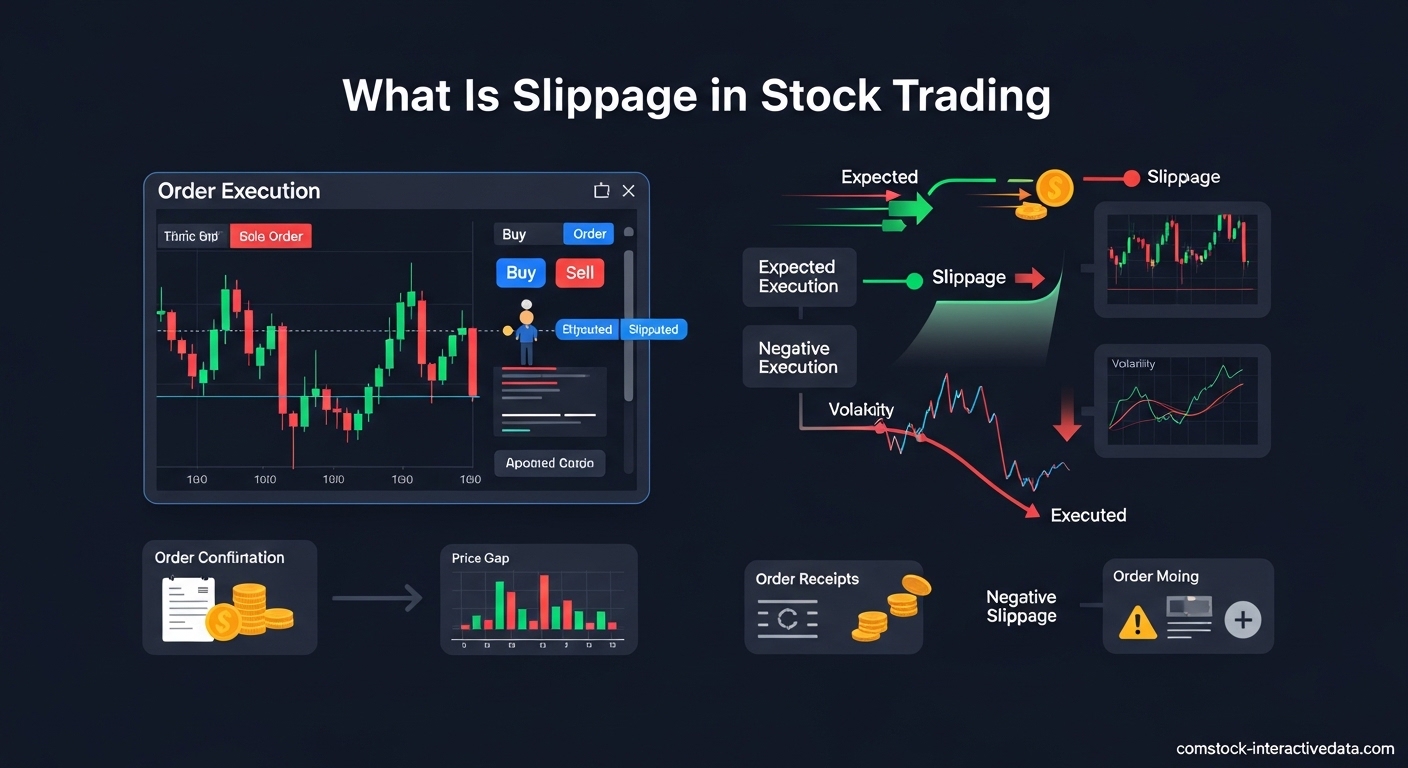
What is slippage in stock trading? Slippage is the difference between the expected price of a trade and the actual price at which the order executes. It happens to every trader at some point, and understanding it can save you from unexpected losses that slowly drain your account.
Our team has spent years analyzing execution data across different brokers and market conditions. We have seen firsthand how slippage impacts everything from day trading scalping strategies to long-term position management. In this guide, I will explain exactly what slippage is, why it happens, and the practical steps you can take to minimize it in your own trading.
Table of Contents
What Is Slippage in Stock Trading?
Slippage occurs when your trade fills at a price different from what you expected when you placed the order. The expected price is what you saw on your screen when you clicked buy or sell. The execution price is what you actually pay or receive when the order completes.
This gap between expected and actual prices stems from how markets function. Prices move constantly based on supply and demand. Between the moment you submit an order and when it executes, market conditions can shift. That shift creates slippage.
The concept extends beyond simple price movements. Slippage involves the bid-ask spread, which is the gap between what buyers are willing to pay and what sellers want to receive. When you place a market order, you are essentially accepting whatever price is available at that moment. That available price often differs from the last traded price you saw displayed.
How Slippage Works in Trading?
Understanding the mechanics helps you anticipate when slippage might strike. The process starts when you submit an order through your broker. That order travels to an exchange or market maker. Execution happens when your order matches with a counterparty.
Each step takes time, even if only milliseconds. In fast-moving markets, prices can change several times within those milliseconds. Your order might arrive at the exchange just as the best available price shifts.
Consider the order book, which displays all pending buy and sell orders at various price levels. When you submit a market order to buy 100 shares, the system matches your order against the lowest available sell orders. If those sell orders get filled or canceled before your order arrives, your trade executes at the next available price. That next price might be several cents or even dollars away from your expected fill price.
Latency also plays a role. Your internet connection speed, your broker’s server response time, and the exchange’s processing speed all contribute to delays. While retail traders rarely have the technology to eliminate latency entirely, understanding its impact helps set realistic expectations.
Types of Slippage
Not all slippage works against you. The trading world recognizes two distinct categories, and knowing the difference matters for your strategy and psychology.
Negative Slippage
Negative slippage, also called adverse slippage, happens when you get a worse price than expected. For buy orders, you pay more. For sell orders, you receive less. This is the type most traders fear and try to avoid.
Imagine you want to buy a stock showing $50.00 on your screen. You submit a market order. By the time it executes, the price has risen to $50.15. Your slippage is $0.15 per share. On a 500-share trade, that is $75 in unexpected cost. These small amounts add up over hundreds of trades.
Positive Slippage
Positive slippage, or favorable slippage, occurs when you get a better price than expected. Your buy order fills below your expected price, or your sell order fills above it. This type of slippage improves your trade outcome.
Using the same example, suppose you submit a buy order at what you think is $50.00. The market moves down slightly before your order executes. You fill at $49.90 instead. That $0.10 per share positive slippage saved you $50 on a 500-share position.
Positive slippage happens more often than many traders realize, especially in volatile markets where prices oscillate rapidly. Some brokers and platforms pass positive slippage to clients, while others may have policies that limit it. Understanding your broker’s execution policy helps you know what to expect.
What Causes Slippage?
Three primary factors drive slippage in modern markets. Recognizing these conditions helps you anticipate when slippage risk is elevated.
Market Volatility
High volatility creates rapid price movements that increase slippage probability. During earnings announcements, economic data releases, or unexpected news events, prices can jump several percentage points in seconds. Your order submitted at one price might execute far from that level.
Our analysis shows that slippage increases dramatically during the first minute after major news hits the wire. We have seen spreads widen from pennies to dollars during these periods. The increased volatility means more frequent and larger slippage events.
Low Liquidity
Liquidity refers to how easily an asset can be bought or sold without affecting its price. Highly liquid stocks like Apple or Microsoft have tight bid-ask spreads and deep order books. Low liquidity stocks, including many small-cap or foreign stocks, have wider spreads and fewer shares available at each price level.
When you trade a low liquidity stock, your order might exhaust all available shares at the best price. The remaining shares of your order fill at progressively worse prices. This is common with thinly traded stocks, after-hours trading, and certain foreign markets.
Forum discussions reveal that algorithmic traders particularly struggle with low liquidity slippage. One user reported that slippage was eating into their algorithmic trading profits, forcing them to abandon strategies that worked perfectly in backtests but failed in live trading due to execution costs.
After-Hours and Pre-Market Trading
Extended hours trading sessions have lower volume and fewer participants. The reduced activity means wider bid-ask spreads and shallower order books. Slippage becomes more common and more severe during these periods.
A stock might have a $0.01 spread during regular hours but show a $0.50 or wider spread after hours. Market orders placed during these sessions almost guarantee some level of slippage. Even limit orders might not fill if the price gaps beyond your limit level.
Real-World Slippage Example
Let me walk you through a concrete example that shows exactly how slippage affects a real trade. This scenario reflects what many traders experience regularly.
You are watching shares of TechCorp, currently trading at $100.00. Your analysis suggests the stock will rise, so you decide to buy 200 shares. You click the buy button at 10:15 AM, expecting to pay $20,000 total.
However, several other traders had the same idea. Multiple buy orders hit the market simultaneously. By the time your order reaches the exchange, the available shares at $100.00 are gone. Your order fills at $100.25 instead.
Your total cost is now $20,050 rather than the expected $20,000. The slippage cost you $50 on this single trade. That is $0.25 per share, or 0.25% slippage on the trade value.
To calculate your slippage percentage, use this formula: (Actual Price – Expected Price) / Expected Price x 100. In this case: ($100.25 – $100.00) / $100.00 x 100 = 0.25%.
Now imagine you trade five times per week and experience similar slippage on each trade. Over a year, that is hundreds of trades with cumulative slippage costs reaching thousands of dollars. This is why professional traders obsess over execution quality.
Order Types and Slippage
The order type you choose directly impacts your slippage exposure. Understanding these differences lets you select the right tool for each situation.
Market Orders and Slippage Risk
Market orders guarantee execution but not price. When you submit a market order, you are saying you want to buy or sell immediately at the best available price. That price might differ significantly from the last traded price you saw.
Market orders make sense when getting filled matters more than the exact price. However, they expose you to maximum slippage risk. During volatile periods, market orders can fill at truly terrible prices. I have seen traders get fills several percent away from their expected price during flash crashes or earnings gaps.
Limit Orders to Prevent Negative Slippage
Limit orders specify the maximum price you will pay when buying or the minimum price you will accept when selling. They protect you from negative slippage because your order will not execute beyond your specified limit.
Using our previous example, if you placed a limit order at $100.00 instead of a market order, your trade would not have executed at $100.25. The order would either fill at $100.00 or better, or not fill at all if the price moved away.
This protection comes with a trade-off. Limit orders risk missing trades entirely. If the stock runs up to $105 without filling your $100.00 limit order, you miss the move. Many traders use a hybrid approach, setting limit orders slightly above the current ask to balance fill probability with slippage protection.
Stop-Loss Orders and Slippage
Stop-loss orders trigger market orders when a price threshold is reached. This combination creates significant slippage risk during gaps or fast moves.
A trader on Reddit shared a painful lesson about stop-loss slippage. They held Netflix through earnings, expecting the stock to rise. Instead, Netflix dropped over 20% after hours. Their stop-loss order triggered, but due to the massive gap down, the order filled at a price far below their stop level. This catastrophic slippage turned a planned small loss into a devastating blow to their account.
Stop-limit orders offer an alternative. They trigger a limit order rather than a market order when your stop price hits. This prevents fills beyond your limit but risks not getting filled at all during fast moves. The choice between stop-market and stop-limit depends on whether you prioritize guaranteed exit or exit price.
How to Minimize Slippage in Trading?
Now that you understand what causes slippage, here are the practical strategies our team uses to reduce its impact on trading results.
Strategy 1: Use Limit Orders Strategically
Limit orders are your primary defense against negative slippage. Set your limit slightly beyond the current price for better fill rates. For liquid stocks during normal conditions, a limit one or two cents beyond the ask usually gets filled quickly while protecting you from major slippage.
For less liquid stocks, widen the limit slightly more. The key is balancing fill probability with price protection. Avoid market orders except in emergencies or highly liquid markets with tight spreads.
Strategy 2: Trade During High Liquidity Periods
Trade when markets are most active. For US stocks, this means the first two hours after the opening bell and the last hour before close. These periods have the deepest order books and tightest spreads.
Avoid trading during lunch hours when volume drops and spreads widen. Similarly, avoid the first few minutes after market open when volatility is extreme. The period from 9:30 AM to 9:35 AM often sees the highest slippage of the entire day.
Strategy 3: Avoid Volatile Market Conditions
Check the economic calendar before trading. Major announcements like non-farm payrolls, Fed decisions, or earnings reports from major companies create conditions where slippage multiplies. Consider sitting out these events or using limit orders with wider tolerances if you must trade.
Many scalping traders report 1-3 ticks of slippage regularly during normal conditions. During high volatility, that slippage can expand to 5-10 ticks or more. The forum consensus among day traders is that avoiding the first 5-10 minutes after major news saves more money than any other single tactic.
Strategy 4: Understand Slippage Tolerance Settings
Many modern trading platforms offer slippage tolerance settings. These let you specify the maximum slippage you will accept. If available prices exceed your tolerance, the order either rejects or requotes.
Set your tolerance based on market conditions and your strategy. For liquid stocks in normal markets, 0.1% might suffice. For volatile or illiquid markets, you might need 0.5% or higher to get fills at all. Review your broker’s documentation to understand how they handle rejected orders due to tolerance limits.
Strategy 5: Position Sizing to Reduce Impact
The dollar impact of slippage scales with position size. A 0.25% slippage on a $1,000 trade costs $2.50. The same slippage on a $100,000 trade costs $250. While slippage percentage might stay constant, the absolute dollar impact grows with position size.
Build slippage into your risk calculations. If you plan to enter a large position, consider breaking it into smaller chunks. Smaller orders move through the order book more easily, reducing the depth you exhaust at each price level.
One trader noted that when scaling into positions of 500+ shares, splitting into two or three smaller orders often resulted in better average fills than a single large order. The market can absorb smaller pieces more smoothly without pushing prices against you.
Strategy 6: Choose Your Broker Wisely
Different brokers have different liquidity pools and execution quality. Some route orders to market makers who pay for order flow. Others route directly to exchanges. The execution quality varies significantly.
Forum traders frequently discuss how brokers with different liquidity pools affect slippage. Direct market access brokers often provide better execution for active traders, though they may charge higher commissions. For high-volume traders, better execution quality often outweighs commission costs.
Catastrophic Slippage Scenarios
Most slippage is annoying but manageable. Occasionally, slippage becomes catastrophic. Understanding these scenarios helps you prepare and protect your capital.
The Netflix earnings example mentioned earlier illustrates earnings-related catastrophic slippage. Traders holding positions through earnings announcements risk massive gaps. Stop-losses become ineffective because no buyers exist at your stop price. Your order fills at whatever price the market opens.
Flash crashes represent another scenario. On May 6, 2010, the Dow Jones dropped nearly 1,000 points in minutes before recovering. Traders with stop-losses saw them trigger at devastating prices, then watched prices rebound immediately. The stop-losses protected nothing and locked in terrible losses.
Foreign stocks traded on US exchanges through American Depositary Receipts sometimes gap overnight. Foreign markets close while US markets remain open, creating information gaps. When foreign markets reopen, prices might gap significantly. Slippage on stop-loss orders during these gaps can be severe.
Protect yourself by avoiding holding through earnings unless your strategy specifically requires it. Consider using options to define risk rather than stop-loss orders for positions held overnight. Size positions so that even catastrophic slippage cannot destroy your account.
Slippage in Different Markets
While this guide focuses on stock trading, slippage varies across asset classes. Understanding these differences helps if you trade multiple markets.
Forex Trading Slippage
Forex markets operate 24 hours with varying liquidity throughout the day. Slippage is common during major economic releases and when markets transition between sessions. The forex market also experiences slippage around weekend gaps when major news breaks while markets are closed.
Forex brokers often offer guaranteed stop-loss orders for an additional cost. These guarantee your stop price regardless of market gaps. Whether this protection is worth the premium depends on your trading style and risk tolerance.
Low Float Stocks
Stocks with small numbers of shares outstanding, called low float stocks, experience extreme slippage. A relatively small order can move the price significantly. These stocks are popular with day traders but require careful position sizing and limit order discipline.
Slippage of several percent is common in low float momentum stocks. Traders who succeed with these names master the art of getting fills without chasing price. They accept that some trades will not fill rather than paying inflated prices due to slippage.
FAQs
How to avoid slippage in trading?
You can minimize slippage by using limit orders instead of market orders, trading during high liquidity periods like market open and close, avoiding volatile market conditions around major news events, and setting appropriate slippage tolerance settings on your trading platform. Breaking large orders into smaller chunks also reduces the price impact that causes slippage.
What assets are prone to slippage?
Low liquidity assets are most prone to slippage, including small-cap stocks, low float stocks, after-hours trading sessions, certain foreign stocks, and thinly traded forex pairs. Cryptocurrencies also experience high slippage during volatile periods. Highly liquid assets like major blue-chip stocks and popular forex pairs like EUR/USD generally have minimal slippage during normal market conditions.
How to calculate slippage percentage?
Calculate slippage percentage using the formula: (Actual Price – Expected Price) / Expected Price x 100. For buy orders, positive results indicate negative slippage. For sell orders, negative results indicate negative slippage. Track your average slippage across trades to understand its impact on your overall profitability.
Is slippage good or bad?
Slippage can be either good or bad. Negative slippage occurs when you get a worse price than expected, costing you money. Positive slippage occurs when you get a better price than expected, saving you money or increasing profits. While traders generally try to avoid negative slippage, positive slippage happens regularly and can improve your results over time.
Why do limit orders prevent slippage?
Limit orders prevent negative slippage because they specify the maximum price you will pay when buying or the minimum price you will accept when selling. Your order will not execute beyond that limit, protecting you from fills at worse prices. The trade-off is that limit orders might not fill at all if the market moves away from your specified price.
Conclusion
What is slippage in stock trading? It is an unavoidable reality that impacts every trader who uses market orders or holds positions through volatile periods. Understanding slippage mechanics, recognizing when conditions favor increased slippage, and applying the minimization strategies outlined in this guide will help protect your trading capital.
The key takeaways are simple but powerful. Use limit orders to control your entry prices. Trade during liquid periods when spreads are tight. Avoid the most volatile moments unless your strategy specifically requires that exposure. Size your positions so that even catastrophic slippage cannot devastate your account.
Start implementing these techniques in your next trading session. Track your fills and calculate your actual slippage over a series of trades. Small improvements in execution quality compound over time, turning what was once a hidden cost into a manageable aspect of your trading business. Your future trading results will reflect the discipline you apply today.