
When I first started investing, bonds confused me more than stocks. I understood that buying a stock meant owning a piece of a company. But bonds felt abstract. What exactly was I buying? Why would I want something that seemed to pay less than exciting growth stocks?
Then the stock market dropped 20% in one month, and my portfolio took a hit I wasn’t prepared for. That’s when I finally understood why investors use bonds.
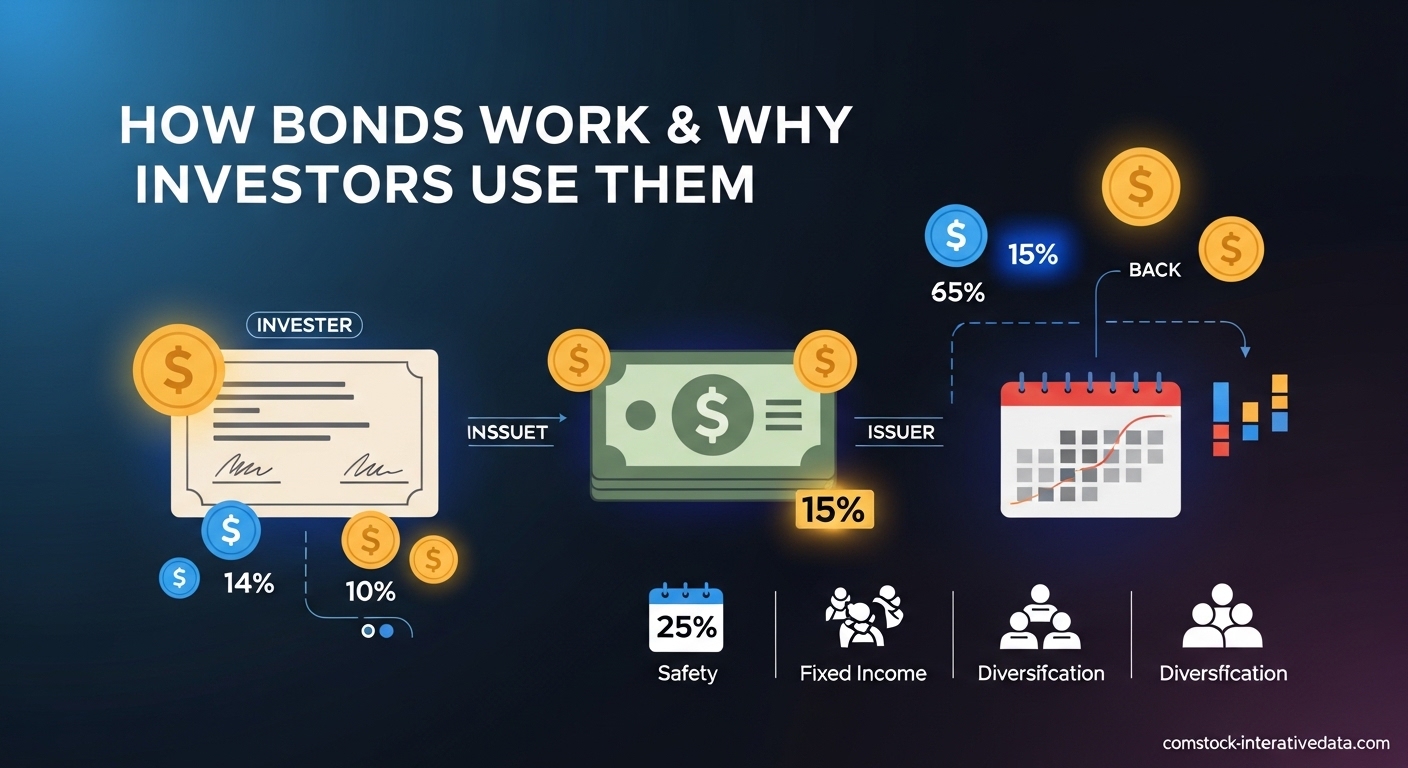
A bond is essentially an IOU. When you buy a bond, you’re lending money to a government, corporation, or other entity. They promise to pay you back on a specific date with interest along the way. It’s that simple at the core, though the mechanics have some important nuances every investor should understand.
In this guide, I’ll explain how bonds work from the ground up. You’ll learn what happens when you buy a bond, how you make money, the different types available, and why professional investors always include them in diversified portfolios. By the end, you’ll know whether bonds deserve a place in your investment strategy for 2026.
Table of Contents
What Is a Bond?
A bond is a fixed-income investment that represents a loan made by an investor to a borrower. The borrower is typically a corporation or government entity that needs to raise money for projects, operations, or debt refinancing.
Think of it like this: when your friend borrows $1,000 and promises to pay you back in a year with $50 interest, that’s essentially a bond. The difference is that real bonds involve formal legal contracts, precise terms, and typically much larger amounts of money.
The Core Components Every Bond Has
Every bond contains four essential elements you need to understand. These components determine how much money you’ll make and when you’ll get it back.
Face Value (Par Value): This is the amount the bond will be worth when it matures. Most bonds have a face value of $1,000, though some go much higher. This is the principal you get back at the end.
Coupon Rate: This is the interest rate the issuer pays on the bond’s face value. If you own a $1,000 bond with a 5% coupon rate, you receive $50 per year in interest payments.
Maturity Date: This is when the bond expires and the issuer returns your principal. Maturities can range from a few months to 30 years or more.
Issuer: This is the entity borrowing your money. It could be the U.S. Treasury, a corporation like Apple or Ford, or a state or local government.
A Real Example: How a $1,000 Bond Works
Let me walk you through a concrete example. Say you buy a $1,000 corporate bond with a 5% coupon rate that matures in 2 years.
You pay $1,000 to buy the bond. Every six months, the company sends you $25 (that’s 2.5% of $1,000, since payments are semiannual). After two years, you’ve collected $100 in total interest. Then on the maturity date, the company returns your original $1,000.
Your total return: $100 in interest, or 10% over two years. The bond kept its promise of steady, predictable income.
How Bonds Work: The Mechanics Explained 2026
Understanding bond mechanics means understanding the full lifecycle of a bond investment. From the moment you buy to the day it matures, several processes are at work.
The Bond Lifecycle from Purchase to Maturity
When you buy a newly issued bond (called buying “on the primary market”), you’re lending directly to the issuer. The issuer receives your money and uses it for their stated purpose building bridges, funding operations, or refinancing old debt.
Most bonds pay interest semiannually, meaning twice per year. These payments arrive like clockwork regardless of what’s happening in the stock market. That’s why investors call bonds “fixed income” securities the income is fixed and predictable.
As the bond approaches maturity, it gets closer to returning your principal. If you hold until maturity and the issuer doesn’t default, you get your full face value back. This return of principal is separate from the interest payments you’ve been receiving.
However, you don’t have to hold bonds until maturity. Bonds trade on the secondary market, meaning you can sell them to other investors before maturity. This flexibility comes with a catch: the price you get might be higher or lower than what you paid.
Understanding Bond Prices and Interest Rates
This is where many new investors get confused. Bond prices move in the opposite direction of interest rates. When rates go up, bond prices go down. When rates go down, bond prices go up.
Here’s why: imagine you own a bond paying 4% interest, and new bonds are being issued at 6%. Nobody wants to buy your 4% bond at full price when they can get 6% elsewhere. So if you want to sell, you must lower your price to make the effective yield competitive.
Conversely, if you own a 6% bond and new bonds only pay 4%, your bond becomes more valuable. Other investors will pay a premium to get that higher income stream.
This inverse relationship matters most if you sell before maturity. If you hold until maturity, you get your face value back regardless of price fluctuations along the way. The issuer doesn’t care what the bond traded for in the secondary market they still owe you the face value at maturity.
Types of Bonds
Not all bonds are created equal. The type of bond you buy determines your risk level, return potential, and tax treatment. Understanding these differences is essential for building an appropriate bond allocation.
Treasury Bonds
U.S. Treasury bonds are issued by the federal government and are considered the safest bond investment available. The full faith and credit of the United States backs them, meaning the risk of default is essentially zero.
Treasury bonds come in several varieties based on maturity:
Treasury Bills (T-Bills): Short-term securities maturing in one year or less. They sell at a discount and don’t pay periodic interest you get the face value at maturity.
Treasury Notes: Medium-term securities maturing in 2 to 10 years. These pay interest semiannually.
Treasury Bonds: Long-term securities maturing in 20 to 30 years. These also pay semiannual interest.
TIPS (Treasury Inflation-Protected Securities): These unique bonds adjust their principal value based on inflation, protecting your purchasing power.
Treasury yields typically serve as the baseline for all other bond yields. When Treasuries pay more, other bonds must pay even more to attract investors willing to take additional risk.
Corporate Bonds
Corporate bonds are issued by companies to raise capital. They typically offer higher yields than Treasuries because companies have a higher default risk than the U.S. government.
Corporate bonds fall into two main categories based on credit quality:
Investment Grade: These bonds are rated BBB- or higher by rating agencies like Standard & Poor’s or Moody’s. Large, stable companies with strong financials issue them. The risk of default is low, but so are the yields compared to riskier bonds.
High Yield (Junk Bonds): These bonds are rated below BBB-. Companies with weaker financials or higher debt levels issue them. To compensate investors for the additional default risk, these bonds pay significantly higher yields sometimes 4-6% more than Treasuries.
When you buy a corporate bond, you’re essentially betting on that company’s ability to generate enough cash flow to pay its debts. This is why credit ratings matter they assess that ability.
Municipal Bonds
Municipal bonds (“munis”) are issued by state and local governments, cities, counties, and other public entities. They fund public projects like schools, highways, hospitals, and utilities.
The standout feature of municipal bonds is their tax treatment. Interest income from most municipal bonds is exempt from federal income tax. If you buy bonds issued in your home state, the interest is often exempt from state taxes too.
This tax advantage makes municipal bonds particularly attractive to investors in high tax brackets. A 4% tax-free yield might be equivalent to a 5.5% taxable yield for someone in a high tax bracket.
Municipal bonds generally pay lower yields than corporate bonds because of this tax benefit. They’re also considered relatively safe, though defaults do happen occasionally.
Other Bond Types
Beyond the three main categories, several specialized bond types exist:
Agency Bonds: Issued by government-sponsored enterprises like Fannie Mae and Freddie Mac. They carry an implicit government backing and typically yield slightly more than Treasuries.
International Bonds: Issued by foreign governments or corporations. These add currency risk to the equation your returns depend on exchange rate movements as well as the bond’s performance.
Zero-Coupon Bonds: These bonds don’t pay periodic interest. Instead, you buy them at a deep discount to face value and receive the full face value at maturity. The difference is your return.
Savings Bonds (I Bonds and EE Bonds): These are government bonds designed for individual investors. You buy them directly from the Treasury without needing a broker. I Bonds adjust for inflation, making them attractive when inflation runs high.
Why Investors Use Bonds?
Now that you understand how bonds work, let’s explore why smart investors always include them in their portfolios. The reasons go far beyond simply wanting “safe” investments.
Portfolio Diversification and Risk Reduction
Stocks and bonds often move in opposite directions. When the stock market crashes, investors typically flee to the safety of bonds, driving bond prices up. This negative correlation means bonds can cushion your portfolio during stock market downturns.
During the 2008 financial crisis, the S&P 500 fell 37%. Long-term Treasury bonds gained 26%. Investors with balanced portfolios didn’t suffer nearly as much as those holding only stocks.
This diversification benefit is the primary reason financial advisors recommend bond allocations. Even young investors with decades until retirement typically hold 10-20% in bonds. As you age, that percentage typically increases.
Stable Income Generation
Bonds provide predictable income through their coupon payments. This matters enormously for retirees who need regular cash flow to cover living expenses. Unlike stock dividends, which companies can cut at any time, bond interest is a legal obligation.
A retiree with $500,000 in bonds paying 4% knows they’ll receive $20,000 per year in income. That predictability allows for better financial planning. The income arrives regardless of whether the stock market is up 20% or down 20%.
This income stability is why pension funds, insurance companies, and endowments maintain heavy bond allocations. They have future obligations they must meet, and bonds help ensure they can.
Capital Preservation
If you hold a high-quality bond to maturity and the issuer doesn’t default, you get your full principal back. This capital preservation feature is unique to bonds. Stocks offer no such guarantee.
For investors who absolutely cannot afford to lose principal bonds are essential. Someone saving for a house down payment in three years shouldn’t put that money in the stock market. A short-term bond or bond fund preserves capital while earning some return.
Even if bond prices fluctuate in the secondary market, maturity acts as an anchor. The closer a bond gets to maturity, the closer its price moves to face value. This mathematical certainty attracts conservative investors.
How Bonds Make Money for Investors?
Investors profit from bonds in two ways. Understanding both helps you choose the right bond strategy for your goals.
Interest Income: The most straightforward way bonds make money is through their coupon payments. Buy a bond, hold it, collect interest. This approach works best for income-focused investors who need regular cash flow.
Price Appreciation: If interest rates fall after you buy a bond, its price rises. You can sell the bond for a profit before maturity. This capital gains approach works best for active investors who monitor interest rate trends.
Some investors combine both approaches. They hold bonds for income but sell if prices rise significantly, reinvesting in higher-yielding bonds when rates increase.
Bonds vs Stocks: Key Differences
Understanding how bonds differ from stocks helps you decide when each belongs in your portfolio. The differences are fundamental and affect everything from your returns to your risk exposure.
| Characteristic | Bonds | Stocks |
|---|---|---|
| What you own | A loan to the issuer | A piece of the company |
| Returns | Fixed interest + principal return | Dividends + price appreciation (variable) |
| Volatility | Generally low | Generally high |
| Priority in bankruptcy | Higher (creditor) | Lower (shareholder) |
| Voting rights | None | Yes |
| Maturity | Fixed date | No maturity |
| Historical returns | ~5% average annual | ~10% average annual |
When you buy a stock, you become a partial owner of the company. When you buy a bond, you become a lender. This distinction drives every other difference between the two asset classes.
Stock investors participate in a company’s growth (or decline). If earnings soar, the stock price typically follows. Bond investors don’t participate in upside beyond their fixed coupon. Whether the company doubles its profits or sees them flatline, bondholders get the same interest payment.
This limited upside is the tradeoff for bonds’ predictability. You sacrifice growth potential for stability. That’s why most portfolios include both: stocks for growth, bonds for stability.
How to Invest in Bonds?
Individual investors have several ways to add bonds to their portfolios. Each approach has advantages and tradeoffs worth considering.
Buying Individual Bonds
You can buy individual bonds through most brokerage accounts. Treasury bonds can be purchased directly from the government at TreasuryDirect.gov. Corporate and municipal bonds trade in the over-the-counter market through brokers.
The advantage of individual bonds is predictability. If you hold until maturity, you know exactly how much income you’ll receive and when you’ll get your principal back. There’s no ongoing management fee.
The disadvantage is diversification. Building a portfolio of 20-30 individual bonds requires significant capital. You also must research each issuer’s credit quality or rely on rating agencies, which aren’t infallible.
For most individual investors, buying individual bonds makes sense only if you have at least $100,000 to allocate to fixed income and want precise control over maturity dates and issuers.
Bond Funds and ETFs
Bond mutual funds and exchange-traded funds (ETFs) pool money from many investors to buy a diversified portfolio of bonds. This approach offers instant diversification even with small investment amounts.
Bond funds come in many varieties:
Total Bond Market Funds: These hold thousands of bonds across all sectors, giving you exposure to the entire U.S. bond market in one fund.
Treasury Funds: These hold only government bonds, offering maximum safety but lower yields.
Corporate Bond Funds: These focus on company-issued bonds, offering higher yields with more credit risk.
Municipal Bond Funds: These hold state and local government bonds, providing tax advantages for investors in higher brackets.
Short-Term, Intermediate-Term, Long-Term Funds: These categorize by maturity, with longer-term funds offering higher yields but more interest rate sensitivity.
The tradeoff with bond funds is that they never mature. The fund manager constantly buys and sells bonds, meaning you don’t have the guaranteed principal return that individual bonds offer. When interest rates rise, bond fund prices fall, and there’s no maturity date when you’re guaranteed to get your money back.
U.S. Savings Bonds
For small investors, U.S. savings bonds offer a simple entry point. You can buy I Bonds and EE Bonds directly from the Treasury with as little as $25.
I Bonds are particularly attractive in inflationary environments. Their interest rate combines a fixed rate with an inflation adjustment that changes every six months. In 2026, I Bonds have become popular as a way to protect cash from inflation.
You can buy up to $10,000 in I Bonds per year per person. They must be held at least one year, and redeeming them within five years costs you three months of interest.
For building a bond position gradually or protecting emergency funds from inflation, savings bonds deserve consideration. They also offer the same full faith and credit backing as other Treasury securities.
When you’re ready to invest, consider understanding market hours for any bond trades you place through brokerage accounts.
Risks and Considerations When Investing in Bonds
Bonds are safer than stocks, but they’re not risk-free. Understanding these risks helps you choose appropriate bonds for your situation.
Interest Rate Risk
Rising interest rates hurt bond prices. If you need to sell before maturity, you might get less than you paid. Longer-term bonds suffer more because their cash flows are locked in for decades.
A bond fund holding 30-year Treasuries can drop 15-20% if rates rise sharply. Even individual bonds show paper losses in your account, even though holding to maturity recovers them.
The solution is matching bond maturity to your time horizon. Money you need in two years belongs in short-term bonds. Money you won’t touch for twenty years can handle longer maturities.
Default Risk
Sometimes issuers fail to pay. Companies go bankrupt. Municipalities run out of money. When this happens, bondholders might receive partial payment or nothing at all.
U.S. Treasury bonds have essentially zero default risk. Corporate bonds vary widely based on the issuer’s financial health. High-yield bonds carry significant default risk that’s why they pay more.
Credit ratings from agencies like Moody’s and S&P attempt to quantify default risk. But ratings can lag reality, as investors learned during the 2008 crisis when AAA-rated mortgage bonds defaulted en masse.
Diversification across many issuers is your best protection against default risk. This is where bond funds shine they spread your money across hundreds or thousands of issuers.
Inflation Risk
A bond paying 3% interest loses purchasing power if inflation runs 4%. Your nominal return is positive, but your real (inflation-adjusted) return is negative.
This risk particularly hurts long-term bond holders. A 30-year bond locked at 3% becomes increasingly painful if inflation persists at high levels. Your fixed payments buy less and less over time.
TIPS (Treasury Inflation-Protected Securities) address this risk by adjusting principal value with inflation. I Bonds offer similar protection for individual investors. Floating-rate bonds adjust their coupon with market rates, offering another inflation hedge.
Frequently Asked Questions
How exactly do bonds work?
Bonds work by you lending money to an issuer (government or company) who pays you regular interest and returns your principal at maturity. You buy the bond at face value (usually $1,000), receive coupon payments semiannually, and get your full investment back on the maturity date. The issuer gets capital to fund projects; you get predictable income.
What are the 5 types of bonds?
The five main types of bonds are: 1) Treasury bonds issued by the federal government (safest), 2) Corporate bonds issued by companies (higher yields, more risk), 3) Municipal bonds issued by state and local governments (tax advantages), 4) Agency bonds issued by government-sponsored enterprises like Fannie Mae, and 5) International bonds issued by foreign governments and corporations (currency risk).
How do bonds make money?
Bonds make money in two ways. First, through interest payments (coupons) paid semiannually based on the coupon rate. Second, through price appreciation if you sell when interest rates have fallen and bond prices have risen. Holding to maturity provides predictable income; selling early can provide capital gains or losses.
Can you lose money on bonds?
Yes, you can lose money on bonds in three ways. First, if you sell before maturity when interest rates have risen, the bond price will be lower than you paid. Second, if the issuer defaults and fails to pay interest or return principal. Third, through inflation eroding your purchasing power even when nominal returns are positive.
Are bonds safer than stocks?
Generally yes, bonds are safer than stocks. Bonds offer fixed income, priority in bankruptcy, and return of principal at maturity. Stocks have no maturity date, no guaranteed returns, and fluctuate more dramatically. However, bonds still carry risks including interest rate risk, default risk, and inflation risk. High-yield bonds can be nearly as risky as stocks.
What happens when bonds mature?
When a bond matures, the issuer returns your principal (face value) and stops making interest payments. The bond ceases to exist. You receive the final coupon payment plus your original investment. If you bought a $1,000 bond, you get exactly $1,000 back at maturity regardless of any price fluctuations that occurred during the bond’s life.
How long does it take for a bond to mature?
Bond maturities range from a few months to 30 years or more. Treasury bills mature in under one year, Treasury notes in 2-10 years, and Treasury bonds in 20-30 years. Corporate and municipal bonds vary widely. When buying, choose maturity dates that match when you’ll need the money shorter for near-term goals, longer for long-term investing.
What questions should you ask before buying a bond?
Before buying a bond, ask: 1) What is the credit rating and default risk? 2) What is the yield compared to similar bonds? 3) When does it mature and does that match my timeline? 4) Is it callable (can the issuer pay early)? 5) What’s the tax treatment of interest? 6) How will rising rates affect this bond’s price? 7) Am I buying individual bonds or a fund?
Key Takeaways: How Bonds Work and Why They Matter
Bonds are fundamentally simple: you lend money, you receive interest, you get repaid. Yet within that simplicity lies a powerful tool for building resilient investment portfolios.
The key lessons to remember: bonds provide diversification that protects you during stock market crashes, income that’s predictable regardless of economic conditions, and capital preservation that becomes increasingly important as you approach financial goals. How bonds work matters because understanding them lets you use them effectively.
Start with Treasury bonds or a total bond market fund if you’re new to fixed income. Match bond maturities to your time horizon. Keep costs low. And remember that bonds aren’t about maximizing returns they’re about creating stability so your stocks can do the growth work while you sleep soundly.
In 2026, with interest rates having risen significantly from their lows, bonds offer more attractive yields than they have in years. The opportunity to build a diversified portfolio with meaningful income is stronger than it’s been in over a decade. Understanding how bonds work and why investors use them positions you to take advantage of that opportunity.