
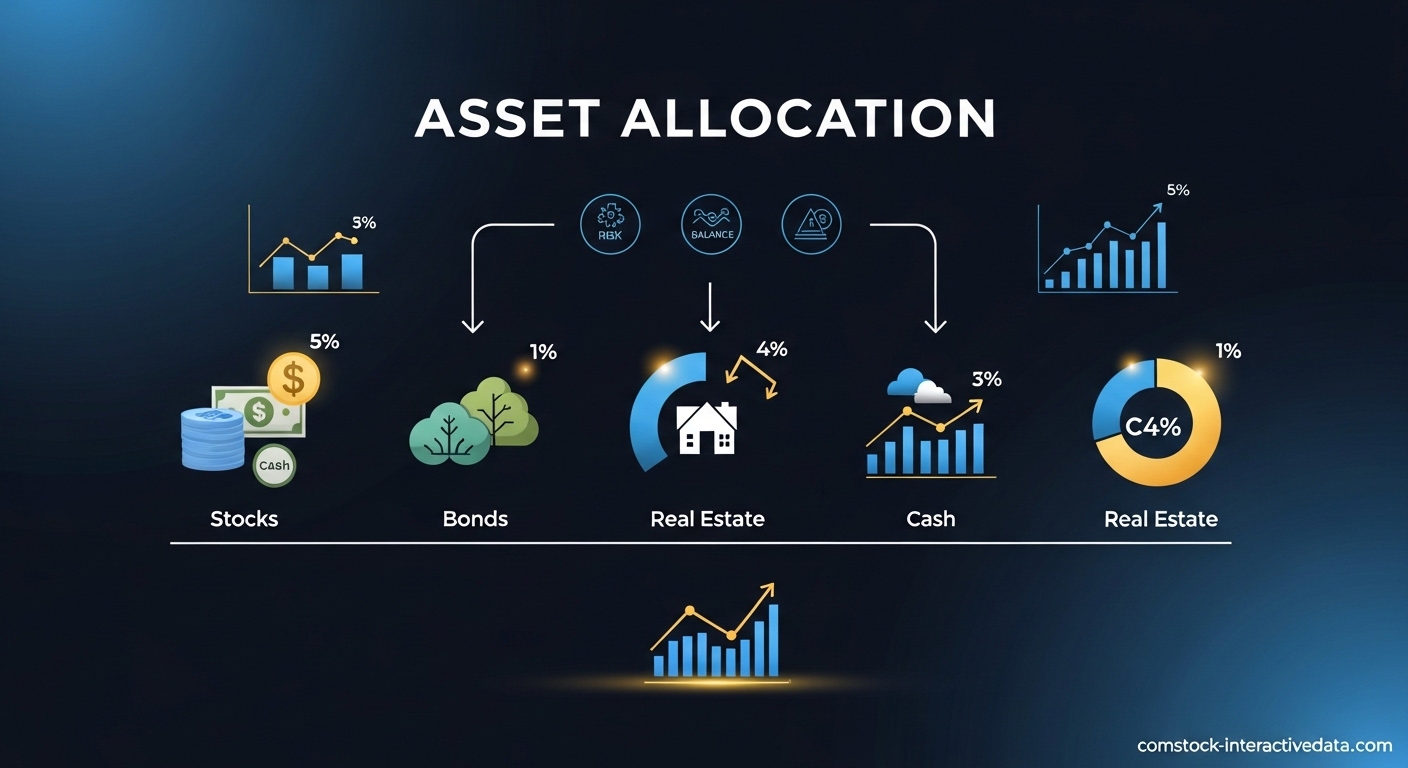
Asset allocation is the process of dividing your investment portfolio among different asset categories, such as stocks, bonds, and cash. It is one of the most important decisions you will make as an investor because it determines the majority of your portfolio’s returns and risk level. Your asset allocation strategy should reflect your financial goals, time horizon, and comfort with market fluctuations.
Choosing the right asset mix can feel overwhelming, especially when you are just starting out. There are countless opinions about the perfect allocation, endless model portfolios to consider, and the constant noise of market news that might tempt you to change course. In this guide, I will walk you through exactly what asset allocation means, why it matters more than picking individual stocks, and how to build a personalized allocation strategy that fits your life.
By the end of this article, you will understand the major asset classes, know how to assess your own risk tolerance, and have a clear framework for choosing between common allocation models. Whether you are 25 and just opened your first 401(k) or 55 and refining your retirement strategy, the principles here will help you make smarter allocation decisions.
Table of Contents
What Is Asset Allocation?
Asset allocation is the big-picture division of your investments across major categories called asset classes. The three primary asset classes are stocks (equities), bonds (fixed income), and cash equivalents. Your allocation decision determines what percentage of your portfolio goes into each category.
This is fundamentally different from diversification, though the two concepts work together. Asset allocation is about choosing your mix of asset classes, while diversification is about spreading investments within each class. For example, deciding to put 60% of your money in stocks and 40% in bonds is an asset allocation decision. Choosing to buy 20 different stocks rather than just one is a diversification decision.
The percentages you choose matter enormously. A portfolio with 80% stocks and 20% bonds will behave very differently from one with 40% stocks and 60% bonds. The first will likely grow faster over long periods but will also experience sharper declines during market downturns. The second will be more stable but may not generate the returns needed for long-term goals.
The Core Concept: The Three Buckets
Think of asset allocation as dividing your money into three buckets with different characteristics. The growth bucket contains stocks, which offer higher return potential but come with volatility. The stability bucket holds bonds, which provide income and help cushion against stock market drops. The safety bucket keeps cash and cash equivalents for liquidity and capital preservation.
Your job as an investor is to decide how much goes into each bucket based on what you need your money to do and when you need it. Someone saving for a house purchase in two years might keep most money in the safety and stability buckets. Someone investing for retirement 30 years away might weight heavily toward the growth bucket.
Why Asset Allocation Is Not One-Size-Fits-All
There is no universally perfect asset allocation. The right mix for you depends on factors unique to your situation. Your age matters because younger investors have more time to recover from market drops. Your goals matter because a retirement portfolio has different needs than a college fund. Your risk tolerance matters because losing sleep over market swings is not worth any theoretical return.
What works for a 30-year-old software engineer with a stable job may not work for a 50-year-old teacher planning to retire early. What works for someone with a pension and paid-off house may not work for someone relying entirely on investment income. Understanding your personal circumstances is the foundation of smart asset allocation.
Why Asset Allocation Matters?
Research consistently shows that asset allocation is the single most important factor in determining your long-term investment returns. A famous study by Brinson, Hood, and Beebower found that asset allocation explains more than 90% of the variability in portfolio returns over time. Stock picking and market timing, despite getting most of the media attention, account for far less of your success.
This means that getting your asset allocation right matters more than finding the next hot stock or predicting where the market will go next month. The decision to hold 60% stocks versus 80% stocks will likely have a bigger impact on your wealth than whether you choose Apple or Microsoft within your stock allocation. This is why financial planners spend significant time on allocation strategy before discussing specific investments.
Risk Management Through Allocation
The primary purpose of asset allocation is managing risk. Different asset classes respond differently to economic conditions. When stocks fall during a recession, bonds often rise as investors seek safety. When inflation spikes, real assets may perform better than nominal bonds. By holding a mix of assets, you reduce the chance that any single event devastates your entire portfolio.
Consider the 2008 financial crisis. A portfolio 100% in U.S. stocks would have lost about 37% that year. A 60/40 stock-bond portfolio would have lost roughly 20%. A 40/60 portfolio would have declined only about 10%. None of these avoided losses entirely, but the difference between a 37% drop and a 10% drop is enormous in terms of recovery time and emotional stress.
The Behavioral Benefit
Asset allocation also protects you from yourself. Investors consistently underperform their own investments because they buy and sell at the wrong times. We tend to buy when markets are high and everyone is optimistic, then panic and sell when markets crash. A thoughtfully constructed asset allocation helps you stay invested through market cycles because you have chosen a risk level you can tolerate.
When you know your allocation matches your risk tolerance, you are less likely to make emotional changes during volatility. The investor with a 60/40 allocation who agreed that a 20% decline was acceptable is less likely to sell during a crash than the investor who thought they could handle 100% stocks but panicked at the first major drop. Your allocation is your promise to yourself about how much risk you can handle.
Long-Term Wealth Building
Over decades, your asset allocation determines your wealth trajectory. Stocks have historically returned about 10% annually before inflation, bonds about 5%, and cash about 3%. The mix you choose between these returns compounds into dramatically different outcomes over time. Someone who maintained an 80/20 stock-bond allocation from 1980 to 2020 built significantly more wealth than someone who stayed 40/60, though they also experienced more volatility along the way.
The key is matching this return potential to your time horizon. If you need the money in five years, a high stock allocation could mean selling during a downturn at a loss. If you will not touch the money for 30 years, being too conservative means missing the growth needed to fund a long retirement. Asset allocation is the bridge between your financial goals and the investments that will get you there.
The Major Asset Classes
To build an effective asset allocation, you need to understand what each major asset class offers and where it fits in your portfolio. Each class has distinct characteristics regarding return potential, risk, income generation, and how it responds to economic conditions. The four main categories are stocks, bonds, cash equivalents, and alternative investments.
Stocks (Equities)
Stocks represent ownership shares in companies. When you buy a stock, you are buying a small piece of that business and its future profits. Stocks are the growth engine of most portfolios because they have historically delivered the highest long-term returns of any major asset class. Over the past century, U.S. stocks have averaged roughly 10% annual returns.
The trade-off for this growth potential is volatility. Stock prices fluctuate daily based on company performance, economic news, and investor sentiment. In any given year, stocks might be up 30% or down 30%. This volatility decreases over long holding periods but never disappears entirely. Stocks are best suited for money you will not need for at least five to ten years.
Within stocks, you can further diversify by company size (large-cap vs small-cap), geography (U.S. vs international), and style (growth vs value). Large U.S. companies like Apple and Microsoft tend to be more stable than small startups. International stocks provide exposure to different economies and currencies. Growth stocks focus on companies expanding rapidly, while value stocks focus on established companies trading at discount prices.
Bonds (Fixed Income)
Bonds are loans you make to governments or corporations in exchange for regular interest payments and the return of your principal at maturity. When you buy a bond, you are the lender, not the owner. This fundamental difference makes bonds generally more stable than stocks. Bond prices do fluctuate, but typically within a much narrower range than stocks.
Bonds serve two primary roles in a portfolio: income generation and stability. The interest payments provide predictable cash flow, which is especially valuable for retirees. When stocks fall, high-quality bonds often rise or hold steady as investors seek safety. This negative correlation with stocks makes bonds a powerful diversifier, even though their long-term returns trail those of stocks.
Not all bonds are created equal. Government bonds from stable countries like the United States are considered the safest investments available. Corporate bonds offer higher yields but carry the risk that the company could default. High-yield or “junk” bonds pay even more but have significant default risk. International bonds add currency exposure, which can help or hurt depending on exchange rate movements. Bond maturity matters too, longer-term bonds are more sensitive to interest rate changes than short-term bonds.
Cash and Cash Equivalents
Cash includes physical currency, bank deposits, money market funds, and Treasury bills with maturities under one year. Cash equivalents are highly liquid, low-risk investments you can convert to cash quickly without significant loss of value. While cash offers safety and flexibility, it has historically provided the lowest returns of any asset class, often barely keeping pace with inflation.
The role of cash in a portfolio is primarily about liquidity and optionality. You need cash for emergencies, upcoming expenses, and opportunities. Having six months of living expenses in cash prevents you from selling investments during a downturn to cover unexpected costs. Cash also lets you take advantage of market drops by buying when prices are low, though timing this perfectly is nearly impossible.
Cash allocations typically decrease as you move from conservative to aggressive portfolios. A conservative investor might hold 10-20% in cash, while a growth-focused investor might hold little to none except for an emergency fund. The opportunity cost of holding too much cash is real, money sitting in a savings account earning 1% is losing purchasing power to inflation over time.
Alternative Investments
Beyond the traditional three asset classes, many portfolios include alternatives like real estate, commodities, and precious metals. These assets often behave differently from both stocks and bonds, providing additional diversification benefits. However, they also come with unique risks and complexities that require careful consideration.
Real estate exposure typically comes through Real Estate Investment Trusts (REITs), which are companies that own and operate income-producing properties. REITs offer income through dividends and can rise with inflation since property owners can increase rents. Commodities like gold, oil, and agricultural products tend to perform well during inflationary periods when both stocks and bonds might struggle.
Alternative investments are not essential for most investors, especially those just starting out. A simple three-fund portfolio of domestic stocks, international stocks, and bonds covers the bases for most goals. Alternatives become more relevant for larger portfolios where additional diversification and inflation protection become worthwhile.
How to Choose the Right Asset Mix?
Choosing your asset allocation requires honest assessment of several personal factors. This is not a theoretical exercise, it determines how you will react when markets inevitably decline. The right allocation is one that you can maintain through good times and bad without abandoning your strategy at the worst possible moment.
Assess Your Risk Tolerance
Risk tolerance is your emotional and financial ability to withstand investment losses without panicking. It has two components: your capacity for risk based on your financial situation, and your comfort with risk based on your personality. You might have the financial capacity to handle 100% stocks, but if a 20% drop would keep you awake at night, your comfort level dictates a more conservative approach.
Ask yourself these questions to gauge your risk tolerance. How did you feel during the last major market downturn? Did you sell investments, buy more, or do nothing? Can you handle seeing your portfolio drop 30% without changing your strategy? Would you still sleep well if your $500,000 retirement account became $350,000 temporarily? Be brutally honest, most people overestimate their risk tolerance until they face a real test.
Your risk tolerance also relates to your investment knowledge and experience. Beginning investors often benefit from starting more conservatively and gradually increasing stock exposure as they become comfortable with market behavior. Watching your portfolio fluctuate for a few years teaches you more about your true risk tolerance than any questionnaire can.
Define Your Time Horizon
Time horizon is when you need to access the money you are investing. The longer your time horizon, the more risk you can typically take because you have time to recover from market downturns. Money needed in two years should be invested very differently from money needed in 30 years.
For goals within five years, such as a home down payment or a wedding, capital preservation should be your priority. A market crash right when you need the money could derail your plans. Conservative allocations with heavier bond and cash weightings make sense here. You sacrifice some growth potential for the certainty that the money will be there when you need it.
For goals 5-15 years away, like a child’s college education, a balanced approach works well. You want growth but cannot afford a major setback near the target date. Many investors use a “glide path” strategy, starting more aggressive and gradually shifting toward conservative allocations as the goal approaches.
For retirement goals 15-30 years away, growth should be your primary focus. The combination of long time horizon and regular contributions through market cycles lets you ride out volatility. Historically, stocks have never lost money over any 20-year period, making them appropriate for long-term wealth building despite short-term uncertainty.
Identify Your Financial Goals
Different goals require different allocation strategies. Retirement accumulation focuses on growth to outpace inflation over decades. Retirement income focuses on preserving capital while generating withdrawals. College savings balances growth with the certainty that funds will be available when tuition is due. Emergency funds prioritize safety and liquidity above all else.
Your goal size matters too. Saving $10,000 for a vacation next year requires different allocations than building a $2 million retirement fund over 30 years. Small, near-term goals are often best kept in cash or short-term bonds. Large, long-term goals need the growth power of stocks to reach ambitious targets.
Consider your total financial picture, not just the account you are allocating today. If you have a pension that covers most living expenses, you can afford more risk in your investment portfolio. If Social Security will be your only other income source, your investment allocation needs to balance growth with income generation.
Consider Your Personal Circumstances
Beyond time horizon and risk tolerance, several personal factors should influence your allocation. Job stability matters, if you work in a cyclical industry or have irregular income, a more conservative allocation provides a buffer during lean periods. If you have a stable government job with guaranteed employment, you can afford more investment risk.
Your other assets and liabilities matter. Someone with a paid-off house and no debt can take more investment risk than someone with a large mortgage and student loans. Existing assets like rental properties or business ownership reduce the need for certain asset classes in your investment portfolio. If you own a business, your overall wealth is already heavily tilted toward equities, so your investment accounts might emphasize bonds for balance.
Tax situation influences allocation decisions too. If most of your money is in tax-advantaged accounts like 401(k)s and IRAs, you have more flexibility since you will not pay taxes on gains until withdrawal. If you hold investments in taxable accounts, tax-efficient allocation becomes important. Placing tax-inefficient assets like bonds in tax-sheltered accounts while holding tax-efficient stock index funds in taxable accounts can improve after-tax returns.
The 100 Minus Age Rule and Its Caveats
A common rule of thumb suggests holding your age in bonds and the remainder in stocks, or the simplified version: subtract your age from 100 to get your stock percentage. A 30-year-old would hold 70% stocks, while a 60-year-old would hold 40% stocks. This provides a starting point, but it has significant limitations.
The rule assumes everyone at a given age has the same risk tolerance, goals, and circumstances, which is clearly not true. A 40-year-old with a pension and no debt has very different capacity for risk than a 40-year-old with unstable employment and three kids approaching college. The rule also fails to account for increasing lifespans, a 65-year-old today might need their money to last 30 years, requiring more growth than the rule suggests.
A better approach uses the rule as a baseline, then adjusts based on your specific situation. If you have above-average risk tolerance and other income sources, add 10-20% to the stock allocation. If you have below-average risk tolerance or need the money sooner than average, subtract 10-20%. Your personal factors matter more than your birth year.
Common Asset Allocation Models
While your ideal allocation is personal, several standard models provide useful starting points. These range from conservative allocations focused on capital preservation to aggressive allocations seeking maximum growth. Understanding these models helps you see where you might fit on the risk spectrum.
| Model | Stocks | Bonds | Cash | Risk Level | Best For |
|---|---|---|---|---|---|
| Conservative | 20% | 70% | 10% | Low | Capital preservation, retirees needing stability |
| Moderately Conservative | 40% | 50% | 10% | Low-Medium | Cautious investors, 5-10 years from retirement |
| Balanced | 60% | 40% | 0% | Medium | Long-term growth, moderate risk tolerance |
| Growth | 80% | 20% | 0% | Medium-High | Young investors, 15+ year time horizon |
| Aggressive | 100% | 0% | 0% | High | Maximum growth, very high risk tolerance |
Conservative Allocation (20% Stocks, 70% Bonds, 10% Cash)
The conservative model prioritizes capital preservation over growth. With 70% in bonds and only 20% in stocks, this allocation minimizes volatility and provides steady income through bond interest. The trade-off is modest long-term growth that may barely outpace inflation.
This model suits retirees who depend on their portfolios for living expenses and cannot afford major losses. It also works for investors with very low risk tolerance who prioritize sleeping well over maximizing returns. The expected return for this allocation historically runs around 5-6% annually, with maximum one-year losses typically under 10%.
Moderately Conservative Allocation (40% Stocks, 50% Bonds, 10% Cash)
The moderately conservative model adds more growth potential while maintaining substantial stability. With 40% stocks, you participate in market gains while the 60% bond and cash allocation cushions against major declines. This is often called the “income with growth” model.
Investors within five to ten years of retirement often gravitate toward this allocation. It provides enough growth to keep pace with inflation during retirement while limiting downside risk. Historical returns average around 6-7% annually, with typical worst-year losses around 15%.
Balanced Allocation (60% Stocks, 40% Bonds)
The classic 60/40 portfolio has been the default recommendation for decades, and for good reason. It captures most of the stock market’s long-term growth while the substantial bond allocation provides meaningful diversification. During the 2008 crisis, a 60/40 portfolio declined about half as much as an all-stock portfolio.
This model works for investors with moderate risk tolerance and time horizons of ten years or more. It balances the need for growth with the reality that markets do crash sometimes. Historical returns average around 7-8% annually, with typical worst-year losses around 20%.
Growth Allocation (80% Stocks, 20% Bonds)
The growth model emphasizes capital appreciation for investors with long time horizons who can handle volatility. With 80% in stocks, you capture most of the market’s upside while the 20% bond allocation still provides some stability and rebalancing opportunities.
Young investors in their 20s and 30s often choose this model for retirement accounts. With decades until withdrawals begin, they can ride out multiple market cycles. The bond allocation provides some ballast during crashes and a source of funds to rebalance into stocks when prices are low. Historical returns average around 8-9% annually, with typical worst-year losses around 25-30%.
Aggressive Allocation (100% Stocks)
The aggressive model goes all-in on growth with no bond allocation. This maximizes long-term return potential but also maximizes volatility. A 100% stock portfolio can drop 30-50% in a bad year, testing the resolve of even experienced investors.
This model suits very young investors with stable incomes and iron stomachs. It also works for investors with substantial assets who can afford temporary losses without changing their lifestyle. Historical returns average around 9-10% annually, but the ride is rough with worst-year losses exceeding 35%.
Target-Date Funds: The Simple Solution
If choosing between these models feels overwhelming, target-date funds offer a hands-off solution. These funds automatically adjust your allocation as you approach a target year, typically retirement. A 2055 target-date fund might start 90% in stocks today, then gradually shift to 50/50 by 2055, and eventually to 30/70 in retirement.
Target-date funds handle the glide path decision-making for you. They rebalance automatically and become more conservative over time without you lifting a finger. The downside is slightly higher fees than building your own allocation, and less customization to your specific situation. For many investors, especially beginners, the simplicity is worth the trade-off.
Rebalancing Your Portfolio
Asset allocation is not a set-it-and-forget-it decision. Over time, market movements cause your allocation to drift from its target. When stocks perform well, they become a larger percentage of your portfolio than intended. When they decline, your allocation becomes more conservative than planned. Rebalancing is the process of bringing your portfolio back to its target allocation.
Why Rebalancing Matters
Rebalancing serves two important functions: risk control and enforced discipline. Without rebalancing, a growth-oriented portfolio that started 80/20 might become 90/10 after a strong stock market run. This increases risk beyond your intended level and leaves you more exposed to the next downturn.
Rebalancing also forces you to sell high and buy low, which is emotionally difficult but financially rewarding. When stocks rise, you sell some to buy bonds, capturing gains. When stocks fall, you sell bonds to buy stocks at lower prices. This mechanical approach removes emotion from the decision and takes advantage of market volatility rather than being hurt by it.
When to Rebalance
There are two main approaches to rebalancing timing: calendar-based and threshold-based. Calendar-based rebalancing happens at set intervals, such as annually or semi-annually. This is simple to implement and removes the temptation to time the market. Many investors rebalance on their birthday or at year-end.
Threshold-based rebalancing triggers when your allocation drifts a certain percentage from target. For example, you might rebalance when any asset class moves more than 5% from its target allocation. This responds more quickly to major market moves but requires monitoring your portfolio more closely.
Research suggests either approach works fine as long as you actually do it. Annual rebalancing is sufficient for most investors and strikes a good balance between maintaining target risk and avoiding excessive trading. More frequent rebalancing adds complexity without significant benefit and can increase costs and tax consequences.
How to Rebalance
Rebalancing is straightforward in tax-advantaged accounts like 401(k)s and IRAs where you will not owe taxes on gains. Simply sell enough of the overweighted asset class to buy more of the underweighted class until you reach your targets. Many brokerage platforms offer automatic rebalancing for target-date funds or robo-advisor accounts.
In taxable accounts, rebalancing has tax consequences since selling appreciated investments triggers capital gains taxes. Several strategies can minimize this impact. Direct new contributions toward the underweighted asset class instead of selling. Use tax-loss harvesting by selling losing positions to offset gains. Consider rebalancing only in tax-advantaged accounts while letting taxable accounts drift slightly.
Tax Considerations
Tax location is as important as asset allocation for investors with both taxable and tax-advantaged accounts. Place tax-inefficient assets like bonds and REITs in IRAs and 401(k)s where their interest income grows tax-deferred. Place tax-efficient assets like broad stock index funds in taxable accounts where you can benefit from lower capital gains rates and tax-loss harvesting.
This strategy can add 0.5% or more to your after-tax returns annually, which compounds significantly over time. The exact benefit depends on your tax bracket and the yield of your fixed-income investments. Higher-income investors in high-tax states see the greatest benefit from strategic tax location.
Frequently Asked Questions
What is a good asset allocation mix?
A good asset allocation mix depends on your age, risk tolerance, time horizon, and financial goals. A commonly cited starting point is the 100 minus age rule, where you hold your age in bonds and the rest in stocks. For example, a 30-year-old would have 70% stocks and 30% bonds. However, this should be adjusted based on your personal situation. Young investors with stable incomes might choose 80-100% stocks for growth, while retirees might prefer 40-60% stocks for stability and income.
What is the 70 20 10 rule of investing?
The 70-20-10 rule suggests allocating 70% of your portfolio to stocks, 20% to bonds, and 10% to cash or alternatives. This creates a growth-oriented portfolio with some stability from bonds and liquidity from cash. It is commonly recommended for investors in their 30s and 40s with moderate risk tolerance and time horizons of 15-25 years. The rule provides more safety than an aggressive 100% stock allocation while maintaining significant growth potential.
Is 70/30 better than 60/40?
Whether 70/30 is better than 60/40 depends on your circumstances. A 70/30 portfolio (70% stocks, 30% bonds) offers higher growth potential but more volatility. Historically, it returns about 0.5-1% more annually than 60/40 but experiences larger declines during market crashes. A 60/40 portfolio provides more stability and smaller drawdowns, making it easier to stay invested during volatility. Neither is objectively better, the right choice depends on your risk tolerance, time horizon, and whether you can handle seeing your portfolio drop 25-30% without panicking.
What is Warren Buffett’s 70/30 rule?
Warren Buffett has recommended a simple portfolio allocation for his wife and non-professional investors: 90% in a low-cost S&P 500 index fund and 10% in short-term government bonds. This is closer to a 90/10 allocation than 70/30. Buffett believes most investors are better off in broad index funds than trying to pick individual stocks or time the market. He emphasizes keeping costs low and staying invested for the long term. The 90/10 allocation reflects his belief that American business will perform well over long periods, and investors should not let short-term volatility derail their strategy.
Getting Started with Asset Allocation
Asset allocation is the foundation of successful investing. It matters more than which specific funds you choose, more than timing the market, and more than finding the next hot stock. The right allocation aligns your portfolio with your goals, time horizon, and ability to handle risk.
The key takeaways are simple. First, understand that asset allocation explains the vast majority of your investment returns. Second, choose an allocation you can maintain through market cycles without emotional decisions. Third, rebalance periodically to keep your risk level on target. Fourth, adjust your allocation as your life circumstances change.
If you are just starting out, consider a target-date fund that handles allocation decisions for you. As you learn more about your own risk tolerance and goals, you can transition to a custom allocation that better fits your specific needs. The most important step is simply to start. Time in the market with a reasonable allocation beats waiting for the perfect plan.
Your asset allocation is not permanent. Review it annually or when major life events occur, marriage, children, job changes, approaching retirement. What worked at 30 may not work at 50. What made sense with a stable salary may need adjustment after a career change. The best allocation is the one that gets you to your goals while letting you sleep at night.