
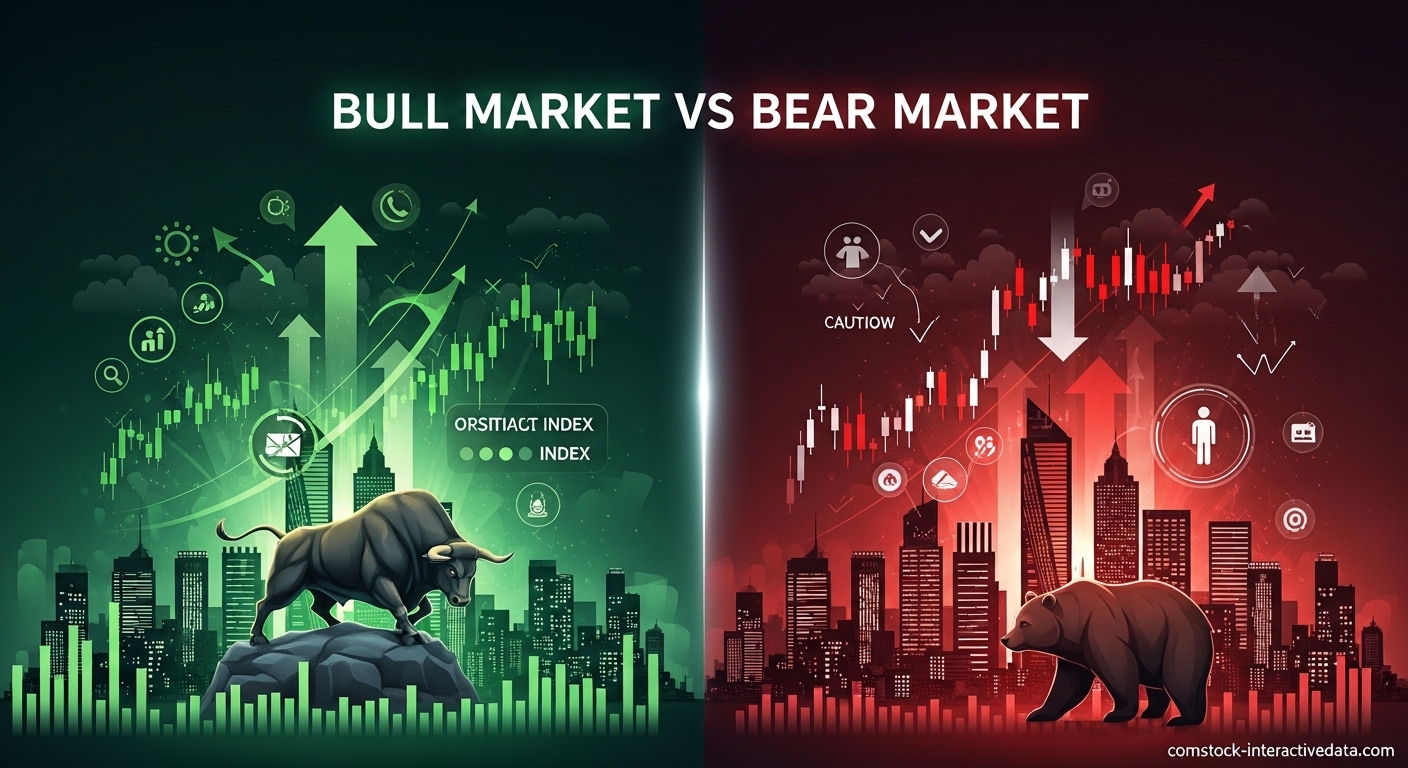
A bull market is a period when stock prices rise 20% or more from recent lows, reflecting widespread optimism and economic growth. A bear market occurs when stock prices fall 20% or more from recent highs, driven by pessimism and economic concerns. Understanding the difference between these market cycles helps investors make informed decisions regardless of market conditions.
I remember when I first started investing, these terms confused me. Everyone seemed to use “bull” and “bear” like everyone knew what they meant. It took me years of watching market cycles firsthand to truly grasp how these phases affect both portfolio values and investor emotions. This guide breaks down everything you need to know about bull markets versus bear markets in plain language.
By the end of this article, you will understand the technical definitions, historical patterns, and practical strategies for investing during both market conditions.
Table of Contents
Key Takeaways
- Bull markets feature a 20%+ rise in stock prices; bear markets feature a 20%+ decline
- Market corrections (10-19.9% drops) differ from bear markets
- Bull markets historically last longer and produce stronger returns than bear markets decline
- Emotional discipline matters more than market timing
- Dollar-cost averaging works effectively in both market types
- Long-term investors should focus on time in the market, not timing the market
What is a Bull Market?
A bull market represents a sustained period of rising stock prices, typically defined as a 20% or greater increase in a major market index from its recent low. The S&P 500, Dow Jones Industrial Average, and Nasdaq Composite serve as the primary benchmarks for identifying these upward trends.
Bull markets earn their name from the way a bull attacks. When a bull charges, it thrusts its horns upward. This upward motion symbolizes rising stock prices and positive market momentum.
Characteristics of Bull Markets
During bull markets, several consistent patterns emerge. Stock prices rise across most sectors, not just a few isolated companies. Trading volume increases as more investors participate. Corporate earnings generally improve, supporting higher stock valuations.
Gross Domestic Product (GDP) typically grows during these periods. Unemployment rates fall as businesses expand. Consumer confidence rises, leading to increased spending and further economic growth.
What Causes Bull Markets?
Several factors drive bull markets. Strong economic growth creates the foundation. Low interest rates from the Federal Reserve make borrowing cheaper for businesses and consumers. Corporate profits increase, justifying higher stock prices.
Technological innovation often sparks extended bull runs. The dot-com boom of the 1990s and the artificial intelligence surge in the 2020s both illustrate how new technologies drive investor optimism and capital investment.
What is a Bear Market?
A bear market occurs when a broad market index falls 20% or more from its recent high. This decline reflects widespread pessimism about economic conditions and typically accompanies slowing GDP growth, rising unemployment, and reduced corporate profits.
The term comes from how a bear attacks. Bears swipe their paws downward when fighting. This downward motion represents falling stock prices and negative market sentiment.
Bear Market vs Market Correction
Not every market decline qualifies as a bear market. A market correction describes a drop between 10% and 19.9% from recent highs. Corrections happen frequently, often multiple times per year, and typically resolve within weeks or months.
Bear markets represent deeper, more prolonged declines. The 20% threshold distinguishes normal volatility from sustained downturns. Once markets cross this threshold, investor psychology shifts significantly from caution to fear.
Characteristics of Bear Markets
Bear markets feature declining prices across most sectors. Trading volume often spikes initially as panic selling occurs, then diminishes as investors retreat. Corporate earnings decline or turn negative. The VIX volatility index typically rises significantly during these periods.
Economic indicators worsen. GDP growth slows or turns negative. Unemployment rises as companies cut costs. Consumer spending drops as households worry about job security and investment losses.
What Causes Bear Markets?
Bear markets stem from various triggers. Economic recessions frequently precede or accompany bear markets. Financial crises, like the 2008 banking collapse, can rapidly erase years of gains. Geopolitical conflicts, pandemics, or unexpected economic shocks also spark downturns.
Sometimes bull markets simply exhaust themselves. Extended periods of rising prices without corrections create bubbles. When these bubbles burst, bear markets follow. The 2000 dot-com crash demonstrated this pattern clearly.
Bull Market vs Bear Market: Key Differences
Understanding the core distinctions between these market phases helps investors maintain perspective. The differences extend beyond simple price direction into investor behavior, economic conditions, and appropriate strategies.
Price Direction and Threshold
The 20% threshold provides the clearest technical distinction. Bull markets require a 20% rise from recent lows. Bear markets require a 20% decline from recent highs. This percentage standardizes definitions across different market cycles and indices.
The S&P 500 serves as the primary benchmark for U.S. markets. When this index crosses the 20% threshold in either direction, financial media and analysts officially declare bull or bear market conditions.
Investor Sentiment
Bull markets feature optimism. Investors believe prices will continue rising. Fear of missing out (FOMO) drives participation. People talk about stock gains at social gatherings. New investors enter the market, sometimes without adequate research.
Bear markets feature pessimism. Investors expect further declines. Fear dominates decision-making. People avoid discussing investments or express regret. Some investors exit the market entirely, often at exactly the wrong time.
Economic Correlation
Bull markets generally correlate with economic expansion. GDP grows, unemployment falls, and corporate profits rise. These fundamentals support higher stock valuations. Interest rates often remain low, encouraging business investment.
Bear markets typically accompany economic contraction or recession fears. GDP growth stalls or reverses. Unemployment rises. Corporate profits decline. The Federal Reserve may raise rates to combat inflation, further pressuring stock prices.
Duration and Frequency
Historically, bull markets last longer than bear markets. Since 1928, the average bull market has lasted approximately 2.7 years. The average bear market has lasted about 9.7 months. Bull markets occur more frequently and produce stronger percentage gains than bear markets create losses.
This asymmetry explains why long-term investors generally build wealth despite periodic downturns. The upward periods more than compensate for the declines over extended timeframes.
Historical Bull and Bear Markets
Historical data reveals patterns that help investors understand current conditions. Since 1928, the S&P 500 has experienced 27 bear markets and 28 bull markets. Despite nearly equal numbers, the upward trajectory remains unmistakable over decades.
Notable Bull Markets
The longest bull market in U.S. history ran from March 2009 to March 2020. Lasting nearly 11 years, this period followed the financial crisis and produced returns exceeding 400%. Low interest rates, technological innovation, and corporate profit growth fueled this extended rise.
The 1990s bull market, driven by internet and technology growth, lasted approximately 10 years. The post-World War II expansion from 1949 to 1956 generated significant wealth for a generation of investors.
Notable Bear Markets
The 2008 financial crisis bear market saw the S&P 500 decline roughly 57% from peak to trough. This devastating drop wiped out years of gains and required over four years for full recovery.
The 2020 pandemic bear market was historically brief but sharp. Markets fell 34% in just over a month before beginning recovery. This demonstrated that bear markets can end quickly when underlying conditions change.
The 2022 bear market followed pandemic recovery gains. Rising inflation and aggressive Federal Reserve rate hikes pushed the S&P 500 down approximately 25%. This bear market lasted roughly 9 months before new bull market conditions emerged.
Historical Returns and Recovery
On average, bull markets have produced gains of approximately 114%. Bear markets have averaged declines of roughly 35%. The recovery periods following bear markets have historically been strong, often generating substantial returns for investors who remained invested.
Since 1950, the S&P 500 has never failed to reach new highs following a bear market. While past performance does not guarantee future results, this historical pattern provides context for investors experiencing downturns.
Investor Psychology in Bull and Bear Markets
Understanding your own psychological reactions to market movements matters as much as understanding the markets themselves. Human emotions follow predictable patterns during bull and bear markets, often leading to costly mistakes.
The Psychology of Bull Markets
Bull markets create euphoria. Portfolio gains feel easy and expected. Overconfidence leads investors to take excessive risks. People increase exposure to volatile assets, chase trending stocks, and abandon diversification principles.
Irrational exuberance, a term coined by former Federal Reserve Chairman Alan Greenspan, describes this phenomenon. Investors begin believing that prices only move upward. They ignore warning signs and fundamentals. This mindset typically peaks shortly before market tops.
The Psychology of Bear Markets
Bear markets trigger fear and panic. Watching portfolio values decline daily creates genuine psychological distress. Loss aversion, the tendency to feel losses more intensely than equivalent gains, drives poor decisions. Investors sell quality holdings at depressed prices to stop the emotional pain.
Media coverage amplifies negative emotions. Headlines focus on decline magnitude and worst-case scenarios. Social media spreads anxiety rapidly. Investors who lacked concern during rising markets suddenly obsess over daily price movements.
Behavioral Finance Insights
Behavioral finance research identifies common mistakes investors make during market cycles. Herding behavior causes people to buy when others buy and sell when others sell. Recency bias leads investors to assume current trends will continue indefinitely.
Confirmation bias causes investors to seek information supporting their existing beliefs. During bull markets, they ignore warning signs. During bear markets, they miss recovery signals. Successful investing requires recognizing these tendencies in yourself.
Investment Strategies for Bull and Bear Markets
Different market conditions favor different approaches. However, the most successful long-term investors maintain consistent strategies adapted to current conditions rather than attempting to time market transitions perfectly.
Strategies for Bull Markets
During bull markets, consider taking profits gradually. Rebalance your portfolio periodically to maintain target asset allocations. Rising stock prices naturally increase equity exposure beyond intended levels. Selling some winners and buying underperforming assets maintains diversification.
Growth stocks typically outperform during bull markets. Companies with strong earnings momentum benefit from positive sentiment. However, avoid overpaying for popular stocks simply because they are rising.
Maintain cash reserves for inevitable downturns. Bull markets do not last forever. Having dry powder ready allows you to purchase quality assets during future declines.
Strategies for Bear Markets
Bear markets present buying opportunities. Quality companies trade at discounts to their true value. Dollar-cost averaging, investing fixed amounts at regular intervals, allows you to accumulate shares at lower prices without attempting to time the exact bottom.
Defensive stocks often outperform during bear markets. Companies providing essential products and services maintain revenues better than cyclical businesses. Dividend-paying stocks can provide income while waiting for recovery.
Avoid panic selling. Selling during market lows permanently locks in losses. Consider tax-loss harvesting, selling losing positions to offset capital gains elsewhere, but maintain market exposure by purchasing similar assets.
Universal Strategies for All Markets
Diversification protects against market volatility. Spreading investments across asset classes, sectors, and geographies reduces the impact of any single market decline. Maintain an asset allocation appropriate for your risk tolerance and investment timeline.
Regular rebalancing forces you to buy low and sell high systematically. When stocks outperform, you sell some to buy bonds. When stocks underperform, you use bond gains to buy cheaper stocks. This mechanical approach removes emotional decision-making.
Time in the market beats timing the market. Research consistently shows that missing just a few of the best trading days dramatically reduces long-term returns. Staying invested through both bull and bear markets produces superior results compared to attempting to exit and re-enter at optimal times.
Current Market Outlook in 2026
As of 2026, market conditions reflect ongoing recovery and uncertainty. Following the 2022 bear market, U.S. markets entered new bull market territory in mid-2023. The S&P 500 has reached new all-time highs, driven largely by technology sector performance and artificial intelligence enthusiasm.
However, risks remain. Inflation, though reduced from 2022 peaks, continues influencing Federal Reserve policy decisions. Interest rates remain elevated compared to the previous decade. Geopolitical tensions and upcoming elections create additional uncertainty.
Long-term investors should remember that bull markets can persist for years while preparing for eventual downturns. No one can predict exact market transitions. Maintaining appropriate asset allocation and emotional discipline matters more than guessing whether 2026 will remain bullish or turn bearish.
Frequently Asked Questions
Is it better to buy in a bull or bear market?
Both market types offer opportunities for different strategies. Bear markets typically provide better entry points for long-term investors since prices are lower. Buying during downturns allows you to acquire more shares for the same investment amount. However, bull markets reward momentum strategies and work well for dollar-cost averaging. The best approach depends on your investment timeline, risk tolerance, and whether you are accumulating wealth or drawing from investments. Time in the market generally matters more than timing the market perfectly.
What is a 20% market drop called?
A 20% market drop from recent highs officially defines a bear market. Declines between 10% and 19.9% are called market corrections. These distinctions matter because bear markets typically involve sustained pessimism and economic concerns, while corrections often resolve quickly without fundamental economic deterioration. The 20% threshold, while somewhat arbitrary, provides a standardized benchmark that financial analysts and media use consistently when describing market conditions.
Will 2026 be a bull or bear market?
As of early 2026, major U.S. indices remain in bull market territory following the recovery from the 2022 bear market. The S&P 500 has reached new all-time highs. However, predicting full-year market direction involves significant uncertainty. Factors including Federal Reserve policy decisions, inflation trends, corporate earnings growth, and geopolitical developments will influence market trajectory throughout 2026. Rather than attempting to predict bull or bear conditions, investors should focus on maintaining appropriate asset allocation and emotional discipline regardless of market direction.
Are we in a bull or bear market?
As of 2026, U.S. stock markets are currently experiencing bull market conditions. The S&P 500 rose more than 20% above its October 2022 lows, meeting the technical definition for a new bull market beginning in mid-2023. Markets have continued reaching new highs, particularly driven by technology and artificial intelligence-related stocks. However, market conditions can change, and investors should monitor key indices and economic indicators rather than assuming current trends will continue indefinitely.
Why is it called bull and bear market?
The terms originate from the way these animals attack. A bull thrusts its horns upward when attacking, symbolizing rising stock prices. A bear swipes its paws downward when fighting, representing falling prices. Some historians suggest the terms may also relate to early market practices. Bears would sell skins they had not yet caught, essentially short-selling before the concept existed. Bulls would buy hoping prices would rise. Regardless of exact origin, the animal attack metaphor provides a memorable way to remember which market direction each term describes.
Is a bear market better than a bull market?
Neither market type is objectively better; they serve different purposes for investors. Bull markets build wealth for existing investors and feel psychologically rewarding. Bear markets create opportunities to acquire assets at lower prices and build positions for future gains. Historical data shows bull markets last longer and produce stronger returns than bear markets decline, suggesting bull markets benefit investors more overall. However, bear markets separate disciplined investors from speculators and reward those who maintain long-term perspective. Successful investing requires navigating both conditions effectively.
Conclusion
Understanding bull market vs bear market differences provides essential context for investing decisions. Bull markets feature rising prices, optimism, and economic growth. Bear markets bring declining prices, pessimism, and economic challenges. Both conditions are normal parts of market cycles.
The 20% threshold distinguishes these phases technically, but the psychological differences matter equally. Bull markets test your ability to avoid greed and overconfidence. Bear markets test your ability to avoid fear and panic. Mastering both emotional challenges separates successful long-term investors from those who struggle.
Focus on time in the market rather than timing the market. Use dollar-cost averaging and diversification to navigate both conditions. Remember that bull markets have historically lasted longer and produced stronger returns than bear markets have erased. Stay invested, stay disciplined, and maintain perspective through all market cycles.