
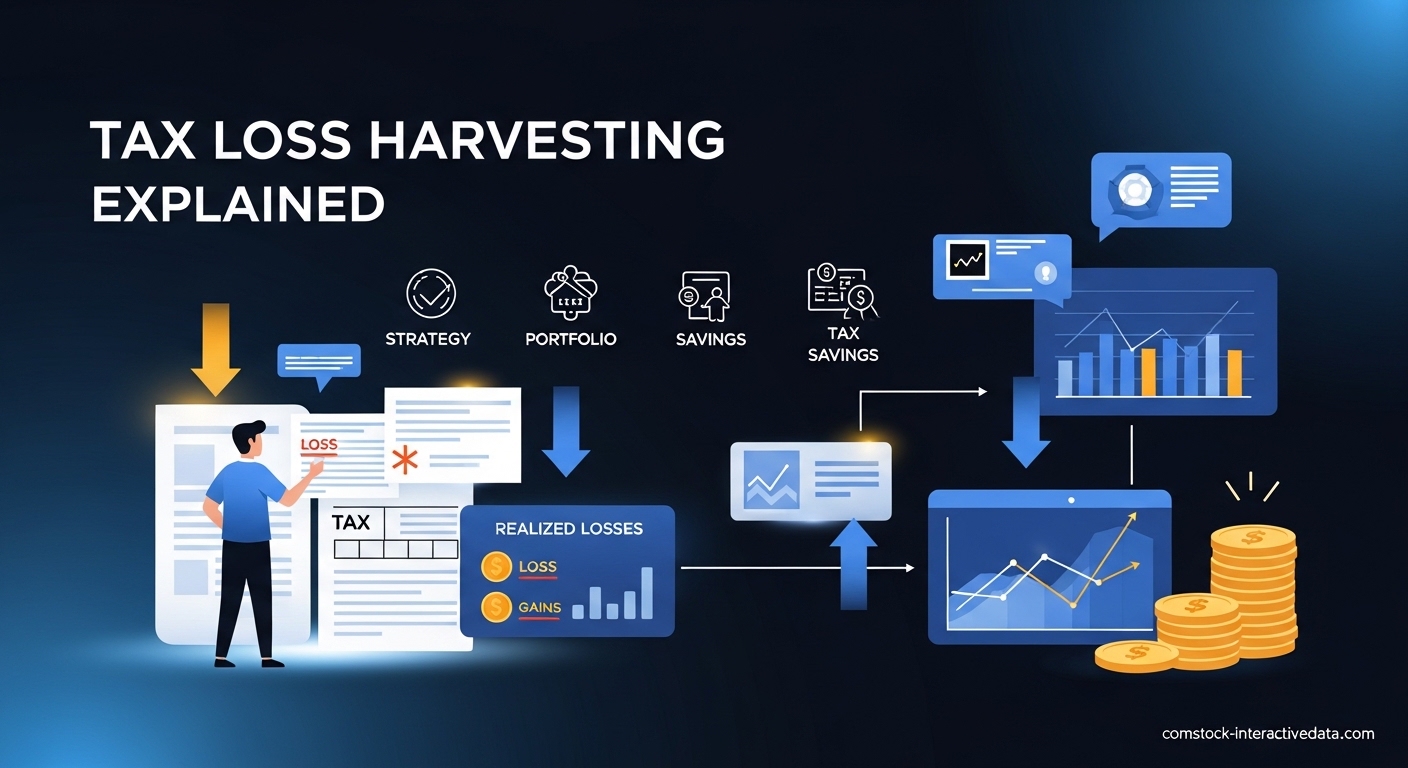
Tax-loss harvesting is when you sell investments at a loss and use those losses to offset gains in other investments, reducing your tax bill. This strategy can save you thousands of dollars annually by lowering your capital gains tax liability.
Our team has helped investors implement tax-loss harvesting strategies for over a decade. We have seen clients save anywhere from $1,500 to over $50,000 in a single year depending on their portfolio size and tax bracket.
In this guide, you will learn exactly how tax-loss harvesting works, the rules you must follow, and how to implement it correctly. By the end, you will understand whether this strategy makes sense for your specific situation.
Table of Contents
What Is Tax Loss Harvesting?
Tax loss harvesting is a tax strategy that converts investment losses into tax savings. You intentionally sell investments that have declined in value to realize capital losses, then use those losses to offset capital gains from other investments.
The key concept here is realized versus unrealized losses. An unrealized loss exists only on paper while you still hold the investment. The loss becomes realized only when you actually sell the investment.
Tax loss harvesting only works in taxable brokerage accounts. It does not apply to tax-deferred accounts like 401(k)s or IRAs because those accounts already grow tax-free. You cannot harvest losses in accounts where you do not pay capital gains taxes.
Here is the basic math that makes this strategy powerful. If you sell Stock A at a $10,000 loss and sell Stock B at a $10,000 gain, your net capital gain is zero. You owe no capital gains tax on Stock B’s profit because Stock A’s loss fully offset it.
Tax loss harvesting creates what professionals call “tax alpha” – additional after-tax returns without taking on additional market risk. You maintain your market exposure by reinvesting in similar (but not identical) securities while capturing the tax benefit.
How Does Tax Loss Harvesting Work?
Tax loss harvesting follows a simple five-step process. Each step requires careful attention to avoid costly mistakes.
Step 1: Identify Investments Trading at a Loss
Review your taxable brokerage account for positions currently worth less than you paid for them. Look at each holding’s cost basis versus current market value.
Many investors check their portfolios quarterly or when markets experience significant downturns. Market corrections in 2022 and 2020 created substantial loss harvesting opportunities for prepared investors.
Step 2: Sell to Realize the Capital Loss
Execute the sale of the underperforming investments. This action converts your paper losses into realized losses that count for tax purposes.
The settlement date (trade date plus two business days) determines the tax year for your loss. Sales executed on December 30, 2026 settle in 2026 and count for that tax year.
Step 3: Offset Your Capital Gains
Use your realized losses to offset any capital gains you realized during the year. Losses first offset gains of the same type – short-term losses offset short-term gains, long-term losses offset long-term gains.
After netting within each category, any remaining losses can offset gains in the other category. This netting order matters because short-term gains face higher tax rates than long-term gains.
Step 4: Deduct Up to $3,000 from Ordinary Income
If your total losses exceed your total gains, you can deduct up to $3,000 ($1,500 if married filing separately) from your ordinary income each year. This deduction applies to wages, business income, and other non-investment earnings.
For someone in the 32% federal tax bracket, a $3,000 deduction equals $960 in tax savings. High-income earners in the 37% bracket save $1,110.
Step 5: Reinvest in Similar Securities
Reinvest the proceeds to maintain your desired asset allocation. You might buy a different fund tracking a similar index or wait 31 days before repurchasing the same security.
The reinvestment step requires careful attention to the wash sale rule. You cannot repurchase the same or “substantially identical” security within 30 days before or after the sale.
Key Tax Loss Harvesting Rules and Limitations
Several IRS rules govern tax loss harvesting. Violating these rules can eliminate your tax benefits or trigger penalties.
The Wash Sale Rule
The wash sale rule prevents you from claiming a loss if you repurchase the same or substantially identical security within 30 days before or after the sale. This creates a 61-day window where repurchases disqualify your loss.
What counts as “substantially identical”? The IRS considers these scenarios problematic:
- Repurchasing the exact same stock or ETF
- Buying a call option on the stock you sold
- Buying a “substantially identical” security – the same company’s preferred stock, for example
- Your spouse buying the same security in their account
- Your IRA or 401(k) purchasing the security you sold
Safe alternatives include buying a different ETF tracking the same index (S&P 500 ETF from a different provider) or buying a fund with similar but not identical holdings (total stock market instead of S&P 500).
The $3,000 Annual Limit
After offsetting all your capital gains, you can only deduct up to $3,000 ($1,500 if married filing separately) from ordinary income per year. This limit has remained unchanged since 1978 despite decades of inflation.
Losses exceeding this limit carry forward indefinitely. You can use them in future years to offset gains or deduct another $3,000 annually until exhausted.
Capital Loss Carryforward Rules
Unused capital losses do not expire. They carry forward to future tax years automatically when you file Schedule D with your tax return.
Carried-forward losses retain their character. Short-term losses carry forward as short-term, long-term as long-term. This matters because short-term losses offset the higher-taxed short-term gains first.
You must track your carryforward losses carefully. The IRS does not maintain records of your unused losses – you must track them yourself or use tax software that preserves this data year-to-year.
Short-Term vs Long-Term Capital Gains
The holding period of your investments determines whether gains and losses are short-term or long-term. This classification dramatically affects your tax rate.
Short-term applies to investments held one year or less. Short-term gains face ordinary income tax rates up to 37% federal plus the 3.8% net investment income tax for high earners.
Long-term applies to investments held longer than one year. Long-term gains face preferential rates of 0%, 15%, or 20% depending on your income level.
Here is why this matters for tax loss harvesting. When netting gains and losses, you must follow this specific order:
- Short-term losses offset short-term gains first
- Long-term losses offset long-term gains first
- Remaining losses in either category offset gains in the other category
- Any excess can offset up to $3,000 of ordinary income
This netting order makes short-term losses more valuable. They first eliminate higher-taxed short-term gains, then can offset lower-taxed long-term gains or ordinary income.
For 2026, long-term capital gains tax rates break down as follows. The 0% rate applies to single filers with taxable income up to $47,025 and married couples up to $94,050. The 15% rate covers most middle and upper-middle income earners. The 20% rate kicks in for single filers above $518,900 and married couples above $583,750.
Tax Loss Harvesting Examples
Real numbers make tax loss harvesting concrete. Let us walk through several scenarios showing how this strategy works in practice.
Example 1: Basic Loss Offset
Sarah has two stock positions in her taxable account. She bought TechCorp for $50,000 and it is now worth $40,000 – a $10,000 unrealized loss. She also bought HealthInc for $30,000 and sold it for $40,000 earlier this year – a $10,000 realized short-term gain.
Sarah sells TechCorp to realize the $10,000 loss. This loss fully offsets her $10,000 gain from HealthInc. Her net capital gain is zero. She owes no capital gains tax despite making a profit on HealthInc.
Without tax loss harvesting, Sarah would owe short-term capital gains tax on her $10,000 profit. At a 32% federal rate plus 5% state tax, she saves $3,700.
Example 2: Excess Losses and Income Deduction
Michael has $25,000 in realized short-term gains from day trading. He also has $40,000 in realized losses from selling underperforming tech stocks.
Michael uses $25,000 of his losses to fully offset his gains. This leaves $15,000 in excess losses. He deducts $3,000 from his ordinary income this year, saving $960 at his 32% federal tax rate.
The remaining $12,000 carries forward to next year. Michael can use it to offset future gains or deduct another $3,000 annually.
Example 3: Multi-Year Carryforward
Jennifer harvested $50,000 in losses during the 2022 market downturn. She used $10,000 to offset gains that year and deducted $3,000 from income, leaving $37,000 to carry forward.
In 2023, she had no gains but deducted another $3,000. In 2024, she had $15,000 in gains from selling some winners and used $15,000 of her carried losses to offset them completely. She also deducted $3,000 from income.
After three years, Jennifer still has $16,000 in losses carrying forward to 2026 and beyond. These losses will continue providing tax benefits until exhausted.
Example 4: High-Income Earner with Net Investment Income Tax
David is a single filer earning $300,000 annually, putting him in the 15% long-term capital gains bracket but subject to the 3.8% net investment income tax. He also pays 9.3% California state tax.
David realizes $50,000 in long-term gains and harvests $30,000 in losses. His net gain is $20,000. Without harvesting, his tax would have been $9,650 (15% + 3.8% + 9.3% on $50,000). With harvesting, he pays $3,860 on his $20,000 net gain.
David saves $5,790 through tax loss harvesting. In high-tax states, the benefits multiply.
| Scenario | Without TLH | With TLH | Tax Savings |
|---|---|---|---|
| Basic offset ($10k gain/loss, 32% bracket) | $3,700 tax owed | $0 tax owed | $3,700 |
| Excess losses ($40k loss, $25k gain) | $8,000 tax owed | $0 tax + $960 income deduction | $8,960 |
| High earner with NIIT (CA resident) | $9,650 tax owed | $3,860 tax owed | $5,790 |
Benefits and Downsides of Tax Loss Harvesting
Tax loss harvesting offers significant advantages, but it is not right for everyone. Understanding both sides helps you make an informed decision.
Benefits of Tax Loss Harvesting
Immediate tax savings – The most obvious benefit is paying less tax this year. Every dollar of loss can eliminate taxes on a dollar of gain.
Compounding benefits – The money you save on taxes stays invested and grows over time. A $5,000 tax savings today, invested at 7% annually, grows to nearly $20,000 over 20 years.
Portfolio rebalancing opportunity – TLH naturally coincides with rebalancing. You can fix portfolio drift while capturing tax benefits.
Tax bracket management – Reducing taxable income can prevent you from crossing into higher brackets or triggering additional taxes like the net investment income tax.
Losses carry forward indefinitely – You bank losses during market downturns and use them for years to come, even when markets recover.
Downsides and Risks of Tax Loss Harvesting
Complexity and time – Manual TLH requires monitoring positions, tracking cost basis, and understanding tax rules. It demands more attention than passive investing.
Wash sale violations – Accidentally triggering a wash sale disqualifies your loss. This happens easily through dividend reinvestment or across multiple accounts.
Tracking error – When you substitute one fund for another to avoid wash sales, you might experience slight performance differences. Over time, this “tracking error” can cost more than your tax savings.
Qualified dividend risk – Holding a substitute security for over 60 days around the dividend date can disqualify you from preferential qualified dividend tax rates.
Lowered cost basis – TLH resets your cost basis lower. When you eventually sell the replacement security, you face higher gains and taxes. You are essentially deferring taxes, not eliminating them entirely.
Robo-Advisor vs Manual Tax Loss Harvesting
You have two main approaches to implementing tax loss harvesting. Each suits different types of investors.
Automated Tax Loss Harvesting (Robo-Advisors)
Robo-advisors like Betterment, Wealthfront, and Vanguard Digital Advisor offer automated tax loss harvesting. Their algorithms scan your portfolio daily and execute trades when opportunities arise.
The benefits include hands-off implementation, sophisticated algorithms that optimize timing, automatic wash sale prevention, and integration with broader tax strategies.
The drawbacks include management fees (typically 0.25% to 0.40% annually), limited investment options (you must use their fund selections), and the same tracking error risks as manual TLH.
Popular robo-advisors with TLH features:
- Betterment – 0.25% fee, TLH for accounts over $50,000, daily monitoring
- Wealthfront – 0.25% fee, TLH for all taxable accounts, stock-level tax-loss harvesting available
- Fidelity Go – Free for balances under $25,000, 0.35% above, limited TLH capabilities
- Vanguard Digital Advisor – 0.20% fee, integrated with Vanguard funds, requires $3,000 minimum
Manual Tax Loss Harvesting
DIY tax loss harvesting gives you complete control over timing, security selection, and strategy. It costs nothing beyond trading commissions (typically $0 at major brokerages).
Manual TLH works best for engaged investors who check their portfolios regularly, understand tax rules, and have the discipline to sell losers without emotional attachment.
The Bogleheads community generally favors manual TLH for larger portfolios. A spreadsheet tracking cost basis and unrealized gains/losses serves as your primary tool.
Our recommendation: Use robo-advisors for smaller portfolios (under $100,000) where fees are minimal and the hassle of manual TLH outweighs benefits. Consider manual TLH for larger portfolios where 0.25% fees add up to significant annual costs.
Tax Loss Harvesting for Cryptocurrency
Cryptocurrency creates unique tax loss harvesting opportunities. The extreme volatility generates frequent loss harvesting chances, and current law creates an interesting loophole.
As of 2026, the wash sale rule does not apply to cryptocurrency. The IRS treats crypto as property, not a security, which exempts it from Section 1091 wash sale restrictions.
This means you can sell Bitcoin at a loss and immediately repurchase it. You realize the tax loss while maintaining identical exposure. This differs fundamentally from stock TLH where you must wait 31 days or buy a substitute.
Some traders harvest crypto losses daily or weekly during volatile periods. This aggressive approach maximizes tax benefits but requires meticulous record-keeping.
Warning: Congress has discussed closing this loophole multiple times. Future legislation could extend wash sale rules to crypto. Always verify current law before implementing a strategy.
Crypto tax loss harvesting also presents challenges. Tracking cost basis across multiple exchanges, wallets, and DeFi protocols complicates matters. Specialized crypto tax software like CoinTracker or Koinly helps organize this data for accurate reporting.
Common Tax Loss Harvesting Mistakes to Avoid
Even experienced investors make errors when implementing tax loss harvesting. Here are the most common pitfalls and how to avoid them.
Accidental Wash Sales Across Accounts
Many investors forget that wash sale rules apply across all your accounts, including those you do not personally manage. Your spouse’s separate account, your IRA, your 401(k), and even accounts you inherited all count.
If you sell a stock at a loss in your taxable account and your spouse buys it in their account within 30 days, you have triggered a wash sale. Your loss becomes disallowed.
The solution: Coordinate with family members. Track purchases across all household accounts. Consider suspending dividend reinvestment in the 30 days before and after a planned harvest.
Dividend Reinvestment Accidents
Automatic dividend reinvestment plans (DRIPs) frequently trigger wash sales. You harvest a loss on the 15th, but your fund reinvests dividends on the 30th. This repurchase within 30 days invalidates your loss.
Our recommendation: Disable DRIPs for positions you plan to harvest. Take dividends as cash instead. You can manually reinvest after the wash sale window closes.
Ignoring State Tax Implications
Federal rules are consistent, but state tax treatment varies. Some states do not follow federal capital loss rules. Others have different limits or do not allow carryforwards.
California, for example, follows federal rules closely. But some states have quirks that affect your strategy. High-tax state residents actually benefit more from TLH because state taxes add to the savings.
Consult your state’s tax guidelines or a local tax professional before implementing aggressive TLH strategies.
Focusing Only on Year-End
Many investors only consider tax loss harvesting in December. This misses opportunities throughout the year. Market downturns in March or August create the same harvesting opportunities as December dips.
Year-round TLH, sometimes called “continuous harvesting,” captures more losses. Robo-advisors excel here because they monitor daily. Manual practitioners should check quarterly or after significant market moves.
Not Tracking Cost Basis Properly
Brokerages now report cost basis to the IRS, but their records might not match your personal tracking. If you have owned positions for years, pre-2011 purchases might lack cost basis reporting.
Keep your own records. Save purchase confirmations. Use the specific identification method for cost basis rather than average cost if you want maximum control over which lots to sell.
Reporting Tax Loss Harvesting on Your Return
Tax loss harvesting requires proper documentation on your tax return. Understanding the forms helps you verify your tax software handled everything correctly.
Form 8949 – You report each individual securities sale on Form 8949. List the description, dates acquired and sold, proceeds, cost basis, and the resulting gain or loss. Mark harvested losses clearly.
Schedule D – Form 8949 feeds into Schedule D, which summarizes your total capital gains and losses. This schedule shows the netting process – short-term gains/losses in Part I, long-term in Part II.
Form 1040 – Schedule D ultimately flows to your main 1040 form, affecting your total tax calculation. The $3,000 ordinary income deduction appears on Schedule 1.
Carryforward losses require tracking but no special forms. Your tax software should automatically preserve unused losses for next year. Verify this by checking your “Capital Loss Carryover Worksheet.”
If you use a tax professional, provide them with all trading summaries and documentation of your harvesting strategy. Clear communication ensures they capture all benefits correctly.
Frequently Asked Questions
How does tax-loss harvesting offset capital gains?
Tax-loss harvesting offsets capital gains by using realized losses to reduce or eliminate taxes on realized gains. When you sell an investment at a loss, that loss can offset dollar-for-dollar any capital gains you realized from selling other investments at a profit. If your losses exceed your gains, you can deduct up to $3,000 from ordinary income annually, with excess losses carrying forward to future years.
How to sell at a loss to offset capital gains tax?
First, identify investments trading below your purchase price. Sell them to realize the loss. Use Form 8949 to report the sale. The realized losses automatically offset your capital gains when you file taxes. If losses exceed gains, carry forward excess losses or deduct up to $3,000 from ordinary income. Avoid repurchasing the same security within 30 days to prevent wash sale violations.
How much capital loss can I use to offset capital gains?
There is no limit on using capital losses to offset capital gains. You can offset unlimited gains with unlimited losses. However, after offsetting all gains, you can only deduct up to $3,000 ($1,500 if married filing separately) from ordinary income per year. Any remaining losses carry forward indefinitely to future tax years.
How to do tax-loss harvesting correctly?
Follow these steps: 1) Identify investments with unrealized losses, 2) Sell to realize losses, 3) Offset gains with losses on Schedule D, 4) Deduct up to $3,000 from income if losses exceed gains, 5) Reinvest in similar (not identical) securities or wait 31 days, 6) Track carryforward losses for future use. Avoid wash sales by not repurchasing the same security within 30 days before or after the sale.
Is there a downside to tax-loss harvesting?
Yes, several downsides exist: complexity and time required, risk of wash sale violations that disallow losses, tracking error from substitute securities, potential loss of qualified dividend status, and lowered cost basis that creates higher taxes when you eventually sell. Additionally, the $3,000 annual income deduction limit means large losses take years to fully utilize.
Is tax-loss harvesting complicated?
Tax-loss harvesting can be simple or complex depending on your approach. Robo-advisors automate the process, making it effortless. Manual TLH requires understanding wash sale rules, tracking cost basis, and monitoring positions. Basic harvesting (selling losers once yearly) is straightforward. Advanced strategies with multiple accounts and frequent trading become complex quickly.
Can I sell today and buy tomorrow for tax-loss harvesting?
No, selling today and buying tomorrow violates the wash sale rule. You must wait at least 30 days after selling before repurchasing the same or substantially identical security. The rule also looks back 30 days before your sale. This creates a 61-day window (30 days before, sale day, 30 days after) where repurchases disqualify your loss. Consider buying a different but similar investment instead.
Can I tax-loss harvest in my 401k or IRA?
No, tax-loss harvesting only works in taxable brokerage accounts. 401(k)s, IRAs, and other tax-deferred accounts do not generate taxable capital gains or losses when you buy and sell investments within them. Since you do not pay capital gains taxes on these accounts, there are no taxes to offset through harvesting. Focus TLH efforts on your taxable accounts only.
Is tax-loss harvesting worth it for small portfolios?
For portfolios under $50,000, the benefits are smaller but still meaningful. A $1,000 harvested loss saves $150-370 depending on your tax bracket. Robo-advisor fees (0.25%) on a $50,000 portfolio cost $125 annually, potentially eating into savings. DIY harvesting makes more sense for small portfolios. As your portfolio grows, the absolute dollar savings increase significantly.
What happens to losses that exceed the $3,000 limit?
Losses exceeding the $3,000 annual limit carry forward indefinitely to future tax years. You can use them to offset future capital gains or deduct $3,000 per year from ordinary income until exhausted. Short-term losses retain their short-term character when carried forward. Track these carefully as the IRS does not maintain records of your unused losses.
Conclusion
Tax loss harvesting offers a powerful way to reduce your tax bill and keep more money working for you. By selling investments at a loss and using those losses to offset gains, you can significantly lower your capital gains tax liability.
The strategy works best for investors in higher tax brackets with taxable brokerage accounts. It requires understanding the wash sale rule, tracking your cost basis, and staying organized with your tax documentation. The effort pays off through immediate tax savings and long-term compounding benefits.
Whether you choose automated robo-advisors or manual implementation, tax loss harvesting deserves consideration as part of your overall investment strategy. Start small, understand the rules, and scale your approach as your portfolio grows. The tax savings from even basic harvesting can add up to thousands of dollars over time.