
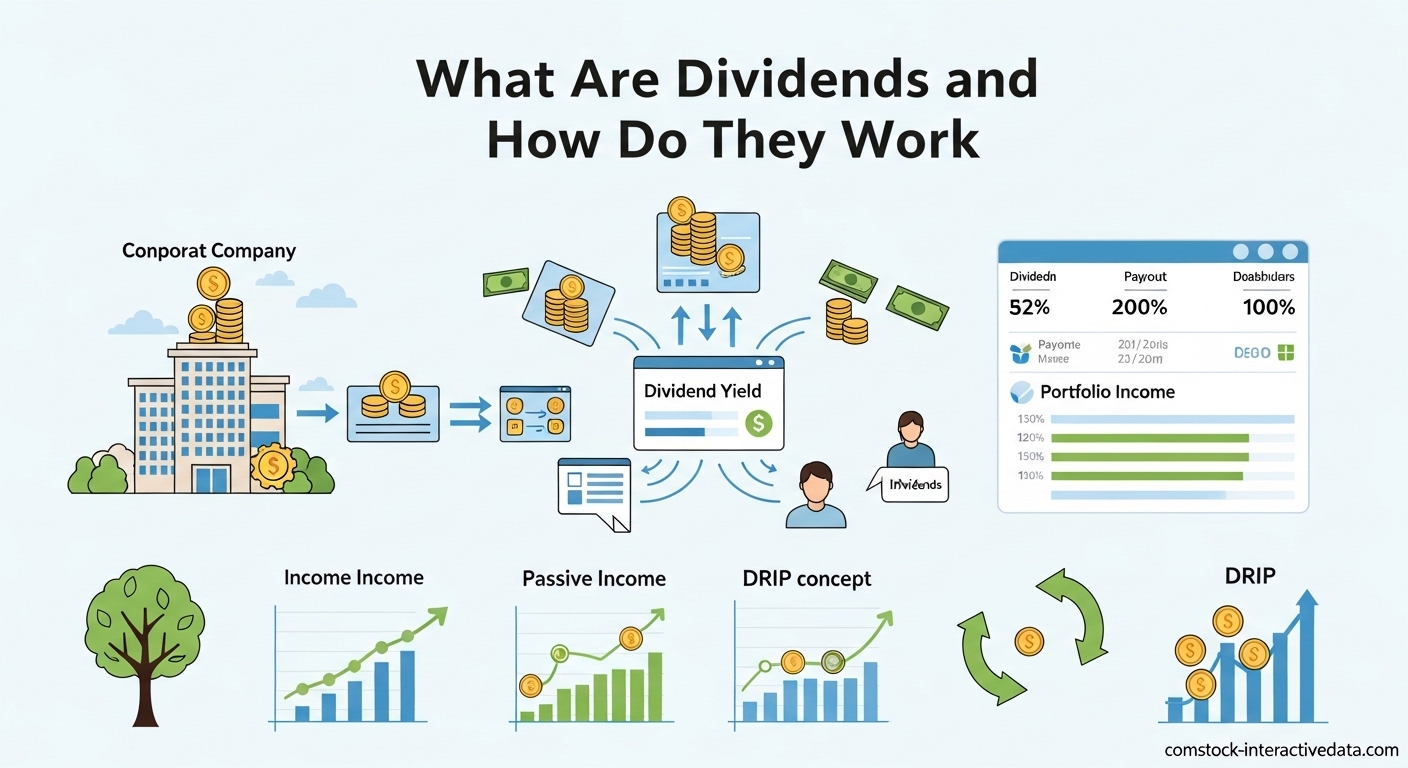
A dividend is a portion of a company’s profits distributed to shareholders as a reward for owning stock. When you own shares in a company that pays dividends, you receive regular payments based on how many shares you hold. These payments typically arrive quarterly, though some companies pay monthly or annually.
Understanding what are dividends and how do they work is essential for anyone building an investment portfolio. Whether you are planning for retirement, seeking passive income, or simply growing your wealth, dividends can play a key role in your strategy.
In this guide, I will explain everything you need to know about dividends. You will learn how companies decide to pay them, the different types available, the important dates to remember, and how dividends are taxed. By the end, you will understand exactly how dividends work and how to evaluate them as part of your investment decisions.
Table of Contents
What Are Dividends?
Dividends represent a share of company profits paid out to stockholders. When a business earns money, its board of directors can choose to reinvest those earnings back into growth or distribute them to owners. The portion they distribute is called a dividend.
Think of it this way: when you own stock, you own a small piece of that company. When the company makes a profit, you deserve a share of that success. Dividends are how companies return value to you without requiring you to sell your shares.
Not every company pays dividends. Young, fast-growing businesses usually reinvest all profits to fuel expansion. Established companies with steady cash flows are more likely to pay dividends regularly. This distinction helps explain why tech startups rarely pay dividends while utility companies often do.
How Do Dividends Work?
The dividend process follows a predictable sequence from company decision to your bank account. Understanding each step helps you plan your investments and avoid common mistakes.
Step 1: Company Generates Profits
A company must first earn a profit before it can pay dividends. This happens when revenues exceed expenses over a quarter or year. Without profits, there is no money to distribute.
Step 2: Board of Directors Approves the Dividend
The company’s board of directors votes on whether to pay a dividend and how much. They consider the company’s financial health, future investment needs, and shareholder expectations. Once approved, they announce the dividend amount per share.
Step 3: Key Dates Are Set
The board establishes four important dates. These dates determine who receives the dividend and when payment occurs. I will explain these dates in detail in the next section.
Step 4: Payment Is Distributed
On the payment date, shareholders receive their dividends. If you own 100 shares and the dividend is $0.50 per share, you receive $50. This money typically deposits directly into your brokerage account.
Many investors misunderstand a critical point about dividends. The stock price typically drops by the dividend amount on the ex-dividend date. You are not getting “free money” – you are receiving a portion of the company’s value in cash form. The total value of your investment remains similar immediately after the dividend payment.
Types of Dividends
Companies distribute dividends in several forms. Each type serves different purposes and offers distinct advantages for investors.
Cash Dividends
Cash dividends are the most common type. You receive actual money deposited into your investment account. This provides immediate liquidity you can spend, save, or reinvest elsewhere. Most investors prefer cash dividends for the flexibility they offer.
Stock Dividends
Stock dividends pay you in additional shares rather than cash. If a company declares a 5% stock dividend and you own 100 shares, you receive 5 additional shares. Your ownership percentage stays the same, but you hold more shares. Stock dividends often signal company confidence while conserving cash for growth.
Special Dividends
Special dividends are one-time payments outside the normal schedule. Companies issue them after exceptional profits, asset sales, or tax windfalls. These are not guaranteed to repeat. While exciting, smart investors do not build strategies around special dividends.
Preferred Dividends
Preferred stockholders receive dividends before common stockholders. These dividends are usually fixed amounts paid at regular intervals. If a company faces financial trouble, preferred shareholders have priority for dividend payments. However, preferred stock typically lacks voting rights and has limited price appreciation potential.
Important Dividend Dates You Need to Know
Four critical dates determine dividend eligibility and payment. Understanding these dates prevents costly mistakes and ensures you receive the dividends you expect.
Declaration Date
The declaration date is when the board officially announces the dividend. They disclose the dividend amount per share and the other three key dates. This announcement often triggers movement in the stock price as investors react to the news.
Ex-Dividend Date
The ex-dividend date is the most important date for buyers and sellers. If you purchase the stock on or after this date, you do NOT receive the upcoming dividend. The seller keeps it. To receive the dividend, you must own the stock before the market opens on the ex-dividend date.
On this date, the stock price typically drops by approximately the dividend amount. This reflects the fact that new buyers are not entitled to the upcoming payment.
Record Date
The record date is when the company reviews its shareholder list to determine who receives the dividend. Only shareholders on record at the close of this date receive payment. Due to settlement times, you must buy the stock at least one business day before the ex-dividend date to appear on the record.
Payment Date
The payment date is when the dividend actually arrives in your account. This typically occurs 2-4 weeks after the record date. The money appears as cash in your brokerage account unless you have enrolled in a dividend reinvestment plan.
What Is Dividend Yield and How Is It Calculated?
Dividend yield helps you compare the income potential of different dividend-paying stocks. It shows your annual return from dividends alone, expressed as a percentage of the stock price.
The Dividend Yield Formula
The calculation is straightforward:
Dividend Yield = (Annual Dividend Per Share / Current Stock Price) x 100
For example, if a stock trades at $50 per share and pays $2.00 in annual dividends, the yield is 4%. This means for every $100 you invest, you receive $4 annually in dividends.
What Is a Good Dividend Yield
Most dividend-paying stocks offer yields between 2% and 5%. Yields below 2% may not provide meaningful income. Yields above 6% often signal risk – the market may be pricing in a potential dividend cut or company troubles.
Our team has observed that sustainable yields typically fall in the 3-4% range for established companies. Extremely high yields can tempt investors, but they often result from falling stock prices rather than rising dividends. Always investigate why a yield seems unusually high.
Why Do Companies Pay Dividends?
Companies choose to pay dividends for several strategic reasons. Understanding these motivations helps you evaluate whether a dividend is likely to continue.
Attract Income-Focused Investors
Dividends attract retirees and other investors who need regular income from their portfolios. These investors often prioritize steady payments over rapid growth. By paying dividends, companies expand their potential shareholder base and create more demand for their stock.
Signal Financial Health
A consistent dividend signals that management is confident in the company’s future cash flows. Cutting a dividend is embarrassing and often hurts the stock price. Companies only commit to dividends when they believe they can maintain them. This makes dividends a credibility signal to the market.
Return Excess Cash
Companies sometimes generate more cash than they can profitably reinvest. Rather than letting cash sit idle or making poor acquisitions, they return it to shareholders. This demonstrates capital discipline and respect for shareholder interests.
Compete with Bond Yields
In low interest rate environments, dividend stocks compete with bonds for income-seeking investors. Companies may maintain or increase dividends to offer attractive yields compared to fixed-income alternatives.
How Are Dividends Taxed?
Dividend taxation significantly impacts your real returns. The tax treatment depends on the dividend type and your holding period.
Qualified Dividends
Qualified dividends receive favorable tax treatment similar to long-term capital gains. To qualify, you must hold the stock for at least 60 days during the 121-day period surrounding the ex-dividend date. Most dividends from U.S. corporations and qualified foreign companies meet this standard.
For 2026, qualified dividend tax rates are 0%, 15%, or 20% depending on your overall income. Many middle-income investors pay just 15% on qualified dividends, significantly less than ordinary income tax rates.
Ordinary Dividends
Ordinary or non-qualified dividends are taxed at your regular federal income tax rate. This can be as high as 37% for high earners. Dividends from real estate investment trusts (REITs), master limited partnerships (MLPs), and certain foreign companies typically fall into this category.
Tax-Advantaged Accounts
Holding dividend stocks in retirement accounts like 401(k)s or IRAs defers or eliminates taxes. Traditional accounts defer taxes until withdrawal. Roth accounts allow tax-free growth and withdrawals. This makes tax-advantaged accounts ideal locations for high-yield dividend investments.
Frequently Asked Questions
How much dividends to make $1000 a month?
To generate $1000 monthly in dividends, you need approximately $300,000 invested at a 4% average dividend yield. The exact amount depends on your portfolio’s yield – at 3% yield you need $400,000, while at 5% yield you need $240,000. Building to this level requires consistent investing and dividend reinvestment over many years.
What does a 4% dividend mean?
A 4% dividend means the annual dividend payment equals 4% of the stock’s current price. If a stock trades at $100 per share, a 4% dividend equals $4 per share annually. This typically arrives as $1 per share each quarter. The yield changes as the stock price moves up or down.
How do you make money from dividends?
You make money from dividends by owning shares in companies that distribute profits to shareholders. The money arrives as cash payments, usually quarterly, based on how many shares you own. You can spend this income or reinvest it to buy more shares. Over time, dividend growth and compounding can build significant wealth.
How long do I have to keep a stock to get the dividend?
You must own the stock before the ex-dividend date to receive the upcoming dividend. Due to trade settlement rules, you need to buy at least one business day before the ex-dividend date. Simply holding through the record date is not enough if you bought on the ex-dividend date itself.
Are dividends free money?
Dividends are not free money. When a company pays a dividend, its stock price typically drops by the dividend amount on the ex-dividend date. You are converting a portion of the company’s value from stock price into cash. The total value of your holding remains similar immediately after the payment.
Do you have to pay taxes on dividends?
Yes, dividends are taxable income. Qualified dividends receive favorable tax rates of 0%, 15%, or 20% depending on your income. Ordinary dividends are taxed at your regular income tax rate. Holding dividend stocks in tax-advantaged accounts like IRAs can defer or eliminate these taxes.
Conclusion
What are dividends and how do they work? Dividends represent your share of company profits paid regularly as long as you own the stock. They provide a way to benefit from business success without selling your investment. For income-focused investors, they offer predictable cash flow. For growth-focused investors, reinvested dividends compound wealth over decades.
The key to successful dividend investing lies in understanding the mechanics we have covered. Watch for sustainable payout ratios, consistent payment histories, and reasonable yields. Avoid chasing unsustainably high yields that often signal trouble ahead.
Start by researching dividend aristocrats – companies with 25+ years of consecutive dividend increases. These businesses have proven their commitment to shareholders through multiple economic cycles. Consider your tax situation when deciding between taxable and tax-advantaged accounts for your dividend holdings. Remember that dividends work best as part of a diversified portfolio, not as your sole investment strategy.