
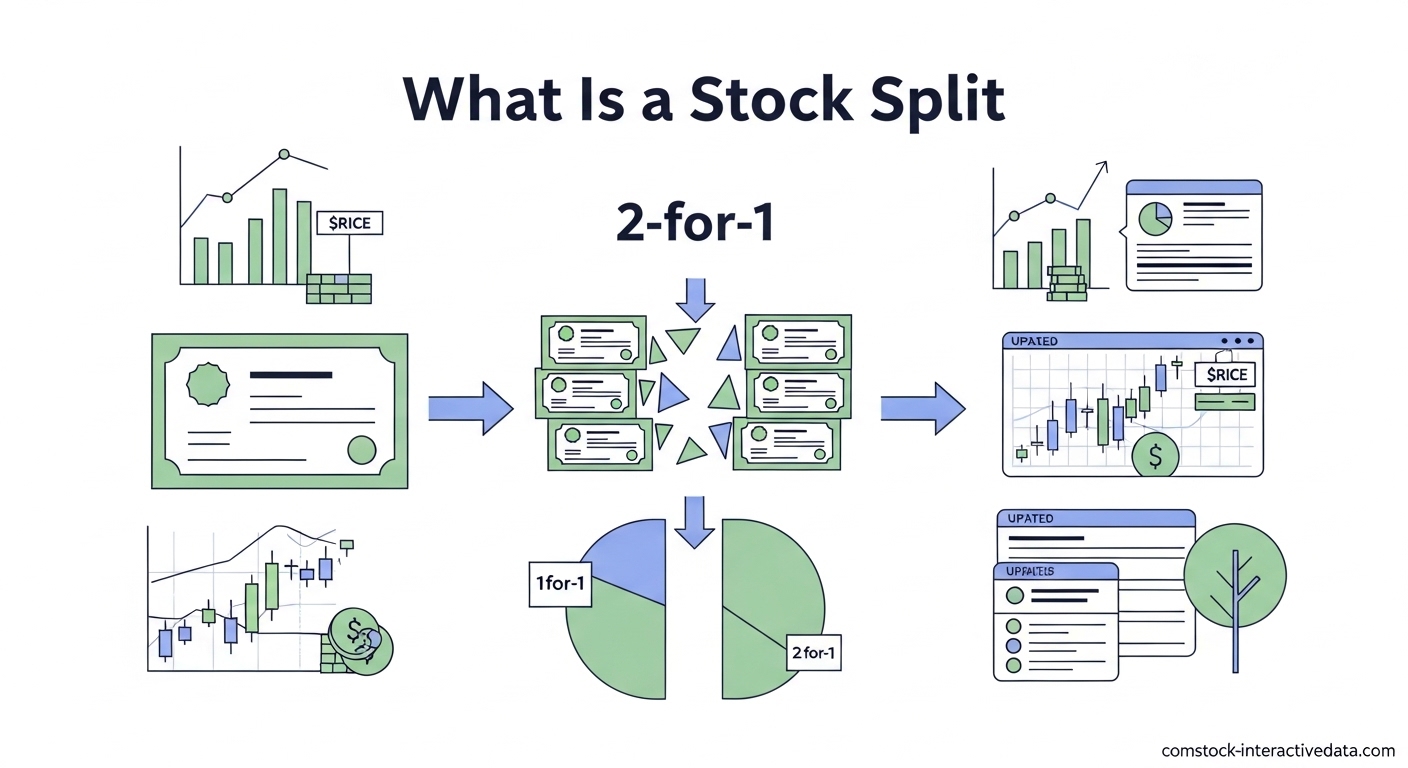
A stock split is when a company divides its existing shares into multiple new shares, lowering the price per share while keeping the total market value the same. Your investment value does not change, but you end up owning more shares at a lower price per share.
In this guide, I will explain exactly how stock splits work, why companies choose to split their stock, and what happens to your shares when a split occurs. You will learn the difference between forward and reverse splits, see real examples from companies like Apple and NVIDIA, and understand whether a stock split is good or bad for your portfolio.
Table of Contents
What Is a Stock Split?
A stock split is a corporate action where a company increases the number of its outstanding shares by issuing new shares to existing shareholders in a set proportion. If you own 10 shares before a 2-for-1 split, you will own 20 shares after the split completes.
Think of it like cutting a pizza. You start with one pizza cut into 6 slices. A stock split would be like cutting those same 6 slices in half, giving you 12 smaller slices. You still have the same amount of pizza, just divided differently.
The key point is that a stock split does not change the company’s total market capitalization. The value of the company stays the same, and the value of your investment stays the same. Only the number of shares and the price per share change proportionally.
The Simple Math Behind Stock Splits
Here is how the math works in a typical 2-for-1 stock split scenario:
Before Split: You own 100 shares at $200 per share. Your total investment value is $20,000.
After 2-for-1 Split: You now own 200 shares at $100 per share. Your total investment value is still $20,000.
The split ratio can vary. Companies might do 3-for-1 splits, 4-for-1 splits, or even 20-for-1 splits. The principle remains the same: more shares, lower price per share, identical total value.
How Does a Stock Split Work?
A stock split follows a specific process from announcement to execution. Understanding this timeline helps you know what to expect when a company announces a split.
The Stock Split Process
Step 1: Board Approval and Announcement — The company’s board of directors votes to approve the split ratio and announces the decision publicly. The announcement includes the split ratio, record date, and effective date.
Step 2: Record Date — The company sets a record date to determine which shareholders are eligible to receive the additional shares. You must own shares before this date to participate in the split.
Step 3: Distribution — On the effective date (also called the distribution date), the new shares are distributed to eligible shareholders. Your brokerage account automatically updates to reflect the new share count and adjusted price.
Step 4: Trading Begins at New Price — The stock begins trading at the split-adjusted price. The ticker symbol remains the same, though some platforms may temporarily append modifiers.
Before and After: Stock Split Comparison
This table shows how different split ratios affect your share count and price per share, assuming you start with 100 shares at $500 each:
| Split Ratio | Shares Before | Shares After | Price Before | Price After | Total Value |
|---|---|---|---|---|---|
| 2-for-1 | 100 | 200 | $500 | $250 | $50,000 |
| 3-for-1 | 100 | 300 | $500 | $167 | $50,000 |
| 4-for-1 | 100 | 400 | $500 | $125 | $50,000 |
| 10-for-1 | 100 | 1,000 | $500 | $50 | $50,000 |
As you can see, regardless of the split ratio, your total investment value remains $50,000 in every scenario.
Why Do Companies Split Their Stock?
Companies choose to split their stock for several strategic reasons. The primary motivation is making shares more affordable and accessible to a broader range of investors.
Improving Share Affordability
When a stock price climbs into the hundreds or thousands of dollars per share, many retail investors find it difficult to purchase even a single share. By splitting the stock, companies lower the price per share, making it easier for everyday investors to buy in.
For example, before its 20-for-1 split in 2022, Amazon shares traded above $2,000. After the split, shares traded around $100, making them far more accessible to average investors.
Increasing Liquidity
Lower share prices typically lead to increased trading volume. More investors can afford to buy and sell, which creates tighter bid-ask spreads and makes the stock more liquid. Higher liquidity benefits all shareholders by reducing transaction costs.
Expanding the Investor Base
Companies want diverse ownership. When shares are affordable, more people can invest, which can increase demand for the stock over time. A broader investor base can also provide more stability during market volatility.
Signaling Confidence
Stock splits often signal that management is confident about the company’s future. Companies typically split after periods of strong performance and rising share prices. The split announcement can generate positive media coverage and investor enthusiasm.
Types of Stock Splits: Forward vs. Reverse
Not all stock splits work the same way. There are two main types: forward splits and reverse splits. Understanding the difference is crucial for investors.
Forward Stock Splits
A forward stock split is what most people mean when they talk about stock splits. The company increases its outstanding shares, and the price per share decreases proportionally.
Forward splits are generally viewed positively by the market. They indicate the company has been performing well, with share prices rising to levels that prompted the split. Common ratios include 2-for-1, 3-for-1, and 4-for-1.
Reverse Stock Splits
A reverse stock split does the opposite. The company reduces its outstanding shares, and the price per share increases proportionally. For example, in a 1-for-10 reverse split, if you owned 100 shares at $5 each, you would end up with 10 shares at $50 each.
Reverse splits are often warning signs. Companies typically execute reverse splits to avoid delisting when their share price falls too low. Exchanges like NASDAQ require stocks to maintain minimum price levels, often $1 per share.
A reverse split can signal financial distress, though not always. Some companies use reverse splits strategically to attract institutional investors who have minimum price thresholds for their holdings.
Forward vs. Reverse Split Comparison
| Feature | Forward Split | Reverse Split |
|---|---|---|
| Share Count | Increases | Decreases |
| Price Per Share | Decreases | Increases |
| Common Ratios | 2-for-1, 3-for-1, 4-for-1 | 1-for-5, 1-for-10, 1-for-20 |
| Market Signal | Usually positive | Often concerning |
| Primary Purpose | Improve affordability | Avoid delisting, meet requirements |
How Stock Splits Affect Your Shares?
The most common question investors ask is: what happens to my shares when a stock splits? The answer is simple in mechanics but important to understand fully.
Your Investment Value Stays the Same
A stock split does not change the total value of your investment. If you owned $10,000 worth of stock before the split, you own $10,000 worth after the split. The number of shares changes, the price per share changes, but your equity in the company remains identical.
Your ownership percentage in the company also stays the same. If you owned 0.001% of the company before, you still own 0.001% after. The split affects all shareholders proportionally.
Impact on Dividends
After a stock split, dividend payments adjust proportionally. If you received $2 per share in dividends before a 2-for-1 split, you would receive $1 per share after the split. However, because you now own twice as many shares, your total dividend income remains unchanged.
Some companies actually increase their dividend payouts following splits, though this is a separate business decision unrelated to the split mechanics.
Impact on Stock Options and Derivatives
If you own stock options, those contracts adjust automatically to reflect the split. A call option for 100 shares at a $200 strike price would become a call option for 200 shares at a $100 strike price after a 2-for-1 split.
The terms of the contract change, but the overall value and potential profit/loss profile remain consistent. Option chains update automatically in your brokerage account.
Tax Implications
Stock splits are not taxable events. You do not owe capital gains taxes when a split occurs because you have not realized any gain or loss. Your cost basis per share adjusts downward proportionally, and your acquisition date remains the same.
For example, if you bought 50 shares at $100 each ($5,000 total cost basis) and the stock splits 2-for-1, your new cost basis becomes $50 per share for 100 shares, still totaling $5,000.
Famous Stock Split Examples
Several major companies have executed notable stock splits in recent years. These examples illustrate how splits work in practice and their market impact.
Apple’s Multiple Splits
Apple has split its stock five times since going public in 1980. The most recent was a 4-for-1 split in August 2020, when shares traded around $500. After the split, shares began trading around $125.
If you had bought one share of Apple at its IPO and held through all splits, that single share would have become 224 shares today. Apple has consistently used splits to keep shares accessible as its market value has grown.
NVIDIA’s 2024 Split
NVIDIA executed a 10-for-1 stock split in June 2024 after its share price surged past $1,200. The split made shares more accessible to retail investors during the AI boom that drove NVIDIA’s valuation.
Post-split, NVIDIA shares traded around $120, opening the door for more investors to participate in the company’s growth story.
Amazon’s 20-for-1 Split
In June 2022, Amazon executed a 20-for-1 stock split, its first since 1999. Before the split, shares traded above $2,000, putting them out of reach for many retail investors. After the split, shares traded around $100.
Amazon also announced a $10 billion stock buyback program alongside the split, combining accessibility improvements with confidence signaling.
Tesla’s Splits
Tesla executed a 5-for-1 split in August 2020 and a 3-for-1 split in August 2022. These aggressive splits reflected Tesla’s rapid share price appreciation and desire to maintain accessibility for its passionate retail investor base.
Tesla’s splits coincided with periods of high public interest and helped fuel continued retail participation in the stock.
Common Misconceptions About Stock Splits
Many investors misunderstand stock splits, leading to confusion about their impact. Let me clear up the most common myths.
Myth: Stock Splits Create Value
Some investors believe that stock splits make them richer because they own more shares. This is false. The total value of your investment does not change. You have more shares, but each share is worth proportionally less.
While splits can sometimes lead to price increases due to increased demand from new investors, this is not guaranteed and is separate from the split mechanics themselves.
Myth: Splits Dilute Ownership
Stock splits do not dilute your ownership percentage. Unlike new share issuances that sell stock to new investors, splits give existing shareholders additional shares proportionally. Everyone’s ownership stake remains the same.
Dilution occurs when a company issues new shares and sells them, bringing in new owners. Splits simply redivide the existing ownership pie into more slices.
Myth: Cheap Stocks Are Better Investments
After a split, the lower share price might make the stock seem more affordable or like a “bargain.” However, the company’s valuation metrics (price-to-earnings ratio, market cap, etc.) remain unchanged. A $100 stock is not inherently better value than a $500 stock if the underlying business is the same.
Focus on the company’s fundamentals and valuation, not the absolute share price.
Myth: You Should Always Buy Before a Split
Some investors rush to buy shares before a split, expecting automatic gains. While pre-split buying can work if the stock continues to rise, the split itself creates no value. Buying solely because of an upcoming split is speculation, not investing.
The best time to buy a stock is when you believe the underlying business is undervalued, regardless of any upcoming corporate actions.
Frequently Asked Questions About Stock Splits
What is the downside of a stock split?
The main downside is that stock splits can create psychological confusion for inexperienced investors who mistake lower prices for better value. Splits also increase administrative costs for companies and can attract short-term traders rather than long-term investors. Additionally, reverse stock splits often signal financial distress and can precede further price declines.
Is it good to buy when a stock splits?
Buying when a stock splits is neither inherently good nor bad. The split itself creates no value. However, splits often follow periods of strong performance, and the lower post-split price can attract new investors, potentially driving demand. Base your buying decisions on the company’s fundamentals, valuation, and growth prospects rather than the split event itself.
What is the 7% rule in shares?
The 7% rule typically refers to a stop-loss strategy where investors sell a stock if it falls 7% below their purchase price to limit losses. This is unrelated to stock splits. Some traders also use 7% as a target for taking profits. The rule is a risk management technique, not a guideline for handling stock splits.
What does a 20 for 1 stock split mean?
A 20-for-1 stock split means that for every 1 share you own, you receive 19 additional shares, ending up with 20 shares total. The price per share is divided by 20. For example, if you owned 10 shares at $2,000 each ($20,000 total), after a 20-for-1 split you would own 200 shares at $100 each (still $20,000 total).
Do I lose money when a stock splits?
No, you do not lose money when a stock splits. The total value of your investment remains exactly the same immediately after the split. While the share price decreases, you receive additional shares proportionally, keeping your total investment value unchanged. Any gains or losses after the split depend on market movements, not the split itself.
Is a reverse stock split good or bad?
Reverse stock splits are generally viewed negatively because companies usually execute them to avoid delisting when their share price has fallen too low. They can signal financial distress. However, some healthy companies use reverse splits strategically to meet institutional investor requirements. The impact depends on the company’s underlying financial health and reasons for the reverse split.
Conclusion: Is a Stock Split Good or Bad?
A stock split is fundamentally neutral for your investment value. It is neither good nor bad in itself. What matters is understanding what is a stock split and how it affects your shares mechanically.
The split changes your share count and the price per share, but your total investment value, ownership percentage, and proportional claim on the company’s earnings remain unchanged. Splits can be positive signals when companies want to make shares more accessible, but they do not create or destroy value on their own.
When evaluating a stock split, focus on why the company is splitting and the underlying business health rather than the split itself. Companies with strong fundamentals that split to improve accessibility often continue performing well. Companies executing reverse splits to avoid delisting may face deeper challenges requiring careful scrutiny.
Understanding stock splits helps you make informed decisions and avoid the common misconception that more shares automatically mean more wealth. The pizza analogy holds true: whether cut into 6 slices or 12, you still have the same amount of pizza.