
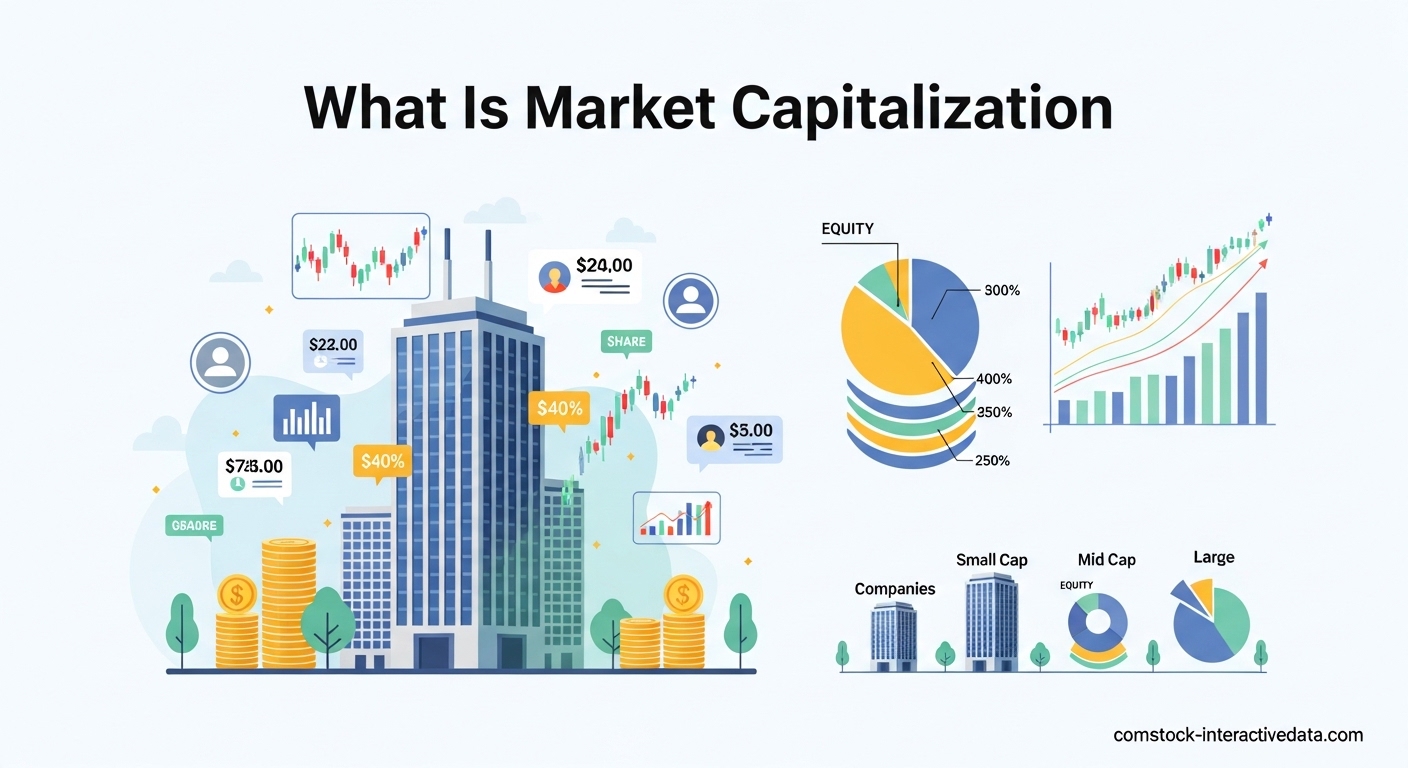
Understanding what market capitalization means is one of the first steps toward becoming a confident investor. I remember when I started investing, I would look at stock prices and assume a $500 stock was somehow “bigger” or “better” than a $50 stock. That confusion cost me until I learned the simple truth: market cap reveals the real size of a company, not its share price.
Market capitalization (or market cap) is the total dollar value of a publicly traded company. You calculate it by multiplying the current share price by the total number of outstanding shares. The formula is simple: Market Cap = Share Price x Outstanding Shares.
In this guide, I will break down exactly what is market capitalization, how to calculate it yourself, why it matters for your portfolio, and how to use it for smarter investing decisions in 2026. Whether you are just starting or looking to refine your strategy, this knowledge will change how you evaluate stocks forever.
Table of Contents
What Is Market Capitalization?
Market capitalization represents the total value the stock market places on a company. Think of it like this: if a company is a pizza, the share price is the cost of one slice, while the market cap is the value of the entire pie.
When investors ask “what is market capitalization,” they are really asking “how much is this entire company worth according to the market?” The answer comes from multiplying what investors currently pay for one share by how many shares exist in total.
For example, if Company XYZ trades at $100 per share and has 10 million shares outstanding, its market cap is $1 billion. That $1 billion figure tells you the company’s total equity value—the price you would theoretically pay to buy every single share and own the entire business.
Investors use market cap because it provides a standardized way to compare companies. Unlike revenue or profit figures that can be manipulated through accounting, market cap reflects the collective judgment of thousands of investors putting real money at stake.
How to Calculate Market Cap?
Calculating market capitalization requires just two numbers, both freely available on any financial website. Here is the simple three-step process:
Step 1: Find the Current Share Price
Look up the stock ticker on Yahoo Finance, Google Finance, or your brokerage platform. The current trading price is your starting point.
Step 2: Locate Shares Outstanding
Find the “shares outstanding” figure in the company’s statistics or fundamentals section. This number represents all shares held by investors, including insiders and institutional holders.
Step 3: Multiply the Two Numbers
Apply the market capitalization formula: Share Price x Shares Outstanding = Market Cap. The result gives you the company’s total market value in dollars.
Real Example: Apple Inc.
Let me walk through a real calculation. As of early 2026, Apple (AAPL) traded around $225 per share with approximately 15.3 billion shares outstanding. Multiplying these gives: $225 x 15.3 billion = $3.44 trillion market cap. That makes Apple one of the largest companies on earth by market value.
Try this yourself with any stock you own. The calculation takes under a minute but gives you crucial context about company size.
Market Capitalization Categories Explained 2026
Investors group stocks into market cap categories to quickly assess company size and associated characteristics. Understanding these segments helps you build balanced portfolios and set appropriate expectations.
Here is the complete breakdown of market cap categories with real 2026 examples:
| Category | Market Cap Range | Risk Level | Growth Potential | Example Companies 2026 |
|---|---|---|---|---|
| Mega-Cap | $200 billion+ | Low | Steady | Apple, Microsoft, Nvidia |
| Large-Cap | $10-200 billion | Low-Medium | Moderate | Coca-Cola, Disney, Pfizer |
| Mid-Cap | $2-10 billion | Medium | Good | CarMax, Molson Coors |
| Small-Cap | $300 million-2 billion | Medium-High | High | Regional banks, specialty retailers |
| Micro-Cap | Under $300 million | High | Very High/Volatile | Penny stocks, new IPOs |
Mega-Cap Giants ($200 Billion+)
Mega-cap companies dominate global markets. These household names include Apple, Microsoft, and Amazon. They offer stability, established business models, and often pay dividends. The tradeoff? Slower growth potential and less agility.
Large-Cap Leaders ($10-200 Billion)
Large-cap stocks form the backbone of most retirement portfolios. Think Coca-Cola, Johnson and Johnson, or Disney. They typically appear in the S&P 500 index and offer a balance of stability and moderate growth.
Mid-Cap Opportunities ($2-10 Billion)
Mid-cap companies often represent the “sweet spot” for growth investors. They have proven business models but still room to expand. These stocks can deliver strong returns while maintaining more stability than smaller companies.
Small-Cap Growth Stocks ($300 Million-2 Billion)
Small-cap stocks appear in indices like the Russell 2000. They offer higher growth potential but come with increased volatility and risk. Many successful large-caps started here decades ago.
Micro-Cap Speculations (Under $300 Million)
Micro-cap stocks are the riskiest category. These tiny companies can deliver explosive gains but often lack liquidity and have higher failure rates. Only experienced investors with high risk tolerance should explore this segment.
Why Market Capitalization Matters
Market cap is not just an academic number. Smart investors use it as a practical tool for making better decisions. Here is why market capitalization should matter to you:
Comparing Apples to Apples
Market cap lets you compare companies fairly. A $50 billion company and a $500 million company operate on completely different scales. Market cap puts them in proper context so you understand what you are actually investing in.
Gauging Risk Levels
Generally, larger market caps correlate with lower risk. Mega-cap companies rarely go bankrupt overnight. Small and micro-cap companies can lose half their value in days. Your risk tolerance should guide which market cap categories you emphasize.
Building Diversified Portfolios
Financial advisors often recommend diversifying across market cap sizes. Holding only large-caps limits growth potential. Holding only small-caps exposes you to excessive volatility. A mix of large, mid, and small-cap stocks creates a balanced portfolio.
Understanding Index Funds
The S&P 500 tracks 500 large-cap U.S. stocks. The Russell 2000 focuses on small-caps. When you invest in these index funds, you are essentially making a bet on specific market cap categories. Understanding market cap helps you choose the right index funds for your goals.
Screening Investment Opportunities
Most stock screeners let you filter by market cap. You might set a minimum market cap of $2 billion to avoid risky micro-caps. Or you might search specifically for mid-cap growth opportunities. Market cap becomes your first filter before deeper analysis.
Market Cap vs. Stock Price: The Critical Difference
One of the most common mistakes beginners make is confusing stock price with company value. I see this confusion constantly in investing forums. Let me clear it up with a striking example.
Berkshire Hathaway Class A shares trade around $700,000 each. Apple shares trade around $225. Does that make Berkshire Hathaway 3,000 times bigger than Apple? Absolutely not.
Apple’s market cap is over $3 trillion. Berkshire Hathaway’s is around $900 billion. Apple is roughly three times larger despite having a share price thousands of times lower. The difference? Apple has vastly more shares outstanding.
This is why market capitalization matters more than share price. A $500 stock from a small company with few shares could represent a tiny business. A $10 stock from a massive company with billions of shares could represent a corporate giant. Always look at market cap first.
Limitations of Market Capitalization
While market cap is incredibly useful, it has limitations you should understand. Relying on market cap alone can lead to incomplete analysis.
Debt Is Ignored
Market cap only reflects equity value. It ignores debt. Two companies with identical market caps might have wildly different debt loads. The company with heavy debt is actually “worth” less in a comprehensive sense. Enterprise value (market cap + debt – cash) addresses this gap.
Market Volatility Effects
Market cap changes constantly as stock prices fluctuate. A company can shift from large-cap to mid-cap during a market crash, even though its underlying business hasn’t changed. Market cap reflects market sentiment, not just business fundamentals.
When to Use Other Metrics
Consider enterprise value when comparing companies with different capital structures. Look at price-to-earnings ratios for valuation context. Examine revenue and profit growth for business trajectory. Market cap is a starting point, not the finish line.
Market Cap in Cryptocurrency
The market capitalization concept applies to cryptocurrencies too, though with important differences. In 2026, crypto market cap has become a standard metric for comparing digital assets.
Crypto market cap works the same way: multiply the current coin price by the circulating supply. Bitcoin’s market cap is calculated by taking its current price (around $60,000-70,000 range recently) and multiplying by approximately 19.7 million circulating coins. This gives Bitcoin a market cap in the trillion-dollar range.
Unlike stocks, crypto market caps can be misleading. Some cryptocurrencies have large portions of supply locked or lost forever. Others have unlimited supply with new coins created constantly. The “market cap” might not reflect true economic reality.
Additionally, crypto markets trade 24/7 with extreme volatility. A cryptocurrency can double or halve its market cap in hours. Stock markets close daily and have circuit breakers to prevent extreme moves. Use crypto market caps as rough guides, not precise measurements.
Frequently Asked Questions
Why is market cap so important?
Market cap is important because it measures company size, helps assess risk levels, enables portfolio diversification, and guides index fund construction. It provides a standardized way to compare companies regardless of share price or shares outstanding. Large-cap companies typically offer stability while small-caps offer growth potential. Understanding market cap helps you build a portfolio matching your risk tolerance and investment goals.
Is $2 billion a good market cap?
A $2 billion market cap places a company at the lower end of the mid-cap category. Whether this is good depends on your investment goals. For conservative investors seeking stability, larger market caps are typically preferred. For growth-oriented investors, $2 billion companies often have more room to expand than mega-cap giants. Many successful investments started in this range. The quality depends on the specific company’s fundamentals, not just its market cap.
What is the best stock to put $1000 in right now?
This article provides educational information about market capitalization but does not offer specific investment advice. The best stock for your $1000 depends on your risk tolerance, investment timeline, financial goals, and current portfolio. Consider consulting a financial advisor or using low-cost index funds like those tracking the S&P 500 for diversified exposure. Always research thoroughly before investing.
Who owns 88% of the stock market in the USA?
The statistic about 88% ownership typically refers to institutional investors combined with the wealthiest individual households. Institutional investors like mutual funds, pension funds, and hedge funds own approximately 70-75% of the stock market. The top 10% of households by wealth own a disproportionate share of individual stock holdings. This concentration has increased over recent decades.
How does market cap affect stock price?
Market cap and stock price are mathematically connected but causally independent in daily trading. Stock price movements change market cap, not the other way around. However, market cap categories influence investor behavior. Index funds that track large-cap indices must buy large-cap stocks, creating demand. Some investors screen out micro-cap stocks entirely, limiting their buyer pool. These indirect effects can influence liquidity and volatility.
What is float-adjusted market cap?
Float-adjusted market cap only counts shares available for public trading (the float), excluding shares held by insiders, governments, or strategic partners. Major indices like the S&P 500 use float-adjusted market cap for weighting. This prevents distortions when companies have large locked-up holdings. For example, if a founder owns 50% of shares that cannot be sold, float-adjusted market cap excludes those shares from the calculation.
Can market cap change daily?
Yes, market cap changes constantly during trading hours as stock prices fluctuate. Every price tick updates the market cap calculation. A company might start the day as a large-cap and end as a mid-cap after a major market decline. These changes reflect investor sentiment and market conditions rather than fundamental business changes. For this reason, market cap is best viewed as a dynamic snapshot rather than a fixed company attribute.
What Is Market Capitalization: Key Takeaways for 2026
Market capitalization remains one of the most fundamental metrics every investor should understand. It cuts through the confusion of share prices and reveals the true size and scale of companies you might invest in.
Remember the core formula: Market Cap = Share Price x Outstanding Shares. Use this to compare companies fairly, assess risk levels, and build diversified portfolios across mega-cap, large-cap, mid-cap, and small-cap categories.
Your next step? Apply this knowledge. Look up the market caps of stocks you currently own or are considering. Ask yourself whether your portfolio has appropriate diversification across company sizes. Consider whether your risk tolerance matches your current market cap allocations.
Understanding what is market capitalization transforms you from a confused beginner into an informed investor. In 2026‘s complex financial markets, this foundational knowledge will serve you for decades of smarter investing decisions.